What Is a Franchise AI ERP? How It Differs from Generic AI + 5 Benefits
Franchise AI ERP: the definition, how it differs from generic AI, and the benefits of adopting one
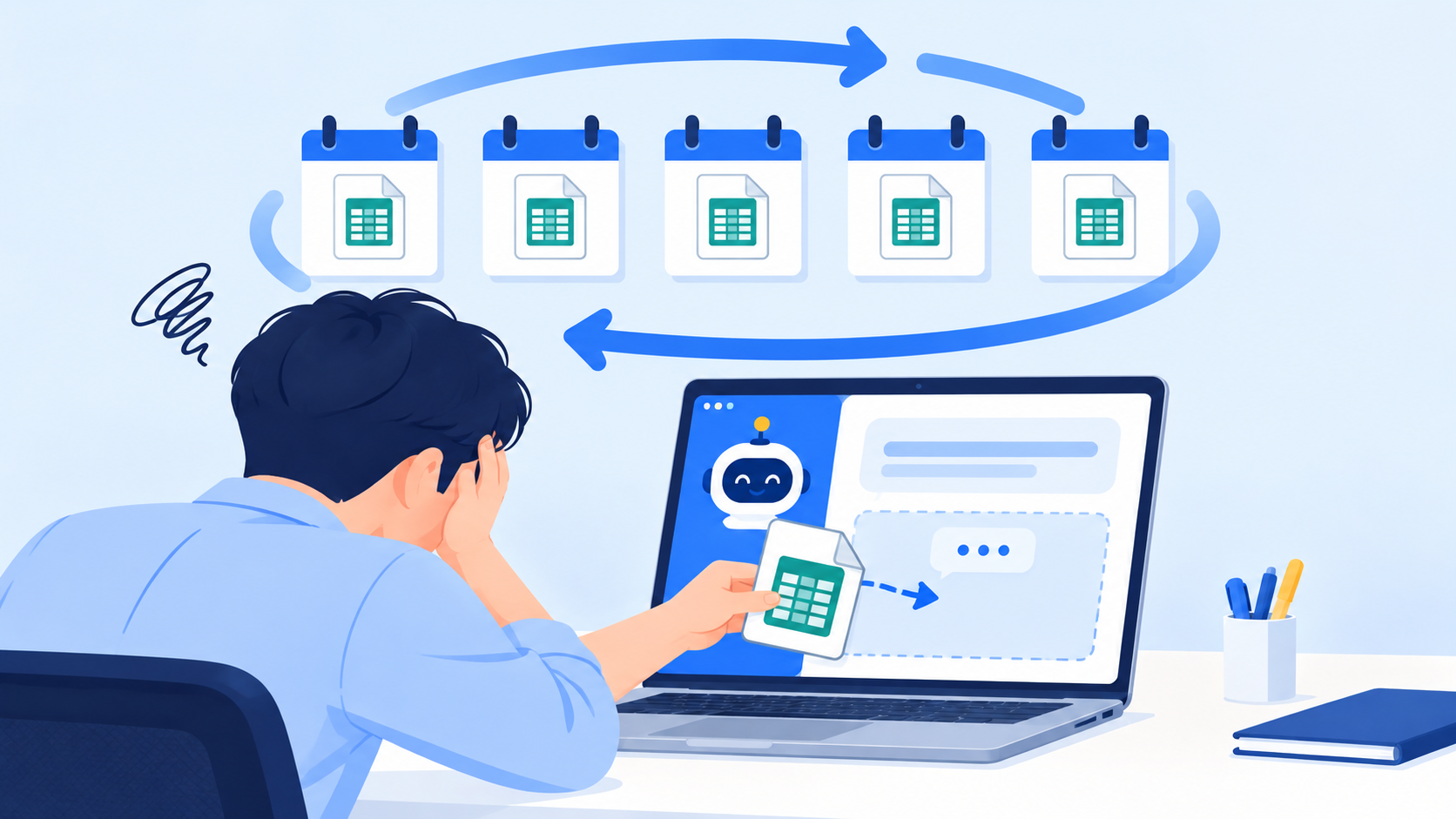
Generic AI can't start working until you upload files and explain the context, every single time
CORE SUMMARY
✓ A franchise AI ERP is a system where headquarters' sales, ordering, inspection and contract data is already connected, so AI can analyze it and suggest the next task.
✓ What sets it apart from generic AI is context, not raw performance. Whether the AI knows your stores, contracts and inspection history decides how useful its answers are.
✓ The benefits show up as shorter prep time in five areas: flagging at-risk stores, drafting reports, summarizing meetings, ordering decisions and responding to reviews.
✓ Headquarters can use AI with confidence only if AI handles recommendations, drafts and alerts while the final decision and execution are reviewed and approved by a person.
A franchise AI ERP is an operations system in which franchisor headquarters' business data, such as franchise sales, contracts, store operations, revenue and ordering, is connected in one place, and AI reads that data to deliver analysis together with the reasoning behind it and the next steps to take. The biggest difference from generic AI tools, which can't start until the user supplies the data, is that headquarters' records are already inside the system, so analysis begins with a simple question.
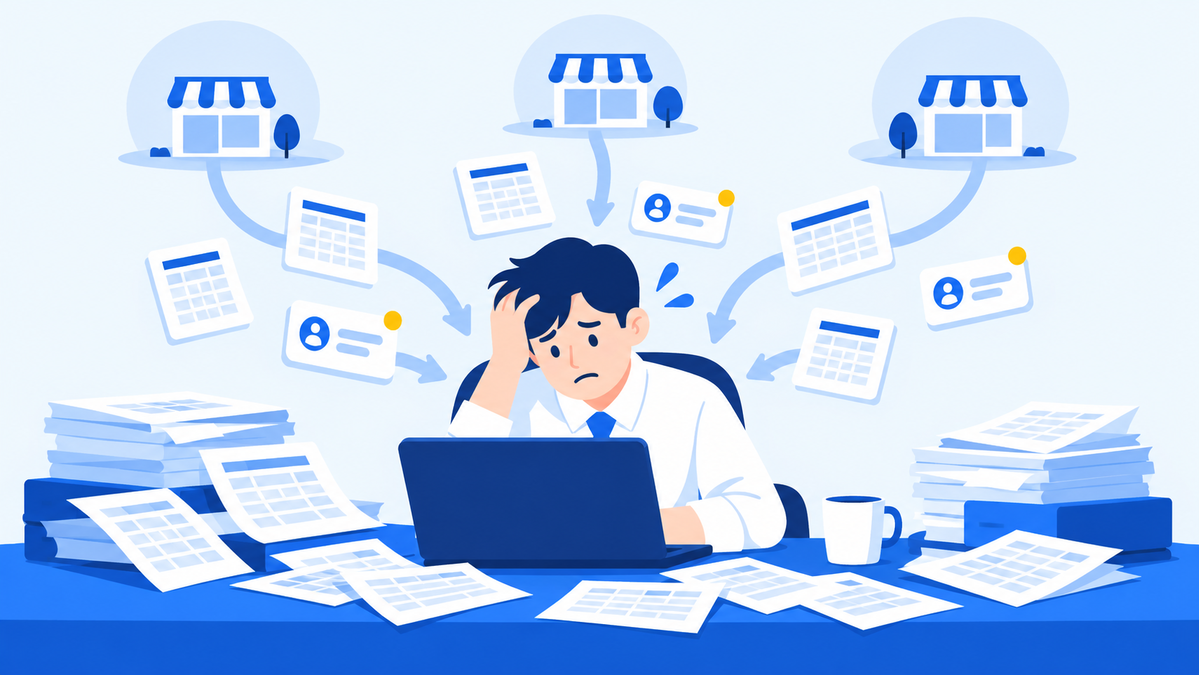
Many headquarters staff have recently tried generative AI at work. But the moment they try to analyze store sales or build a report, they end up repeating the same routine every time: downloading data, pasting it in and explaining the brand's situation from scratch. This article first looks at why headquarters struggles to use generic AI for real work, then explains how a franchise AI ERP solves the problem, which tasks see shorter prep time after adoption, and what to check before you adopt one.
Why is it hard for headquarters to use generic AI for real work?
Headquarters staff grow tired of generic AI not because the AI lacks capability, but because a person has to feed in the data and standards that franchise work requires, every time. Most headquarters questions assume a specific store, period or contract term, and generic AI starts the conversation without knowing any of it.
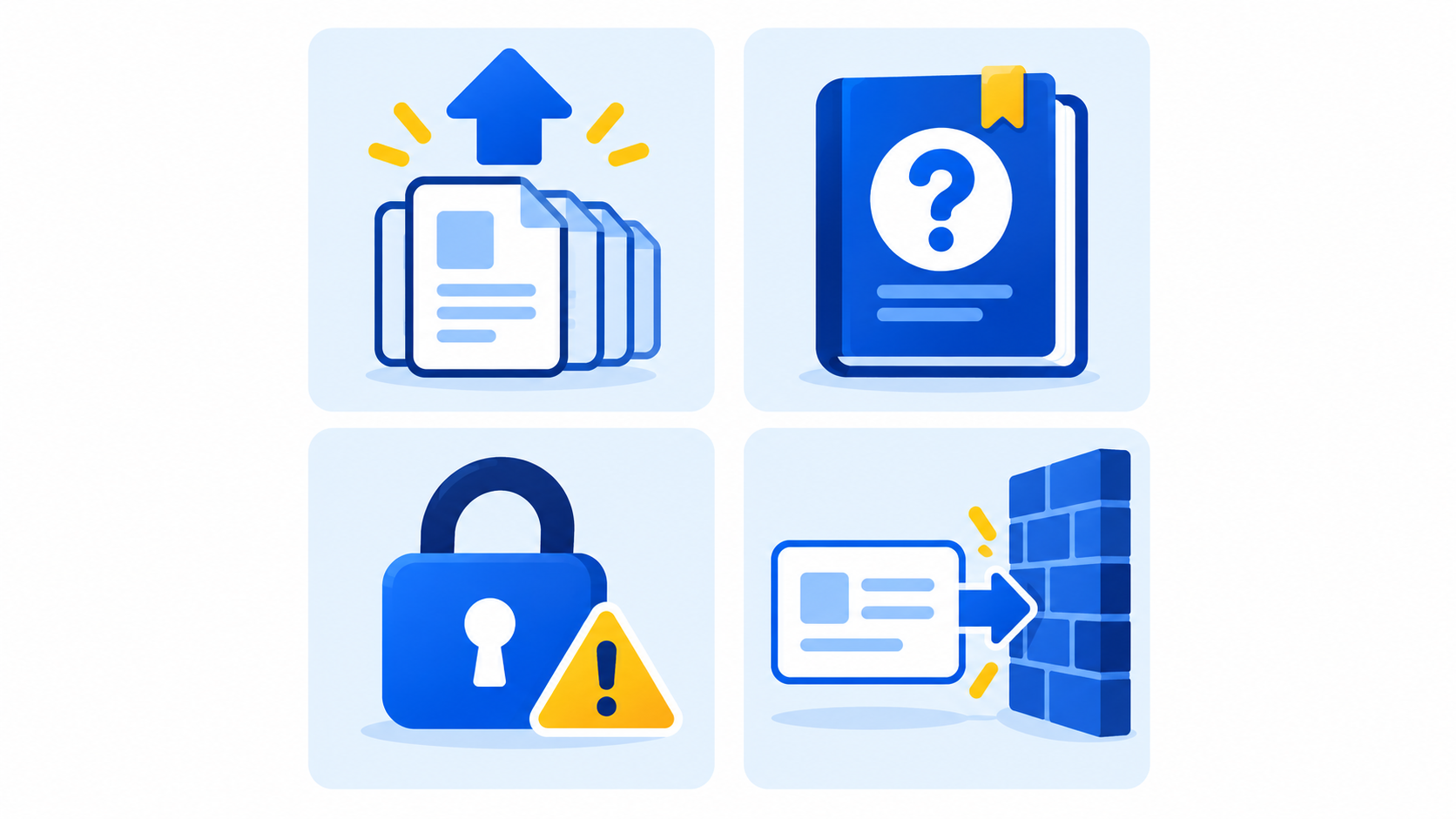
Four walls headquarters runs into with generic AI
1
CAUSE 01
You have to upload the data again every time
Sales data you analyzed yesterday is already out of date today. To reflect the latest situation, staff must download data again from POS and delivery app admin screens and upload it, and this prep work often takes longer than the analysis itself.
Solution: When data is gathered in the system from the start, AI answers right away based on the latest records.
2
CAUSE 02
It doesn't know your brand's standards
Generic AI doesn't know the rules that differ from brand to brand, such as royalty terms, inspection items, store grades and trade-area categories. Unless staff explain the rules, the answers stay generic, and explaining them takes even more time.
Solution: When contract terms and inspection standards are recorded in the system, AI analyzes with those standards as its starting point.
3
CAUSE 03
Security calls are hard to make
Franchise store sales and store owner information are sensitive data. It's hard for individual employees to decide whether that data can be uploaded to an outside AI service as is, or who should be able to see what.
Solution: You need a structure in which AI limits the data it can query according to each user's role and store scope.
4
CAUSE 04
Answers don't turn into action
Even after you get the analysis, moving it into work requests, reports or inspection plans is still left to people. In the end, the more you use AI, the more copying you do.
Solution: Time is truly saved only when the actions AI suggests flow straight into staff tasks and reports.
All four challenges come down to one cause: headquarters data is scattered across departments and channels, so to use AI, a person first has to take on the middle step of gathering and explaining the data. That's why, before looking for a better AI tool, headquarters should check whether its data is connected in a form AI can read. A franchise AI ERP is a system with that connection built in.
How is a franchise AI ERP different from generic AI tools?
The differences between a franchise AI ERP and generic AI tools come down to four things: data context, brand standards, permissions and connection to action. Ask the same question, and whether these four are in place determines if the answer stops at general advice or leads to work you can handle today.
| Criterion | Generic AI tools | Franchise AI ERP |
|---|---|---|
| Data context | Analyzes only the files the user uploads | Analyzes with sales, ordering, inspection and contract records connected |
| Brand standards | Rules must be explained every time | Judges based on contract terms and inspection standards |
| Permissions | The uploader decides what to share | Query scope limited by role and store scope |
| Connection to action | People copy results over by hand | Recommended actions flow into tasks and reports |
Take the question, "Which stores saw sales drop this week, and why?" With generic AI, you first have to upload per-store sales files, explain the comparison criteria and spell out the channel breakdown. In a franchise AI ERP, POS and delivery app sales are already standardized by store, date and channel, so AI finds stores that broke from their usual patterns and lays out possible causes by time slot, channel and menu item.
The difference in context becomes even clearer with questions beyond sales. If you ask which stores with contracts expiring next month have seen inspection scores fall recently, generic AI can only answer after receiving the contract file and the inspection file separately and having a person match them up by set criteria. In a system where contract and inspection history are tied to the same store, you can filter by both conditions at once and immediately decide which stores to prepare renewal talks and on-site inspections for first.
The biggest difference shows up after the answer. A generic AI answer ends in the chat window, while a franchise AI ERP answer gets assigned as an inspection task to the responsible supervisor or turned into a root-cause report. Because what headquarters wants from AI is not a single right answer but the next action, this connection determines how much work time is actually saved.
Where do the benefits of a franchise AI ERP show up?
The benefits of a franchise AI ERP appear first in five tasks where the prep time for decisions, rather than the decisions themselves, gets shorter. Flagging at-risk stores, writing reports, summarizing meetings, making ordering decisions and responding to reviews all take a lot of time for people to gather and organize material.
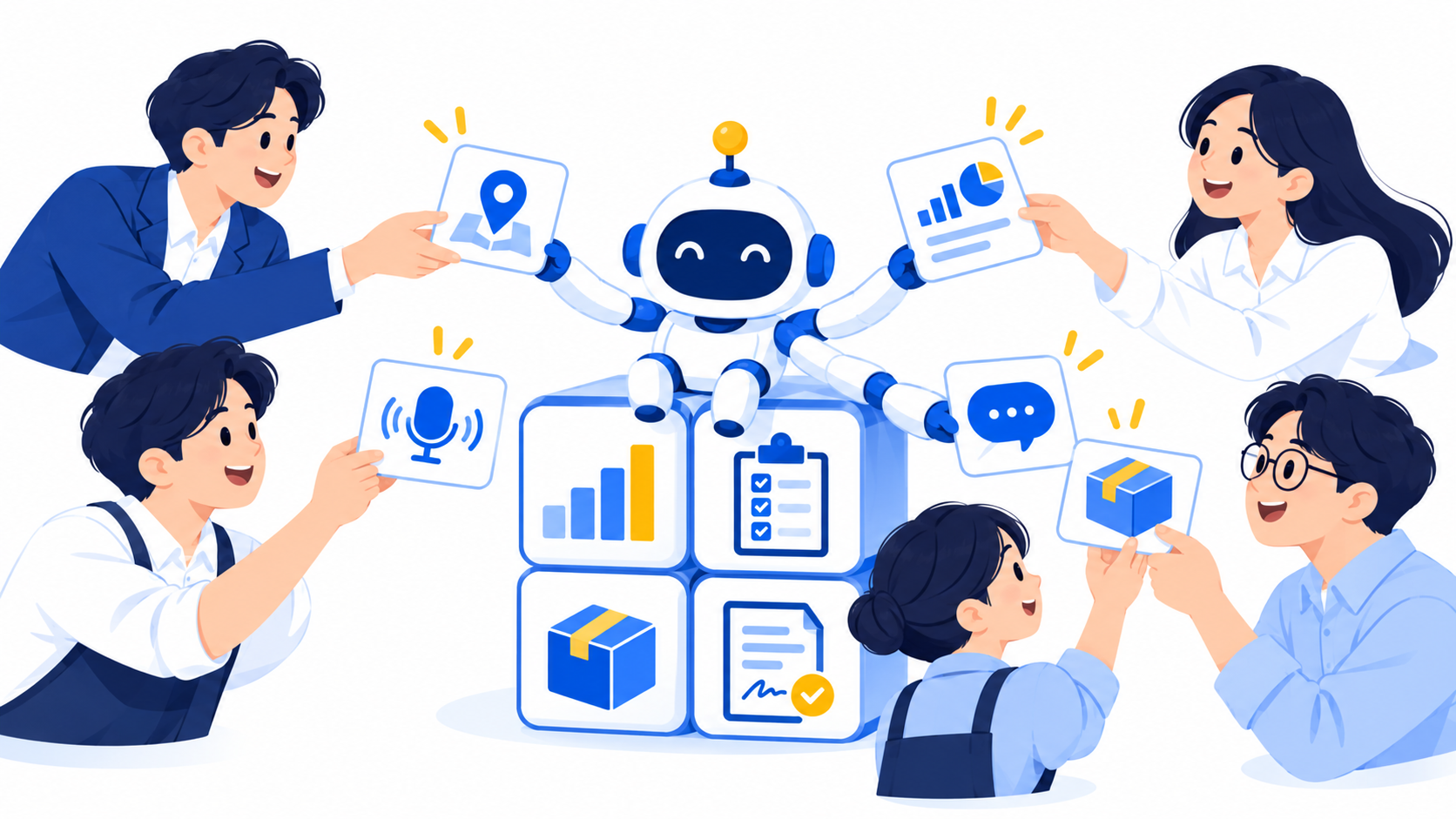
On top of connected data, AI handles the prep for five kinds of work
1
EFFECT 01
It flags at-risk stores first
As the store count grows, a supervisor's first question is where to go first this week. When AI looks at long-term sales trends, operating history and management metrics together and points out stores that need focused attention along with their risk factors, visit order is set by evidence rather than gut feeling.
2
EFFECT 02
Sales report drafts are created for you
Draft operations reports covering performance by period, key changes, at-risk stores and recommended actions are created in separate versions for executives and for frontline teams. Staff spend their time reviewing the content and adding interpretation instead of adding up numbers.
3
EFFECT 03
Action items are organized when meetings end
Record a sales consultation or operations meeting, and you get a structured summary with decisions, owners and deadlines. People ask less often about things they missed while taking notes, and action items go straight onto the headquarters work schedule.
4
EFFECT 04
Store ordering becomes a matter of review and approval
AI calculates recommended order quantities per item and the risk of stockouts or overstock using sales history, current inventory, scheduled deliveries and day-of-week and seasonal patterns. Recommendation accuracy is 90%, verified by our in-house lab on real customer data, and accuracy may vary by store, item, training period and data quality. Store owners review and approve the recommendations, and ordering inquiries that used to come in to headquarters decrease.
5
EFFECT 05
Review reply drafts are ready
AI reads each review's rating and key points and drafts a reply that fits the brand's response principles and tone of voice. Because staff review the draft before posting it to the channel, response quality that used to vary from store to store can be aligned with headquarters standards.
How do you measure the benefits?
The most accurate way to confirm the benefits is through prep time and the number of missed items, not impressions. Before adoption, record the current values of the metrics below using consistent definitions, then measure them again each quarter, starting with the tasks where AI features are in use, and compare side by side.
- Report prep time: the time it takes to build weekly and monthly operations reports
- At-risk store response speed: the time between a risk signal appearing at a store and a supervisor's visit
- Meeting follow-up rate: the share of action items from meetings that have an assigned owner and deadline
- Ordering inquiries: the number of times stores contact headquarters about order quantities
- Review response rate: the share of reviews that receive a reply within a set period
The five metrics won't all move at once. Changes appear first in tasks whose data was connected first, and tasks without settled input standards may actually require more checking at the start. When a metric doesn't move as expected, the first step is to check whether that task's data is being collected on time and to the same standard, before looking at the AI features.
How do you divide work between AI and staff?
In a franchise AI ERP, AI handles gathering data, finding signals and creating drafts, while staff handle reviewing the results and deciding on execution. When this boundary is clear, headquarters can trust AI while keeping operational responsibility with people.
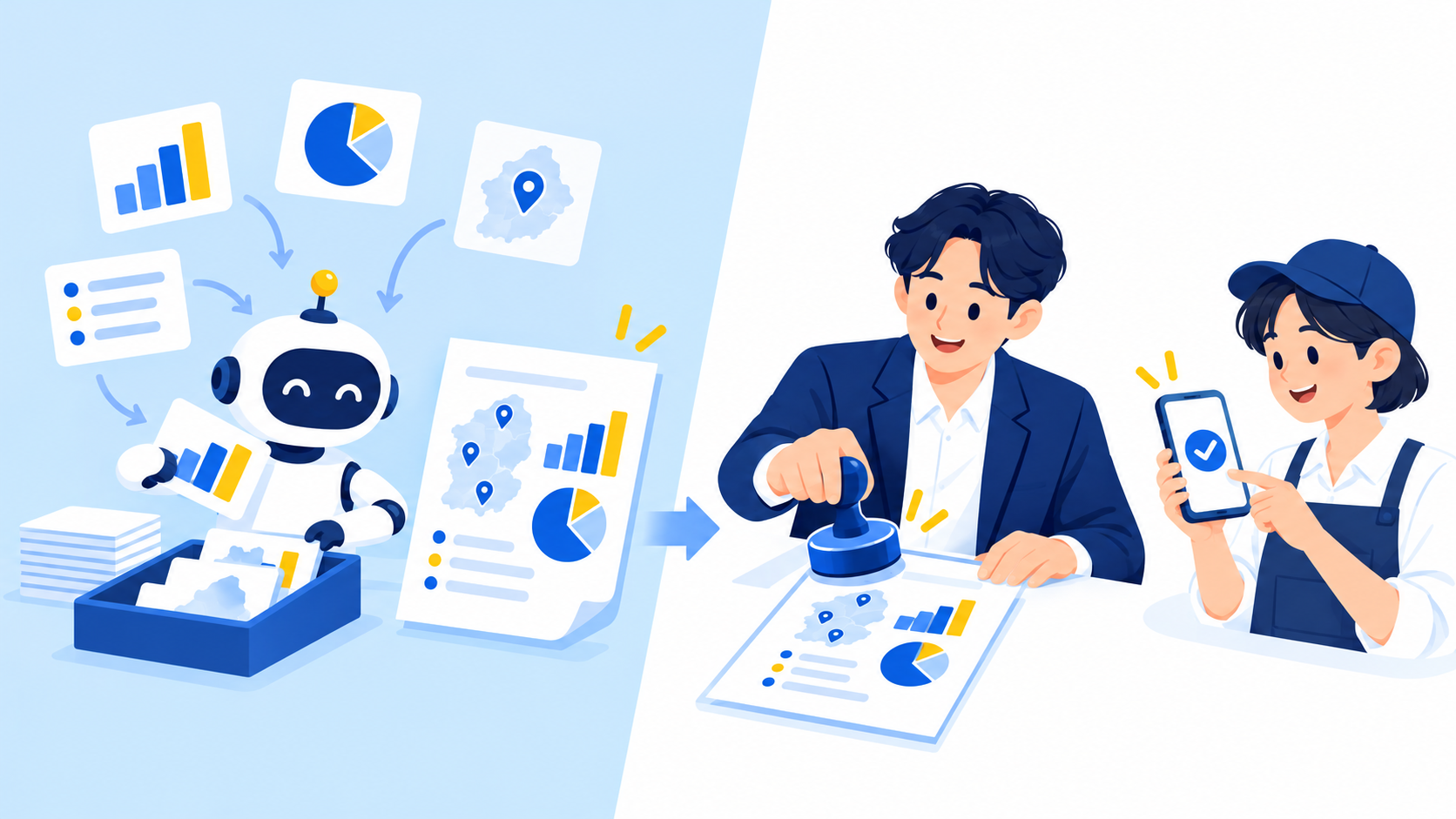
AI handles drafts and recommendations; people handle approval and execution
| Work stage | What AI handles | What staff handle |
|---|---|---|
| Organizing data | Standardizing sales by channel, gathering history | Confirm the standards are correct |
| Finding signals | Flagging unusual changes and at-risk stores | Verify causes on site |
| Creating documents | Drafts of reports, meeting notes and replies | Refine to brand standards and approve |
| Execution | Suggesting recommended actions and priorities | Assign inspections, confirm orders, post replies |
Execution that directly touches franchise stores in particular must always go through human review. If AI placed orders automatically or posted review replies on its own, a wrong call would reach stores and customers right away. With a review step in place, AI's mistakes are caught by staff, and the corrections staff make build up as a basis for future decisions.
Permissions follow the same principle. Supervisors see only the data for the stores they manage, while executives see the whole brand, and AI's answers must likewise be generated only within the user's role and store scope. When this principle holds, AI adoption is seen as a work tool rather than a security burden.
What 3 things should you check before adopting a franchise AI ERP?
Compare franchise AI ERPs not by the number of AI features but by three criteria: the scope of data AI can see, permission design and how results connect to work. Even AI features with the same name can see very different levels of real-world use if these three differ.
1
CHECK 01
How much data does the AI see?
- Check whether it looks only at sales or also at inspections, ordering and customer feedback.
- Confirm in a demo that it breaks down possible causes by channel, time slot and menu item.
- Ask what scope you can start with if you don't have much data.
2
CHECK 02
Do permissions respect roles and store scope?
- Check whether supervisors, operations staff and executives see different scopes when they ask the same question.
- Check the boundary between what store owners see and what headquarters sees.
3
CHECK 03
Do results lead to the next task?
- Check whether recommended actions can be registered as staff tasks or turned into reports.
- Check whether there is a step where people edit and approve recommendations.
If your headquarters doesn't have enough data yet, you can start in phases. First diagnose the length and quality of your data, then build up data while using rule-based recommendations or limited-scope analysis. The first thing to connect in this case is sales data. Sales need to be gathered by store so that at-risk store flagging, reports and ordering recommendations all run on the same numbers.
How does FDAM implement a franchise AI ERP?
FDAM is an AI operations platform for franchises that connects HQ Operations, Unified Sales and the store app Sodam into a single data set, on top of which AI reads first and suggests the next task. It was built by MS Benter, which started in 2003 by automating franchise stores' phone orders and went on to develop logistics ERP and headquarters ERP systems. Its government-recognized franchise IT research lab verifies AI recommendation accuracy on real customer data.

With less prep time, headquarters staff can focus on decisions and communication
- AI operations reports and AI sales decline prediction: builds reports with performance by period, at-risk stores and recommended actions, and pinpoints causes of sales changes that break from usual patterns by store, time slot, channel and menu item.
- AI store-closure risk prediction and AI off-catalog purchasing analysis: identifies stores needing focused attention and suggests supervisor visit priorities and inspection items, and compares headquarters-supplied items with outside purchasing to flag stores that need cost and inventory checks.
- AI meeting notes: summarizes sales consultations and operations meetings, organizes decisions, owners and deadlines, and adds them to the headquarters work schedule.
- AI order recommendations and AI review replies: store owners review and approve recommended order quantities in the store app Sodam, and review replies are posted to channels after staff review.
AI-generated recommendations and drafts also connect to store-side work. Sodam, the dedicated store program, is connected to the same data as FDAM, so store owners check ordering recommendations and handle headquarters' corrective action requests and notices in Sodam. Because the results flow back to the headquarters screen, you can track in the same flow what actions were taken at the at-risk stores AI flagged. Headquarters sees the data through FDAM, and stores see the same data through Sodam.
Feature availability and scope vary with each brand's data and workflows, so we confirm them together during a sales consultation. You can start with the highest-priority areas in the order of diagnosis, connection, validation and training, and expansion, and we prioritize connecting your existing POS and delivery apps rather than replacing them.
Frequently asked questions
Q. How is a franchise AI ERP different from a standard franchise ERP?
A standard franchise ERP focuses on managing records for franchise sales, contracts, store openings and operations. A franchise AI ERP differs in that AI works on top of those records to spot changes and risks first and create reports, recommendations and drafts, helping staff carry out the next task right away.
Q. Can headquarters without much data still use the AI features?
Yes. The usual approach is to first diagnose the length and quality of your data, start with rule-based recommendations or limited-scope analysis, and expand the scope as data accumulates.
Q. Does AI place orders automatically or post review replies right away?
No. AI creates recommendations, drafts and alerts, and final decisions and execution proceed only after staff and store owners review and approve them.
Q. Is it secure to let AI handle franchise store sales data?
Role-based permission design is key. Before adopting, check that the system limits queryable data so that AI's answers are generated only within the user's role and store scope.
Wrapping up: What should you check first for a franchise AI ERP?
The value of a franchise AI ERP lies not in smarter answers but in answers that understand headquarters' context without you uploading and explaining data. Pick one prep task that repeats every week at your headquarters, and start by listing where the data that task needs is currently scattered. That list becomes the starting point for defining the scope of your AI adoption.
What would AI tell you first using your headquarters' data?
In a consultation, you can find out which AI features to apply first and in what order, based on the current state of your sales and operations data.
Contact sales about FDAMExplore FDAM features Chat with us on KakaoTalk
Call us at 1544-7120 (Korea)
Franchise AI ERP, AI ERP, Franchise AI, Franchise ERP, AI sales analysis, AI order recommendations, AI meeting notes, AI operations reports, franchise store management, franchisor headquarters, MS Benter, FDAM