One Contract Line, 19 Months in Court: Lessons from Vodafone
Franchise disputes and HQ data management: lessons from the 62-franchisee Vodafone lawsuit

What matters more than a single line in the contract is a record that can explain the decision behind it.
Key takeaways
Franchise disputes start less from the fact that fees or penalties changed and more from how that change was decided, communicated, and recorded. The recent lawsuit by 62 former Vodafone franchisees in the UK shows exactly this. In practice, what escalates a dispute is usually not "whether a policy existed" but "whether a record existed." This article uses the Vodafone case and similar Korean cases to lay out eight operating principles every headquarters should have, and explains how to bring scattered data into one place to build an explainable process.
When one line in the contract becomes a boomerang
It is perfectly normal for franchisor headquarters to change sales commissions or cost-sharing rules in the course of running the business. When costs rise or the market shifts, existing policies can become hard to sustain, and some sanctions on store operating errors may be needed to protect brand quality and meet legal standards. The problem is not the change itself but how it is made.
Change fees without reviewing the impact on store P&L, shift costs without adequate explanation and consultation, or impose penalties far out of proportion to minor mistakes, and HQ's operating policy quickly becomes the cause of a large-scale franchise dispute. Speaking from roughly 25 years of watching franchise IT up close: what usually collapses in practice is not the result of "having no policy" but of "being unable to prove the basis for a decision."
1. What happened at Vodafone UK
Quick note: what is a "penalty"?
In this article, a penalty broadly means any financial sanction HQ imposes when a store breaches its contract or operating standards. In Korea these show up less as routine operating fines and more as early termination fees, liquidated penalties (pre-set amounts for breaches such as forced-purchase or non-compete violations), and clawbacks. The names differ, but in every case money flows from the store to headquarters.
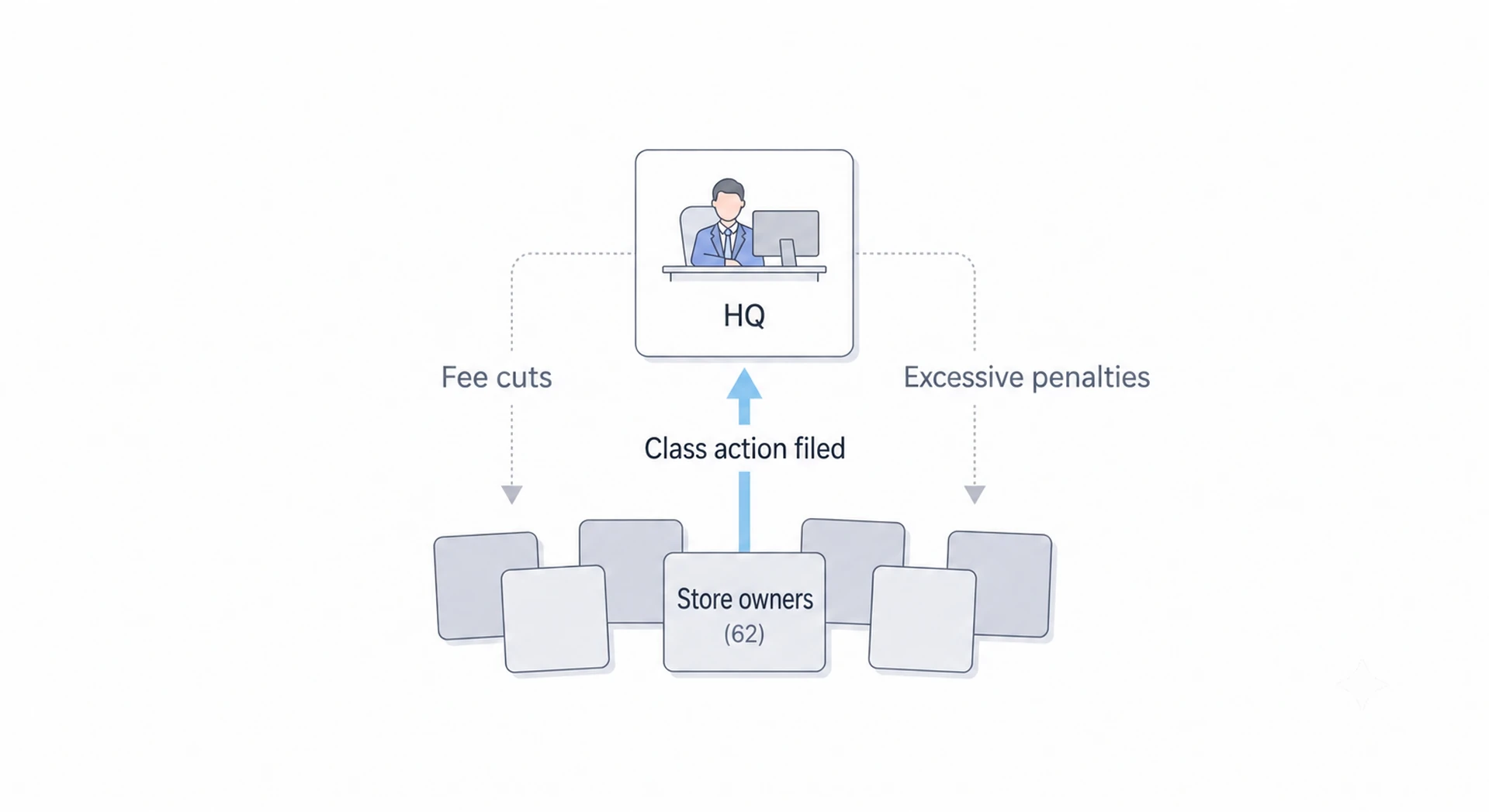
In 2024, 62 former franchisees of UK mobile carrier Vodafone filed a High Court lawsuit against the company. That was about 40% of the 167 people who had been franchisees. Their claims fell into three main areas: Vodafone unilaterally cut the sales commissions it paid, eroding store profitability; it imposed penalties and clawbacks of thousands of pounds for minor administrative errors; and it pressured them to take out loans or apply for government support to keep their businesses afloat.
They alleged that Vodafone gained up to £85 million in unjust enrichment this way. These are the franchisees' claims, however, not findings of the court. The most controversial issue was how penalties were handled. According to The Guardian, Vodafone reportedly set targets that encouraged internal security staff to increase clawbacks. In one case, it was claimed that Vodafone's actual loss was £7.08, yet the store was hit with a £10,000 penalty.
Vodafone said it never intended to profit from penalties and that the controls were meant to protect customers and ensure regulatory compliance. Franchisees, however, said falling commissions and repeated clawbacks pushed their personal debts above £100,000. The key point for headquarters is not that "the amounts were large." If the structure rewarded staff for imposing more penalties, sanctions stop looking like a quality-control tool and start looking like a revenue source for HQ. That structure was the real trigger of the dispute.
2. How the lawsuit ended: costs that remain even if you win
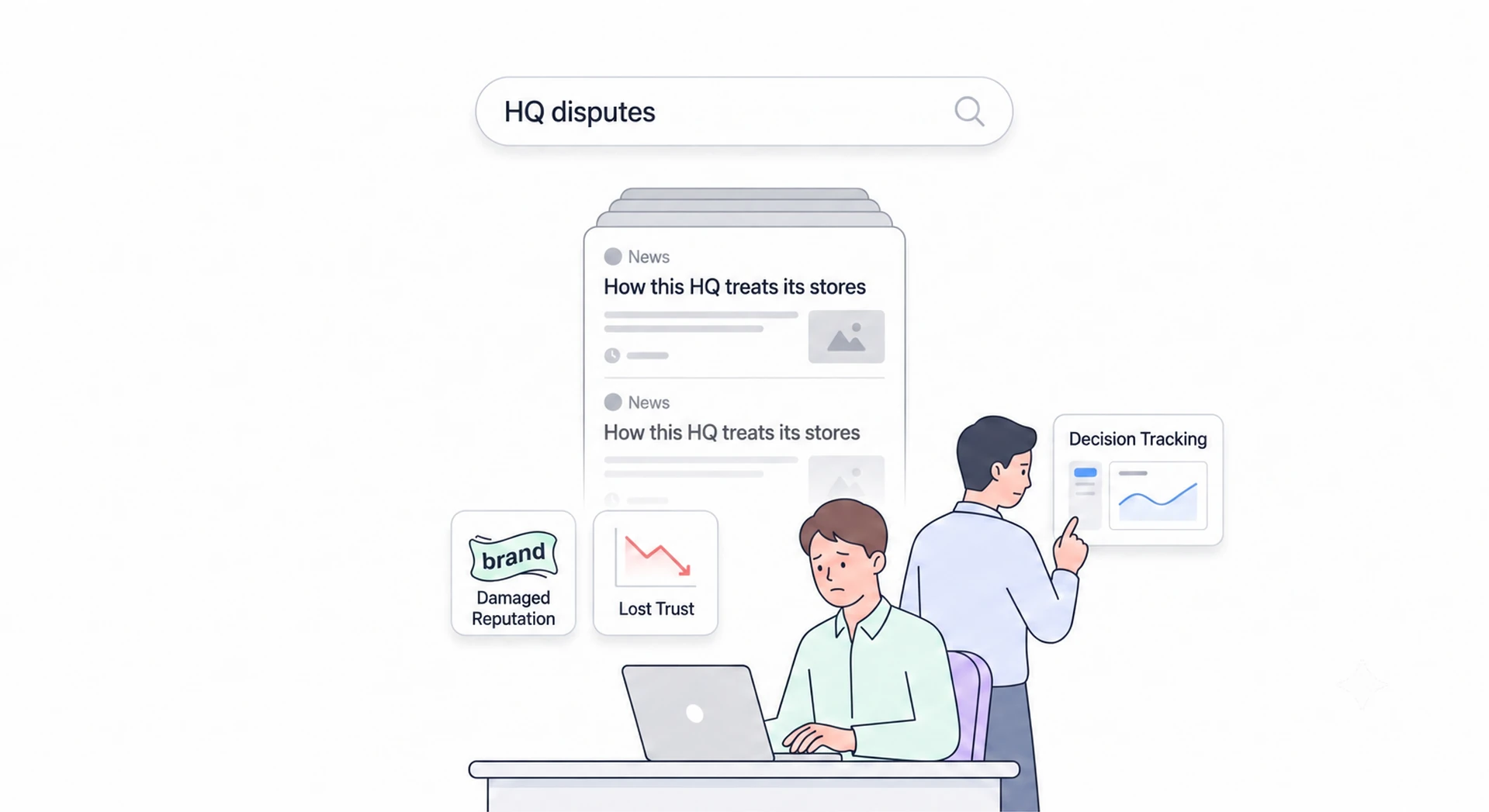
Vodafone and the 62 franchisees ended their 19-month legal battle with a settlement before trial. The terms and amount were confidential, and the settlement was made without any admission of liability by Vodafone. So the settlement can be read neither as proof that Vodafone broke the law nor as proof that nothing was wrong with how it ran its network. Regardless of the outcome, though, the costs already incurred are clear.
Nineteen months of litigation, outside counsel and investigation costs, refunds of past clawbacks (Vodafone said it refunded £4.9 million including VAT across its entire franchise network), four reviews of its franchise division, reputational damage from press coverage, eroded trust among existing stores and prospective franchisees, and a complete overhaul of internal operating procedures. In short: the cost of cleaning up after the dispute far exceeded the cost of managing to prevent it. And most of that cost comes from items that are hard to put a price on: reputation and trust. Even if the lawsuit ends in a settlement, a single headline like "the HQ that treats its franchisees this way" lingers in prospective franchisees' search results for a long time. The only way to reduce this cost, which HQ cannot control, is to manage the decision process so it never escalates into a dispute in the first place.
3. Korea has cases with a similar structure
No Korean case has exactly the same legal relationship as Vodafone. But structures that shift costs affecting store profits without prior consultation, or set sanctions out of proportion to the actual violation, have been found repeatedly. In other words, this is not something to dismiss as an overseas case from a very different market. In Korea, too, cases where HQ "announced a decision that changes the revenue structure without explanation" recur every year, and many of them have turned into disputes. The three cases below take different forms but share the same outcome: stores' real profits shrink and trust breaks down.
① Unilaterally shifting mobile gift card fees: In 2025, the Korea Fair Trade Commission (KFTC) sanctioned Anhouse, operator of Mega MGC Coffee, for unilaterally making store owners bear the full cost of mobile gift card fees. Store owners signed their contracts without knowing about this burden until it appeared in the franchise disclosure document. Together with other violations such as forced equipment purchases, the KFTC issued a corrective order and fines totaling KRW 2.292 billion. If Vodafone was a case of "cutting the commissions HQ pays," this was a case of "raising the costs stores pay." The method is the opposite, but the outcome is the same: stores' real profits fell without explanation or consultation.
② Dispute mediation after a 50% increase in required items: In 2025 in Gyeonggi Province, a franchisor switched suppliers and notified stores of a 50% price increase on required items, prompting 14 stores to file for dispute mediation. Through mediation, the franchisor sharply reduced the increase and applied it retroactively to all stores. Unlike Vodafone, it was resolved at the mediation stage without going to court. HQ explained why the increase was necessary, and owners also weighed inflation and the length of the price freeze to reach a reasonable level.
③ KRW 50 million for buying common supplies elsewhere: Pizza & Company, operator of Banolim Pizza, had a liquidated penalty clause charging KRW 50 million if stores bought pizza savers (the small plastic tripods that hold the lid up) or disposable forks from anyone other than the designated supplier. These were ordinary items readily available on the market. The KFTC found this to be forced purchasing and issued a corrective order and a fine. The legal structure differs from Vodafone, but the principle is the same: if a sanction is excessive relative to the violation and actual damage, having the clause in the contract does not make the dispute risk go away.
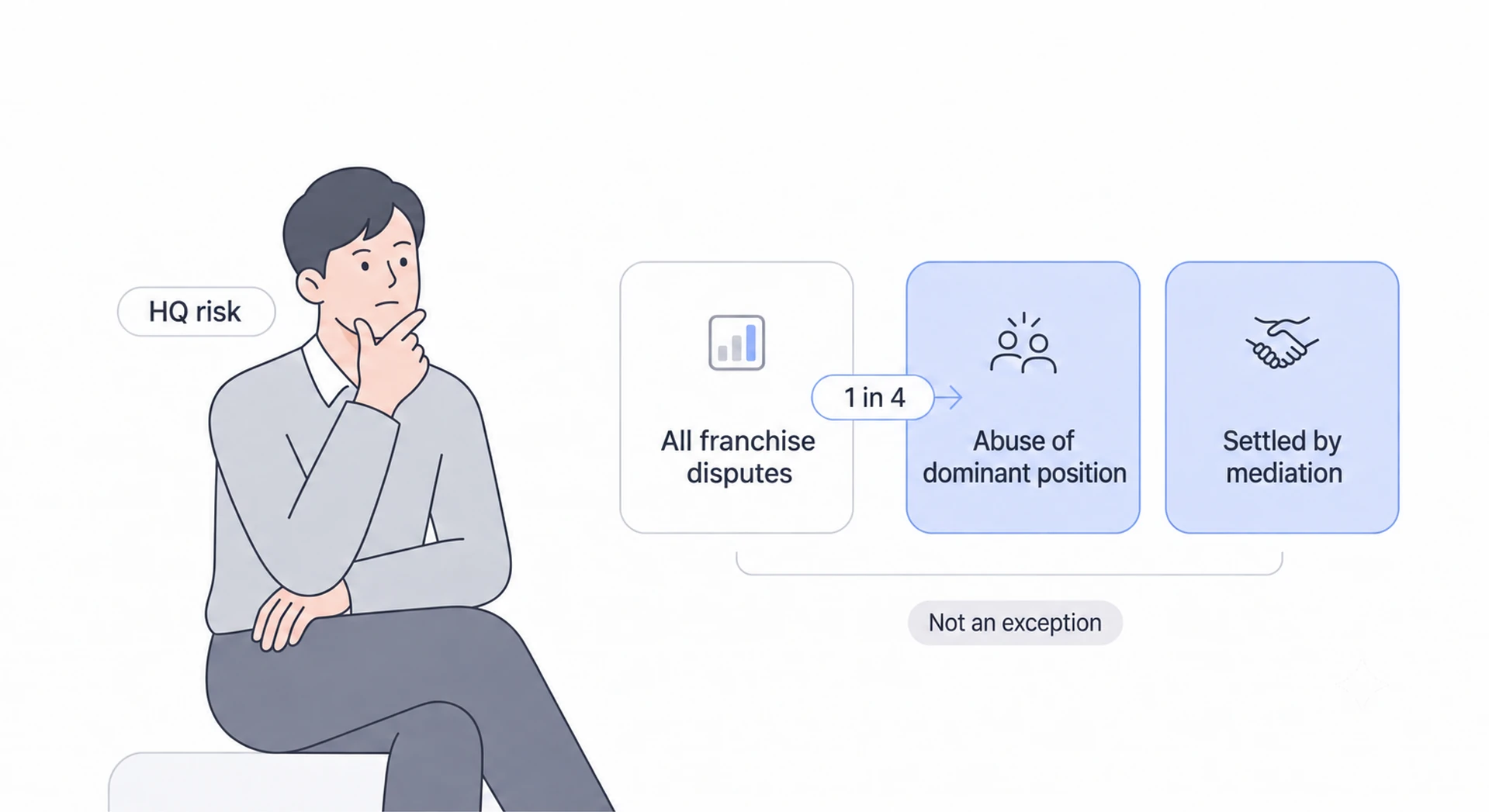
And these are not isolated incidents. According to data released by Gyeonggi Province in 2026, 26 of the 106 franchise disputes it handled in 2025, about 25%, involved franchisors abusing their superior bargaining position, and 22 of those were settled through mediation. That is roughly one in four.
4. Seven HQ operating principles that prevent the same problem
The current Enforcement Decree of the Franchise Business Act requires consultation when trading terms for required items, such as specifications, price, quantity, quality, or counterparty, are changed to the store owner's disadvantage. This does not mean it applies identically to every fee or penalty change, and each case needs legal review. As an operating principle, though, it is safer to apply the same process to royalties, payment fees, promotion costs, and clawbacks.
1Before any change, calculate the P&L impact store by store
Overall averages are a trap. The same fee change hits differently depending on sales, rent, labor costs, delivery share, and cost ratio. Stores likely to slip into losses, new stores that haven't recouped their investment, and the cumulative burden on multi-unit owners must be viewed at the store level. A 1% fee adjustment and a 20% drop in operating profit are entirely different problems.
2Provide the reason and the calculation in writing
"The market has changed" is not enough. Along with the reason, such as rising costs, platform fees, or legal obligations, you need to show the formula that produced the amount stores will bear. Ideally include the old and new criteria, the formula with worked examples, cost-sharing rules, the effective date, and exceptions.
3Distinguish "notification" from "gathering input"
Sending a notice does not mean consultation is done. You need to track questions, objections, alternatives, and response status. For significant changes, run briefings, surveys, consultations with representatives, and one-on-one meetings in parallel, and avoid announcing right before the effective date or applying changes retroactively to transactions that have already occurred.
4Run a pilot and allow a grace period
Rather than rolling out to everyone at once, pilot with a subset of stores to see the real P&L impact and adjust the formula. Give new policies an adequate grace period, and it is safer to separate when they apply to existing versus new contracts.
5Make penalties proportional to actual damage and severity
Don't set the amount based on whether a violation occurred alone. Consider actual damage, intent or negligence, first-time or repeat, and whether it was corrected immediately. Escalate in stages, from guidance to a corrective request, a warning, and sanctions for repeat violations, and use internal caps, mitigation criteria, and a second approval step so no single staff member can impose penalties arbitrarily.
6Run a separate appeals process
If the person who imposed the penalty also rules on the appeal, there is no objectivity. You need a process covering notice of violation, a period to respond, first review, a second review by a separate manager, written notice, and prompt cancellation of penalties imposed in error.
7Keep tracking profitability after the change
Don't look only at HQ revenue. Compare stores' cost ratios, operating profit, receivables, order volume, closure inquiries, and complaints before and after the change, and for stores that deteriorate sharply, consider counseling, payment deferrals, or temporary support rather than blanket sanctions.
5. Why most headquarters can't "prove" any of this

Having read this far, you may be thinking, "We already have a process of our own." But disputes don't erupt only because there is no process. They erupt because the process exists but is scattered. In the field, notices sit in email, store feedback in messenger apps, contracts on a staff member's PC, and approvals exist only verbally.
When a dispute starts in that situation, HQ can't answer the following questions: Which stores were notified, and when? Did the owner actually see the document? What feedback came in, and how did HQ respond? Who approved the change? How did store profits change before and after? What was the basis and evidence for the penalty, and how was the appeal answered? The difference between an HQ that can answer these questions immediately and one that can't is the difference between a dispute that ends in mediation and one that drags into a 19-month lawsuit.
6. How FDAM fills this "proof gap"
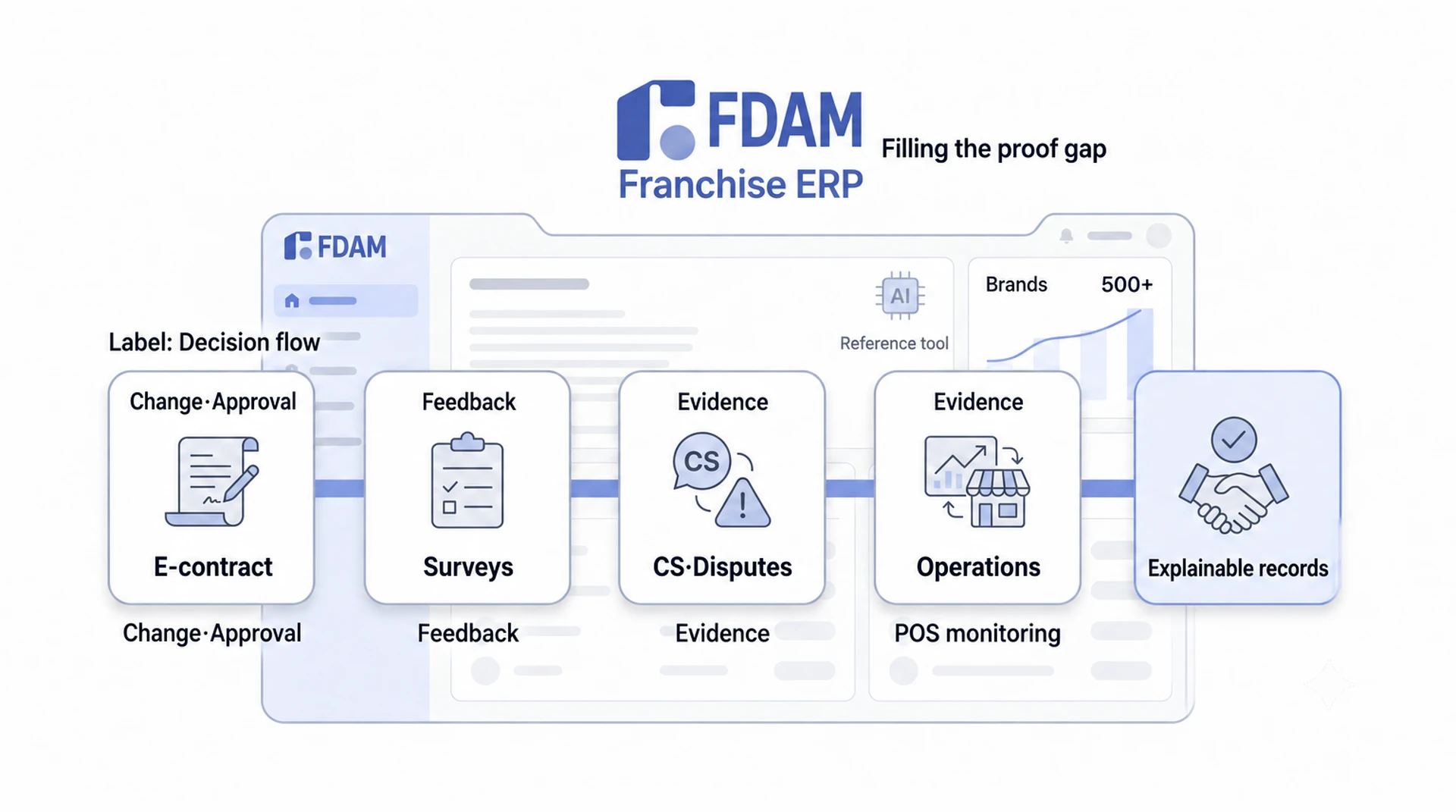
FDAM is an operations ERP for franchisor headquarters that organizes and standardizes everything from franchise sales management to store-opening and operations management in one place. Unlike general ERPs or POS analytics tools that only show sales dashboards, a franchise-specialized ERP's role is to connect the "flow of decisions" needed to prevent franchise disputes. Know-how built up with about 500 brands is baked into how that flow is designed.
Here is how the eight principles above map to FDAM features. For contracts and changes to terms, the e-contract module keeps change history and approval flows, along with automatic alerts 30 days before a contract expires. For gathering input, the survey feature collects and tracks store feedback and response status on proposed changes. For penalty evidence and appeals, CS management and dispute management build up violations, inspection history, explanations, and outcomes in a single flow. For post-rollout monitoring, POS sales aggregation and store information in operations management let you see how each store's situation is changing.
The feature that maps most directly to this topic is dispute management. It keeps the full history, from intake through review, action, and outcome, in one place so it doesn't scatter, organizing who decided what, when, and on what basis in an explainable form. On top of that, AI, a first among Korean franchise ERPs, works alongside as a reference tool that supports HQ decision-making rather than making the decisions itself.
In practice, this difference becomes stark the moment a dispute begins. HQs with scattered data start digging through email archives, staff PCs, and messenger logs only after receiving a lawsuit or mediation notice. Often the records they actually need, such as when notice was given or the basis for approval, simply aren't there. When contracts, notices, surveys, inspections, and case history are accumulated in one place, HQ can present "when we notified, what feedback we received, and who decided on what basis" in chronological order. That difference determines HQ's bargaining power at the mediation table.
The problem grows as the number of stores grows. With a few dozen stores, staff memory and personal files can get you by, but at scale, notice timing and response status for the same change end up varying from store to store. At that point, scattered records become a risk that actually produces conflicting accounts. That is why HQ needs a consistent, organization-wide record system.
Let me be clear about one thing. FDAM does not automatically guarantee the legality of contracts or policies. What it does is keep a record of whether HQ's decisions were based on data, whether notice was adequate, whether feedback was reviewed, who approved, and what happened after rollout. A good franchise ERP's job is not to make penalties easier to impose but to make HQ's judgments consistent and explainable and to spot warning signs before they become disputes.
One line in a contract, or 19 months in court

The question HQ should take from the Vodafone case can't stop at "Did the contract give us the right to make changes?" How much did the change reduce store profits? Did we explain the reason and the calculation? Did we actually review feedback? Was the penalty excessive relative to the mistake? Was there an appeals and mitigation process? Did staff performance reviews encourage excessive clawbacks? Did we provide separate support to vulnerable stores? HQ needs to be able to answer all of these.
If stores can't accept a change and HQ can't prove its basis, one line in the contract comes back as a long-running dispute. That is why contracts, notices, surveys, operating data, and case history need to be connected. Checking store profitability and building an explainable process is the most realistic dispute-prevention strategy there is.
Build an "explainable HQ" with FDAM
If you'd like to learn about adoption or see a demo, feel free to reach out.
Learn more about FDAM at fdam.co.kr >
Frequently asked questions
Q. If the contract gives HQ the right to make changes, can HQ change fees unilaterally?
That requires legal review depending on the contract and what is being changed. In particular, under the current Enforcement Decree, consultation is required when trading terms for required items, such as price, quantity, quality, or counterparty, are changed to the store owner's disadvantage. Even with the contractual right, advance notice, P&L impact analysis, a reasonable basis, and a consultation process all matter.
Q. What criteria should be used to set store penalties?
Penalties should be tiered based on actual damage, intent, repetition, whether the issue was corrected, and impact on the brand. Rather than starting with large amounts, it is better to escalate from training to corrective requests, warnings, and sanctions for repeat violations, with appeals and mitigation procedures in place.
Q. Can a franchise ERP prevent franchise disputes?
An ERP does not directly block legal disputes. But managing profitability before and after changes, notice and survey responses, contract and document versions, and approval, CS, and dispute-handling history in one system lets HQ explain its decisions objectively and helps catch anomalies before a dispute escalates.
Sources · The Guardian (2026.07.16) / Korea Fair Trade Commission & Korea Policy Briefing (2025.10.01, Anhouse) / Gyeonggi Province (2025.05.06, required-item dispute mediation) / Gyeonggi Province (2026.03.03, abuse of superior bargaining position) / Korea Fair Trade Commission (2025.09.07, Pizza & Company) / Korea Law Information Center (Enforcement Decree of the Franchise Business Act). The legal content in this article is general reference material for HQ operations and does not replace legal advice on any specific contract or dispute.
franchise disputes, franchise dispute prevention, franchisor headquarters, franchisor, store fees, store penalties, required item price increases, abuse of bargaining position, franchise ERP, Franchise Business Act, dispute mediation, FDAM