Store Management Is Now a Core Franchisor Capability: 2026 White Paper
How the standards for franchise store management are changing, and how to manage per-store profitability and store owner satisfaction with FDAM
Franchise store managementrefers to the work franchisor headquarters do to oversee and support stores against consistent standards, from store opening through operations, sales, quality and communication. The recently published 2026 China Restaurant Franchisee Relationship Management White Paper concludes that this store management capability has become "a must-have for chain franchise companies." The yardstick of competition has shifted from "How many stores did you open?" to "Does each store actually make money, and is its owner satisfied?"
A quick note on what this white paper is. The 2026 China Restaurant Franchisee Relationship Management White Paper was published by the NCBD (餐宝典) Research Institute, a Chinese restaurant big-data research and rating organization, and officially released through 36Kr (36氪), one of China's leading tech, startup and business media outlets. Rather than offering mere forecasts, it draws on real judicial statistics and industry data, including a white paper on restaurant franchise dispute rulings (2023–2025) issued by the Dongcheng District Court in Beijing, making it a useful reference for gauging trends in China's restaurant franchise market. The market environment differs, but because China is already facing the challenges that come after rapid expansion, it holds plenty of lessons for Korean franchisors as well.
In this post, we summarize the key points of the white paper and look at what Korean franchisor headquarters should prepare for in store management.
KEY SUMMARY
· The yardstick of competition has moved from "store count" to "per-store profitability and store owner satisfaction."
· Store management now plays three roles at once: risk firewall, profit booster and brand moat.
· HQ revenue models are shifting from one-time franchise fees to structures tied to store health.
· FDAM brings operations, CS, surveys, store openings, sales and dispute management into one system so HQ can manage stores with data across the board.
1. The standards for store management have changed
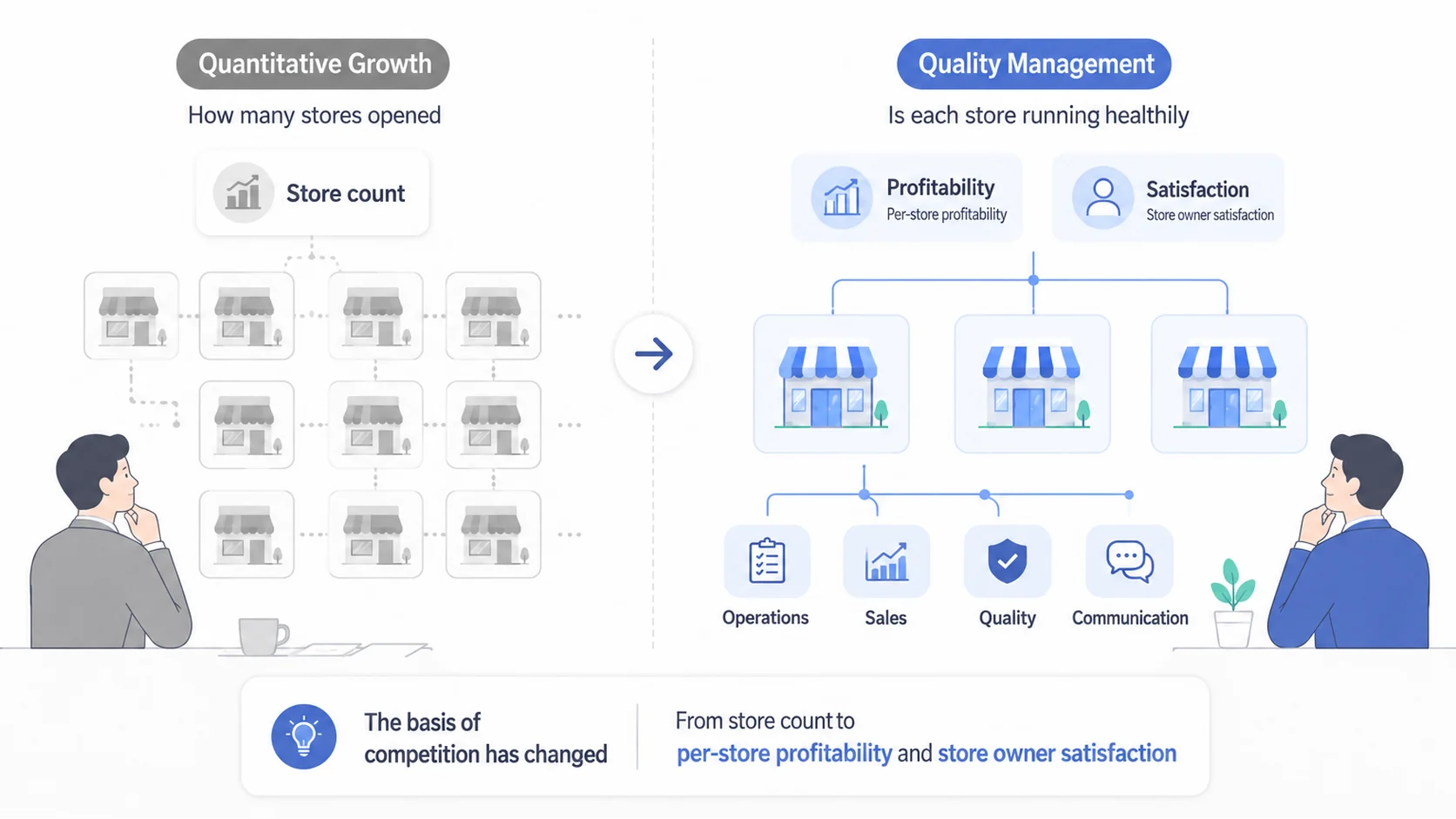
The white paper's biggest finding is that the market's center of gravity has shifted. China's restaurant chain penetration rose rapidly from 13% in 2019 to 25% in 2025, but behind that growth, about 65% of stores that closed in 2025 had not lasted two years. The white paper calls this the dilemma of "fall behind if you don't open, self-destruct if you open recklessly." In other words, adding stores alone no longer guarantees growth or even survival.
So the measure of store management has been reset as well. Management has shifted from focusing on adding stores to making sure each store already open is healthy and profitable (per-store profitability) and that its owner is satisfied (store owner satisfaction).
Underlying this shift is a change in HQ revenue models. According to the white paper, many leading brands have effectively abandoned models that relied on "one-time franchise fees" and are moving toward supply chain services and profit sharing. In this structure, HQ only makes money when stores make money. Store management becomes not a "cost" but an activity directly tied to HQ revenue.
The white paper describes this trend as an "evolution" of the relationship between HQ and stores, in four stages: exploration (2000s) → extensive expansion (2010s) → adjustment and transition (2020–2025) → symbiosis and rebuilding (2025 onward). The key is the name of the last stage. It means HQ has moved past the era of treating stores merely as "things to manage" and entered a phase where it must redesign the relationship so both can survive together.
2. The three roles store management now plays
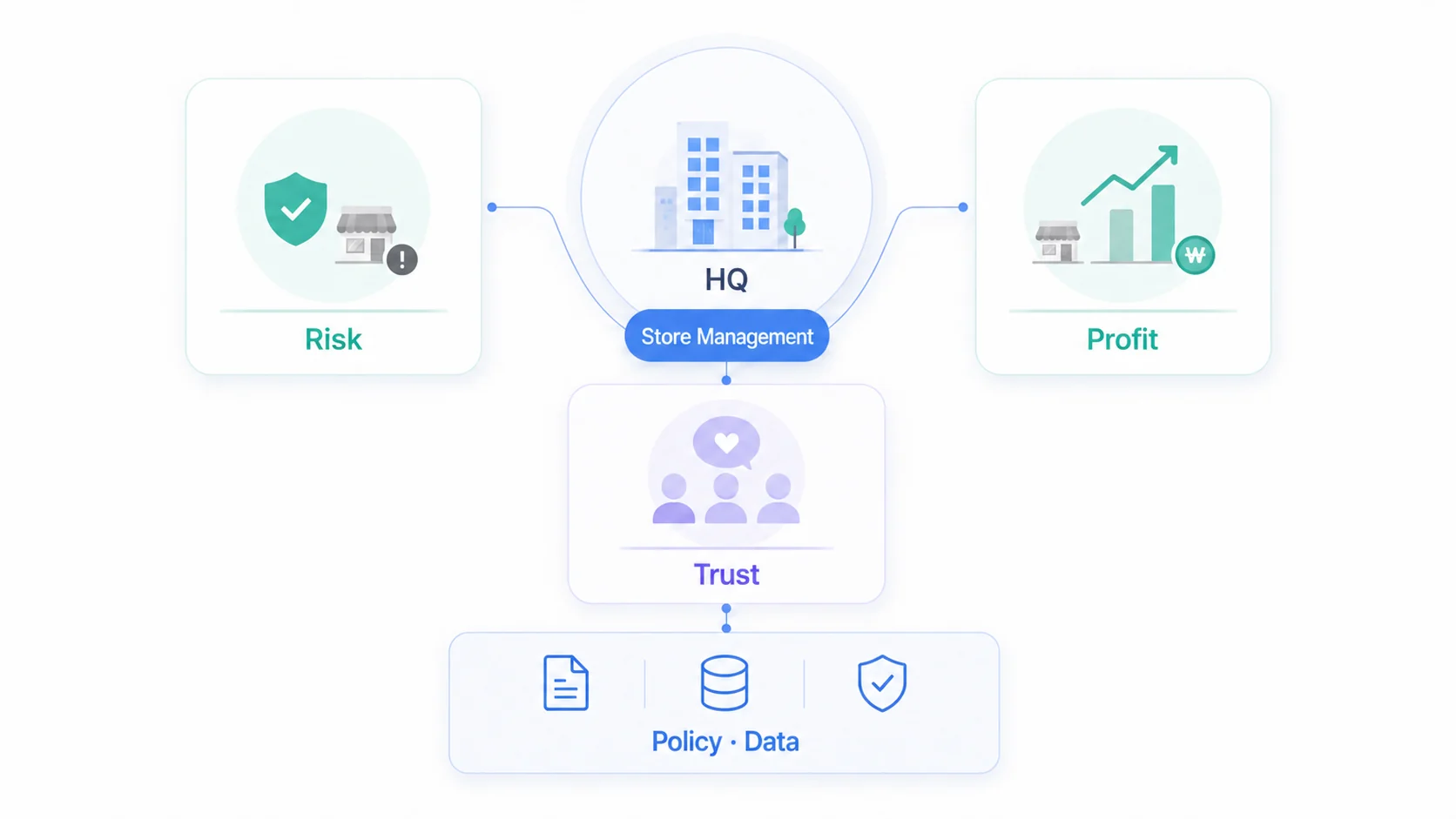
The white paper argues that a well-built store management system plays three roles for HQ. This framework makes it possible to see store management not as mere "administrative work" but as a strategic asset for headquarters.
First, it is a risk firewall. It stops an incident or quality problem at a single store before it spreads to trust in the entire brand. Second, it is a profit booster. When HQ looks closely at store operations and works through underperformance together with owners, the results flow back as HQ revenue. Third, it is a brand moat. Word of mouth from satisfied store owners becomes a barrier to entry that competitors can't easily match.
But doing all three at once isn't easy. The white paper cites the dilemma of profit sharing, the tension between operational control and store autonomy, and the information asymmetry between HQ and stores as the reasons store management is hard. HQ wants to enforce standards, owners want autonomy, and conflict takes root when the two sides see different amounts of information. Ultimately, management capability is the ability to resolve this tension through "systems and data" rather than "emotion."
The white paper also notes that the intensity of the relationship varies by category. The highly standardized beverage category has the tightest bond between HQ and stores, yet also the most disputes (37.5% of all restaurant franchise disputes), showing a double-edged nature. It's a signal that the stronger the bond, the more sophisticated management needs to be.
3. Pillar one: per-store profitability, from "hands-off" to "visible"
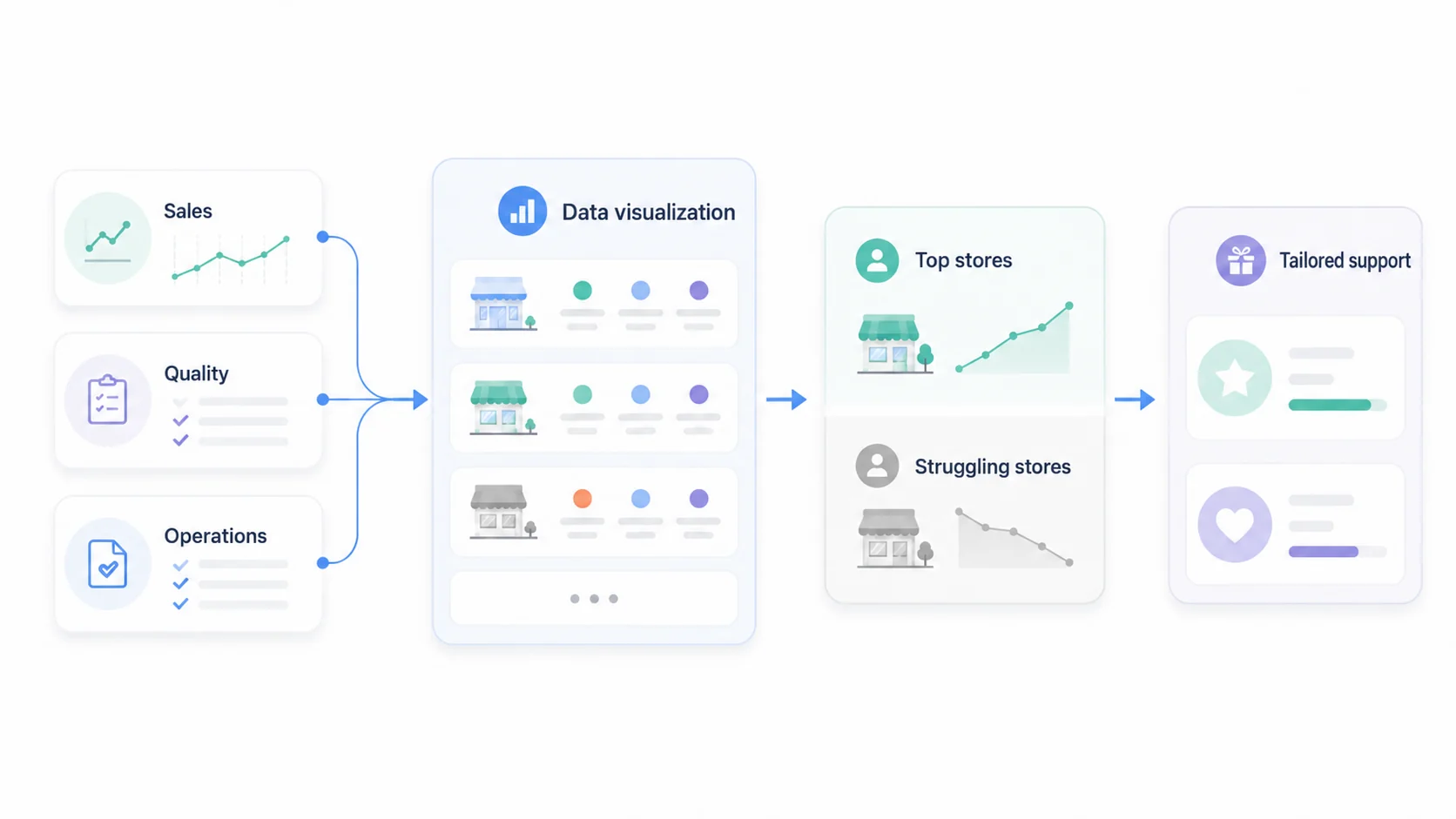
The old approach of "collect the franchise fee, then let them run it on their own" no longer works. The shift in revenue models described above means HQ can't protect its own revenue without knowing the state of its stores' operations. That's why managing per-store profitability starts with "knowing" each store's condition.
Specifically, HQ needs to watch three things: each store's sales trend, the results of on-site quality inspections, and compliance with operating standards. If these three aren't gathered as data, HQ is simply late in noticing which stores are struggling. There's a big difference between HQ catching a store whose sales have fallen two months in a row right away and only finding out after the owner asks about closing.
The "tiered, segmented management" the white paper recommends, a differentiated support strategy that gives more opportunities to high-performing stores, is also only possible on top of data. Fair differentiation requires being able to objectively identify who is doing well. Managing per-store profitability means HQ examines store health through data and designs support on that foundation.
4. Pillar two: store owner satisfaction, where digitalization builds the foundation of trust
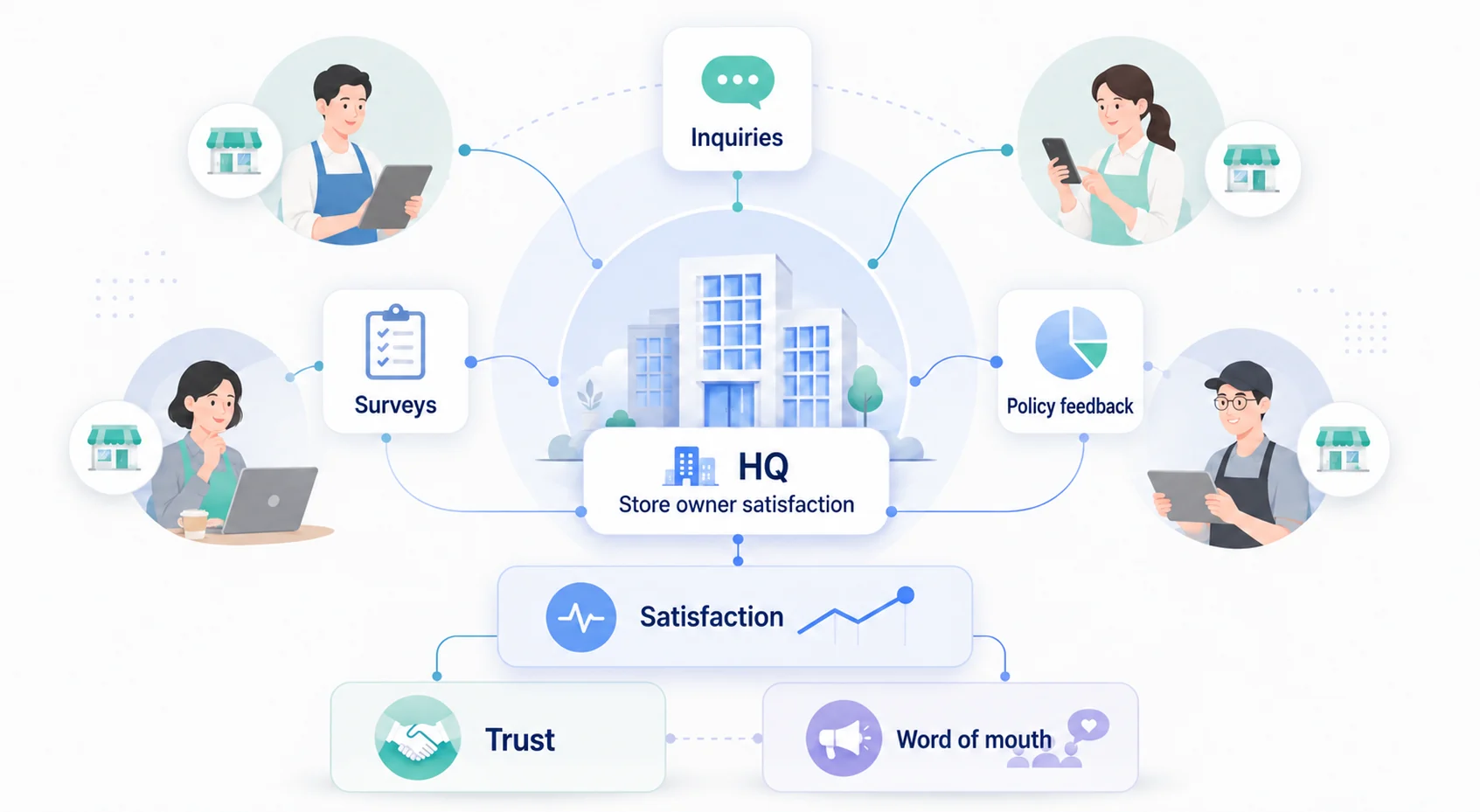
One of the future trends the white paper identifies for franchisee relations (FR) is that "digitalization rebuilds the foundation of trust." As store count grows, it becomes hard for HQ to give every owner's voice equal weight by hand alone. Only when data builds up on who is facing what difficulties and how owners respond to policy changes can HQ manage satisfaction as "numbers" rather than "feelings."
Satisfaction is a core HQ asset because store owners are changing. The white paper finds that the new generation of franchisees is younger and more educated, and many are evolving into professional investors who run two or more brands or stores at the same time. They decide whether to join a franchise based not on "brand halo" but on the real per-store profit model and HQ's support system. In other words, existing owners' satisfaction translates directly into competitiveness in recruiting new ones.
That's why satisfaction management must be two-way data collection, not one-way notices. HQ can only act once it's clear where owners' inquiries are piling up and what complaints surveys have surfaced. The white paper's description of franchisee word of mouth as the foundation for a chain's sustained growth makes the same point. It ties directly to the third role discussed above: satisfied owners become the brand's moat.
5. Store management is risk management
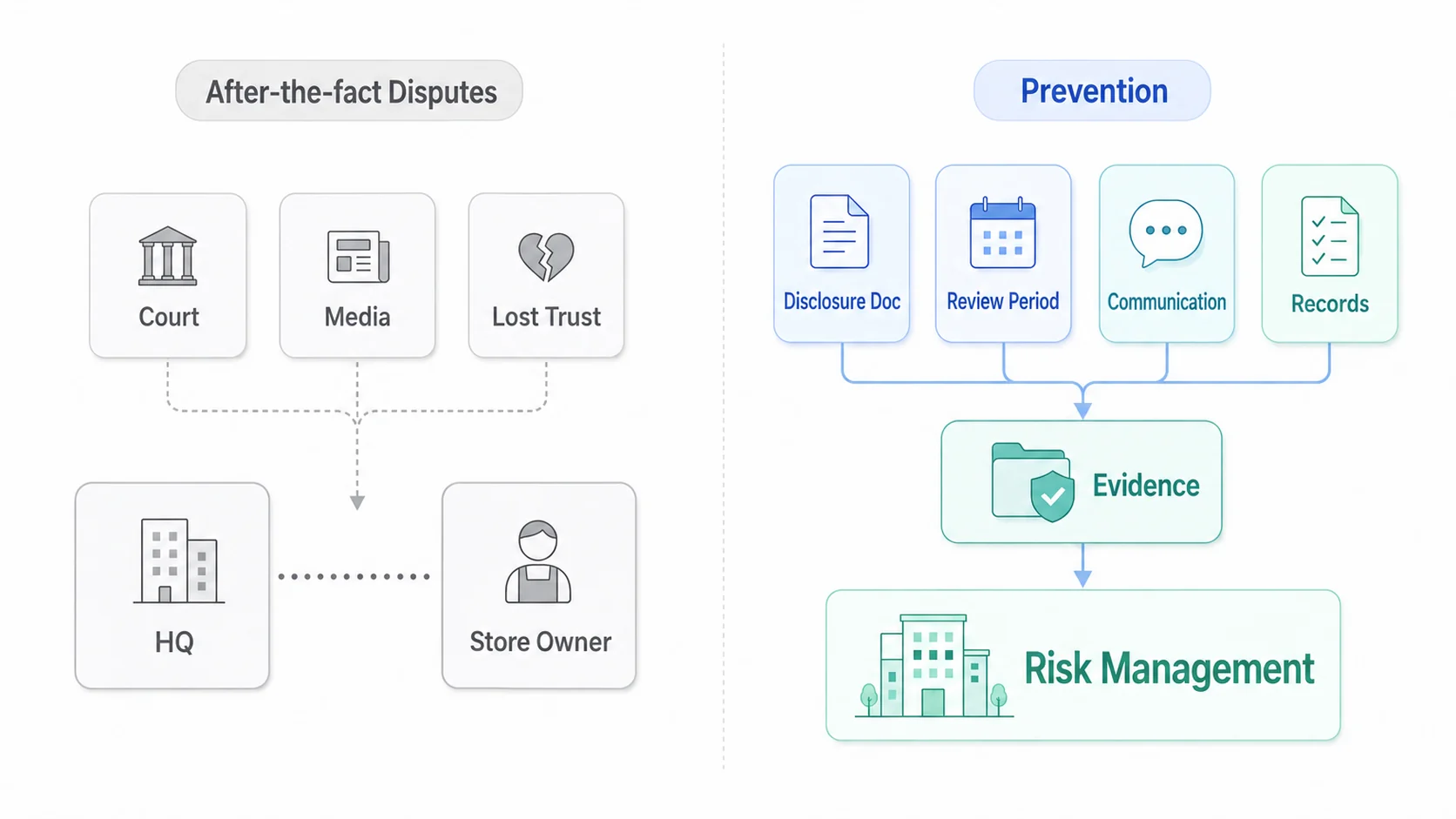
Disputes grow where profitability and satisfaction have collapsed. According to the judicial statistics cited in the white paper, store owners were the plaintiffs in about 98% of restaurant franchise dispute lawsuits. In a structure where HQ holds the information advantage and the power to draft contracts, owners easily end up in a weaker position, turning to legal action only after losses have piled up.
The white paper issues one more warning. So-called "hit-and-run recruitment" (快招) hasn't disappeared; it has survived in new forms, dressed up more convincingly with things like financing information. In Korea, too, the main trigger for disputes is false or exaggerated information at the recruitment stage. That makes "transparent recruitment you can document" the first step in risk management.
Disputes are most expensive "after they blow up"
The moment a dispute reaches the courts or the media, HQ's costs grow exponentially. It's not just legal damages; HQ also takes a hit to brand trust. That's why preventing conflict in advance through communication, training and record-keeping is always cheaper than "cleaning up after it blows up."
Korea's Franchise Business Act already mandates providing a franchise disclosure document, a cooling-off period (14 days after the disclosure document is provided, or 7 days if the prospective franchisee has consulted a lawyer or certified franchise consultant), a ban on false or exaggerated information, franchisee associations' right to request negotiations, and a dispute mediation system. In other words, the unified accountability and transparent recruitment that the Chinese white paper says "will now be enforced" are already the legal baseline in Korea. In practice, though, the key is less "doing it" than "proving it." HQ can only defend itself if there's a record of what was provided and communicated, and when. If day-to-day store management runs on data, risk management follows almost naturally.
6. What kind of store management system should HQ have?
The white paper lays out seven stages of a healthy management system: rigorous screening → transparent recruitment → systematic development → joint management → overhauled oversight → deeper support → healthy exit. From screening before recruitment all the way to exit, HQ needs to manage the store's entire lifecycle against consistent standards. Interestingly, this flow closely mirrors the operating stages of a franchisor headquarters itself.
Headquarters that want to standardize and unify this entire process in one system, rather than scattered Excel files and messengers, choose FDAM, the AI ERP built for franchises. FDAM is an AI ERP built for franchises that brings every franchisor headquarters task, from franchise sales to order management, logistics and settlement, into one place. Let's look at it in the order of the two pillars above.
Feature 01 · Per-store profitability
Operations Management
HQ sees QSCV on-site inspections, POS sales totals (as of the next day) and store information in one place. By gathering sales trends, quality inspections and standards compliance as data, it's the starting point for store management: knowing the state of every store.
Feature 02 · Store owner satisfaction
CS · Survey Management (optional)
Handle owners' inquiries and issues in one channel, and measure satisfaction and needs quantitatively through surveys. It directly addresses the two-way "communication and satisfaction" mechanism the white paper emphasizes.
Feature 03 · Consistent store opening quality
Store Opening Management
HQ manages paperwork, interior work and training through standard procedures, so every new store opens to the same quality standard. It's the foundation for HQ to consistently carry out the "systematic development" stage the white paper describes.
Feature 04 · Risk firewall
Sales Management · Dispute Management
HQ manages everything from leads to consultations, e-contracts and the delivery and history of pre-contract disclosure documents in one flow, keeping a data record of when disclosure documents were provided. Since 2026, automatic alerts 30 days before contract expiration have been added. The Dispute Management option handles conflicts through an institutionalized channel.
FDAM supports PC, tablet and mobile devices, and holds multiple GS (Good Software) certifications, Korea's government-accredited software quality certification based on ISO/IEC international standards.
Closing thoughts
As store count grows, it becomes ever more important for HQ to manage each store's profitability and each owner's satisfaction with data. To borrow the white paper's words, the sooner you take this on, the more opportunity you gain; the later you are, the more risk you carry. If your HQ is thinking about what comes after rapid expansion, it's time to start by putting store management on a system.
How can FDAM help your HQ manage its stores?
Talk to sales to see firsthand how it can work for your HQ's situation.
Contact sales for FDAMfdam.co.kr | KakaoTalk chat | 1544-7120
Frequently asked questions
Q. What is franchise store management?
It's the work franchisor headquarters do to oversee and support stores against consistent standards, from store opening through operations, sales, quality and communication. The key isn't simply expanding store count, but looking after both each store's profitability and its owner's satisfaction.
Q. Why do you need a store management system (software)?
As store count grows, it becomes hard to manage every store at the same level by hand alone, and if sales, quality and communication records aren't kept as data, you miss the moment to help struggling stores as well as the evidence you need to defend yourself in a dispute.
Q. How does FDAM help with store management?
Operations Management (QSCV inspections, POS sales totals, store information) makes store health visible through data, and CS · Survey Management (optional) manages communication with store owners and their satisfaction. Add Store Opening Management (consistent opening quality) and Sales and Dispute Management (risk), and FDAM lets HQ handle store management as a whole in one system.
franchise store management, store management system, store management software, franchise ERP, FDAM, per-store profitability, store owner satisfaction, QSCV inspection, franchisor headquarters, franchise AI solution