How to Standardize Franchise Store QSC Management with a Franchise ERP
Practical standards for linking QSC inspections to improvement with a franchise ERP.

In franchise store QSC management, what matters is connected records, not the number of inspections
CORE SUMMARY
✔ Franchise store QSC management keeps returning to square one because standards and records are not connected in a system.
✔ For inspections to lead to improvement, the four stages of defining standards, conducting inspections, recording results, and tracking improvements must sit in a single flow.
✔ General-purpose ERPs are not designed around the dual structure of headquarters and franchise stores, which creates structural limits for store-level history management.
✔ When evaluating adoption, the priority is to confirm that inspection, recording, and tracking actually connect on a single set of data, rather than to compare feature lists.
A franchise ERP is operations software built specifically for franchisor headquarters, designed to handle work scattered across many departments and stores, from startup consultations and franchise agreements to opening preparation and store operations management, on a single system.
Within this, franchise store QSC (Quality, Service, Cleanliness) management is usually the first area raised when evaluating adoption. The reason is clear: most headquarters already have an inspection checklist, and supervisors visit stores regularly, yet they often struggle to answer right away, “Was the issue we flagged last month fixed this month?” This article walks through the structural reasons QSC management keeps breaking down, a four-step framework that links inspections to improvement, the structural differences between general-purpose and franchise ERPs, and how this flow is handled in an actual system.
Structural reasons franchise store QSC management keeps returning to square one
The biggest reason franchise store QSC management keeps repeating itself is that each inspection ends as a single document.
Sound familiar?
What is checked on site stays on a paper checklist or Excel file, site photos sit on staff members’ personal phones, and corrective action requests are scattered across KakaoTalk and text messages. If these three are not tied together, each inspection is no different from starting over, because the basis for comparing against the previous round does not exist in the system.
Staff turnover makes the problem worse. Even for the same store, scores vary depending on the inspector’s standards, and franchise stores come to feel that HQ’s standards are inconsistent. As a result, inspections stop at “finding problems” and never get to “confirming the problems were fixed.” In practice, this last step, confirming improvement, is the first to be dropped in manual management. As inspections and franchise stores multiply, this gap grows beyond what HQ staff can handle.

Even with standards in place, scattered records send inspections back to square one
A four-step framework and decision criteria for linking inspections to improvement
QSC management works only when the four stages of defining standards, conducting inspections, recording results, and tracking improvements are connected in a single flow.
1
Define standards: finalize the items the brand manages and the scoring system, and apply them equally to all stores. The test is: “Is there room for this item to be interpreted differently by different stores?”
2
Conduct inspections: check each item on site and leave photos and comments together. If you record only scores without photos, it is hard to present evidence when disagreements arise.
3
Record results: inspection results accumulate as store-level history and are automatically compared with the previous round. Without history, you cannot even spot patterns of repeated issues.
4
Track improvements: the process of confirming at the next inspection whether flagged issues were addressed, then closing them. This is the first step to be dropped in manual management.
If even one of these four stages remains outside the system, in separate documents or messengers, the flow breaks at that point. When evaluating adoption, the more practical criterion is not “Does it have an inspection feature?” but “Do these four stages connect on the same data?”

If any one of the four stages breaks, inspections turn back into paperwork
General-purpose and franchise ERPs manage fundamentally different things
Looking only at franchise store management features, general-purpose ERPs and franchise ERPs differ structurally in that they manage fundamentally different things.
A general-purpose ERP assumes the company’s own organization and assets as the unit of management and is designed around accounting, HR, and purchasing. It also has the concept of inspections or audits, but these are closer to audits of internal departments. A franchise ERP, by contrast, is designed around a dual structure of one headquarters and many franchise stores. When work that repeats at the store level and builds history over time, like franchise store QSC management, is handled on this dual structure, comparisons by store, by region, and by staff member come naturally.
| Category | General ERP | Franchise ERP |
| Unit of management | HQ organization and assets | HQ + many franchise stores |
| Core work | Accounting, HR, purchasing | Consultations, contracts, openings, store operations |
| Inspection concept | Internal department audits | Regular store-level inspections with accumulated history |
| How it scales | With organization size | With the number of franchise stores |
This difference is not about having more or fewer features but about design assumptions. That is why franchisor headquarters that try to bolt a QSC inspection feature onto a general-purpose ERP often run into structural limits in store-level history management and integration with franchise store information.

A franchise ERP is designed around the dual structure of headquarters and franchise stores
How QSCV inspections are handled in FDAM’s operations management
FDAM is an operations ERP for headquarters that consolidates and standardizes franchisor HQ work in one place, and its operations management module, which follows sales management and opening management, includes franchise store QSCV (Quality, Service, Cleanliness, Value) inspections.
When inspection items are standardized on HQ’s terms, inspections follow the same standards even when staff change, and results automatically accumulate and are tracked as store-level history. In terms of the four-step framework above, defining standards corresponds to setting items and scores, conducting inspections to on-site entry, and recording results and tracking improvements continue on the store history screen. Because POS sales aggregation and store information management sit in the same screen flow as inspection results, there is no need to check a store’s inspection history and operating status in separate materials.
Since it supports PC, tablet, and mobile, inspectors can enter findings right on site, reducing the double work of reorganizing them back at the office. Two-way communication between headquarters and franchise stores, such as notices, surveys, and CS requests, is handled separately in Sodam, and using the two systems together keeps HQ management and field communication in the same flow. MS Benter designed this flow based on about 25 years of working exclusively on franchise software, with experience building systems for more than 500 brands as the basis for its standards.
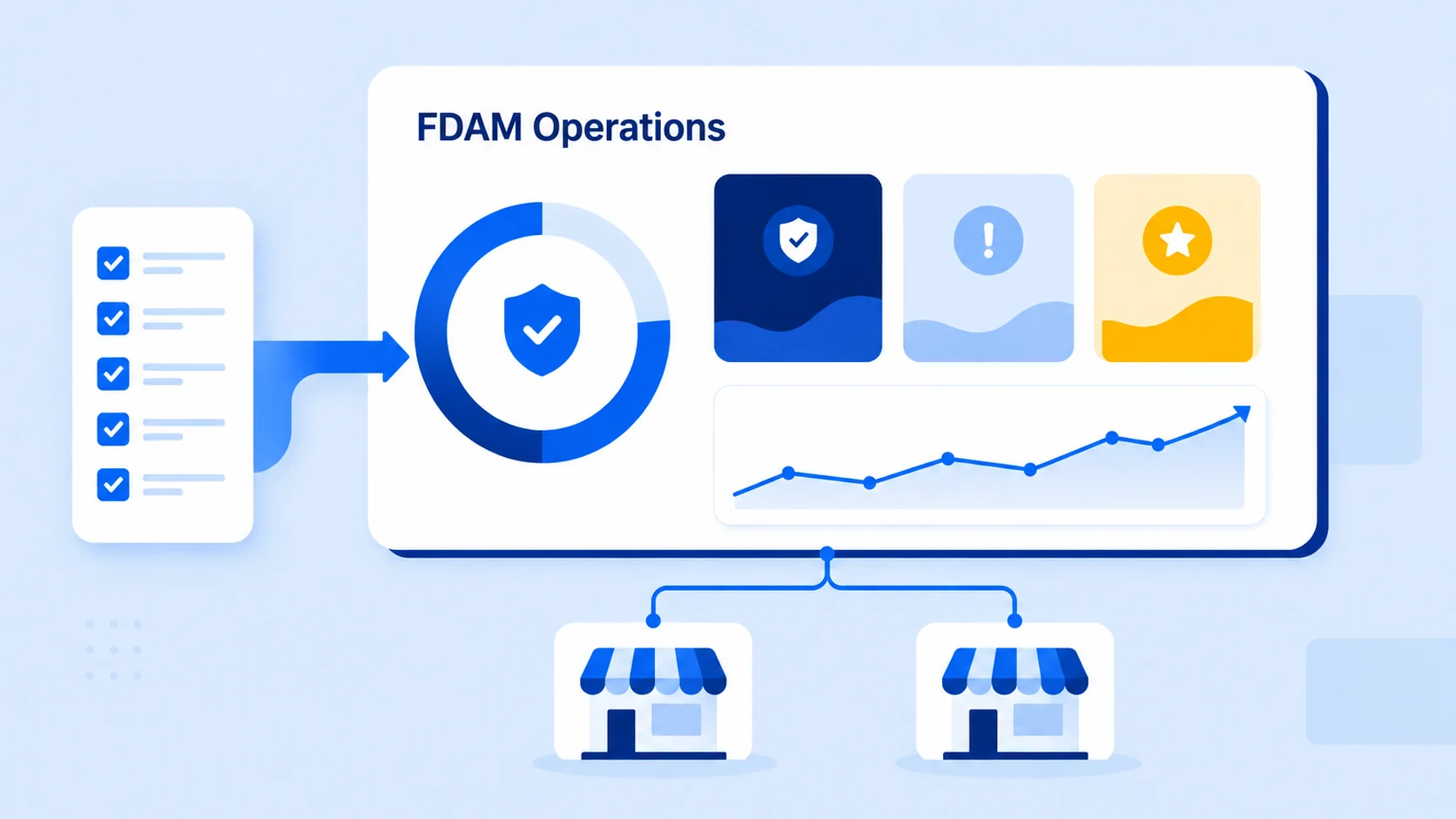
Inspection results, sales, and store information continue in the same screen flow
Practical criteria for headquarters evaluating adoption
When evaluating a QSC management system, it is more important in practice to examine fit with your operating style before looking at feature lists.
POINT 01
Check whether you can carry over the inspection items and scoring system you already use. If you must rebuild your standards from scratch, the initial burden of adoption grows.
POINT 02
Check whether inspection results automatically accumulate as store-level history and whether you can immediately confirm at the next inspection whether flagged issues were addressed. Both must be possible for inspections to move from evaluation to improvement.
Even early-stage brands with few stores are better off setting standards now. If you wait to overhaul standards until openings accelerate and the store count grows, you will also have to undo practices that have already taken root in the field. Finally, check whether inspection data connects with other HQ work, such as sales data and store information, in the same screen flow. If inspections exist as a standalone feature, you may end up with yet another separate document management task.
Frequently asked questions
Q. Should we adopt a franchise ERP or a general-purpose ERP?
A. If your core work repeats across the dual structure of headquarters and franchise stores, especially store-level inspections and history management, an ERP designed specifically for franchises is a better fit. General-purpose ERPs are not designed around this structure, which can create limits in store-level history management.
Q. Can we move our existing QSC checklist into the system as-is?
A. You can configure inspection items based on the items and scoring system your brand already uses. There is no need to discard your existing standards and create new ones.
Q. Should early-stage brands with few franchise stores consider adoption?
A. Setting standards early actually reduces the burden of overhauling them later as stores grow. It is easier to organize your standards before openings become frequent.
Q. Besides QSC inspections, what other work is handled in HQ operations management?
A. In FDAM’s operations management module, POS sales aggregation and store information management are handled in the same flow as QSCV inspections. The upstream sales management (startup consultations, electronic franchise agreements) and opening management also run on the same data.
QSC management is not about increasing the number of inspections; it is about building a structure where what you inspect is recorded and carried through to improvement. Whether standards, records, and tracking are connected on a single set of data should be the key criterion when evaluating adoption.
See your current inspection standards on a system
MS Benter, which has specialized in franchise software for many years, designed FDAM based on its experience building systems for many brands.
Contact salesView product details Chat on KakaoTalk
Call 1544-7120
Franchise ERP, Franchise store QSC management, QSCV inspection, Franchisor HQ operations management, Store operations standardization, Supervisor inspections, Franchise SaaS, Franchise store management system, FDAM, Franchise-specific ERP, Store information management, MS Benter