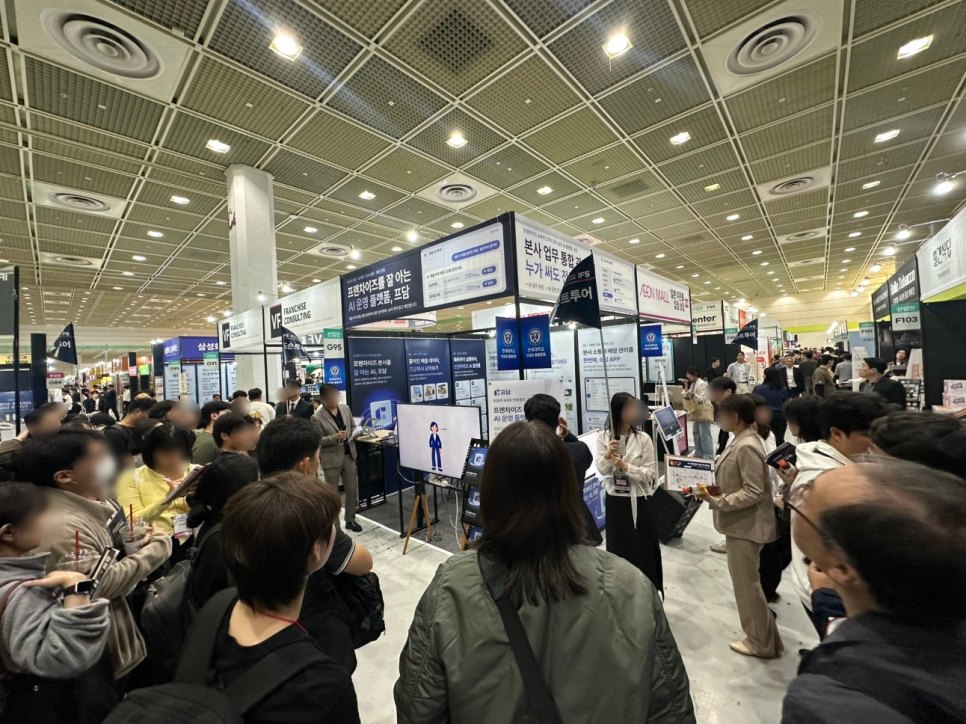
Restaurant Sales Are Up, So Why Are Store Owners Struggling?
Using field data from supervisors, we analyze why franchisor headquarters need to manage franchise store profit structures with data.
FRANCHISE INSIGHT · REVENUE MANAGEMENT
Restaurant Sales Are Up,
So Why Are Store Owners Struggling?
The uncomfortable truth about franchise store profit structures: key store management strategies analyzed through delivery fees, food costs, and waste rates

The profit structure of a delivery-focused franchise store, as calculated by working supervisors (based on field data)
CORE SUMMARY
A delivery franchise store that sells a KRW 18,000 menu item keeps only about KRW 5,500 · Once fees, delivery charges, and food costs are added up, 75–80% of sales are already gone · When franchise stores struggle, headquarters struggles too · Using field data, we analyze why franchisor headquarters now need a system that manages profit structures, not just sales
Sell KRW 18,000, Keep KRW 5,500?
The Uncomfortable Truth About Delivery
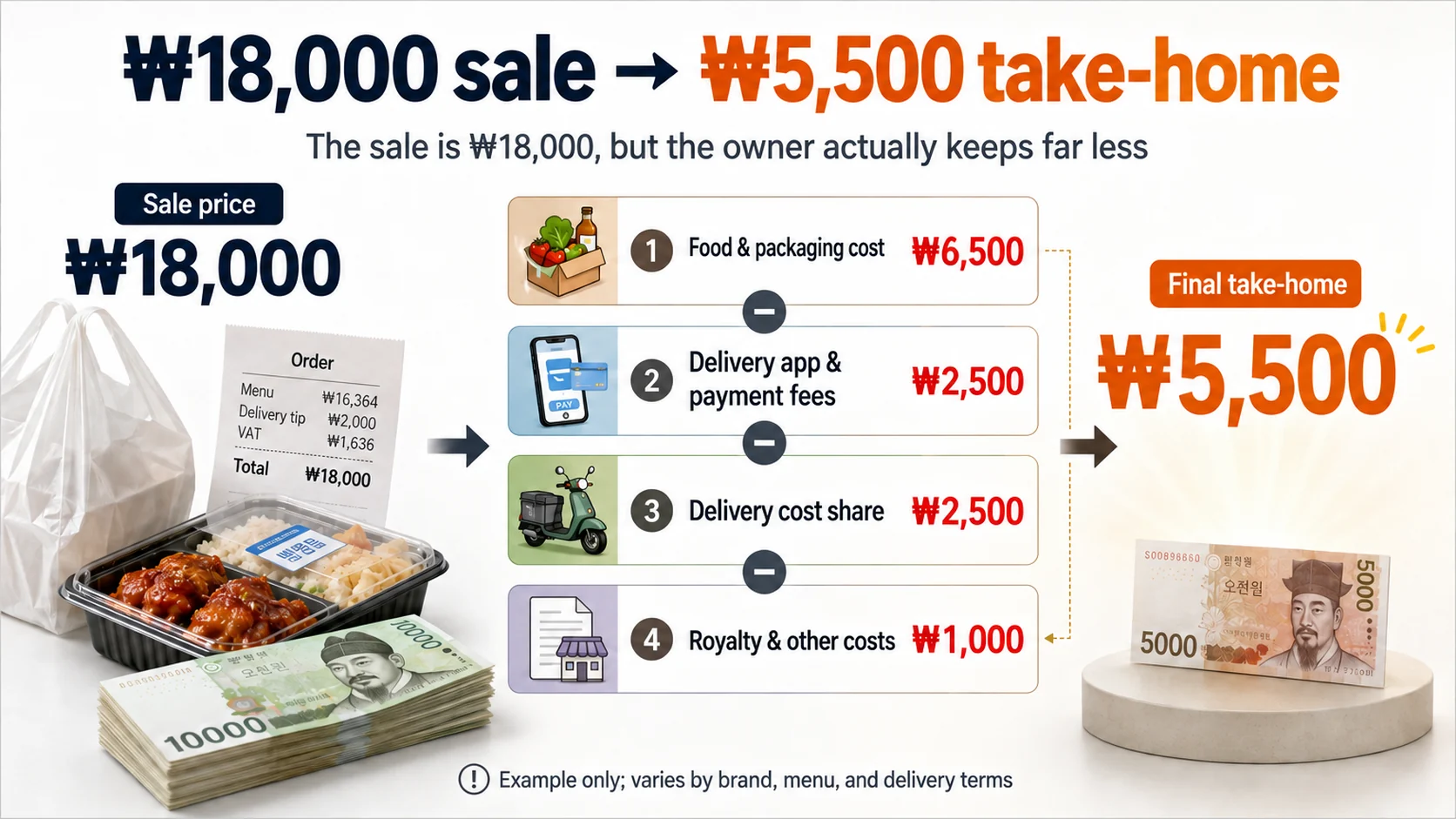
Simulation of what's actually left after delivery app fees and delivery charges, assuming a 35% food cost
We asked a delivery-focused franchisor headquarters, "What's the net profit per menu item?"
"Figure 35% for food cost, take out all the fees, and a KRW 18,000 item leaves a little over KRW 5,500."
This isn't a theoretical figure floating around the industry. It's field data calculated per menu item by working supervisors who manage multiple brands. Here's what actually comes out when you break down a single KRW 18,000 item sold through delivery.
| Item | Rate / Amount |
|---|---|
| Ingredients (35% food cost) | About KRW 6,300 |
| Delivery app commission | 7.8–7.9% → about KRW 1,400 |
| Card fees + VAT | 3.3% → about KRW 600 |
| Delivery charge (rider) | KRW 2,900–3,400 |
| Amount actually left | About KRW 5,300–5,800 |
Subtract rent, labor, electricity and gas, and packaging, and it's no exaggeration to say there's practically nothing left. The lower the average order value, the harsher this structure becomes. There are real cases where setting a KRW 10,000 minimum order and handing out a KRW 2,500 coupon drops the settlement amount to around KRW 2,900.
Cafés are even more extreme. Selling a KRW 8,000 drink through delivery and receiving a KRW 2,900 settlement after a coupon is not a rare story in the field. Add fees, delivery charges, coupons, time sales, and review events, and close to half of sales end up going to the platform.
Key Point
At an average order value of KRW 15,000–20,000, total delivery-related costs come to 40–45% of sales. Add a 35% food cost and 75–80% is already spent. Sales are a number; profit is reality.
Sales Are Up, So Why Do Franchise Stores Say They're Struggling?
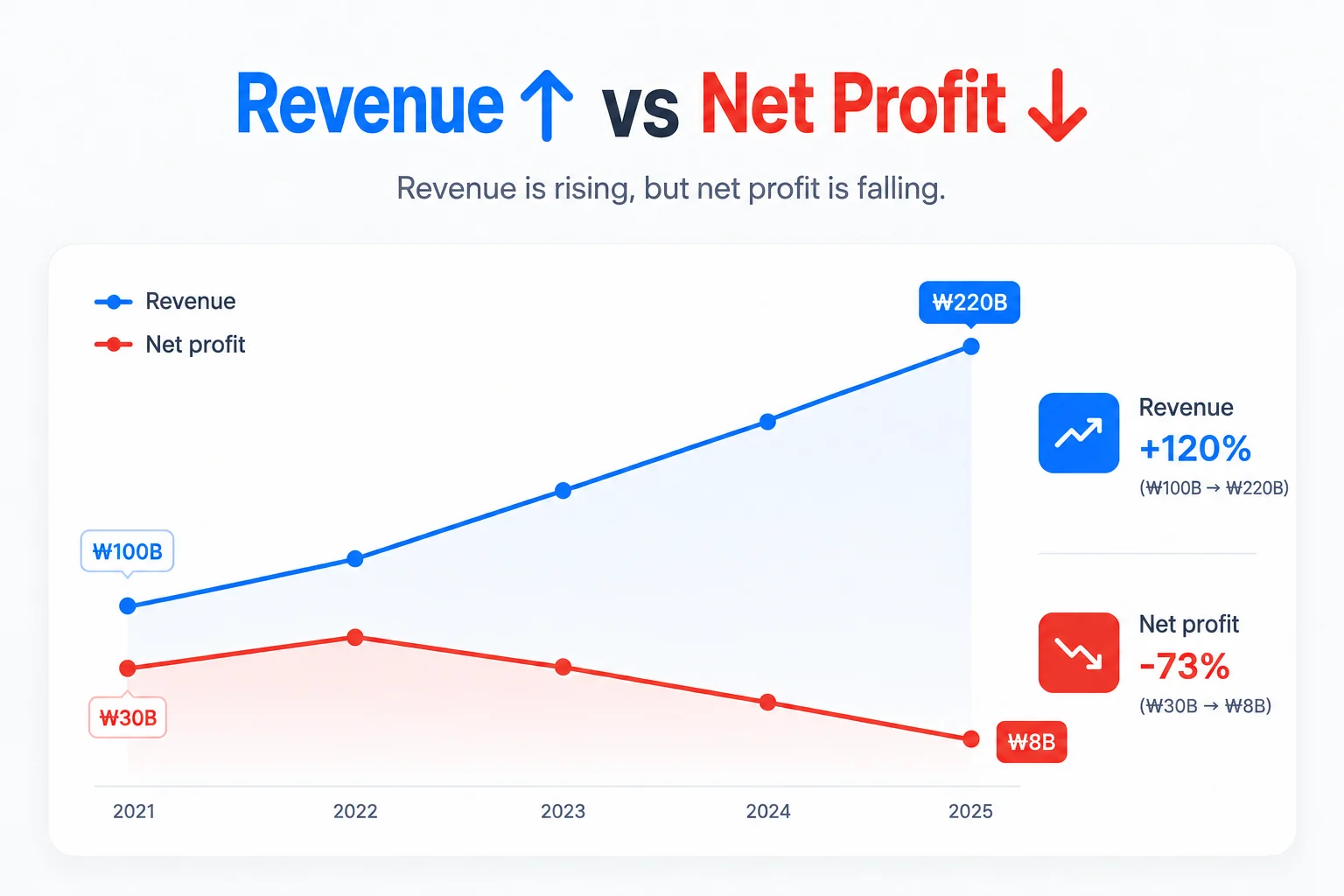
The structural reality of the restaurant industry: sales rising while net profit falls
According to the Korea Foodservice Industry Research Institute, total restaurant industry sales grew about 7–10% year over year in 2023–2024. Yet restaurant closure rates rose over the same period. Why does this contradiction exist?
There's one answer. The real driver of sales growth was price increases. In 2023 alone, average restaurant menu prices rose about 8.2%. Higher menu prices made the sales numbers bigger, but behind them three costs surged at the same time.
- Ingredients: Food ingredient prices rose an average of 15–20% over two years
- Labor: Minimum wage went from KRW 9,860 in 2024 to KRW 10,030 in 2025, rising every year
- Delivery platform costs: 7.8–7.9% commission + 3.3% card fees and VAT + KRW 2,900–3,400 delivery charge + advertising
In the end, sales are a number; profit is reality. Supervisors' own calculations in the field show that at an average order value of KRW 15,000–20,000, total delivery-related costs reach 40–45% of sales. Add coupons, time sales, and review events, and effectively half of sales go to the platform.
When Stores Struggle, HQ Struggles Too: Why This Is a Serious Problem for Headquarters
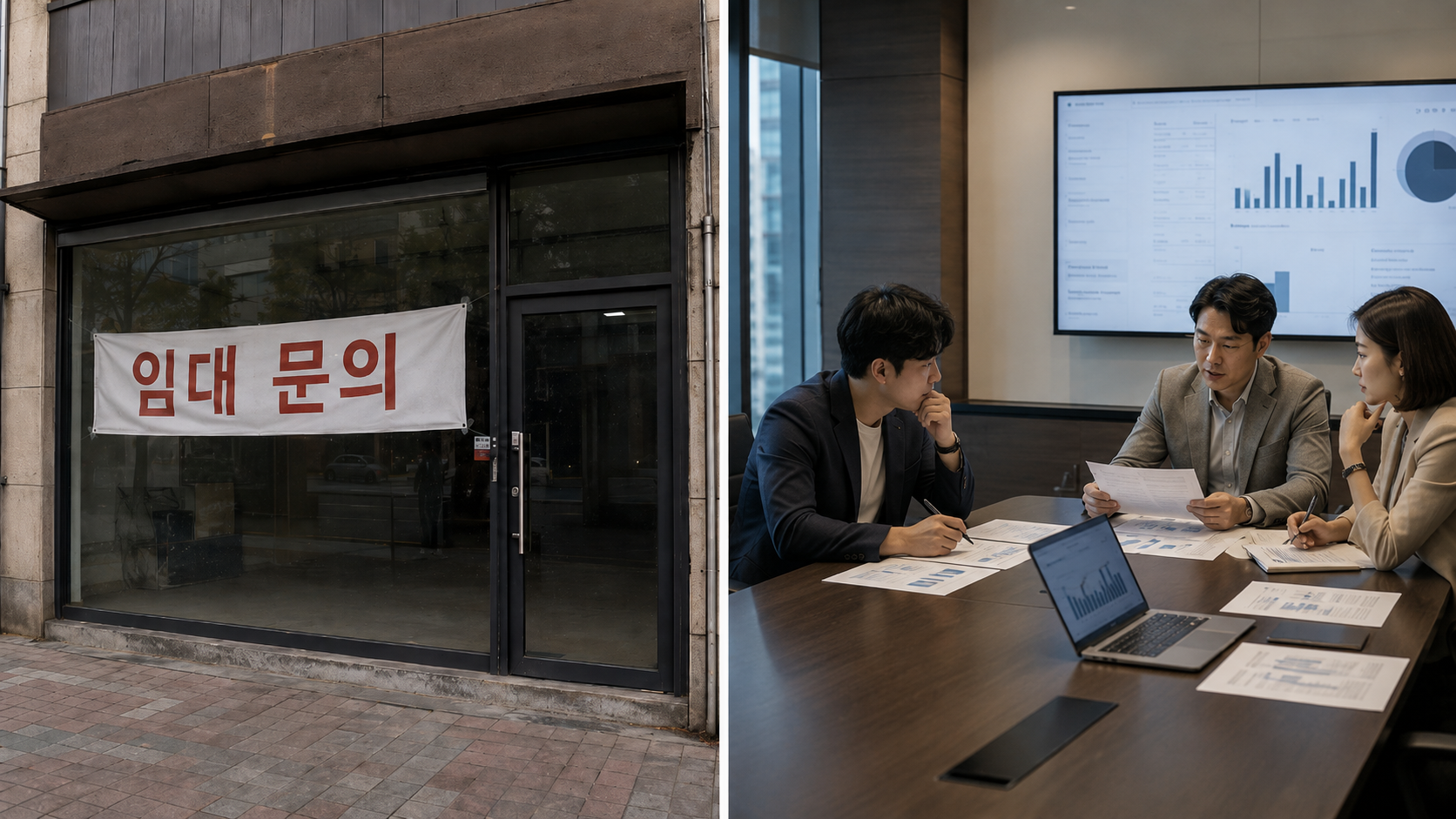
Franchise store attrition leads directly to declining brand trust
When franchise stores struggle, it's not just the owners who suffer. Headquarters suffers too. As store profitability deteriorates, the problems HQ faces unfold in this order.
①
Store profitability declines
Owners' real income drops sharply under delivery fees and food costs
②
Store attrition rises
Owners who can't hold out choose to end contracts or close
③
Brand trust declines
Fewer stores → brand awareness and competitiveness fall together
④
Harder to recruit new franchisees → HQ revenue declines
Lower franchise revenue and brand rebuilding costs hit at the same time
Delivery-focused franchise stores are especially vulnerable to this structure. An independent restaurant can adjust menu prices immediately or switch to cheaper substitute ingredients when costs rise. Franchise stores can't. They have to use HQ-designated ingredients, and pricing policy needs HQ approval.
In one actual case, when wholesale chicken prices rose 30%, the HQ supply price wasn't adjusted until six months later. During those six months, franchise store margins were cut in half. One of the biggest reasons stores can't hold out is that HQ's response can't keep pace with the field.
Common Operational Challenges Headquarters Face
· Inefficiency from not being able to see each store's profitability in real time
· Slow HQ-level response to ingredient price changes
· The structural limits of one supervisor managing many stores by gut feeling
· Managing only combined sales without separating profit by channel (delivery vs. dine-in)
3 Management Strategies HQ Can Use to Keep Franchise Stores Alive
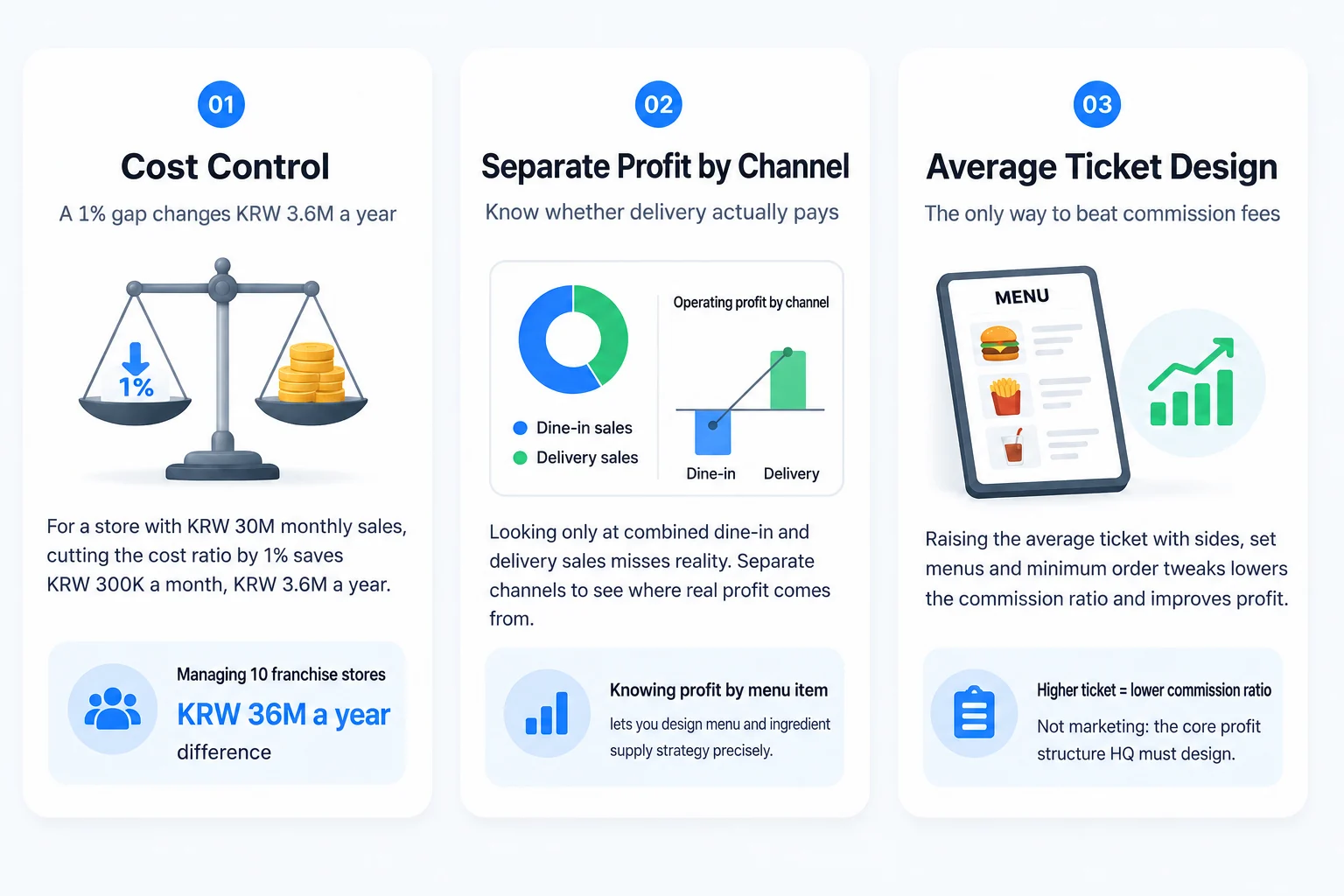
Three HQ-level management strategies to protect franchise store profit structures
1
Cost Management: A 1% Difference Is Worth KRW 3.6 Million a Year
At a franchise store with KRW 30 million in monthly sales and a 35% food cost, food costs come to KRW 10.5 million. Lowering the food cost ratio by just 1% makes a difference of KRW 300,000 a month, or KRW 3.6 million a year. If HQ manages 10 stores, that's a KRW 36 million difference per year.
Simply tracking ingredient cost changes in real time and keeping order quantities at the right level can create this difference. That's why HQ needs a system that sets a food cost baseline and monitors it store by store.
2
Separate Profit Structures by Channel: Know Whether You're Earning From Delivery or Surviving on Dine-In
There's something supervisors in the field all say: "If you only look at combined delivery and dine-in sales, you miss the reality. You have to look at them separately to see whether you're earning on dine-in and losing it on delivery, or whether delivery is really a profitable channel."
A best-selling item isn't always a good item. If Item A sells 50 a day at a 65% food cost and Item B sells 20 a day at 30%, it's Item B that actually keeps the store going. HQ needs profitability data by menu item across all franchise stores to properly design both menu strategy and ingredient supply strategy.
3
Order Value Design: The Only Way to Beat the Fee Structure
Under the delivery fee structure, profitability deteriorates sharply as average order value falls. Raising the average order value through side items, set menus, and minimum order adjustments is the most direct way to lower the fee ratio.
This is not just a marketing tactic; it's a profit structure issue that HQ has to design. With practitioners increasingly seeing delivery as "a channel for spreading fixed costs, while profit comes from dine-in," HQ needs to redesign its menu strategy.
Can One Supervisor Manage 20 Stores by Gut Feeling?

Without a data-driven multi-store management system, problems are always discovered after the fact
Here's what supervisors in the field say candidly.
"We used to handle it by experience, but now we can't explain anything without data. Not to owners, not to HQ."
When one supervisor covers 10–20 franchise stores, keeping track of each store's cost flow, inventory status, and profit by channel in their head is structurally impossible. The bigger problem is that managing by gut means you only notice problems after they happen. Ingredient waste piles up, low-margin items keep selling, and over-ordering goes in, and only then does it show up in the numbers.
The average food waste rate in the restaurant industry is about 8–12%. For a store with KRW 5 million in monthly ingredient costs, that means KRW 400,000–600,000 goes in the trash every month. What if HQ could track this figure for each store in real time and step in immediately at any store that exceeds the threshold? Across 10 stores, that could mean annual savings of tens of millions of won.
Key Insight
Franchise store management isn't about finding problems; it's about stepping in before problems happen. That difference comes down to whether you have a data system.
FDAM: How HQ Can Help Franchise Stores Thrive Together

FDAM: an integrated franchise store management solution built for franchisor headquarters
FDAM is not just a logistics ordering system. It is an integrated franchise store management solution that lets franchisor headquarters see each store's profit structure in real time and step in proactively.
| HQ's challenge | How FDAM/Logidam solves it |
|---|---|
| Can't see profitability by store | Real-time data on food cost ratio and channel profit by store |
| Hard to control ingredient waste and over-ordering | Data-driven automatic calculation of optimal order quantities |
| Supervisors can't keep up with multiple stores | Integrated dashboard of key metrics for instant anomaly detection |
| No visibility into profitability by menu item | Reports analyzing actual profit margin by menu item |
| Hard to control labor efficiency | Analysis of labor efficiency against sales by time of day |
Core Value
HQ can spot problems in the data and step in before the store even notices them. This goes beyond operational efficiency; it becomes HQ's competitive edge in raising store survival rates. The longer franchise stores survive, the stronger the HQ brand becomes.
The Quality of Franchise Store Management Determines the Life of the Brand
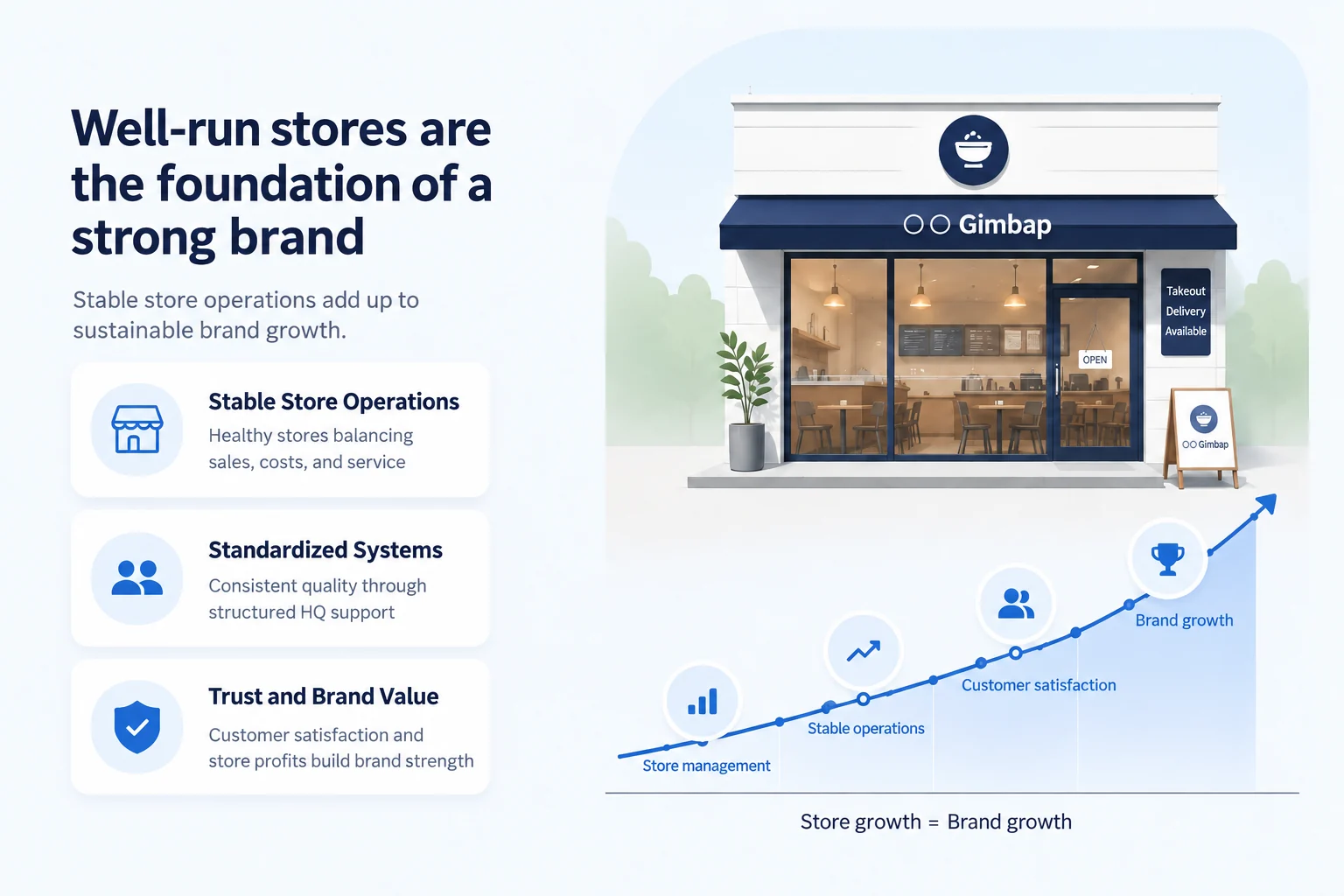
Well-managed franchise stores are the foundation of a strong brand
Why store owners struggle even as sales rise can now be clearly explained in numbers.
- Delivery fees and delivery charges alone take 40–45% of sales
- Add a 35% food cost and 75–80% is already spent
- Add coupons, advertising, labor, and rent, and there's nothing left
Within this structure, expecting owners to hold out on their own only goes so far. The whole brand survives only when HQ manages store profit structures with data and steps in before problems arise.
Managing well matters more than selling well. That is the core capability franchisor headquarters need right now.
Frequently Asked Questions
Q. What does the actual profit structure of a delivery franchise store look like?
A. At a 35% food cost, selling a KRW 18,000 item through delivery leaves about KRW 5,300–5,800 after the platform commission (7.8–7.9%), card fees and VAT (3.3%), and rider delivery charge (KRW 2,900–3,400). Subtract rent, labor, and packaging, and real net profit is close to zero. The lower the average order value, the harsher this structure becomes.
Q. How does lower store profitability affect headquarters?
A. Declining store profitability creates a vicious cycle: store attrition → declining brand trust → difficulty recruiting new franchisees → lower HQ revenue. Franchise store management isn't a welfare program for owners; it's HQ's survival strategy.
Q. How can supervisors manage multiple stores efficiently?
A. When one supervisor covers 10–20 franchise stores, gut-based management has its limits. They need to see each store's food cost ratio, inventory, and channel profit in real time on an integrated dashboard, along with a data-driven management system that steps in immediately when an anomaly is detected.
Q. What is the food waste rate at franchise stores, and how can it be reduced?
A. The average food waste rate in the restaurant industry is about 8–12%. With KRW 5 million in monthly ingredient costs, KRW 400,000–600,000 is thrown away every month. A data-driven ordering system can bring this down to around 3–5%, which across 10 stores can mean annual savings of tens of millions of won.
Q. Why should HQ manage profitability by menu item?
A. Best-selling items aren't always the most profitable. If an item that sells 50 a day has a 65% food cost, it contributes less profit than an item selling 20 a day at a 30% food cost. HQ needs to know the actual profit margin of each menu item across all stores to base its ingredient supply strategy and menu revamps on data.
Q. How is FDAM/Logidam different from a conventional POS system?
A. A typical POS focuses on tallying sales. FDAM/Logidam is a specialized franchise store management solution that builds on POS data to deliver food cost analysis, profit separation by channel, inventory and ordering optimization, and profit structure comparisons across stores, all in one place. HQ supervisors can see each store's key metrics in real time without visiting the site.
FRANCHISE MANAGEMENT · FDAM
How Well Are Your Franchise Stores
Being Managed Right Now?
The era of supervisors making the rounds and managing by gut is over.
Food cost ratio, channel profit, and inventory waste for each store
need to be visible in data, right now.
Franchise stores have to last for the brand to grow stronger.
Contact salesLearn about FDAM Chat on KakaoTalk
Franchise store management, franchisor headquarters, delivery fees, restaurant profit structure, supervisor, store profit improvement, delivery food cost ratio, franchise operations, FDAM, Logidam, restaurant management, delivery franchise