How Franchise ERP Plus AI Changes Franchisor HQ Operations
How to bring HQ operations into a single flow with franchise ERP and franchise AI, explained through the FDAM example.
franchise ERP, franchise AI, FDAM, franchise software, franchisor HQ system, franchise store sales management, AI review replies, CS AI, unified delivery sales management, restaurant franchise ERP, franchise operations system
As the number of franchise stores grows, the data headquarters has to handle grows exponentially. Here's how HQ operations change when franchise ERP and franchise AI come together, with FDAM as the example.
Key takeaways
- ✓ Franchise ERP is an integrated solution that manages HQ's sales, opening and operations stages as a single flow
- ✓ Franchise AI features reduce HQ staff's repetitive work, from review replies and CS responses to data analysis
- ✓ HQ can only decide which stores to support first by looking at sales and review data together
What is franchise ERP, and why is it getting attention again?
Franchise ERP is an integrated solution that ties HQ's sales management, opening management and operations management into one flow within a single system. From franchise consultations and e-contracts to interior work and training, and on to QSCV inspections and sales tallies after a store opens, it is the operating infrastructure that connects the work HQ handles every day into one continuous line.
Add franchise AI, and its value moves up a level. It goes beyond simply collecting and viewing data, creating an environment where HQ staff can quickly diagnose a store's situation and turn that straight into action. Let's look at how AI is easing the operational burden that HQ takes on as its store count grows, focusing on restaurant and food & beverage franchisor headquarters.
What has changed in HQ operations, and how?
Let's start with why the old way no longer works. Here's how the complexity of franchise store sales management has changed, and the reality HQ staff face every day.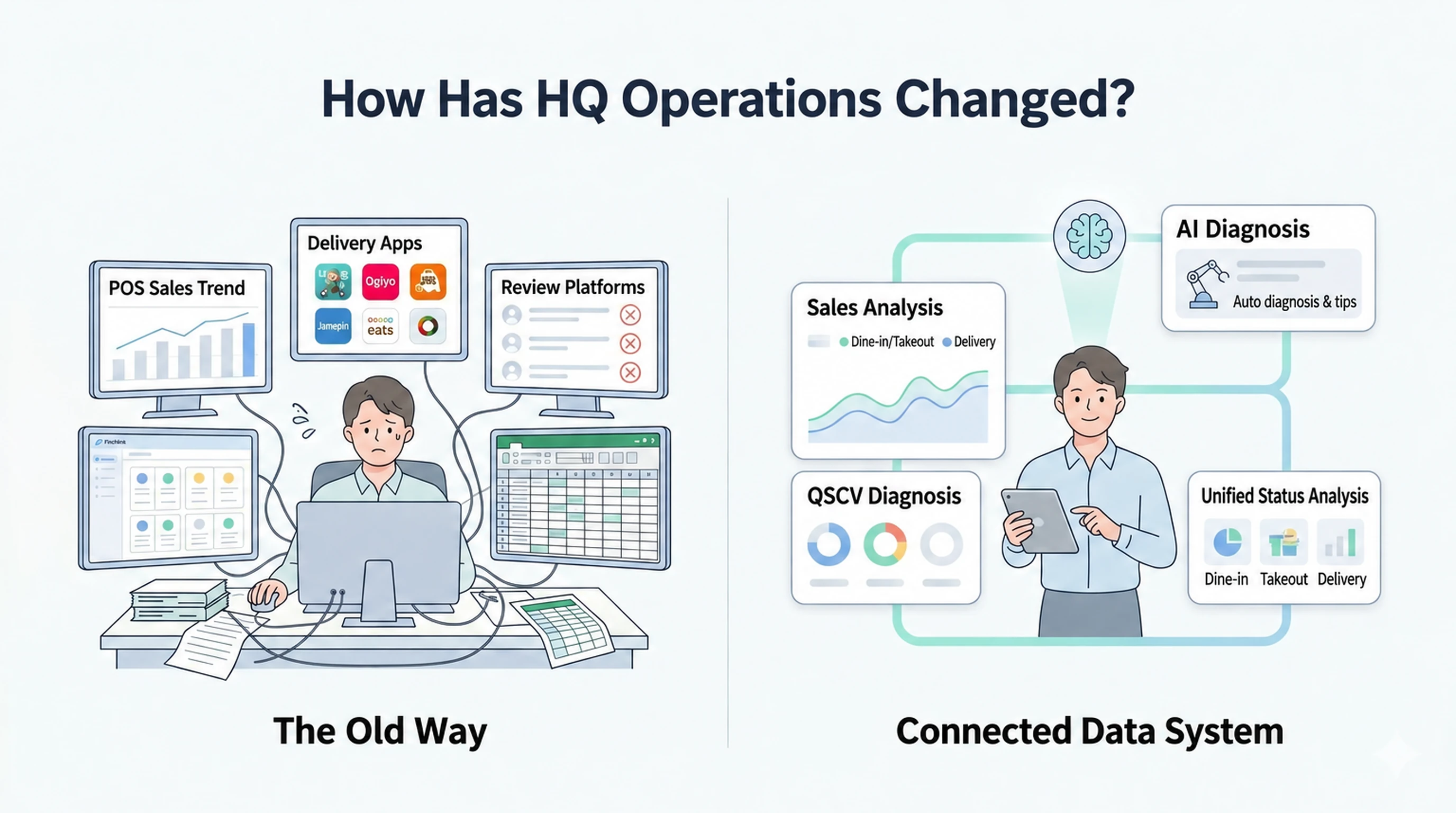
The days of reading a store through POS sales alone are over
There was a time when looking at POS sales alone gave you a fair sense of whether a store was doing well. If daily sales were steady, the store was considered fine, and only when sales dropped did HQ start calling the store owner.
Things are different now. Even within a single store, dine-in, takeout and delivery app sales each follow their own patterns. Some stores are strong in dine-in, while at others delivery makes up most of total sales. On top of that, customer reviews have begun to directly affect a store's reputation and next month's sales, so the data HQ needs to watch has grown beyond comparison with the past.
The biggest problem is that the data isn't in one place
The trouble is that this data is almost never gathered in one place. POS data sits in the POS, delivery app data is split by platform across Baemin, Yogiyo, Coupang Eats and others, and reviews are somewhere else again. Staff have to jump from window to window every time to pull it all together.
With only a few stores, you can get by that way. Somehow you can stitch things together with Excel, messengers and staff memory. But once the number of franchise stores grows, the same approach stops working. Organizing the data becomes HQ's main job, and the actual decisions come late.
Scattered data delays HQ decisions
What HQ staff need most, in the end, is the ability to decide quickly: spotting as early as possible which stores are slipping and which franchise stores need attention first.
But when data is scattered, those decisions get delayed by a week at a time. A week becomes a month, a month becomes a quarter, and sales can fall to a point where it's hard to recover. Reviews are the same. One or two negative reviews are just isolated cases, but once similar complaints start repeating, they become a signal. If HQ can't read that signal quickly, it affects the image of the entire brand.
Ultimately, what HQ needs is not a tool that "stores" data but a system that "connects" scattered data into a single flow.
How the franchise ERP FDAM handles HQ work
FDAM is an ERP that brings franchisor headquarters' operating flow together into one continuous line. Let's look from two angles at how an HQ staff member's day changes, from the sales stage through operations after a store opens.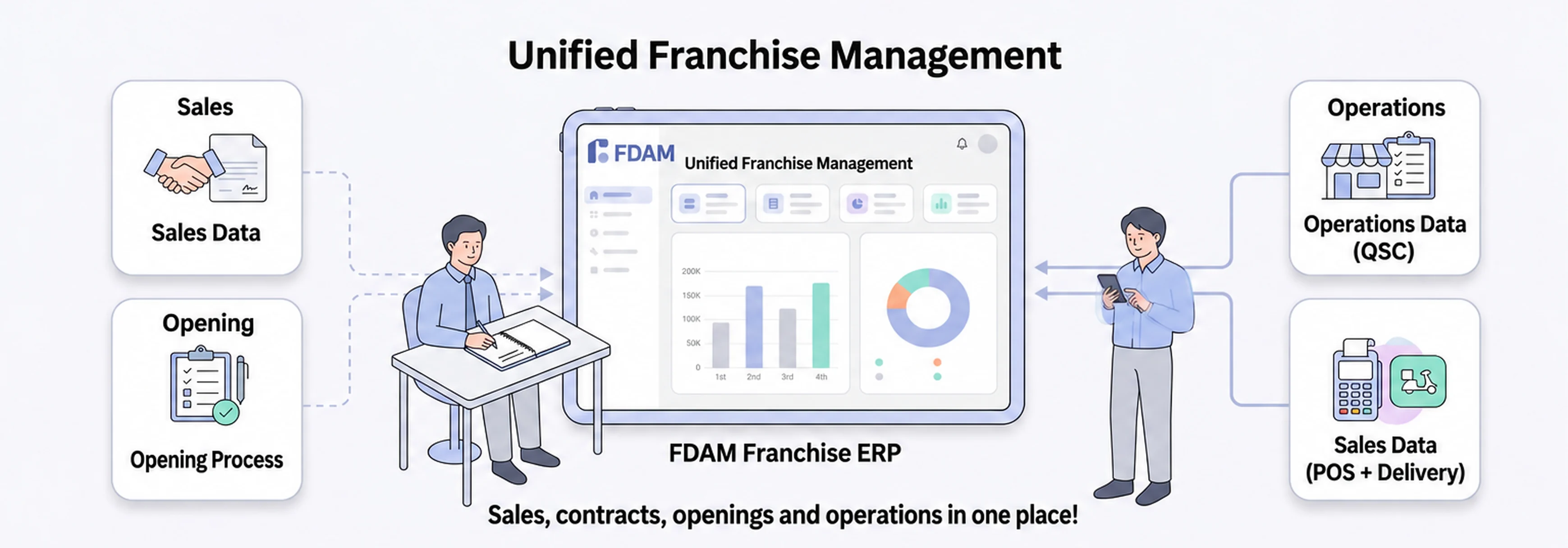
An ERP that connects sales, opening and operations in one line
FDAM is a system that puts franchisor headquarters' entire operating flow, covering sales management, opening management and operations management, into a single ERP. It starts with lead management at the franchise consultation stage and continues through e-contracts, sending and tracking franchise disclosure documents, interior schedules and training, then QSCV inspections, POS sales tallies and store information management after opening. The work HQ handles every day flows as one line.
Compared with having each stage scattered across separate tools, the difference is clear. Consultation history from the sales stage links to progress at the opening stage, and operating data after opening feeds back into HQ's next decisions. This is the first point where franchise ERP parts ways with a simple management program.
Unified sales management: what restaurant franchisor HQs notice first
Of all its features, sales management is the one restaurant franchisor headquarters feel the benefit of fastest. Because POS sales and delivery app sales can be viewed together, there's no need to check each store's trends separately. Here's an example.
If Store A's total sales look fine but its delivery sales are dropping sharply on certain days of the week, HQ can spot that pattern relatively early. If Store B has steady dine-in sales but low ratings, that may explain why its reorder rate is slipping. If Store C has strong Baemin sales but lags on other platforms, it becomes clear which channel's operations need fixing.
None of this is visible from store totals alone. Only when you look at data by store, period and channel together does it become information HQ can use to make decisions. For reference, FDAM's POS sales data is tallied on a next-day basis and organized in a form that can be used directly in HQ meetings and reports.
Where franchise AI actually changes HQ work
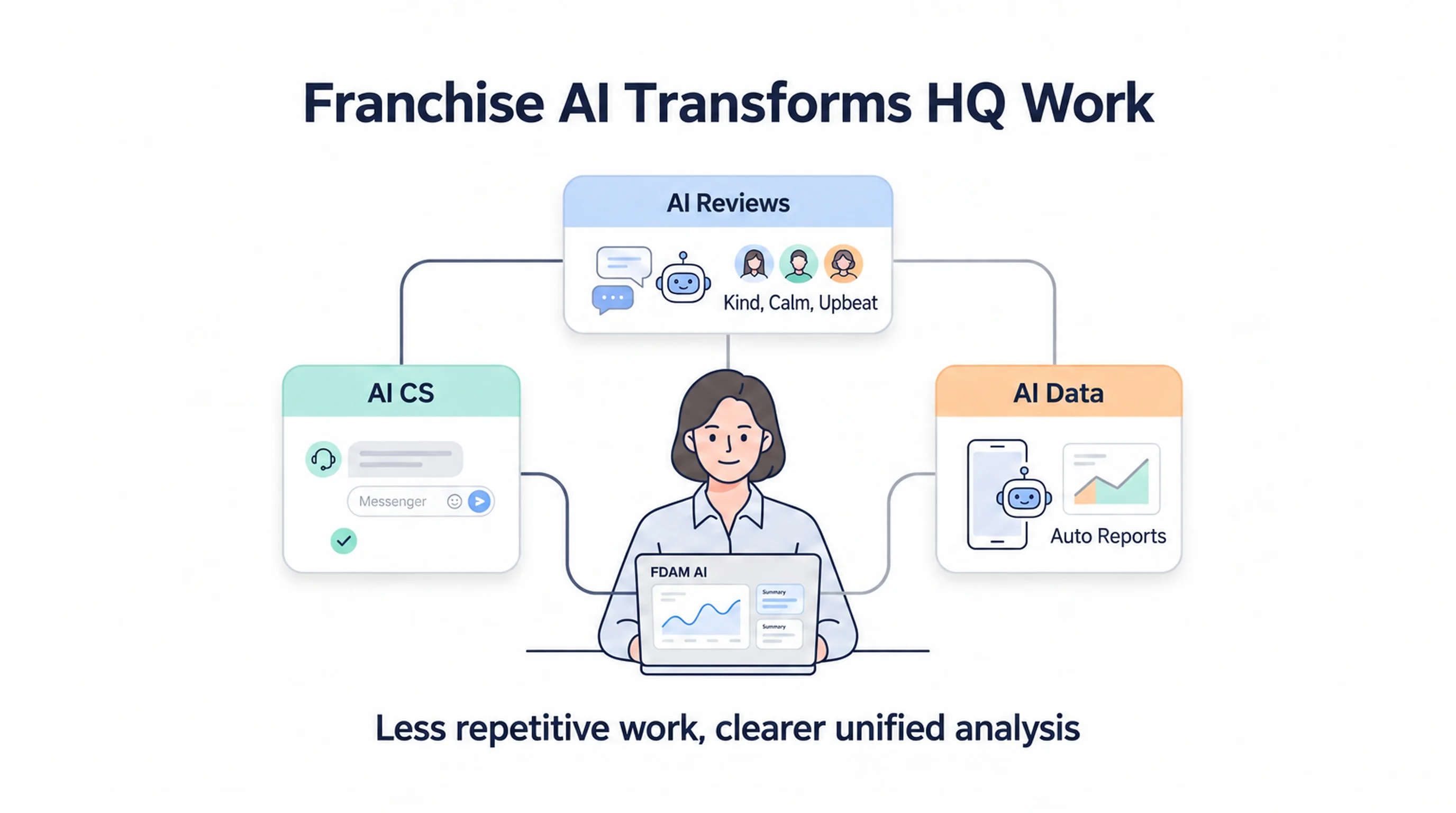
FDAM's franchise AI features reduce HQ staff's repetitive work in three main areas. And all three lead to an operating structure where sales and reviews are viewed together.
AI replies help with repetitive review responses
Reviews matter to HQ as much as delivery sales. Positive reviews call for a natural thank-you, and complaints need a response that is sincere without being emotional. That's manageable for one or two stores, but once it scales to the entire brand, it becomes a serious workload.
FDAM's AI reply feature solves exactly this. It drafts replies based on review content and helps you refine them to match your brand's tone. Friendly, calm or upbeat: set a persona that fits your brand in advance, and replies keep a consistent feel even across different stores.
Responding to reviews isn't just a CS task. If every store responds in a very different way, the brand's image becomes fragmented, and that quickly turns into a trust issue. This is where franchise AI plays its biggest role.
AI drafts CS responses too
The volume of inquiries coming from franchise stores to HQ is substantial too. Questions about operations, settlements, ordering and interiors pile up every day, and often the same question repeats with only the store changing. FDAM's CS AI automatically drafts responses to these store inquiries. Staff just review the draft and tailor it to the store's situation, cutting response time significantly.
Ask the AI assistant about your data and get reports
Preparing data before HQ meetings or executive reports is no small task either. If you have to rebuild Excel files every time to show how each store's sales moved, which regions are underperforming and which menu categories are growing, there's no time left for actual analysis.
FDAM's AI assistant answers questions asked in plain language with reports or charts. Ask something like "Show me last month's delivery sales trend for stores in the Seoul metro area," and you get organized results. The less time HQ staff spend organizing data, the more time they have for decisions and execution.
Don't look at sales and reviews separately
Many headquarters manage sales and reviews on separate screens. In real-world operations, though, the two aren't separate. When you look at reviews for a store whose delivery sales have dropped, you often find recurring issues such as food quality, late deliveries or service complaints. Conversely, a store with good ratings but flat sales may be signaling that it's time to rework its visibility or menu lineup.
Numbers show where a store stands "now," and reviews show the "problems" customers experience. Only by looking at both can HQ clearly decide which stores to support first and which improvements to start.
How to choose a franchise ERP
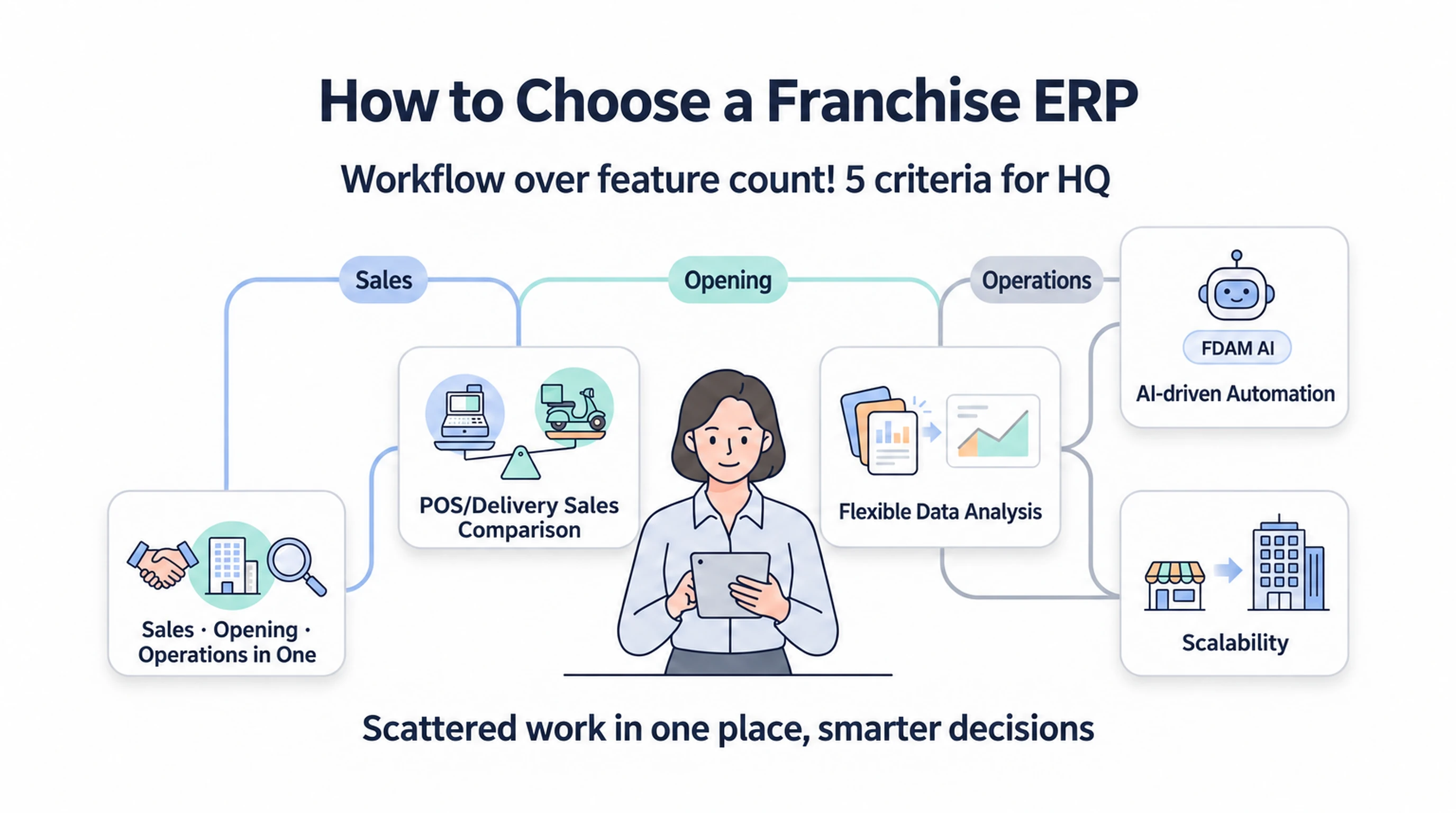
When evaluating a franchise ERP, look at how well it fits HQ's day-to-day workflow rather than how many features it has. Here are five criteria HQ should check, and how franchise ERP differs from general ERP.
Five criteria HQ should check
✓Are the sales, opening and operations stages connected within a single system? Data from the franchise consultation stage needs to flow naturally into the opening and operations stages for HQ staff's manual organizing work to disappear.
✓Can it compare POS and delivery app sales together? Restaurant franchisor headquarters need to compare sales from both channels on one screen to quickly understand each store's trends.
✓Can you freely slice data by store, period and channel? A system that only shows simple totals has limits when it comes to HQ decision-making.
✓Are AI features that reduce repetitive work built into the actual workflow? AI should be naturally integrated into the areas that take up the most of HQ staff's time, such as review responses, CS responses and data analysis.
✓Can it scale with the same structure as the number of stores grows? Systems that seem like a good fit at first often reveal their limits as stores are added. Scalability should be considered from the start.
How franchise ERP differs from general ERP
There's one point worth noting here. General ERP and specialized franchise ERP share the name "ERP," but they cover different areas and are built on different design philosophies.
| Category | General ERP | Franchise ERP |
|---|---|---|
| Focus | Common business functions such as accounting, inventory and HR | Franchise consultations, e-contracts, QSCV, store operations |
| Data flow | Organized by department and function | Connects sales → opening → operations |
| Sales management | Tallied to company-wide accounting standards | Analysis by store, channel and period |
| Fit for HQ work | General-purpose but lacks detail | Optimized for franchisor HQ workflows |
The more know-how accumulated from years of supporting restaurant and food & beverage franchisor headquarters, the bigger the difference in the details. Which documents are needed at which stage, and which data should appear together on which screen: these decisions ultimately shape staff members' days. FDAM is a franchise ERP built on that accumulated field experience.
Frequently asked questions
Q. How is franchise ERP different from general ERP?
While general ERP handles common business functions such as accounting, inventory and HR, franchise ERP is designed around workflows unique to franchisor headquarters, such as franchise consultations, e-contracts, franchise disclosure documents, opening progress, QSCV inspections and store sales tallies. As a result, it fits the work HQ staff handle every day much more precisely.
Q. What kinds of franchisor headquarters is FDAM suited for?
It is especially useful in industries that need to look at sales and review data together, such as restaurants, food & beverage, cafés and bakeries. That said, the sales, opening and operations flow applies across all industries, so headquarters outside the restaurant sector can also consider adopting it.
Q. How far can the franchise AI features be used?
FDAM offers three main AI features: automatic AI replies to delivery app reviews, automated draft responses to store CS inquiries, and an AI assistant that lets you ask about HQ data in plain language and receive reports and charts. All of them focus on reducing HQ staff's repetitive work.
Q. Can POS sales data be viewed in real time?
FDAM's POS sales tallies are provided on a next-day basis. The system is designed so that data organized each day can be reliably used for reporting and decision-making.
Q. How does a sales consultation work?
Contact us at our main number, 1544-7120, or at msb@benter.co.kr, and we'll review your brand's operating structure and store count with you before recommending the right adoption approach. You can also send a quick inquiry through our KakaoTalk channel.
It's time to run HQ operations on data
Running a franchisor headquarters on instinct alone is no longer realistic. Viewing sales, reviews and operating data as one flow, and making fast decisions and moves based on it: that is the next-generation HQ operating model.
MS Benter's FDAMis designed to handle franchise ERP and franchise AI within a single system, built on know-how accumulated over many years of building operating systems for restaurant and food & beverage franchisor headquarters. From sales consultations to sales and review management, start running HQ operations where scattered data connects into one line with FDAM.
Your franchisor HQ's day, in one flow
FDAM consultations are free. We'll review your brand's operating structure with you and recommend a tailored approach.
📞 1544-7120 | ✉️ msb@benter.co.kr
Contact sales Ask on KakaoTalkThis content is provided by MS Benter.