Franchisee Consultation Duties: Why Consultation Records Matter Now
As franchisee consultation duties take shape in Korea, here is how franchisor headquarters should gather store owner input and keep consultation records on major decisions such as price increases, promotion costs, required-item changes and logistics fee adjustments.
FRANCHISE INSIGHT · CONSULTATION HISTORY
Franchisee Consultation Duties:
Consultation Records Now Matter More Than "Partnership" Talk
How franchisor headquarters listen to store owners, collect real responses, review survey results as reports and keep a record of what was done is becoming the benchmark for brand trust.

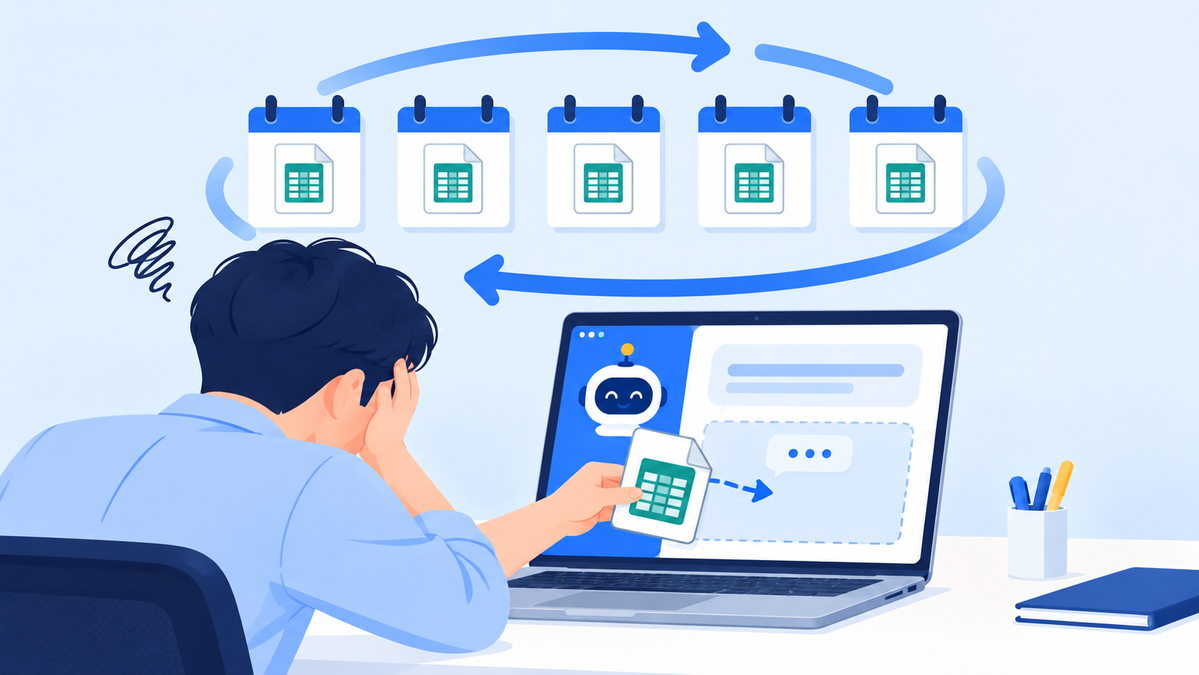
A franchisor headquarters manager reviewing store owner feedback and consultation history on a dashboard
CORE SUMMARY
"We grow together with our store owners" is a familiar line at franchisor headquarters. Going forward, that sentence alone may not be enough. What matters is how HQ actually listens to store owners, what criteria it uses to review their input, and how it records the outcome. On June 9, 2026, the Korea Fair Trade Commission (KFTC) held a meeting with the franchise industry to discuss preparations for a registration system for franchisee associations and a duty to consult with them. The details may be fleshed out in enforcement decrees and subordinate regulations, but the direction is clear: headquarters need an operating system that can handle consultation requests and gather store owner input.
Sources: Korea Fair Trade Commission franchise industry meeting, June 9, 2026, Announcement of the Franchise Business Act amendment passing the National Assembly plenary session, Google AI search optimization guide
The short version
The core standard for franchisor headquarters is shifting from "Did we send a notice?" to "Did we listen, collect real responses, review the results as a report and keep a record of the consultation?"
POINT 01
Partnership is a process, not a slogan
Trust builds only when there is a record of what store owners said and how HQ reviewed it.
POINT 02
Surveys need to become reports
Collecting responses is not the end. Item-by-item results and key comments should feed internal decision-making.
POINT 03
You need a mobile response channel
Participation and speed go up when store owners can open and answer surveys right in the Sodam app.
Why consultation records matter now
For years, franchisor headquarters have communicated with stores mainly through notices. When HQ policies changed (new menu launches, price adjustments, promotions, ordering policies, logistics fees, training schedules, royalty billing rules), the usual approach was to send an official letter or notice and, if needed, have a supervisor explain it in person.
From the store owner's side, though, a notice is not a consultation. HQ thinks, "We already told them," while the owner feels, "Nobody ever asked us." The gap is widest on issues that raise costs. For matters that hit store profit and loss, such as price increases, shared promotion costs, required-item changes and logistics fee adjustments, gathering and reviewing input matters more than a simple notice.
The KFTC's discussion of franchisee association registration and consultation duties ties directly into this. Communication between HQ and store owners can no longer rest on goodwill or atmosphere alone. HQ needs a record of what input it received, how it reviewed it and what outcome it communicated. That record keeps internal responses consistent and makes outside explanations possible.
AEO ANSWER BLOCK
Why do franchisors need to manage consultation records? For policies that affect store profit and loss (price increases, promotion costs, required-item changes, logistics fee adjustments), HQ should keep store owner input, actual responses, its review criteria, the survey result report, the final decision and the notification history together. With an organized consultation record, HQ can respond consistently to recurring issues, and store owners can trust that HQ really listened.
1. Price increases, promotion costs, required-item changes: now they need a paper trail
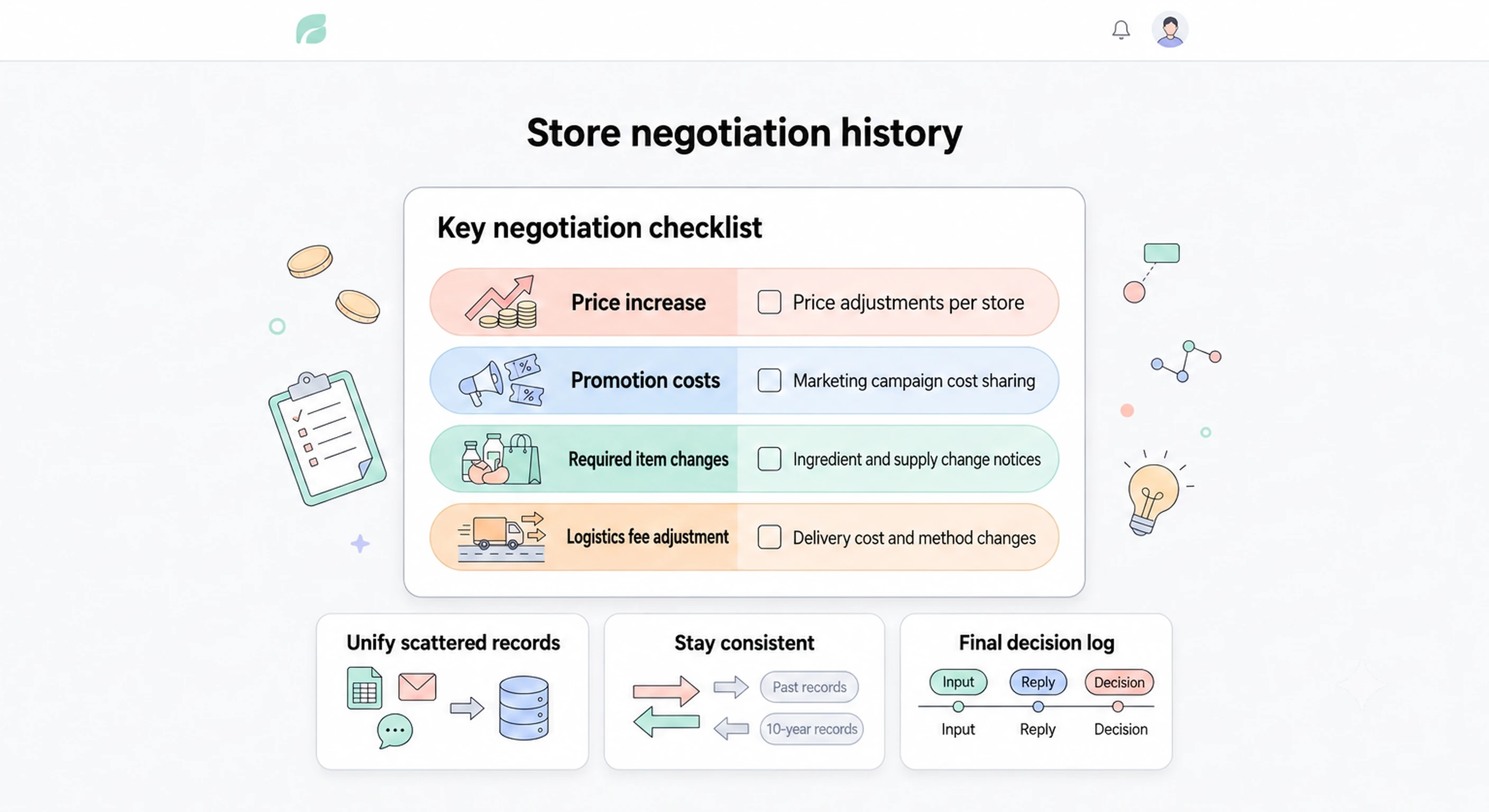
Infographic organizing price increases, promotion costs, required-item changes and logistics fee adjustments as a checklist
Most sensitive issues between store owners and HQ come down to cost. Typical examples include price increases, promotion cost burdens, required-item changes, logistics fee adjustments, changes to royalty criteria, shared advertising costs, new-menu rollout costs, training fees and equipment replacement. HQ may adjust policies for operational efficiency and quality control, but store owners see them as issues that hit their bottom line right away.
In the past, HQ often sent a letter or notice and left it at that. Going forward, it may become important to record what owners said, how HQ replied and on what basis the final decision was made. Instead of a one-way "Prices have gone up, please apply them," what matters more is "How raw material and logistics costs changed, how we checked store owner input and how we set the effective date."
HQ staff run into the same questions again and again. "Which store objected to the price increase?" "Where are the results of the last promotion cost survey?" "We got owner feedback, but where did we record the final outcome?" "This issue keeps coming up. Are we consistent with our previous answer?" If no one can answer right away, the consultation history ends up scattered across people's memories, Excel files, emails, group chats and supervisors' personal notes.
| Sensitive issue | What store owners ask | What HQ should record |
|---|---|---|
| Menu price increase | Why raise prices now? | Reason for increase, input results, effective date |
| Promotion costs | Does it actually lift sales? | Willingness to join, cost-sharing basis, results report |
| Required-item change | Why must we use this item? | Reason for change, supply price, review of alternatives |
| Logistics fee adjustment | Why did our region's costs go up? | Regional criteria, before/after amounts, notification history |
| Royalty criteria | Is the calculation basis clear? | Billing criteria, rationale for changes, owner notifications |
2. Gathering store owner input is an operating process, not a one-off event
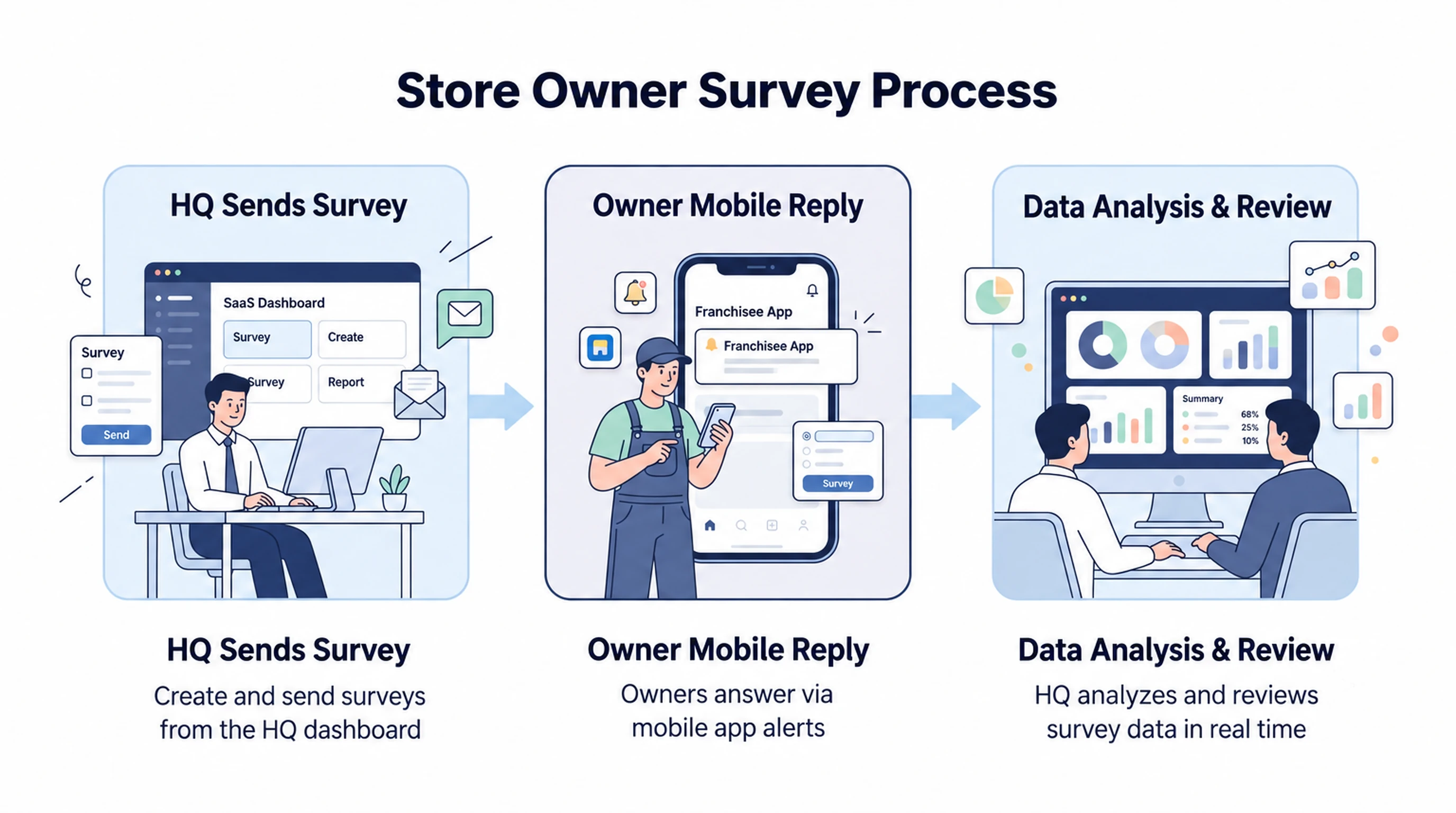
Process image showing HQ sending a survey and store owners responding in a mobile app
Gathering store owner input is not about running a survey once. It is recurring management work that comes up every time an HQ policy changes. Asking owners for feedback before a new menu launch, confirming whether they will join a promotion, gauging the burden on stores before a price adjustment and collecting opinions on a required-item change all fall into this category.
The key point is that it does not end with receiving input. HQ needs to check the response rate, key comments, reasons for objection, improvement requests and whether anything was ultimately adopted. Only then do store owners feel that HQ actually listened. If owners respond and never hear about the outcome, they have no reason to take the next survey.
Partnership is built through process, not slogans. There has to be a channel where owners can speak up, a step where HQ reviews their input, and a loop where HQ communicates the final decision and its rationale, again and again. And that process has to live in data, not in someone's memory.
Store owner input as an operating process
· Advance notice: explain what is changing and why, in terms owners can understand
· Mobile responses: owners open the survey in the Sodam app and actually respond
· Results report: check response rate, key comments, reasons for objection and non-responders
· Outcome notice: clearly communicate the final decision, what was adopted, the effective date and follow-up actions
3. Consultation data HQ must keep
Managing consultation history is not just storing survey result files. You need to connect when a policy was proposed, who was notified, which owners said what, how HQ reviewed it and how the final outcome was communicated. Only connected data lets you respond consistently when the same issue comes up again.
Say you ran a survey on a logistics fee adjustment. If all you have is "65% in favor, 35% against," it is hard to use in practice. You also need to know which regions objected most, whether the objection was about cost or delivery delays, what remedies HQ considered and how the final effective date was adjusted.
| No. | Item | What to record |
|---|---|---|
| 01 | Agenda info | Agenda name, purpose, background, related cost items, planned effective date |
| 02 | Target stores | All stores, specific brand, specific region, stores using a specific item |
| 03 | Response channel | Sodam app, survey link, in-person visit, phone, email reply |
| 04 | Response status | Response rate, non-responding stores, for/against ratio, regional reactions |
| 05 | Results report | Item-by-item results, key comments, reasons for objection, internal summary |
| 06 | HQ review | Reviewing team, review criteria, feasibility, alternatives considered |
| 07 | Final decision | Go/no-go, effective date, before/after details, exception criteria |
| 08 | Outcome notice | Notice date, channel, read confirmation, follow-up inquiries |
Risks HQ often overlooks
· Survey responses were collected, but there is no results report or record of the final outcome
· Owner objections are scattered across group chats, emails and call logs, making them hard to find later
· Different staff gave different answers on the same issue
· Regions or stores with many objections were not tracked separately
4. Consultation records keep HQ consistent internally
Consultation records are not only for dealing with outside parties. They also keep HQ's own operations consistent. Operations, logistics, purchasing, marketing, training, supervisors and executives all move together at a franchisor. A single policy change touches several teams, so without a record, each one may read the same issue differently.
For example, after a survey on promotion participation, marketing might report "high participation," supervisors might sense "lots of complaints in the field," and operations might decide "non-participating stores need an exception." If the survey responses, results report, key comments, final decision and exception criteria are all in one place, these differences in interpretation shrink.
A record also keeps response quality steady when staff change. One of the biggest risks in franchise operations is losing context when someone leaves. A new manager who doesn't know what feedback came up before or how it was answered may repeat the same mistakes. Consultation records turn individual memory into an HQ asset.
5. Structure store owner input with FDAM Survey Management
FDAM SURVEY REPORT
Topic · Response rate · Key comments · Report
Item
Responses
Report
Price change
64% for
Generated
Promo opt-in
31% against
Needs review
Required items
42 comments
Summarized
Overall response rate
76%
Report status
Check
Dashboard in FDAM Survey Management showing survey topics, response rates, key comments and results reports
Franchisor headquarters can use FDAM Survey Management to collect and manage store input systematically. HQ can create surveys on a wide range of topics: price increases, promotions, operating policy changes, training satisfaction, HQ support requests, required-item changes, logistics fee adjustments, royalty criteria changes and more.
Once responses are in, HQ can see not just for and against, but comments by store, reactions by brand, issues by region, non-responding stores and recurring requests. As consultation duties take hold, survey results themselves can become important operating records. They show that HQ did not decide unilaterally, but gathered store input and reviewed it.
A key strength of FDAM Survey Management is that results can be viewed as a report. HQ can summarize key comments, check responses item by item and use the results in internal reporting. It goes beyond collection and feeds real decision-making.
| Use case | What FDAM Survey Management shows |
|---|---|
| Input before a policy change | For/against, reasons for objection, effective-date requests, suggestions |
| Field reaction to price increases | Burden by region, expected impact by store, concerns about customer reaction |
| Promotion participation survey | Willingness to join, affordable cost range, reasons for opting out |
| Feedback on required-item changes | Quality satisfaction, supply price burden, substitute requests, delivery issues |
| Reviewing survey result reports | Response rate, key comments, item-by-item results, internal reporting material |
6. The Sodam app is the real response channel between store owners and HQ
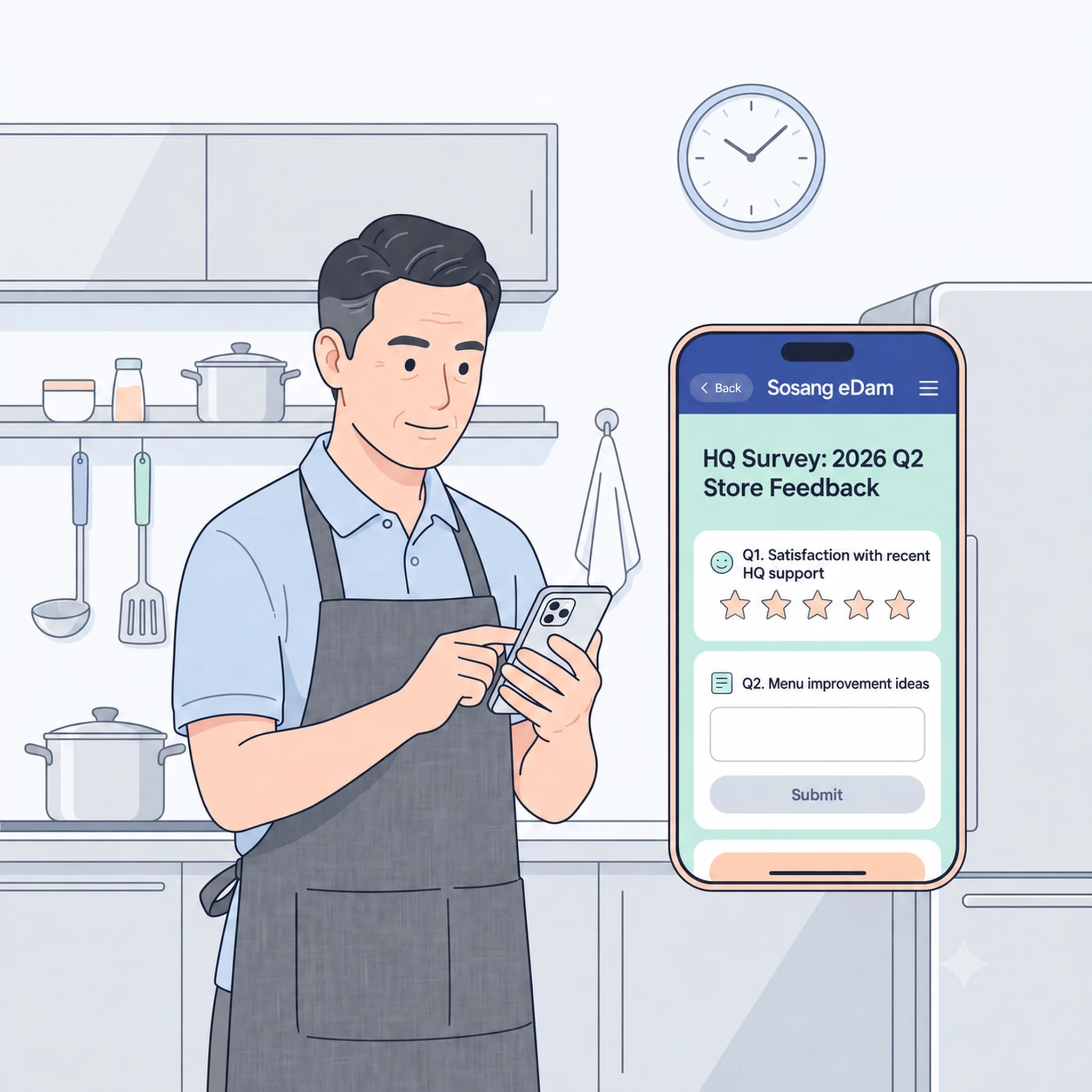
Illustration of a mobile screen where a store owner reviews and answers an HQ survey in the Sodam app
For store owners, accessibility matters most. No matter how good the survey, participation drops if it is hard to find or tedious to answer. Owners running a store would much rather check and respond on their phone than open a separate document or log in on a PC.
The Sodam app gives owners a mobile channel to see HQ notices and requests and actually answer surveys. When HQ builds surveys in FDAM and owners respond directly in the Sodam app, gathering input becomes far more natural.
In other words, HQ designs surveys in FDAM and reviews results as reports, while store owners respond easily in the Sodam app. Once this flow is in place, gathering owner input stops being manual work for staff and becomes a structured HQ operating process.
FDAM + Sodam app workflow
· HQ: create survey topics and questions in FDAM
· Store owner: open the HQ survey in the Sodam app and respond
· HQ: check response rate, key comments and non-responders in FDAM
· HQ: run internal review and communicate outcomes based on the survey results report
7. Excel and group chats can't manage consultation history
Many franchisors start out managing owner input with Excel and group chats. With only a few stores, it is quick and convenient. But as the network grows and issues recur, the limits become obvious. It gets hard to tell which survey is the latest, which stores responded, what the main reasons for objection were and whether the final outcome was communicated.
Group chats are great for instant communication but poor for record-keeping. As messages pile up, important comments get buried, and it is hard to organize who said what. Phone calls and store visits are essential for understanding field context, but if they aren't recorded, HQ can't share them internally.
A consultation history should not be "material that's somewhere." It should be "data you can pull up and explain the moment you need it." Stores, agenda items, respondents, comments, status, results reports and final notices need to be linked so HQ staff can answer the same question by the same standard.
Common problems with manual management
· Survey result files exist, but final outcomes are tracked separately
· Owner objections stay in the group chat and never reach internal reports
· Staff have to check non-responding stores by hand
· It's hard to find what was said during previous policy changes
· When staff change, the consultation context and owner requests disappear with them
8. HQ's edge comes from consultation data, not partnership slogans
FROM SLOGAN TO DATA
BEFORE
Slogan-driven
There's a pledge to "grow together with store owners," but input gathering and follow-up are scattered
→
AFTER
Data-driven
Mobile responses, survey result reports, review outcomes and final notices managed to HQ standards
Comparison infographic showing the shift from slogan-driven to consultation data-driven management
To build trust with store owners going forward, abstract partnership messages won't be enough. What matters is what input HQ received, what criteria it used to review it and what outcome it communicated. Store owners don't reflexively oppose every HQ decision; they want to see that their input was actually considered.
Using FDAM Survey Management together with the Sodam app brings everything from gathering owner input to mobile responses and results reports into a single flow. HQ sees response rates and key comments by survey topic, and owners share their views easily on mobile. HQ then records the final decision and notifications, giving it a reference point when the same issue comes up again.
Franchisee consultation duties shouldn't be seen only as a burden on HQ. They can be a chance to raise the level of operations and build trust with store owners through data. A franchisor with a consultation history can respond more calmly when conflicts arise, because the conversation rests on records, not emotions.
9. A 30-day plan to build a consultation record system
You don't need a perfect system from day one. What matters is standardizing the issues that come up repeatedly. Start by prioritizing agenda items tied directly to cost (price increases, promotion costs, required-item changes, logistics fee adjustments) and lock in the flow from gathering input to communicating outcomes.
1
Week 1: Classify consultation agenda items
Classify items that affect store profit and loss: price increases, promotion costs, required items, logistics fees, royalties, training, new menus and so on.
2
Week 2: Build standard survey templates
Create standard surveys covering for/against, reasons for objection, cost burden, effective-date requests, suggestions and additional questions.
3
Week 3: Set rules for mobile responses and non-responders
Define the Sodam app response flow, overall and regional response rates, reminder rules for non-responding stores and deadlines.
4
Week 4: Roll out results reports and record retention
Organize survey result reports, final decisions, what was adopted, effective dates and follow-up channels, and keep the consultation history by agenda item.
10. Consultation record checklist for franchisor headquarters
Use this checklist to gauge how systematically your headquarters currently gathers store owner input and manages consultation history. What matters is not whether you have run surveys before, but whether owner responses, results reports and outcomes are linked at the store level.
| No. | Checkpoint | Evidence |
|---|---|---|
| 01 | Do you separately classify major agenda items that affect store profit and loss? | Agenda classification sheet, list of policy changes |
| 02 | Is there a standard procedure for gathering owner input before policy changes? | Survey templates, distribution rules |
| 03 | Can store owners actually answer surveys in the Sodam app? | Mobile response screen, response logs |
| 04 | Can you see response status by store and identify non-responders? | Response rate dashboard, non-responder list |
| 05 | Do you review survey results as a report and use them internally? | Survey results report |
| 06 | Do you record HQ review criteria and the reasons for final decisions? | Internal review notes, approval history |
| 07 | After a decision, do you notify owners of the outcome and effective date? | Outcome notice, app alerts, read confirmations |
| 08 | Can you search past consultations to respond consistently to the same issue? | History by agenda item, handling logs by staff |
Consultation records are about operating maturity, not just legal risk
If you treat franchisee consultation duties purely as a legal team matter, you may respond too late. Consultation history is data that operations, marketing, logistics and supervisors create every day. Price increase notices, promotion surveys, feedback on required-item changes, logistics fee inquiries, training satisfaction surveys and HQ support requests all feed into it.
The point is not to wait and see "how far the law requires us to go." It is more important to manage how systematically HQ communicates with store owners, whether it can respond consistently to the same issue and how owner input shapes HQ decisions.
Partnership now has to be proven with data and records, not just words. If a franchisor can collect owner input, get real responses, review survey results as reports and keep the consultation process as data, regulatory change becomes a chance to sharpen its operating edge rather than a burden.
Frequently asked questions
Q. Is managing consultation history really necessary?
A. For matters that affect store owners, such as price increases, promotion costs and required-item changes, the process of gathering input and following up may become increasingly important. HQ also needs a record to respond consistently internally. Rather than simply keeping notices, it is safer to link owner input, actual responses, HQ review, final outcomes and notification history.
Q. How should we prepare for franchisee consultation duties?
A. Detailed requirements and procedures may be specified in enforcement decrees and other subordinate regulations. From an HQ operations standpoint, though, it is important to classify agenda items that could trigger consultation requests and to standardize how you gather owner input, your mobile response channel, internal review criteria, results reports and outcome notifications.
Q. When can we use FDAM Survey Management?
A. Use it to gather input before policy changes, survey promotion participation, gauge reactions to price adjustments, measure training satisfaction, compile owner requests, collect feedback on required-item changes and check field opinions on logistics fee adjustments. You can also review survey results as reports and use them in internal reporting.
Q. What can store owners actually do in the Sodam app?
A. Store owners can open surveys sent by HQ in the Sodam app and respond directly. That makes communication between HQ and stores faster and easier. HQ builds surveys in FDAM, and owners respond in the Sodam app.
Q. Why do survey result reports matter?
A. Collecting responses isn't enough. HQ needs to see key comments, response rates, reasons for objection and item-by-item results in report form to use them in internal review and decisions. A results report is an important operating record showing that HQ gathered input and reviewed it.
Q. Can't we just take feedback through group chats or phone calls?
A. They help with quick communication but fall short for consultation records, because it is hard to search and report who said what, how HQ reviewed it and how the final outcome was communicated. For important agenda items, it is best to use a dedicated survey and record-keeping system.
Q. How can we raise survey response rates?
A. Explain the survey's purpose clearly, make it quick to answer on mobile, and share the response deadline and when results will be announced. Above all, tell owners what HQ decided after the survey; that is what motivates them to take part next time.
Q. Which team should own consultation history?
A. It can't be the legal team's job alone. Consultation history is data created jointly by operations, supervisors, marketing, logistics and purchasing. HQ should assign a lead team for each agenda item, but manage store-level responses and outcomes together in one system.
FRANCHISE COMMUNICATION · FDAM + SODAM
Is your store owners' feedback
disappearing after the notice goes out?
Consulting with store owners can no longer be managed with simple notices or phone calls.
Input gathering, actual responses, results reports, review outcomes and final notices need to live as data.
If you want to collect owner input, get real responses, review results as reports and keep the consultation process as data, try FDAM Survey Management and the Sodam app.
Contact salesExplore FDAM Chat on KakaoTalk
※ This content is general information written from the perspective of franchisor headquarters operations. Specific legal judgments may vary depending on the individual case and the final enforcement decrees, notices and contract structure.
franchisee consultation duty, franchisee association registration, franchisor headquarters, consultation history management, store owner feedback, FDAM Survey Management, Sodam app, survey results report, mobile survey responses, franchise ERP, store owner survey, franchise partnership, price increase consultation, promotion cost consultation, required-item changes, logistics fee adjustment, royalty criteria, franchise store management solution, franchise operations, supervisor, HQ notice management, franchise store communication