Franchise Royalties: Types, Calculation Methods and Typical Rates
If calculating store royalties is a burden, start with the calculation methods. We cover franchise royalty types, typical rates by industry, and how to automate CMS collection and reporting for free.
As the number of franchise stores grows, one of the most labor-intensive tasks at headquarters is managing franchise royalties . Every store has different contract terms, sales change every month, and HQ also has to handle billing and collection. Calculating by hand when every store follows a different standard takes a long time and raises the risk of errors and disputes.
This post covers franchise royalties as of 2026: what they are, how each type is calculated, actual rates by industry, the problems HQ runs into in practice, and how automation solves them. At the end, we also introduce FDAM Royalty, which automates royalty calculation, billing and collection for free.
KEY SUMMARY
· Franchise royalty = an ongoing franchise fee a store pays HQ every month
· Calculation methods: flat fee, percentage, built into supply prices, or hybrid
· Food service typically charges 2–4% of monthly sales; services tend to be higher
· FDAM Royalty automates calculation, billing, collection and reporting for free
What is a franchise royalty?
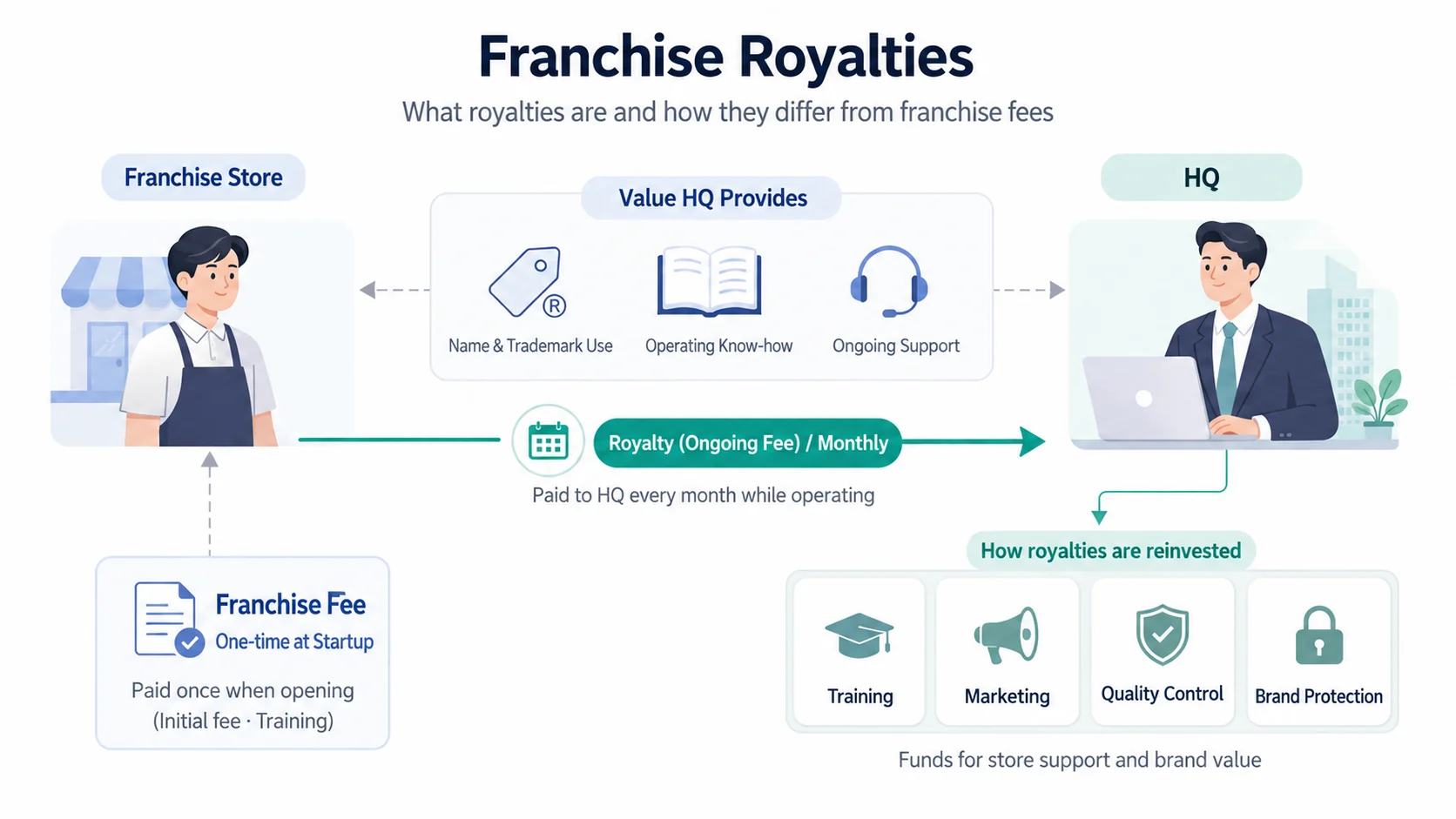
A franchise royalty is an ongoing franchise fee a store pays headquarters every month in exchange for using the brand's name and trademarks and receiving operating know-how and continuous support. Unlike the franchise fee paid once at startup (initial franchise fee, training fee), the key difference is that royalties are incurred every month for as long as the store operates.
For headquarters, royalties are not just a source of income; they also fund reinvestment in store training, marketing, quality control and brand protection. That is why how royalties are set and managed directly affects the competitiveness of the entire franchise system.
Franchise royalty types and calculation methods
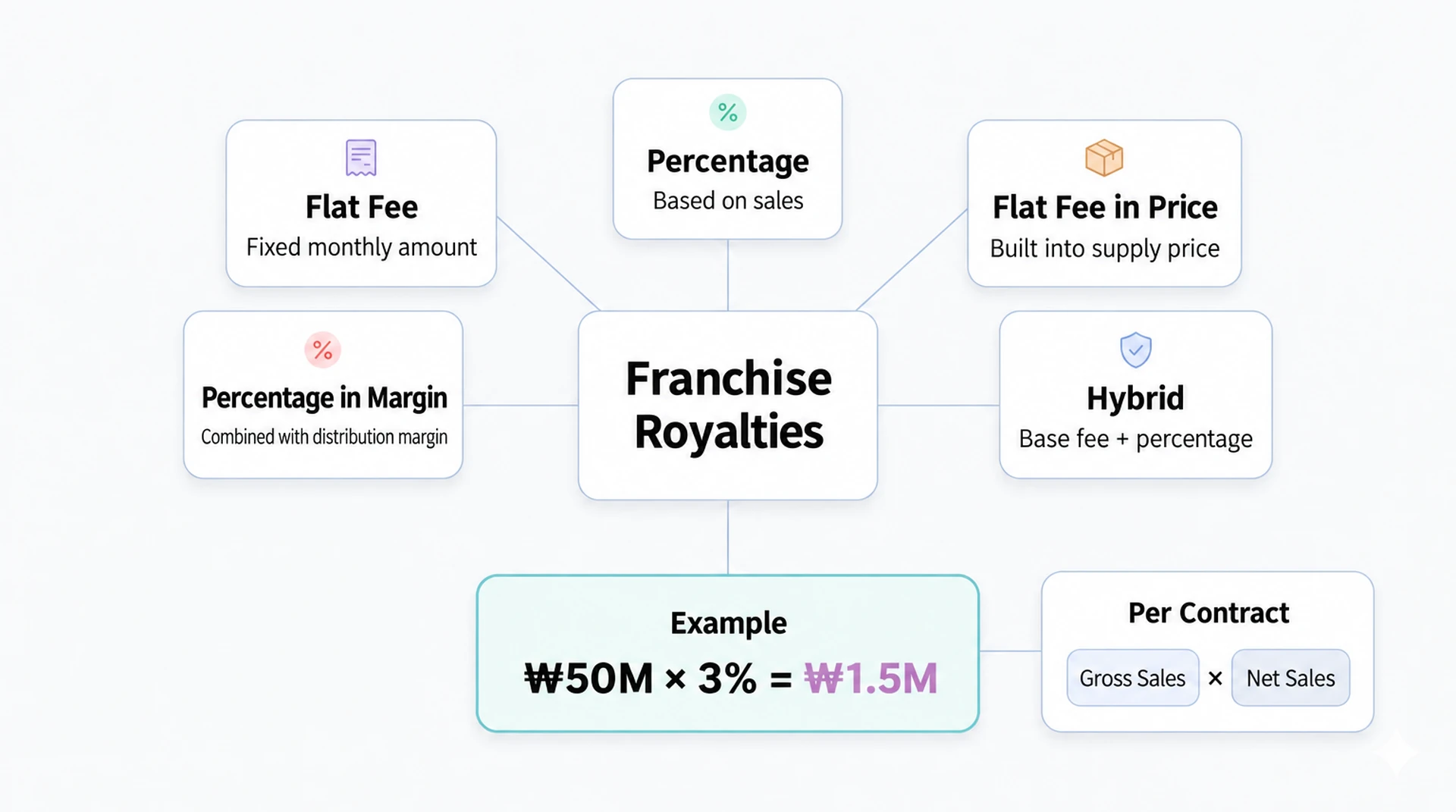
Royalties fall broadly into flat-fee and percentage models, with variations that fold the royalty into supply prices or mix the two. Every headquarters sets its own terms, but knowing the five types below will help you understand most contract structures.
1
Flat fee
HQ receives a fixed amount every month regardless of sales (e.g., KRW 0.5 million per month). Income is stable and calculation is simple, but HQ has relatively less incentive to help stores grow sales.
2
Percentage
HQ receives a fixed percentage of sales (e.g., 3% of monthly sales). Because HQ and store earnings move together, this model is well suited to building a win-win structure. Note, however, that the amount changes depending on whether gross or net sales are used as the base.
3
Flat fee built into supply prices
A fixed amount is included in the price of supplies and similar items. This reduces separate billing steps, but because the royalty is tied to supply prices, the cost structure is less visible to stores.
4
Percentage built into supply prices
A sales-proportional rate is included in the price of supplies and similar items. Combining distribution margin and royalty, this model links the royalty to sales while also leveraging the supply structure.
5
Hybrid percentage
A base flat fee plus a sales-proportional rate (e.g., KRW 0.3 million + 1% of sales). Headquarters adopt this to balance the stability of a flat fee with the sales linkage of a percentage model.
Percentage calculation example — If monthly sales are KRW 50 million and the royalty rate is 3%, that month's royalty is KRW 50 million × 3% = KRW 1.5 million. Because the amount differs depending on whether sales means gross sales or net sales (excluding returns and discounts), clearly stating the base in the contract is key to preventing disputes.
What are typical franchise royalty rates by industry?
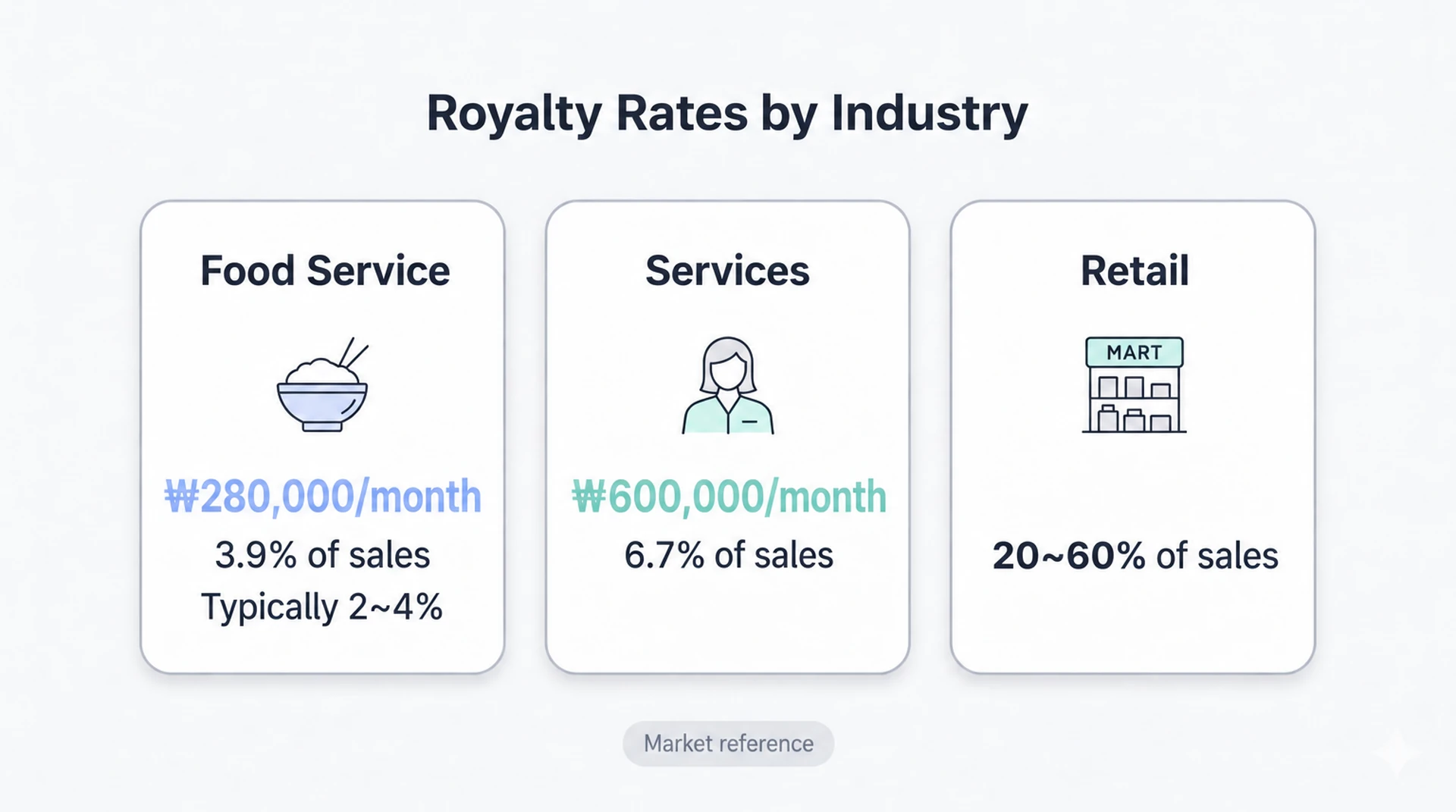
The question you are probably most curious about is "What percentage do businesses in our industry usually charge?" Published research and Korea Fair Trade Commission registration data provide a rough benchmark.
1
Food service
Among brands with 100 or more stores, about half charge royalties. Surveys have found flat-fee royalties average about KRW 280,000 per month and percentage royalties about 3.9% of monthly sales. In general, many brands charge 2–4% of monthly sales.
2
Services
Flat-fee royalties average about KRW 0.6 million per month and percentage royalties about 6.7% of monthly sales, higher than in food service.
3
Retail, such as convenience stores and marts
Some charge on a sliding scale of 20–60% of sales, depending on the store's investment size.
A Korea Development Institute (KDI) study found that about 68% of Korean franchises charge royalties on average, but pure percentage royalties, where HQ and store profits move together, account for only around 25%. The same study found that when the percentage rate rises by 1 percentage point, store sales tend to increase by about KRW 4.4 million, showing that the percentage model pushes HQ to work harder on growing store sales. That said, figures vary widely by industry and brand, so treat them as a rough sense of the market, not an absolute standard.
How should royalty receipts be handled?
When HQ receives royalties in cash, it must issue a tax invoice or cash receipt. With that documentation, the store can claim the royalty as a VAT input. When paid by card, no separate documentation needs to be issued. Keep in mind that as the number of stores grows, this documentation and settlement work grows with it.
The real problems HQ faces in calculating and billing royalties
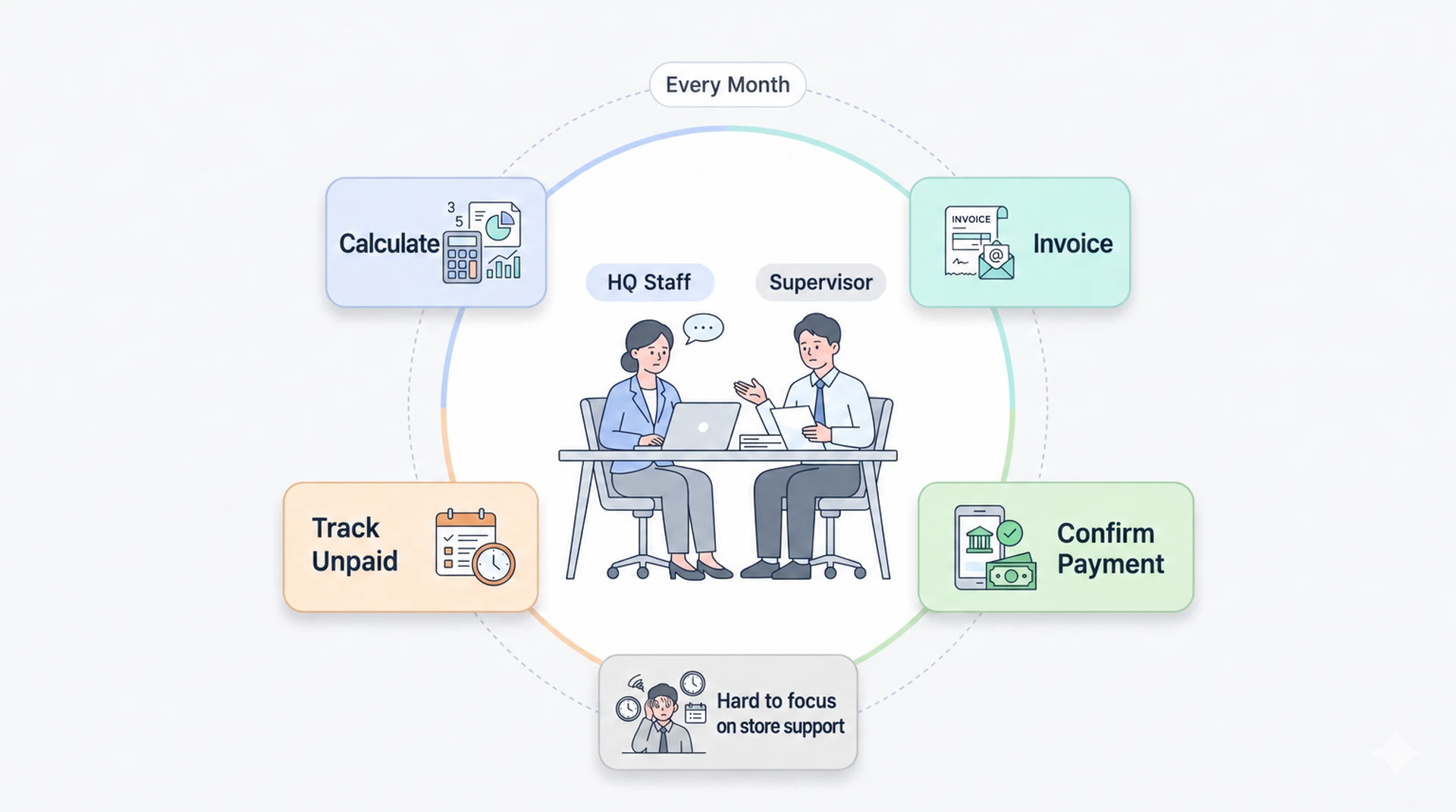
Those are the standards; in the field, what HQ actually wrestles with is operations. Here are the difficulties that come up most often in practice.
1
Every store has a different standard
Flat fee, percentage, built-in and hybrid models get mixed, and as policies change, standards diverge: a store opened a year ago pays a flat fee while one opened a month ago pays 3% of sales.
2
Manual calculation has limits
As the store count grows, so do the volume of calculations and the chance of errors.
3
Billing and collection are tedious
Sending invoices, confirming payments and managing receivables repeat every month.
4
There is a risk of disputes
If the gross vs. net sales base is unclear or the handling of returns and discounts is not settled, calculations change from month to month, which can easily lead to disputes with stores.
While supervisors and HQ staff spend time on this repetitive work, it becomes hard to focus on what really matters: managing stores. Work like this is faster and more accurate when handled by a system rather than by people one item at a time.
Automating franchise royalty management with FDAM Royalty
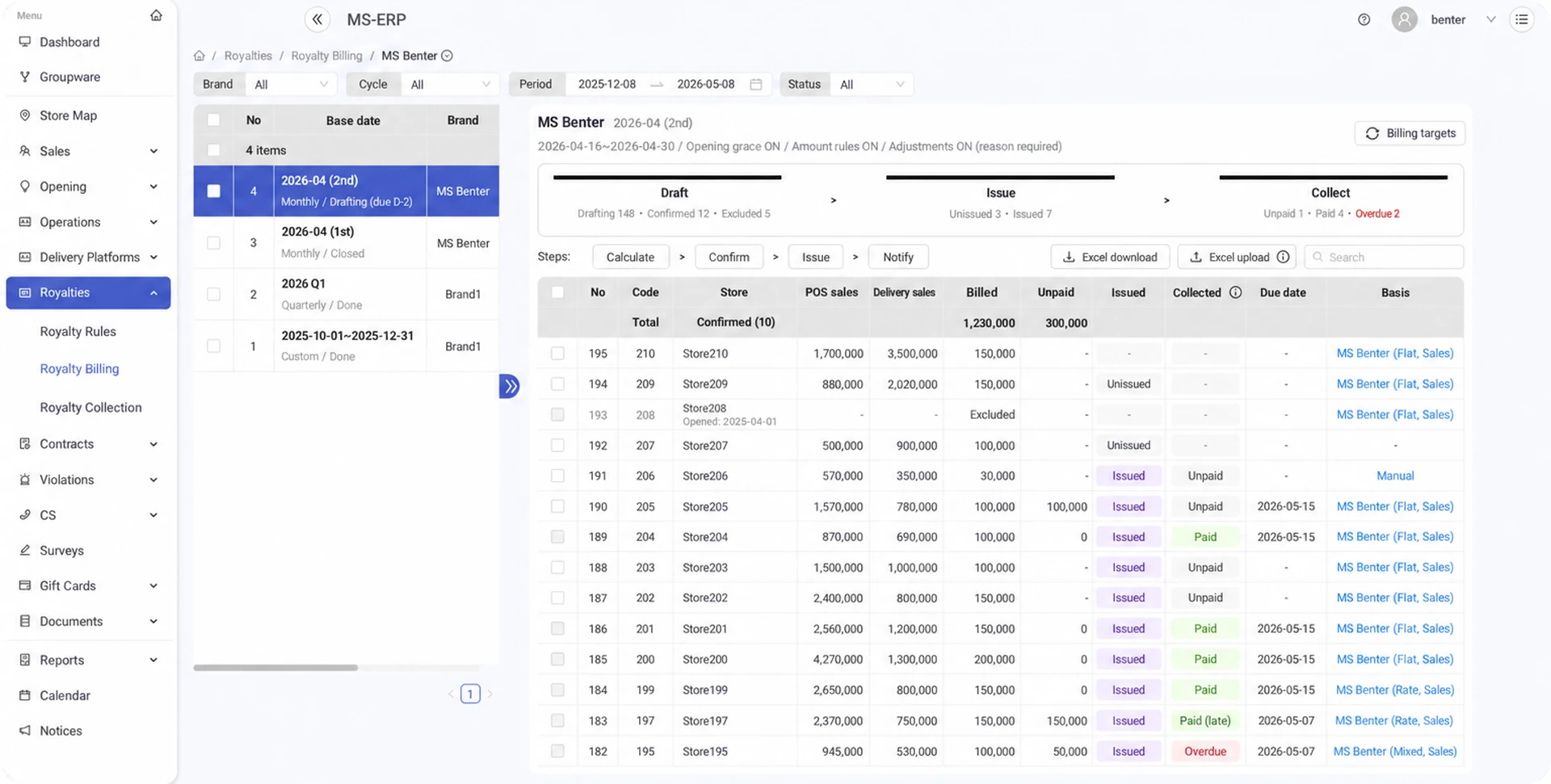
FDAM Royaltyis a feature that automatically manages the entire process for each store: royalty calculation → billing → collection → reporting. MS Benter, which has grown alongside the franchise industry for 25 years,has built the HQ know-how it accumulated in the field into the system.
1
Automatic calculation per store
Whatever the standard (flat fee, percentage, built-in or hybrid), set it up per store and it is calculated automatically each month. Even if standards differ by store or change midway, they are applied separately at the store level.
2
Automatic billing
Calculated royalties are billed to stores automatically, so there is no need to create invoices one by one each month.
3
Collection via CMS auto-debit
Royalties are collected on set dates via CMS auto-debit, easing the burden of confirming payments and managing receivables.
4
Automatic reporting
Collection results are compiled automatically so HQ can see them at a glance.
Cost structure
No usage or service fees, plus the lowest transfer fees
Many solutions charge usage fees, service fees and transfer fees, while FDAM Royalty charges no usage or service fees, only low-cost transfer fees. The royalty management feature itself is free to use, so you can keep operating without added management costs as your store count grows.
Frequently asked questions (FAQ)
Q. Are franchise royalties different from franchise fees?
Yes. The franchise fee is paid once at startup, while royalties are an ongoing franchise fee incurred every month during operation.
Q. Which is better, a flat fee or a percentage model?
There is no single right answer. A flat fee offers stable income and simple calculation, while a percentage model ties HQ and store earnings together, making it well suited to a win-win structure. Choose by weighing your industry, sales volatility and settlement transparency.
Q. Our stores each have different royalty terms. Can they be managed automatically?
Yes. Set up each store's fee standard individually and monthly calculation, billing and collection are handled all at once. Even if standards change, they are applied separately per store.
Q. Does automating royalty calculation cost a lot?
It depends on the solution. FDAM Royalty charges no usage or service fees, only low-cost transfer fees, so the management features are free to use.
FREE
Manage store royalties:
start free with FDAM Royalty
As your store count grows, royalty calculation, billing and collection get more complex. FDAM Royalty automates everything in one flow, from per-store calculation to CMS auto-debit collection and reporting. With no usage or service fees, see for yourself what it can change at your headquarters.
Sign up for FDAM Royalty free Quick question on KakaoTalk Main line 1544-7120 (Korea)franchise royalties, store royalties, royalty calculation, percentage royalty, flat-fee royalty, royalty automation, CMS auto-debit, franchisor headquarters, FDAM Royalty, FDAM