Franchise Review Management: Unifying Delivery App and Place Reviews
Here's how to view store reviews in one place and manage replies, too.

Reviews are scattered across channels. Where should headquarters start?
CORE SUMMARY
✔ Franchise review management is how headquarters standardizes the criteria and tone stores use to respond to delivery app and Place reviews.
✔ As channels multiply and store counts grow, reviews become hard to manage by checking them one by one.
✔ Setting up unified viewing first improves both response speed and quality gaps between stores.
✔ Once reviews accumulate as reports, they can be tied to other operating metrics such as QSCV inspections.
Store review management is the set of operating activities in which headquarters views, responds to, and records customer reviews scattered across delivery apps, Naver Place (Korea's Google Maps-style local listings), and other channels, following criteria and a tone HQ defines. As franchise ERPs cover a broader range of work, review management has recently been moving inside HQ systems too.
The reason reviews are becoming HQ work is simple. Reviews are the first thing consumers see before visiting a store, and how those reviews are answered ultimately reads as the brand's attitude. The problem is that reviews aren't collected in one place.
This article covers why review management goes beyond individual stores to become HQ work, and in what order HQ should approach organizing scattered reviews.
Store review management: definition and background
Store review management isn't about managing a particular store's rating. It's about getting the whole brand to respond with a consistent attitude. Using this definition as the yardstick makes it clear where HQ needs to step in.
In the past, review responses were often left entirely to each store's discretion, because they were treated as each store's own way of communicating. But a franchise brand is built on the premise of growing to many stores. As stores multiply, so do differences in how they respond, and consumers see those differences as a brand consistency problem.
The point at which review management shifts to HQ usually shows up as three signals.
If you see these signals, it's time for HQ to step in
- Reply tone and speed vary noticeably from store to store within the same brand
- Responses to low-rated reviews are left entirely to stores, so HQ learns of situations only after the fact
- Complaints recur in reviews, yet HQ has no accumulated data on them
If even one of these applies, reviews have already outgrown the individual store level. Rather than responding on stores' behalf, HQ should step in to set response criteria and tone and to check that those criteria are followed in the field.
This happens especially often once a brand grows past a certain size. The more stores are spread across different trade areas and the more staff are involved, the harder it is for HQ to notice differences in how stores respond. If HQ only looks at reviews "when something goes wrong," that's a sign it has already settled into a reactive structure. Conversely, if there's a routine of checking review trends regularly before problems arise, the brand has already moved to an HQ-led management system.
What teams often miss when setting review response criteria isn't "who writes the reply" but "what the judgment is based on." For example, the criteria should cover how many hours HQ has to check 1–2 star negative reviews, what process to follow to report or respond to reviews containing profanity or false claims, and how far ambiguous, question-style reviews should be handled in a reply versus routed to a separate channel. If these criteria aren't documented, the standard for judgment shifts every time the person in charge changes.

Same brand, different responses. Consumers read this as a brand problem, not a store problem
3 structural reasons review management is hard
HQ staff don't fall behind on reviews for lack of interest but because of structural limits. Understanding these structures lets you get the order of solutions right.
1
Channel fragmentation.
Major delivery apps alone, such as Baemin, Coupang Eats, and Yogiyo, mean three places to check, and adding Naver Place pushes the number of screens staff must visit daily past four. If a store is listed on several delivery apps at once, that number multiplies again per store. Each channel has its own login and screen layout, so even checking a single store means switching between multiple screens.
2
Workload that scales with store count.
For example, with 10 stores and just 5 minutes a day per store spent checking reviews, that's 50 minutes a day. At 50 stores, the same approach can hardly be finished within a day. Realistically, it's hard to grow management staff in step with store growth, so check cycles get longer and reviews that miss the response window pile up.
3
Nothing gets recorded.
Say a store gets the same kind of complaint, "delivery is slow," all month long. If staff only checked each one as it came in, the pattern easily slips by without being recorded. Even if staff check reviews every day, unless the results accumulate as data, they can't inform the next decision.
Of the three, the one with the biggest practical impact is the third: the lack of records. Even with fragmented channels, checking somehow gets done, but if the results aren't kept, reviews remain a one-off task judged by gut feeling every time. Running through the questions below will give you a sense of where you stand.
- Can you immediately see, as data, which stores had which types of reviews last month?
- Can the system tell you how many days unanswered reviews have been sitting?
- Have you ever compared how much reply tone differs between stores?
If the answer to any of the three is "we can't tell," review management is still at the stage of checking one by one.
In the early stage with only a few stores, these problems are often patched over with spreadsheets or group chats. Staff screenshot reviews and post them in a chat room, and others comment to mark them as checked. This works well enough with a handful of stores, but as stores grow, the chat room itself becomes yet another channel to check and tends to add to the management burden.
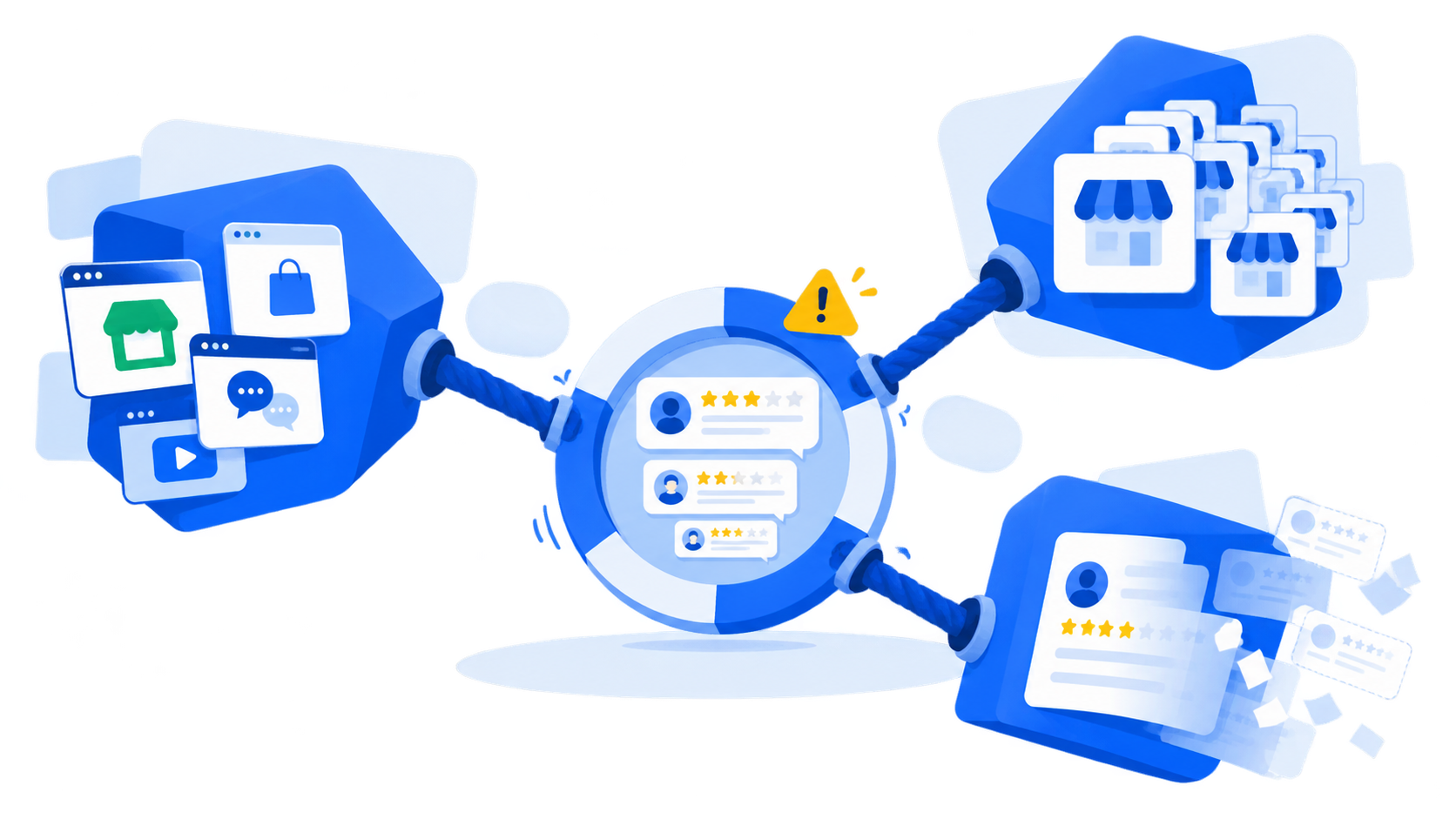
Review management is hard because of structure, not willpower
Why unified viewing should come first
Review management becomes efficient when you sort out the viewing structure before reply quality. If you can't see what was posted where on one screen, responses will structurally always start late.
There are three main criteria for evaluating a unified viewing system. The first is channel coverage: does it include every channel you need to check, such as delivery apps and Place? The second is prioritization: are items that need attention first, such as unanswered or low-rated reviews, automatically surfaced at the top? The third is store-level filtering: can you isolate a specific store or a specific period?
To decide whether you need a unified viewing system, it's practical to check in the following order.
1
List every channel you currently check.
2
Record, even roughly, the average time spent per channel each day.
3
Judge whether that time is sustainable relative to your store count.
4
If you conclude it's unmanageable, it's time to consider a unified viewing tool.
FDAM, an operations ERP for franchisor headquarters, addresses these three criteria systematically with AI Review Management. It brings delivery app reviews and Naver Place reviews onto one screen, viewable by store and by period.
The process of staff switching between accounts to check stores one at a time happens inside a single unified screen, and the very order of checking changes. Instead of scanning every review chronologically, the reviews that need a response first are the ones you see first. Changing the viewing order alone makes a noticeable difference in actual response speed.
When adopting a unified viewing system, also consider staff who need to check while moving between stores. If it's accessible only from an office PC, supervisors and regional managers who are often in the field will still rely on individual channels. Whether it works the same on PC and mobile is another practical criterion for evaluating a unified viewing system.
The key point is that unified viewing is the starting point of review management, not the whole of it. Only once the viewing structure is in order can you move on to the next steps: response criteria, tone management, and data accumulation.
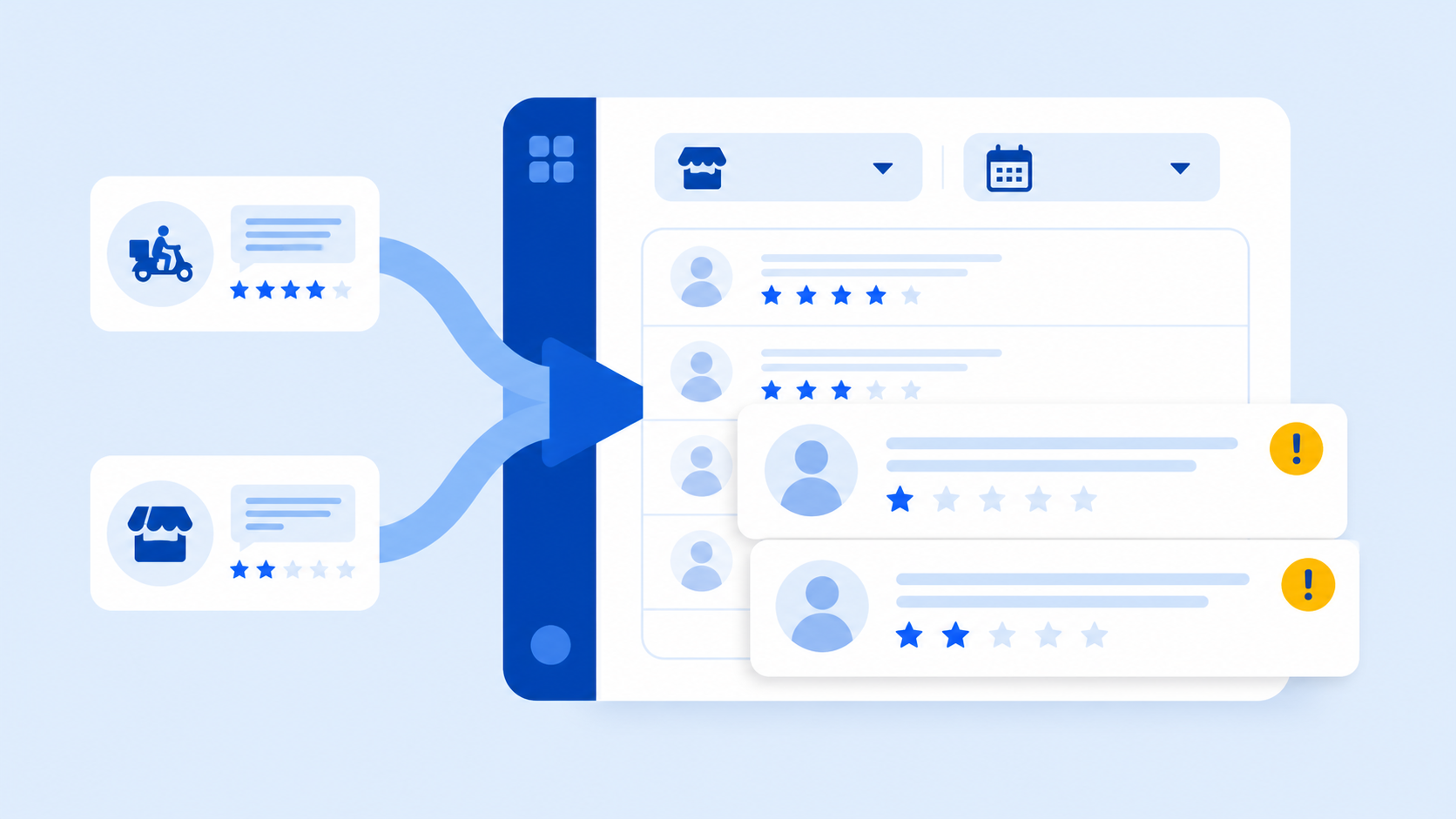
Change the order of checking, and response speed changes too
Reply management principles that keep your brand tone
The hard part of replies isn't writing the sentences but keeping the tone consistent. Because different people write replies at each store, the level of wording and politeness easily varies even in the same situation. For example, one store may answer a complaint about late delivery with a single line, "We're sorry," while another explains the situation and promises to prevent it from happening again. Consumers tend to take this difference as a difference in the brand's trustworthiness, not the store's.
It's hard for HQ to solve this by reviewing every store's replies each time, because review time grows right along with store count. So in practice, providing criteria in advance at the sentence level works better than reviewing.
FDAM handles this with a reply draft feature. It analyzes the review and generates a reply draft that matches the brand tone. The step of composing a reply from a blank page disappears, leaving only the step of tailoring it to the situation, which naturally narrows the gap in reply quality between stores.
It's worth being clear about who owns the response. The primary responder to reviews is each store owner. HQ sets the brand tone standard and supports keeping it in the field. The reply draft feature sits between these two roles, turning HQ's criteria into sentences stores can actually use.
When standardizing reply management, it helps to check the following in practice.
- Whether the level of apology in responses to negative reviews matches the brand guide
- Whether store-specific information (location, menu, etc.) is accurately reflected in the reply
- Whether drafts get at least minimal edits for the situation rather than being used as is
The third item is especially important. A draft is a starting point, not a finished reply, so replies stay credible only if a process takes hold for store staff to refine drafts to reflect the situation.
Once reply criteria are documented, they can be used directly to train new staff. Even when staff change, the tone the brand has used can be handed down through the documents and the draft feature, reducing breaks in tone during handovers.

The draft is the starting point. Refining it is the store's job
Using reports to turn reviews into operating data
To make review management sustainable, what you check ultimately has to be kept in an organized form. If you just check reviews each day and let them go, HQ responds to the same recurring issue as if it were discovering it for the first time.
FDAM's store review report organizes each store's review status and trends so HQ can check them regularly. Instead of looking at individual reviews one by one, it gathers response rates and review trends by store.
| Category | Checking one by one, unmanaged | Review management with FDAM |
|---|---|---|
| Viewing | Log in to each channel separately | Unified view of delivery apps and Place |
| Responding | Store discretion, tone varies | Brand-tone reply drafts provided |
| Records | Nothing accumulates after checking | Accumulated in store review reports |
Reports are most effective not for a monthly skim of every store but for pinpointing stores where specific issues recur. For example, if a store has the same type of complaint several times within a short period, you can feed that into QSCV inspection priorities.
As reports pile up, reviews change from passing impressions into operating data. You start to see which issues recur at which stores, and this naturally connects with other operations items such as QSCV inspections and training management. For example, if hygiene keeps coming up in a store's reviews, that can become a priority item to check at the next QSCV inspection.
Review reports become more useful when there's a routine of sharing them regularly with supervisors and regional managers rather than HQ staff checking them alone. For example, setting up a weekly review of review status lets you pull items to check on store visits from review data in advance.
When you connect review data with operations management, review management goes beyond CS work to become another signal HQ uses to understand each store's condition.

Recorded reviews become data, not impressions
Frequently asked questions
Q. What exactly does review management mean in a franchise ERP?
A. It means viewing, responding to, and recording store reviews from multiple channels, such as delivery apps and Naver Place, according to criteria and a tone HQ defines. The focus is on managing consistency across the whole brand, not individual store responses.
Q. Which channels' reviews can be viewed together?
A. FDAM's AI Review Management lets you view delivery app reviews and Naver Place reviews on one screen, by store and by period.
Q. Can AI-generated replies be posted as is?
A. What you get is a reply draft that reflects the brand tone, intended to be edited for each store's situation before use. Store owners are the primary responders to reviews, and HQ supports them with tone standards.
Q. Can review management be adopted on its own?
A. AI Review Management is a feature within FDAM's operations management flow. Used together with franchise sales management, store-opening management, and QSCV inspections, store data connects into one and the impact grows.
The goal of review management isn't to reply to every single review but to make the brand's attitude in responses consistent regardless of store. Once you have three steps in place, viewing channels in one place, turning tone criteria into sentences, and keeping the results as data, reviews become something you can manage.
See FDAM's AI Review Management for yourself
View delivery app and Naver Place reviews on one screen, and see reply drafts that keep your brand tone.
Contact salesVisit the FDAM website Chat with us on KakaoTalk
franchise ERP, AI review management, store review management, delivery app reviews, Naver Place reviews, store review reports, brand tone management, standardized review responses, FDAM, MS Benter, store operations management