Franchise Markup Fee Disputes: Prepare with FDAM E-Contracts
How franchise markup fee disputes unfold, and how to use e-contracts in FDAM, a franchise ERP
Franchise markup fees, franchise ERP, FDAM, e-contracts, Franchise Business Act, pre-contract disclosure documents, HQ operations system, franchise disputes, franchise agreement management, HQ risk management
Key takeaways · At the heart of franchise markup fee disputes are disclosure of the markup on supply prices for raw materials and the transparency of the store owner consent process. · When headquarters accumulates its contracting process and pre-contract disclosure delivery history in a system, its response materials are already organized if a dispute arises. · FDAM’s e-contract feature automatically records contract, signature, and viewing history for use in HQ risk management. · Pre-contract disclosure delivery and viewing logs remain in the system, organizing the supporting records for calculating the 14-day review period set by the Franchise Business Act. |
Franchise markup fees are a form of franchise fee in which the franchisor adds a set amount to the supply price of ingredients and supplies provided to store owners. Korea’s Franchise Business Act requires headquarters to disclose markup fee information to prospective franchisees in advance through the franchise disclosure document, so HQ’s disclosure and delivery procedures, and the records of them, are emerging as the central issue in disputes.
Built by MS Benter, which has focused on franchise IT for nearly 25 years, FDAM is designed to let franchisors accumulate contracts, pre-contract disclosure documents, and consent procedures in one system for use in HQ risk management. In this article, we look at why franchise markup fee disputes matter from an HQ perspective and how the e-contract feature keeps HQ response materials organized.
Transparency in the contracting process is the starting point of HQ risk management.
Note : This article outlines contract and record management workflows from an HQ operations perspective. For legal advice on franchise markup fees or legal judgments in specific cases, we recommend consulting a lawyer or a certified franchise consultant. |
1. Why franchise markup fee disputes weigh on headquarters
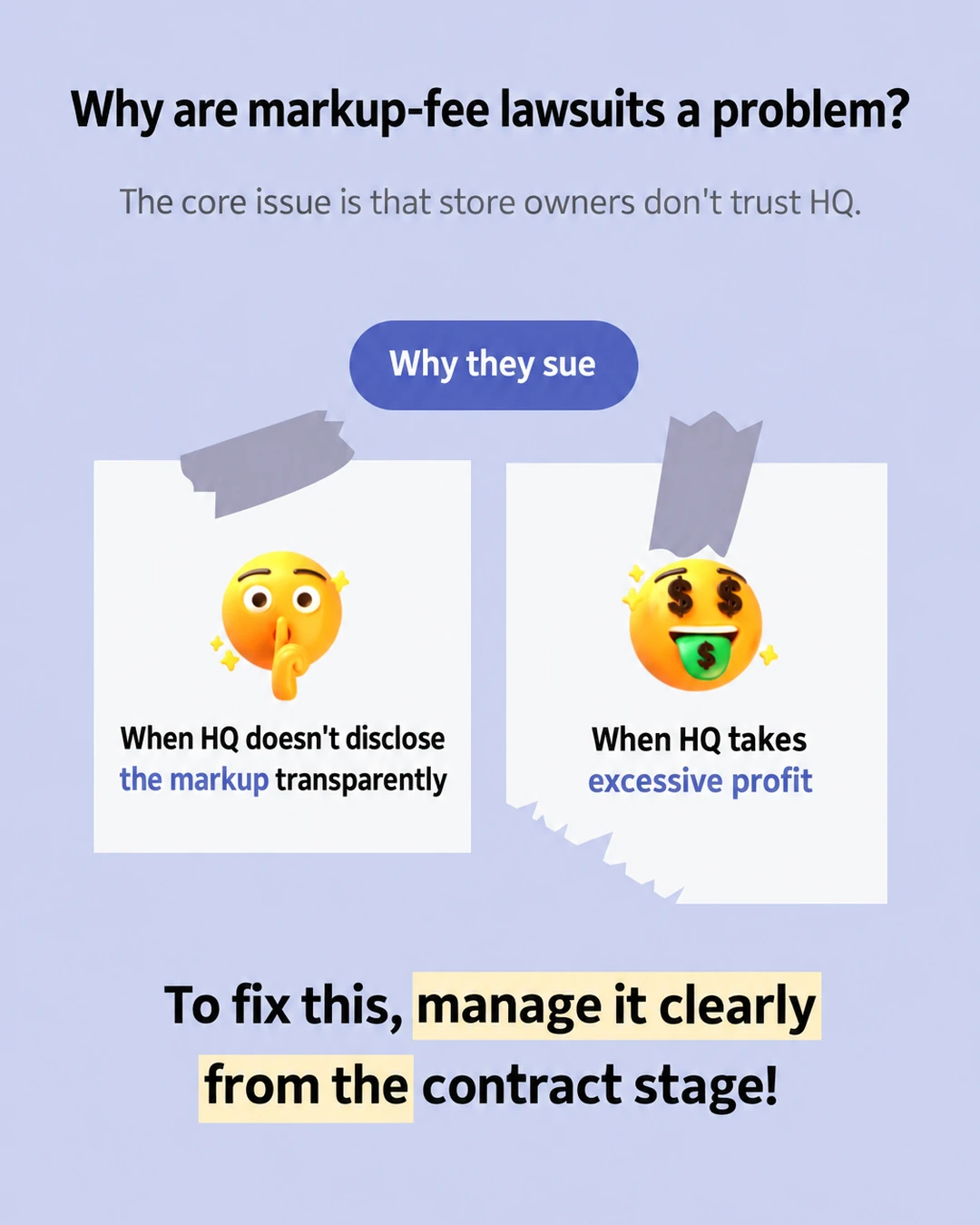
At the core of disputes are information transparency and HQ record-keeping.
The franchise industry has recently seen a steady stream of news about markup fee lawsuits. As more store owners challenge headquarters over how ingredient and supply prices are set and how information is disclosed, headquarters are paying closer attention to keeping records of their contracting and disclosure procedures. With reports of courts ruling in favor of store owners in some cases, the procedures headquarters routinely use to deliver markup fee information and obtain consent have become even more important.
Franchise markup fees are a form of franchise fee recognized under the Franchise Business Act, but headquarters can manage them reliably only when advance disclosure through the franchise disclosure document and records of the contracting process are both in place. When a dispute arises, the nature of HQ’s response depends heavily on whether it has organized materials showing the procedures it normally used to deliver information.
2. Three records headquarters should keep as a matter of routine
To prepare for markup fee disputes, headquarters needs to accumulate the following three records in a standardized format as part of everyday work. The key is not to gather materials once a dispute arises, but to build a structure where they are naturally created in daily operations.
Three records headquarters should standardize ① Pre-contract disclosure delivery history : to whom and when documents such as the franchise disclosure document and the nearby-store status report were sent ② Prospective franchisees’ viewing and confirmation records : the starting point for calculating the 14-day review period ③ History of each stage of contract signing : what the prospective franchisee agreed to and when |
When these three records are scattered across messengers and email, it is hard for headquarters to show consistently how it operated when a dispute arises. Being able to show with data that the same procedure was applied equally to every franchise store also raises the credibility of HQ’s response.
3. How FDAM e-contracts support HQ risk management
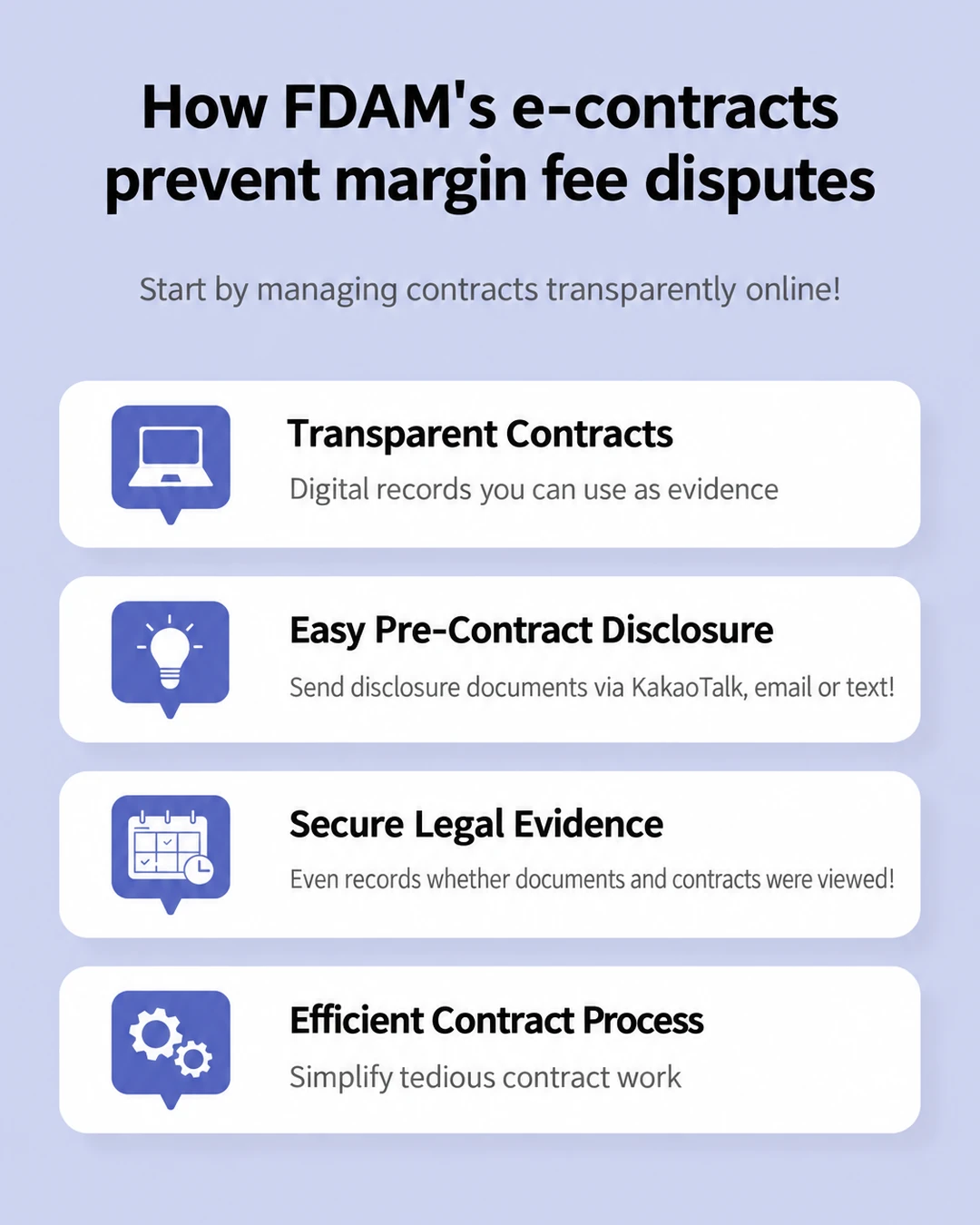
Contract and pre-contract disclosure history accumulates as-is in a single system.
FDAM’s e-contracts handle the contracting process with prospective franchisees within the system while automatically keeping the records headquarters needs. Dispute scenarios that headquarters actually face, drawn from experience working with about 500 brands, are reflected in the module design, so teams can work in a familiar flow from day one.
Transparent contract management
Contract terms and the signing process are all recorded electronically, so if a markup fee dispute arises, the records can show the procedures headquarters normally followed in contracting. They can also demonstrate that the same contract format was applied equally to every franchise store.
Easy delivery of pre-contract disclosure documents
FDAM generates pre-contract disclosure documents, including the franchise disclosure document, within the system and can send them instantly to prospective franchisees via KakaoTalk, email, or text message. Which documents were sent to which prospective franchisee and when is recorded in the same format, leaving a consistent record of how headquarters has routinely fulfilled its advance disclosure obligation.
Reference materials for dispute response
Even whether pre-contract disclosure documents were viewed is recorded in the system. Records marking the starting point of the 14-day review period after advance disclosure of the franchise disclosure document, as set by the Franchise Business Act, are kept automatically, so organized materials are on hand for headquarters to reference if a dispute arises. That said, we recommend that actual legal judgments be made with advice from a lawyer or a certified franchise consultant.
Efficient contracting process
Handling tedious contract work in a single system reduces the HQ workload. Problems that occurred with paper documents, such as omissions and schedule delays, are resolved as well.
4. Managing franchise markup fee risk with FDAM
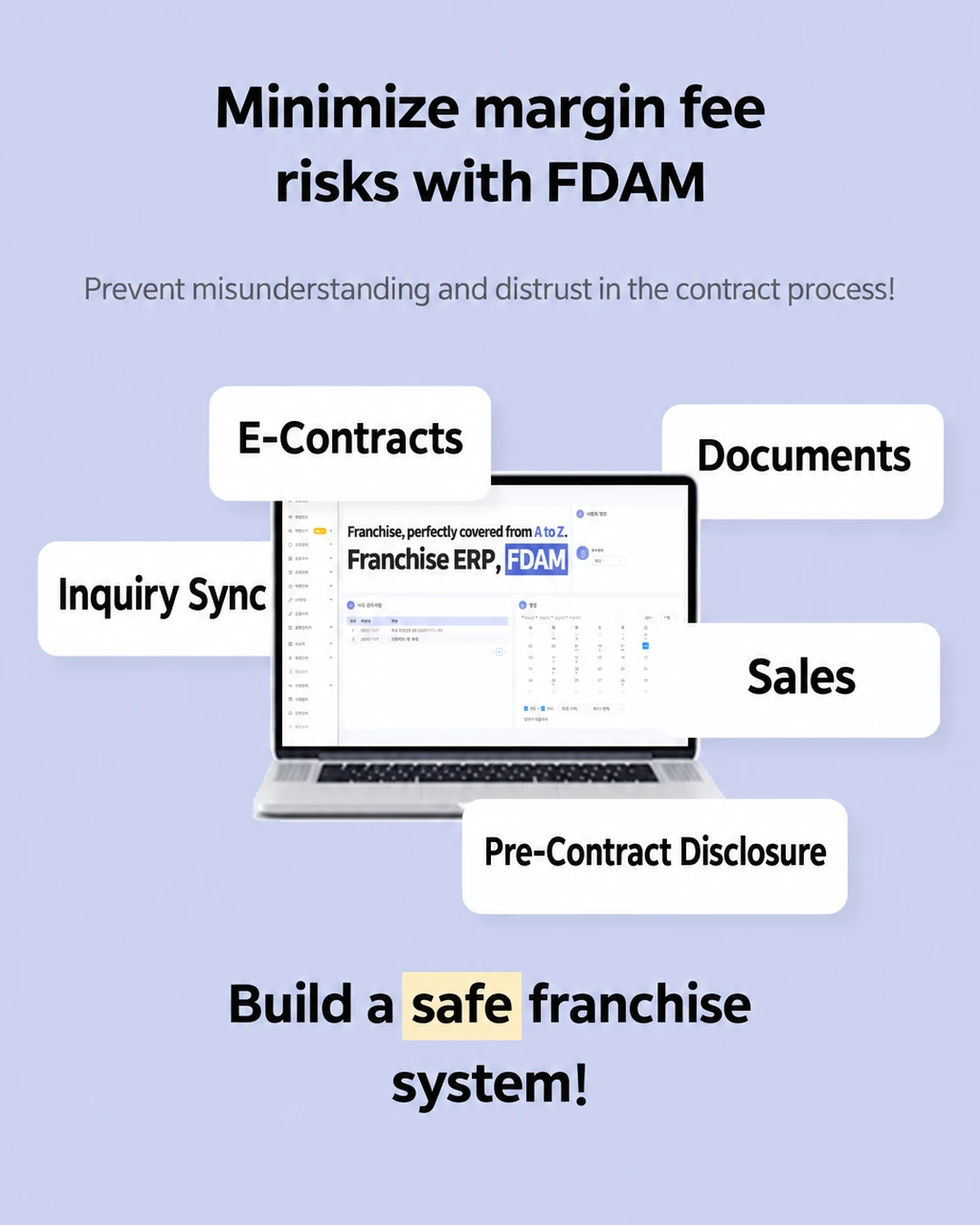
Standardizing contracting and disclosure procedures is the starting point of HQ risk management.
Adopting FDAM creates an environment that reduces misunderstandings and information gaps that can arise during contracting. HQ’s operating procedures are delivered consistently to store owners, and the process accumulates as-is in the system, so HQ’s response materials don’t get scattered when a dispute arises.
When the contracting process is managed systematically, the workload on HQ’s operations team decreases too. Handling the advance disclosure procedures required by the Franchise Business Act in a standardized flow, and having an environment where headquarters can review that history directly, is HQ’s most practical safeguard against markup fee disputes. Simply ask the AI assistant, the first to be built into a franchise ERP in Korea, “Show me prospective franchisees who didn’t view their pre-contract disclosure documents last quarter,” and headquarters can immediately see who needs follow-up.
Frequently asked questions
Q. What exactly are franchise markup fees?
Franchise markup fees are a form of franchise fee in which the franchisor adds a set amount to the supply price when supplying ingredients and other materials to store owners. The Franchise Business Act requires headquarters to disclose this information in advance through the franchise disclosure document, so HQ’s disclosure procedures and records of them should be standardized as a matter of routine.
Q. Are contracts created through e-contracts legally binding?
Korea’s Framework Act on Electronic Documents and Transactions recognizes the validity of electronic documents, so an e-contract executed through proper procedures has the same effect as a paper contract. However, legal judgments in individual cases may vary depending on the facts and the contracting process, so we recommend also consulting a lawyer or a certified franchise consultant.
Q. Does delivering pre-contract disclosure documents electronically satisfy the Franchise Business Act?
The Franchise Business Act requires the franchise disclosure document to be provided to prospective franchisees in advance, and electronic delivery is also recognized. However, interpretations of the delivery date, whether the document was viewed, and the calculation of the 14-day review period may vary case by case, so we recommend designing procedures to fit your HQ operations and also seeking advice from a lawyer or a certified franchise consultant.
Q. Can we move our existing paper contract history into the system?
Your existing paper contracts and pre-contract disclosure delivery history can be organized into digital records and registered in the system during initial setup. During your sales consultation, we review the format of the materials your headquarters holds and recommend the most suitable migration method.
Q. How does the sales consultation work?
You can contact FDAM through the consultation page (fdam.co.kr/register), our KakaoTalk channel, or our main number (1544-7120). We will walk you through how to apply it to your HQ contracting and disclosure procedures.
Standardizing HQ contracting procedures
Prepare for franchise markup fee risk
with everyday records
Learn more about FDAM Ask on KakaoTalk