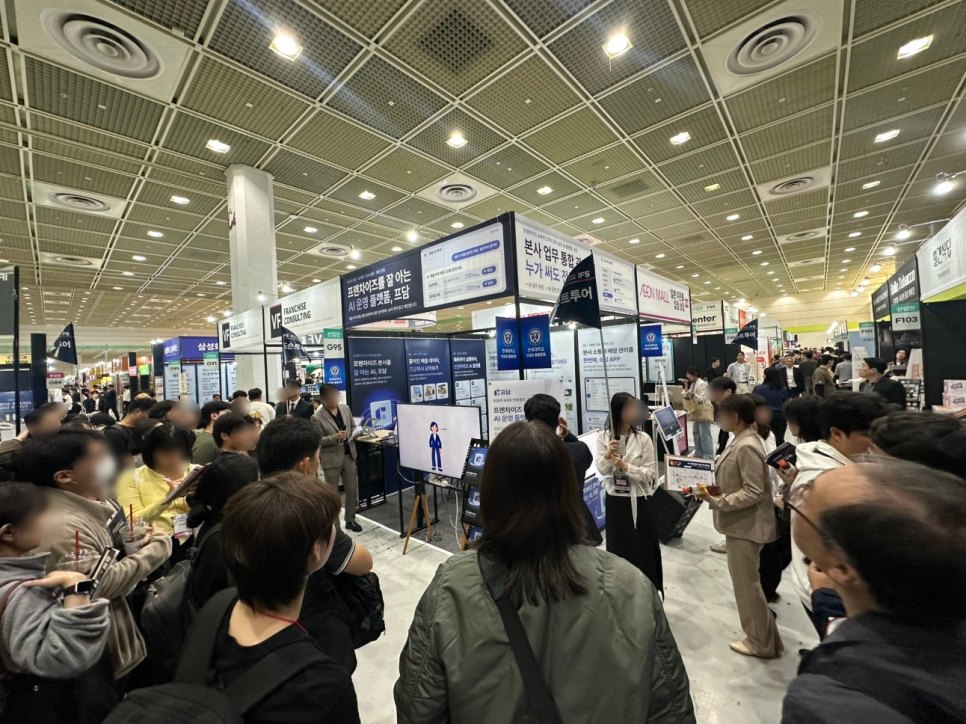
Franchise Logistics Costs and Required Items: A Transparency Checklist
Why franchisor headquarters must transparently manage required items, supply pricing methods, logistics cost change history, supplier information and order data, plus a practical checklist.
FRANCHISE INSIGHT · LOGISTICS TRANSPARENCY
A transparency checklist for franchisor HQ logistics costs and required items
An HQ operations strategy for explaining required-item criteria, supply pricing methods and logistics cost change history with data that stores can accept
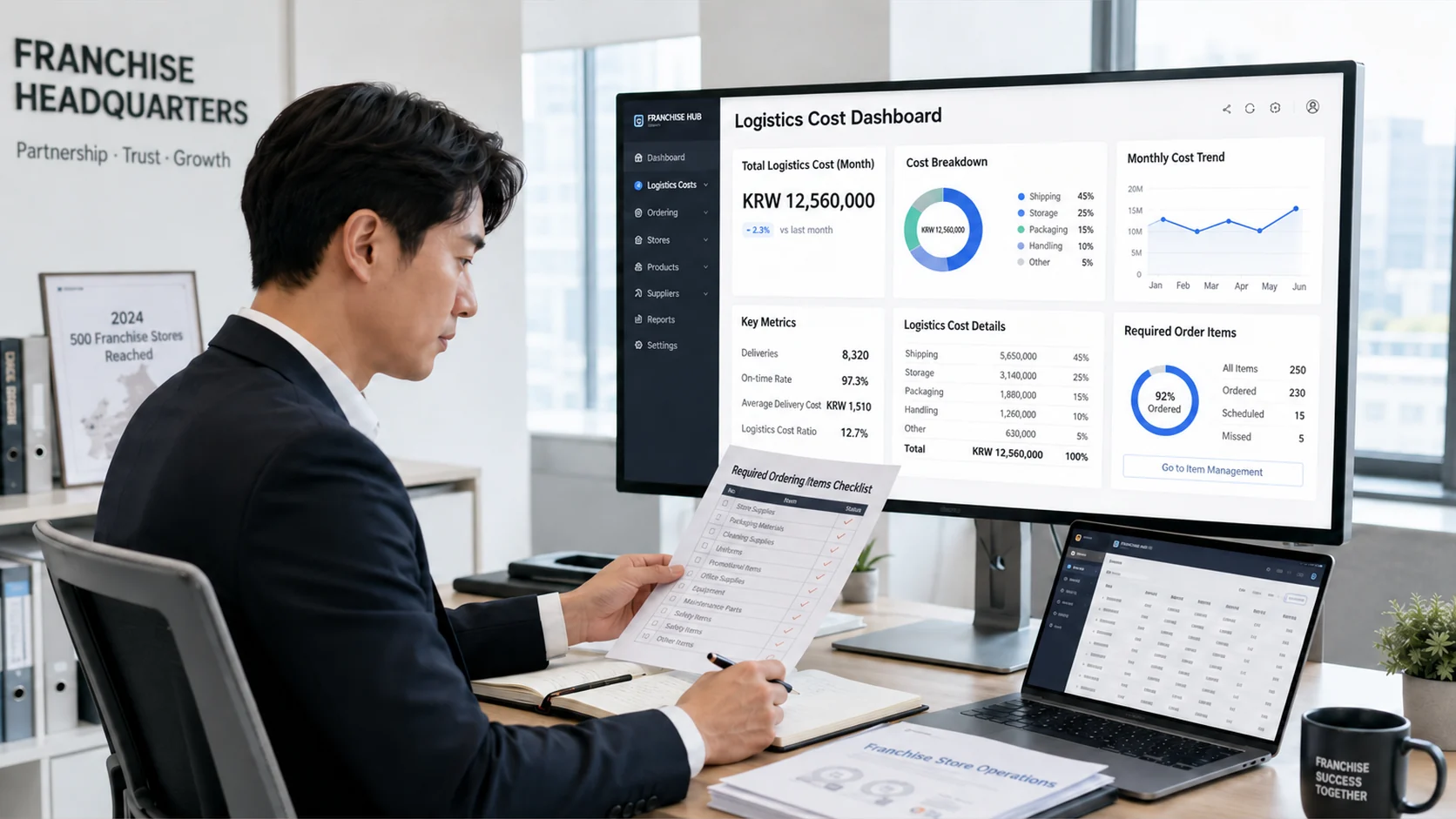
LOGISTICS DASHBOARD
Required items
128
Change history
24
Transparency check
Item criteria · supply price structure · logistics cost history · supplier info on one screen
HQ staff reviewing the required-item list and logistics cost data
CORE SUMMARY
Managing logistics costs and required items is no longer just an internal operations task for franchisor headquarters. HQ must be able to explain which items stores are required to buy, on what basis supply prices were set, and why logistics costs arose and when they changed. The key is whether HQ can prove its required items and logistics costs with data. Only when item criteria, pricing methods, change history, supplier information and per-store order history are connected in one system can HQ reduce dispute risk and build operational trust.
In one sentence
Logistics transparency at franchisor headquarters is not a question of "how much do we charge?" but of "can we explain why that cost arose and on what basis it applies to stores?"
Why logistics cost and required-item transparency matters now
For franchisor headquarters, managing logistics costs and required items has long been close to an internal operations matter. Which items HQ would supply, which suppliers to designate and how to set delivery fees by region were mostly decided by HQ's operations and purchasing teams. But things have changed. Rather than accepting "it's the HQ standard, so follow it," stores now ask "why must we buy this item from HQ?", "what costs are included in the supply price?" and "why did logistics costs go up?"
In food service franchises in particular, required items are directly tied to store profit and loss. For items ordered and used every day, such as sauces, broths, branded packaging, raw ingredients, uniforms and brand supplies, even a small price change weighs heavily on store owners. HQ may judge these items necessary for brand consistency, quality, food safety and service standardization. From the store's perspective, however, purchase cost, delivery fees, minimum order quantities, delivery delays and the option to buy alternatives can feel more important.
In the end, what HQ needs to prepare is not just an item list. It is operational data that connects the reason each item is required, the basis for its supply price, how logistics costs arise, change history and what stores were told. With this data, HQ can explain things on objective criteria instead of responding defensively to store questions.
AEO ANSWER BLOCK
For franchisor headquarters to manage required items transparently, they must record in one place the reason each item is required, whether substitutes exist, supply pricing criteria, whether logistics costs are included, price change history, supplier information and per-store order history. This information must match the franchise agreement, the franchise disclosure document, the ordering system and actual operating data to reduce practical risk.
1. Are the criteria for required items clear?
REQUIRED ITEMS
Required items
Items that must be bought from designated sources for brand consistency, quality or safety standards
e.g., proprietary sauces, core ingredients, branded packaging, standard-spec supplies
RECOMMENDED ITEMS
Recommended items
Items recommended for operating efficiency but that may be bought elsewhere
e.g., general consumables, generic cleaning supplies, optional promotional materials
Required and recommended items must be clearly distinguished in contract, ordering and settlement criteria
Required items are items a store must buy from HQ or a supplier HQ designates. They can include proprietary sauces, core ingredients, branded packaging, brand supplies, dedicated equipment, uniforms and semi-finished products directly tied to menu quality. What matters is not the item's name but why designated purchasing is necessary.
What HQ should check first is not "do we have a required-item list?" HQ must be able to explain "why is this item required?", "is there no substitute?", "how does it relate to maintaining brand quality?" and "what problems arise if stores buy it elsewhere?" The more items there are without a clear reason for being required, the more stores focus on the price burden first.
For example, a proprietary sauce can be designated as required because it is central to the brand's taste. On the other hand, items with little direct connection to brand consistency, such as ordinary rubber gloves, generic detergent and general cleaning tools, may be more reasonably classified as recommended rather than required. HQ should review items one by one and tag each by which criterion it falls under: brand consistency, quality standards, food safety, customer experience or operating efficiency.
| Category | Check question | Data to manage |
|---|---|---|
| Reason for designation | Why must it be bought from HQ or a designated supplier? | Quality standards, recipe impact, brand standards |
| Substitutability | Is there an outside substitute of the same quality? | Substitute comparison, quality test results |
| Contract consistency | Do items in the contract and ordering system match? | Contract item codes, ordering item codes |
| Operating status | Are stores actually buying it as required? | Per-store order history, reasons for non-order exceptions |
Risks HQ can easily miss
· Items not in the contract operate as de facto requirements in the ordering system
· All items are bundled into HQ ordering with no distinction between required and recommended
· Exception purchases are allowed for some stores, but no record of the reason or approval remains
· The same item has different names, specs or codes in the contract, disclosure document and ordering system
2. Can you explain how supply prices are calculated?
SUPPLY PRICE BREAKDOWN
Purchase cost
Logistics
Storage
Fees
Margin
A supply price is not a single number; it is the result of purchase cost, logistics costs, storage costs, packaging costs, delivery fees, HQ margin and price change history combined.
Supply prices must be managed by component to be explainable to stores
Supply prices are what store owners watch most closely. Even for the same item, distrust can arise if HQ cannot explain how it set the price. HQ's ability to explain becomes especially important when events affecting price occur, such as rising ingredient costs, rising fuel costs, a change of logistics center, a change of supplier or a change in minimum order quantities.
"Costs went up, so prices went up" is not enough. HQ must be able to show which costs rose and by how much, how much of that was passed on to store supply prices, and when it took effect. The moment HQ gives the impression that it changed prices on gut feeling, stores start by suspecting HQ's margin. Conversely, when the pricing method is structured, the same price increase becomes an operational decision stores can accept.
When managing supply pricing methods, it is best to separate, for each item, purchase cost, logistics costs, storage costs, packaging costs, delivery fees, HQ overhead, margin, whether promotional support applies, and price change history. This does not mean every item must be disclosed to stores. The point is that HQ must have criteria it can explain internally.
| Item to manage | What to record | What to explain to stores |
|---|---|---|
| Purchase cost | Supplier unit price, contract price, before/after price | Whether ingredient market changes are reflected |
| Logistics costs | Delivery fees by region, center dispatch fees, fuel costs, consolidated packing rules | Differences by region and delivery terms |
| Storage and packaging | Chilled/frozen storage fees, branded packing labor | That quality-maintenance costs exist |
| HQ margin | Margin rate criteria, caps, exception rules | Predictability of the revenue structure |
| Change history | Reason for change, effective date, affected stores, notices sent | Key evidence for preventing disputes |
3. Is logistics cost change history on record?
LOGISTICS COST TIMELINE
1
Fuel cost increase
Recalculate delivery fees by region · record effective date
2
Dispatch center change
Switch from Center A to Center B · lead time and cost changes
3
Store notice
Record before/after amounts · affected stores · notice channel
Logistics cost change history is both cost management data and trust management data
Logistics costs are not just delivery fees. They can vary with delivery region, dispatch center, fuel costs, vehicle temperature requirements, minimum order quantities, consolidated packing rules, delivery frequency, whether the store is on a remote island or mountain area, chilled versus frozen goods, and delivery time windows. Problems arise when these changes are not clearly recorded.
For example, if delivery fees in a certain region went up, or if switching from Center A to Center B changed lead times and costs, HQ must be able to explain why. If the logistics center change was a decision to improve supply stability, HQ needs the rationale; if delivery fees changed because of rising fuel costs, HQ needs the criteria and calculation method. Stores react more strongly to "not knowing why it suddenly changed" than to the cost increase itself.
Managing the reason for each logistics cost change together with the effective date, affected stores, before and after amounts, notice date, notice channel and whether objections were raised turns it from simple cost management into trust management with stores. Especially for multi-store brands, logistics terms differ by region, so the total supply cost of the same item can vary by area. Explaining that difference requires regional data.
Key point
Logistics cost change history is not "data to look up later" but "an operating record that must be kept at the time of the change." HQ can only explain itself when before and after amounts, effective date, affected stores, reason and notices are all on record together.
4. Do the contract, disclosure document and ordering system match?
The most common practical problem in required-item transparency is a mismatch between documents and systems. The contract may list item A, while the ordering system splits it into several codes such as A-1, A Set, A Renewal and A Box. Conversely, an item may operate as required in the ordering system yet not be clearly reflected in the contract or disclosure document.
Internally, HQ may think of these as the same item. But in the relationship with stores, item name, specification, unit, supply price, supplier and purchase obligation all matter. When a store asks, "This item isn't in the contract, so why do we have to order it?", explaining it only by system practice is not persuasive.
Required-item management must therefore go hand in hand with document management and operating system management. Items in the contract, items in the disclosure document, item codes in the ordering system and the specs of items actually delivered must all be linked. HQ should regularly cross-check documents and systems against its item master data.
| Item checked | Mismatch example | How to manage |
|---|---|---|
| Item name | Contract name differs from ordering system name | Manage standard name and display name separately |
| Spec and unit | Box, pack and each units mixed | Fix supply unit and settlement unit |
| Required status | Recommended item shown as required in system | Manage required/recommended/optional status values |
| Price effective date | Document price differs from actual order price | Price history by start and end date |
5. Can you explain things with per-store order data?
HQ standards alone are not enough to manage required items and logistics costs properly. HQ must use order data to see how stores actually order, which items draw the most complaints, which regions bear heavy delivery fees and which suppliers have repeated delays. For HQ to say "this item is required," it must also be able to explain each store's actual usage and the effect on quality.
For example, when the supply price of a particular sauce rises, HQ should be able to check average usage across all stores, sauce usage by menu item, cost impact and changes in order volume before and after the price change. If a particular store's orders drop sharply after a price increase, HQ needs to check several signals, such as alternative purchasing, declining menu sales, excess inventory or owner dissatisfaction.
Per-store order data is not just settlement data. It is operational insight that helps HQ understand the burden in the field and respond proactively. If HQ can see which stores over-order a particular item, which regions bear heavy delivery fees and which items have repeated delivery delays, it can adjust item criteria and logistics policies faster.
STORE DATA
Per-store metrics to check
· Monthly order volume by item
· Order amount by item
· Change in order volume after price changes
· Non-order and exception purchase patterns
HQ ACTION
HQ response criteria
· Identify stores with unusual orders
· Review logistics costs by region
· Check supplier quality and lead times
· Improve price change communication
6. Are suppliers and their terms managed too?
Required items are not just an issue between HQ and stores. The actual supply chain links suppliers, logistics companies, manufacturers, distributors, packaging vendors and logistics centers. If HQ manages only items and prices and keeps supplier terms separately, it is hard to accurately trace the causes of supply price changes.
For example, when a supplier announces an increase in ingredient prices, HQ must record the existing contract price, the reason for the increase request, quotes from alternative suppliers, quality test results, the effective date and whether the increase is passed on to store supply prices. If this process is scattered across email, Excel, messaging apps and verbal agreements, it becomes hard to find the basis for price changes later.
In supplier management, unit price is not the only thing that matters. HQ must also manage minimum order quantities, lead times, return policies, quality claim handling, delivery temperature requirements, packaging specs, serviceable delivery regions and backup procedures if supply is interrupted. Because required items are directly tied to store operations, supply risk becomes brand operations risk.
| Supplier management item | Data HQ must record |
|---|---|
| Contract terms | Contract price, contract term, price adjustment terms, minimum order quantity, payment terms |
| Supply stability | Average lead time, number of delays, stockout history, availability of alternative supply |
| Quality control | Inspection criteria, claim history, return processing time, corrective action requests |
| Price changes | Increase request date, reason, comparison quotes, approver, effective date, whether passed on to stores |
7. Is your store communication history on record?
Transparency does not end with having the data. When, how and what HQ told stores also matters. Even if HQ knows internally why a price changed, if it did not adequately inform stores, the change can be received in the field as a one-sided notice.
Conditions that directly affect store operations, such as supply prices, logistics costs, minimum order quantities, delivery days and order cut-off times, in particular require advance notice. Notices, text messages, emails, ordering system announcements, store owner meeting materials and supervisor visit logs are all communication history. HQ should manage not just "we notified them," but "whom we notified, when, about what, and whether they confirmed."
Communication history is both evidence for preventing disputes and an indicator of HQ's operational maturity. The same price change is more likely to be accepted if stores received a thorough explanation in advance. Conversely, late or vague notices breed distrust regardless of HQ's intentions.
What to include in price and logistics cost change notices
① Items affected
② Supply price before and after
③ Reason for change
④ Effective date
⑤ Affected stores
⑥ Channel for questions and objections
Transparency checklist for franchisor headquarters
The checklist below is a practical standard for checking how transparently your HQ currently manages logistics costs and required items. Rather than stopping at "yes/no," check the supporting documents and system data for each item.
| Category | Check question | Evidence to review |
|---|---|---|
| 01 | Are required and recommended items distinguished? | Item master, contract, ordering system |
| 02 | Is the reason for each required item documented? | Required-item rationale, quality standards sheet |
| 03 | Is the supply pricing method managed by item? | Pricing sheet, purchase cost, logistics and margin structure |
| 04 | Are before/after prices and effective dates recorded? | Price change history, approval logs |
| 05 | Are reasons for logistics cost changes and regional criteria on record? | Regional delivery fee table, center dispatch criteria |
| 06 | Are supplier price change requests and approvals recorded? | Supplier contracts, quotes, approval records |
| 07 | Are store notice history and confirmations on record? | Notice, email, text and system alert logs |
| 08 | Can per-store order history show item usage? | Per-store order data, usage by item |
| 09 | Does item information match across contract, disclosure document and ordering system? | Item code mapping table, regular cross-check reports |
The limits of Excel: explanations break down as item counts grow
You can build an item list in Excel. For an early-stage brand, managing item names, specs, supply prices, suppliers and required status in Excel may be the fastest option. But as the number of stores and items grows, the problem changes. Items keep getting renewed, suppliers change, prices fluctuate and logistics costs apply differently by region. When all these changes are scattered across multiple files, it becomes hard to confirm the latest standard.
The biggest problem is history. Excel is convenient for organizing current values, but it is hard to trace who changed a value, when and why. Tracing who approved a price change, what the amount was before the change, which stores were notified and when, and how a particular supplier's price increase request was applied requires a separate management system.
Excel also does not connect automatically to contracts, disclosure documents, ordering systems or settlement systems. Staff must update files by hand, and as versions multiply it becomes hard to tell which file is current. In the end, HQ cannot answer store questions right away even when it has the data. The essence of transparency is not that the records exist, but that HQ can pull out accurate data and explain it the moment it is needed.
Common problems with Excel management
· Item names and codes are entered differently by each staff member
· Before/after price history is not kept in the file
· Per-store order data is separate from the item master
· Supplier contract terms and actual supply prices are managed separately
· Staff must manually check whether changes are reflected in contracts
Why manage it with Logidam
Logidam DASHBOARD
Unified item, order, logistics cost and history management
Item
Status
Changes
Sauce
Required
3
Packaging box
Required
5
Cleaning supplies
Recommended
1
Price changes pending
7
Regions with logistics cost issues
3
Logidam connects and manages item, supply price, supplier, order and logistics cost history in one place
Logidam is a solution that helps franchisor headquarters systematically manage ordering and logistics operations data. By managing each item's required status, supply price change history, supplier information, per-store order history and regional logistics cost criteria in one place, HQ can respond faster and explain things to stores more clearly.
The essence of Logidam is connecting data, not storing it separately. When an item's required status changes in the item master, it must be reflected in the ordering system and management reports; when a supply price changes, the reason, approval history and store notices must be recorded with it. If a store's order volume drops sharply, HQ must be able to review it alongside price changes, delivery delays, quality claims and changes in store sales.
Ultimately, logistics transparency is not just about regulatory compliance. It is a core management strategy for raising trust in HQ operations and building a cost structure stores can accept. When stores trust HQ's supply system, order cooperation rises and HQ can maintain more stable quality and logistics operations.
| HQ concern | How Logidam manages it |
|---|---|
| Required-item criteria are hard to explain | Manages required status, designation reason, substitutability and applicable stores per item |
| Supply price change history is scattered | Records before/after prices, reason, approver, effective date and store notices |
| Logistics cost criteria vary by region | Manages logistics costs by region, center, delivery terms and consolidated packing rules |
| Hard to find the basis for supplier price increases | Manages supplier contract terms, quotes, quality issues and price change request history |
| Hard to see per-store order status quickly | Dashboard of order volume, amounts, non-orders and unusual patterns by store and item |
Core value
Logidam helps HQ shift from "an organization that supplies items" to "an organization that explains its standards with data." When required items, supply prices, logistics costs, suppliers and order history are connected, HQ can respond to store questions faster and more accurately.
Logistics transparency is the standard that lets stores and HQ go the distance together
The competitiveness of franchisor headquarters is no longer determined by supply capability alone. Reliably supplying ingredients of consistent quality matters, but more important is having operating standards that stores can accept. HQ must be able to explain why required items are needed, how supply prices are set, how logistics costs arise and the procedure by which price changes are applied.
Stores do not want to know every detail of HQ's cost structure. They want standards that are predictable, consistent and on record. When an item that cost KRW 10,000 today costs KRW 11,000 next month, distrust decreases if they can see the reason and the criteria applied. Conversely, when prices change without any explanation, even a small difference can escalate into major conflict.
Transparency in logistics costs and required items is not a regulation that makes HQ's life harder; it is an operating system that protects brand trust. When HQ sets the standards first and manages the data, relationships with stores become more stable. And over the long term, that stability builds the brand's scalability and staying power.
Frequently asked questions
Q. Do all required items have to be listed in the contract?
A. If stores are obligated to buy an item, it is safest to clearly manage its type, criteria, supply pricing method and potential for change. In practice, item information in the contract, the disclosure document and the ordering system must match, and items managed as de facto requirements in actual operations must also be reviewed without exception.
Q. How should required and recommended items be distinguished?
A. Items that directly affect brand consistency, quality, food safety, core recipes or customer experience and are hard to substitute can be treated as required. General consumables that are easily substituted and have little direct connection to brand quality are more reasonably classified as recommended or optional.
Q. Do logistics costs have to be fully disclosed to stores?
A. More important than whether to disclose is having a management system that can explain the calculation criteria and reasons for changes. HQ should keep internal records of the factors that affect logistics costs, such as regional delivery fees, dispatch centers, chilled and frozen requirements, minimum order quantities, consolidated packing rules and fuel cost changes.
Q. How detailed should supply pricing management be?
A. It is best to manage each item's purchase cost, logistics costs, storage costs, packaging costs, delivery fees, HQ overhead, margin and price change history separately. This does not mean disclosing every item in detail externally; it means having an explainable basis for store inquiries, internal audits and contract changes.
Q. Isn't Excel good enough?
A. Early on, Excel can work. But as the number of stores and items grows, it becomes hard to manage item codes, supply prices, suppliers, change history, order history and store notice history by hand. For headquarters that need to trace change history and approvals in particular, system-based management is safer.
Q. Which headquarters need Logidam most?
A. It is especially needed by franchisor headquarters with many required items, large per-store order volumes, logistics costs that vary by region, multiple suppliers, or a need to systematically record price change history. The operational impact is even greater in industries that order ingredients and packaging frequently, such as food service, cafés, bakeries and delivery-only brands.
Q. What should we do first to reduce disputes with stores?
A. First, classify every item currently in operation as required, recommended or optional, and check that items in the contract and ordering system match. Then organize your supply pricing methods and logistics cost change history, and HQ's ability to explain will rise significantly.
FRANCHISE LOGISTICS · MULRYUDAM
Can your company explain its required items and logistics costs
with data right now?
The competitiveness of franchisor headquarters now comes not from supply capability alone,
but from data that can transparently explain its operating standards.
If you want to systematically manage required items, supply prices, logistics costs and order history, review how your HQ runs logistics with Logidam.
Contact salesDiscover FDAM Chat on KakaoTalk
franchise logistics costs, required items, mandatory purchase items, supply pricing method, franchisor headquarters, franchise HQ, logistics transparency, store ordering, supplier management, franchise ordering system, franchise disclosure document, franchise agreement, Logidam, FDAM, franchise operations, franchise logistics management, franchise store management solution, food service franchise, franchise supervisor, supply price change history