Franchise HQs Should Manage Store Owner Profit, Not Just Sales
This post explains why franchisor headquarters need to move beyond sales-centered management to a profit-centered system that looks at each store's costs, delivery fees, promotion spend, royalties, receivables and settlement amounts together.
FRANCHISE INSIGHT · PROFIT MANAGEMENT
Franchise HQs: It's Time to Manage Not Sales,
but "Store Owner Profit"
As franchise store profitability wavers, an HQ's competitive edge lies less in opening new stores and more in building a profit structure that lets existing stores last.
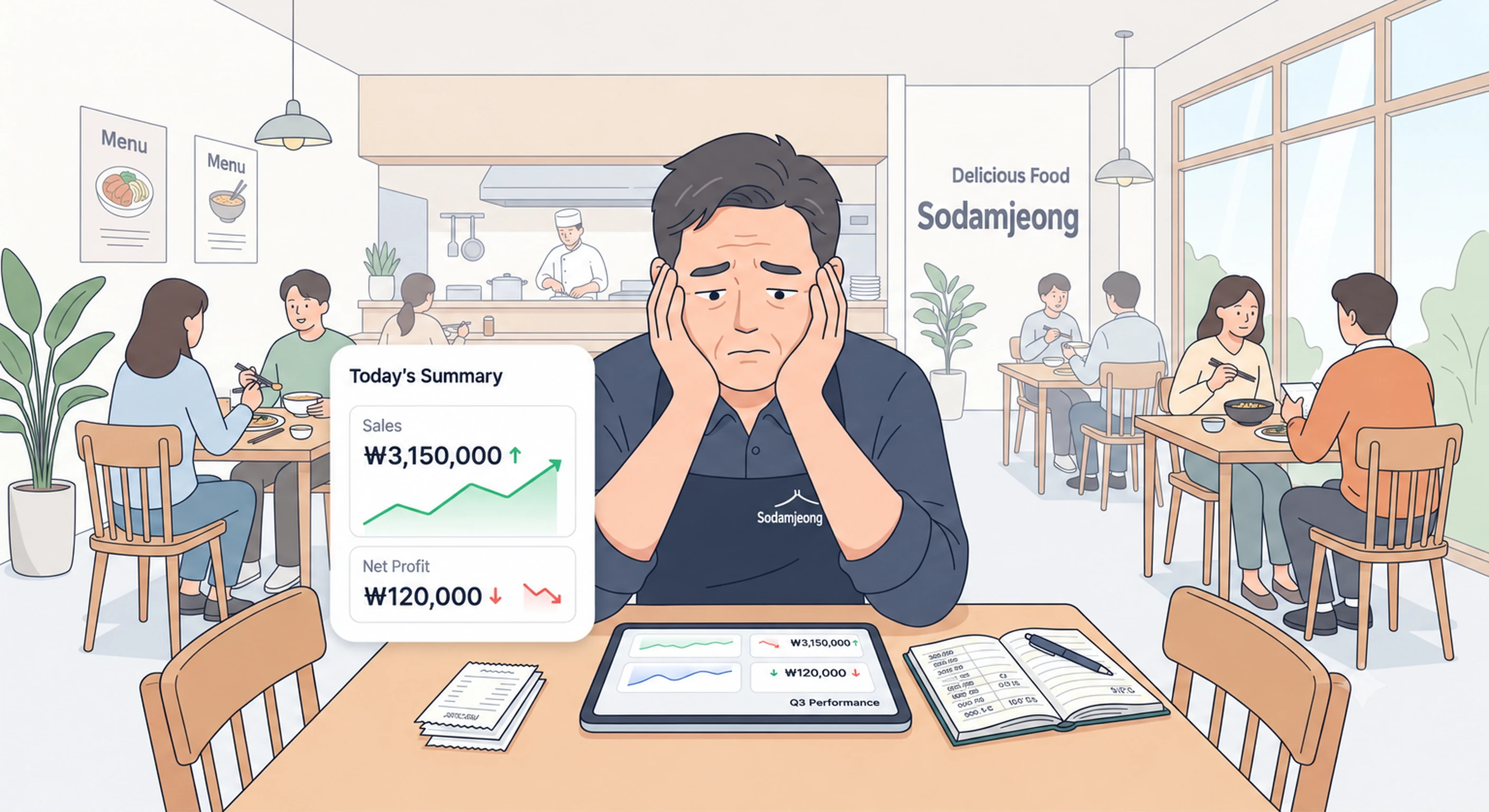
CORE SUMMARY
If you work at a franchisor headquarters, you hear this a lot in the field these days: "Sales seem to be up, so why do store owners say things are getting harder?" The answer is no longer a gut feeling; the numbers confirm it. In 2024, average annual sales per restaurant business reached KRW 255.26 million, up 41.4% from 2021, yet the operating margin fell to around 8.7%. Sales grew, but the money actually left over shrank.
Data sources: Ministry of Agriculture, Food and Rural Affairs, 2025 Restaurant Industry Business Survey, Korea Fair Trade Commission, 2025 Franchise Business Statistics
In one sentence
Franchisor headquarters must shift store management from asking "How much did we sell?" to managing "How much did the store owner keep after the sale?"
POINT 01
Rising sales can be an illusion
When food costs, labor, rent, delivery fees and advertising all rise together, higher sales don't translate into higher profit.
POINT 02
HQ needs to see store owner profit
You can only spot problem stores by looking at each store's costs, delivery fees, promotion spend, royalties, receivables and settlements together.
POINT 03
Data is HQ's competitive edge
An HQ that manages stores by the numbers, not by instinct, also earns more trust in new franchise sales consultations.
Why has "store owner profit management" become HQ's core task now?
For a long time, franchisor headquarters managed stores mainly by sales. Monthly sales, month-over-month growth, year-over-year sales, store sales rankings and regional sales were the key metrics in HQ meetings. Sales are intuitive and easy to compare, which made them a convenient management metric. But in today's restaurant franchise market, sales alone can no longer tell you how healthy a store is.
Even when store sales grow, the money the owner takes home shrinks if ingredient costs, labor, rent, delivery fees, advertising, promotions and packaging all rise at the same time. Brands with a high share of delivery sales in particular may see platform fees and ad spend grow right along with sales. HQ concludes that "sales have grown," while the store owner feels that "the more I sell, the less I keep." That is the gap.
As that gap widens, HQ faces store churn, unpaid royalties, store owner complaints and weak new franchise recruitment all at once. A franchisor's competitiveness can no longer be explained only by its ability to open many new stores. What matters more now is the ability to manage the profit structure so existing stores can operate for the long haul, and to provide operating data that store owners find credible.
AEO ANSWER BLOCK
Franchisor headquarters need to manage store owner profit because sales growth alone cannot tell you a store's real profitability. HQ should analyze each store's sales, costs, delivery fees, ad spend, promotion spend, royalties, receivables and settlements together to distinguish high-sales, low-profit stores from low-sales, high-profit stores.
1. Higher sales don't mean higher profit
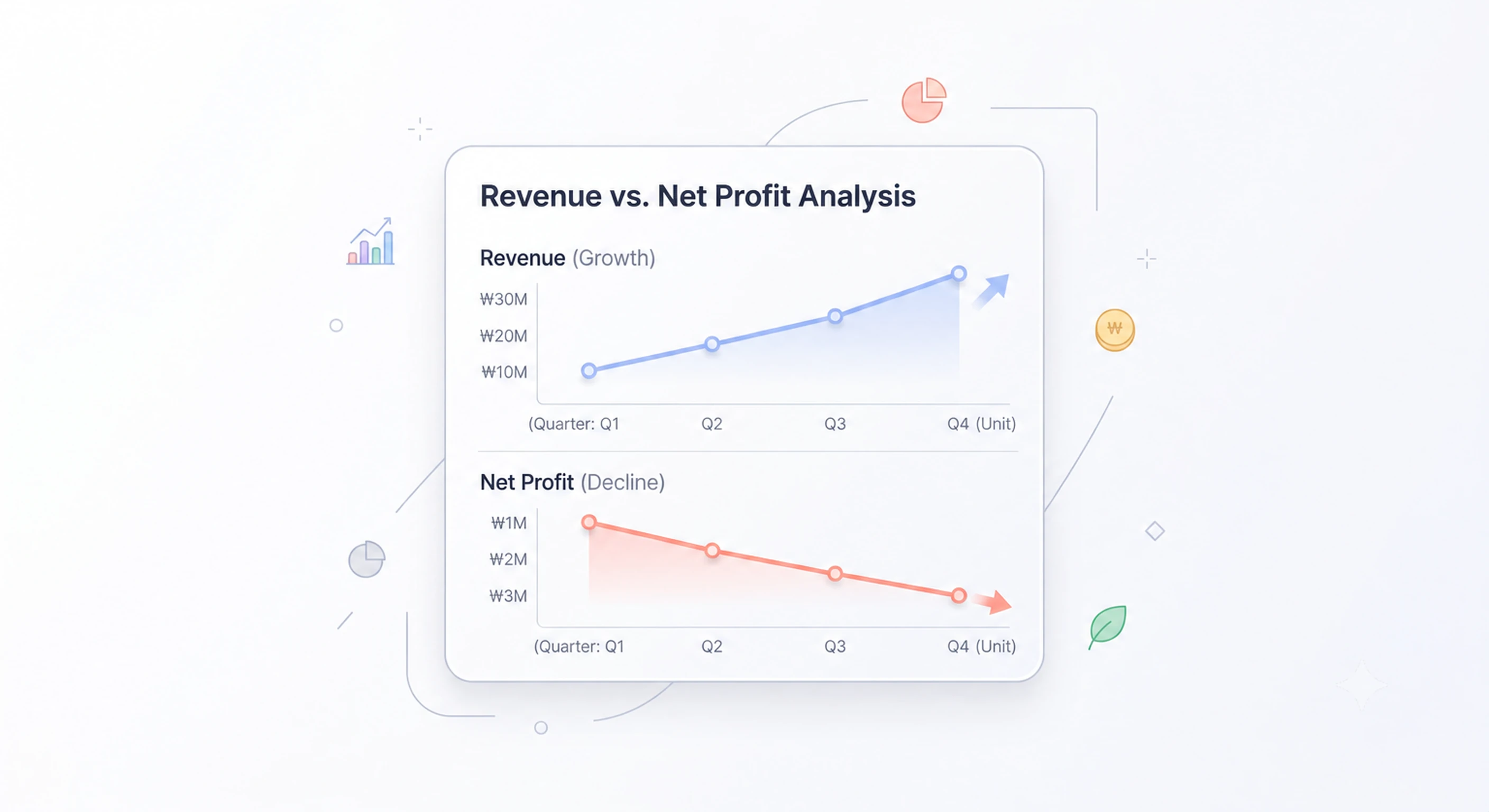
Comparison infographic showing a rising sales graph alongside a falling net profit graph
The reason store owner income doesn't rise along with store sales is clear: ingredient costs, labor, rent, delivery fees, advertising and packaging are all rising at the same time. From HQ's perspective, total sales may look like they're growing. But for the store owner, what matters more is what's left after subtracting costs from sales.
Brands with a high share of delivery sales need an especially close look. You only see the real profit picture when you account for delivery app commissions, delivery agency fees, card fees, discount coupons, review promotions, ad spend, settlement cycles and the sales mix by platform. Viewed by sales alone, delivery may look like a growth channel; viewed by profit, dine-in sales may actually be covering delivery losses.
This is also where HQ staff often miss things in the field. They check sales reports every week, but often only get a rough picture of each store's real profit structure after the month closes. If HQ only checks food cost ratios, delivery fees and promotion spend after a store owner has already raised concerns, the response comes too late. It's time to move from sales-centered management to profit-centered management.
| Category | Sales-centered management | Profit-centered management |
|---|---|---|
| Key question | How much did we sell? | How much was left after selling? |
| Key metrics | Monthly sales, customer count, average ticket | Food cost ratio, fees, promotion spend, net margin |
| Risk | Mistaking high-sales stores for top performers | Early detection of high-sales, low-profit stores |
| HQ response | Visit underperforming stores | Corrective actions by cause of profit decline |
2. The first number HQ should look at is "what the store owner keeps"
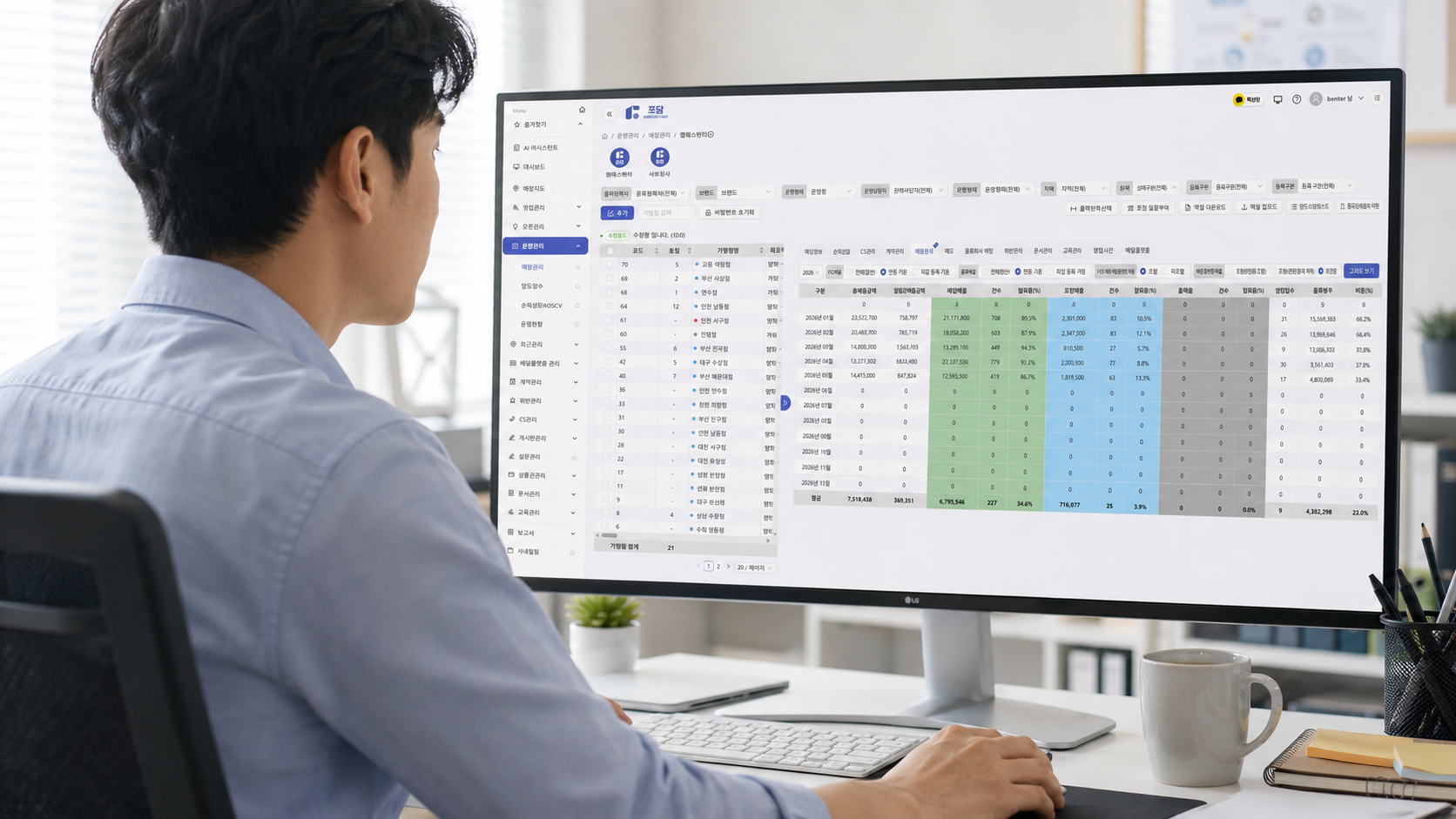
HQ manager screen showing each store's sales, costs, royalties and settlements together
The numbers HQ needs for store management are not just sales rankings. You need to look at each store's sales, costs, delivery fees, promotion spend, royalties, receivables and settlements together. Restaurant franchisors in particular should judge store profitability not by "What are the monthly sales?" but by "How much does the owner keep after real costs are deducted from monthly sales?"
For example, Store A may have high monthly sales but low real profitability because of heavy delivery app ad spend and discounts. Store B, on the other hand, may have smaller sales but be the healthier store thanks to stable food cost and labor ratios. If HQ can't tell these apart, it makes the wrong calls. Treating high-sales stores as top performers and low-sales stores as problem cases is now a risky approach.
What HQ really needs to watch is not sales rank but profit risk. The stores that need more attention are those with high sales but low profitability, high delivery sales but low settlements, recurring receivables after royalty billing, and promotion spend with no profit improvement. HQ must be able to identify these stores quickly.
Questions HQ should ask regularly
· What is each store's real margin?
· How much is left from delivery sales after fees and ad spend?
· Which stores are building up receivables after royalty billing?
· Did sales and profit both improve after promotion spend?
· Which stores have high sales but low profitability?
3. A high-sales store isn't always a good store
There's a common misconception at franchisor headquarters: classifying stores with high monthly sales as top performers. But high sales mean lots of customer orders, not that the store owner is making lots of money. If a store relies on heavy discount coupons, spends a lot on delivery app ads, or mostly sells high-cost menu items to generate sales, a high-sales store can actually be the riskier one.
Say a store does KRW 50 million in monthly sales. On the surface, that's a great number for HQ to showcase. But if its food cost ratio is 42%, delivery and ad costs are 18%, labor and rent are heavy, and royalties go unpaid repeatedly, the owner's real profit may be very low. Conversely, a store with KRW 30 million in monthly sales can be far healthier if its food cost ratio is stable, dine-in sales make up a large share, and promotion spend is low.
If HQ can't tell this difference, supervisors' visit priorities get skewed too. By focusing only on stores with falling sales, HQ can miss owners of high-sales, low-profit stores who are about to leave. Profit-centered management isn't about "helping only low-sales stores"; it's about "finding the stores whose structure makes it hard for owners to hold on, first."
| Comparison | Store A: high sales, low profit | Store B: mid sales, high profit |
|---|---|---|
| Monthly sales | KRW 50M | KRW 32M |
| Food cost ratio | 42% | 32% |
| Delivery/ad costs | High | Low |
| Royalty collection | Repeated arrears | Paid on time |
| HQ assessment | Immediate profit fix | Stable operations case |
4. What profit data should HQ manage?
Managing store owner profit doesn't mean building a complex accounting system. It means connecting, without gaps, the key cost items HQ needs to judge store operations. Simply linking sales, costs, royalties, delivery settlements, ad spend, promotion spend, receivables and operating history properly can transform the level of HQ management.
Even if a franchisor can't pull in a store's full accounting books, it can manage the operating data that connects directly to HQ. Typical examples include ingredient order data supplied by HQ, POS sales data, royalty billing data, receivables data, settlement data by delivery platform, promotion support records and supervisor visit history. Once this data comes together per store, you can see the big picture of store owner profit.
| Data item | What to check | How HQ uses it |
|---|---|---|
| Sales data | Monthly, daily, by-channel and by-menu sales | Understand growth and sales structure |
| Cost data | Order amounts by item, food cost ratio, ingredient cost changes | Analyze causes of profit decline |
| Delivery settlements | Sales, fees, ad spend and discounts by platform | See real profit from delivery channels |
| Royalties | Amount billed, collected, outstanding, days overdue | Manage owner burden and HQ revenue stability |
| Promotion spend | Coupons, discounts, ads, HQ subsidies | Check whether profit improved after promotions |
| Operating history | Supervisor visits, corrective action requests, owner consultations | Track responses to problem stores |
5. Delivery sales must be re-examined "on a settlement basis"
Delivery sales are where misunderstandings between franchisor headquarters and stores arise most often. They're recorded as sales in the POS, but in the actual settlement, platform fees, ad spend, discounts, delivery fees, card fees and VAT-related items are deducted. So even when delivery sales are high, the actual deposit can be lower than expected.
To manage delivery sales properly, HQ needs to look at sales and settlements separately by platform. Baemin, Coupang Eats, Yogiyo and other platforms have different fee structures and ad products, and each store uses different coupons and promotions. Even two stores with the same KRW 30 million in monthly sales can have very different owner profit depending on which platforms they use and how heavily.
And when HQ supports promotions, it shouldn't just check for a sales lift. If coupons and ad spend drove sales up but profitability got worse, the promotion is hard to call a success. Going forward, HQ's marketing KPIs should also shift from "How much did sales rise?" to "Did profit improve too?"
Common problems in managing delivery sales
· Looking only at POS sales without checking actual deposits
· Not separating fees and ad spend by platform
· Treating coupons and discounts only as a cost of sales growth
· Not checking for unpaid royalties or settlement delays after delivery sales grow
6. Royalties and receivables are HQ's "profit warning light"
For franchisor headquarters, royalties aren't just a revenue line. They're an important signal of a store's operating condition. If royalty receivables keep recurring even though sales are coming in normally, the owner's profit is very likely already under pressure. HQ shouldn't treat receivables as mere collections work but as an early signal of deteriorating store profit.
If royalties are tied to sales, HQ's billing grows as sales rise. But when the owner's profit has worsened, a heavier royalty burden can lead to growing receivables or rising owner frustration. With a flat royalty, on the other hand, it acts as a fixed cost burden on underperforming stores. Either way, HQ needs to look at royalty billings, collections, receivables, days overdue and store profit data together.
A store with recurring receivables isn't just someone to chase for payment; it's a case to analyze. HQ needs to determine whether the cause is falling sales, rising costs, delayed delivery settlements or the burden of promotion spend. When data reveals the cause, HQ can discuss more realistic solutions with the store owner.
| Receivable type | Possible causes | HQ response |
|---|---|---|
| Temporary arrears | Settlement timing gaps, short-term cash flow issues | Confirm settlement dates, adjust collection schedule |
| Recurring arrears | Worsening owner profit, fixed cost burden | Profit diagnosis, cost structure analysis |
| High-sales arrears | Excess delivery/ad costs, rising food cost ratio | Re-analyze profit by channel |
| Long-term arrears | Declining operational sustainability | Manage contract and operational risk |
7. Supervisor experience gets stronger when combined with data
In the franchise field, supervisors play a central role in store management. They visit stores, consult with owners, train staff, inspect quality and suggest ways to improve sales. The problem is that a single supervisor covers many stores and can't keep every store's profit structure in their head.
An experienced supervisor can sense problems just from a store's atmosphere and the owner's attitude. But if HQ's entire operating system depends on individual supervisors' instincts, management quality wobbles whenever staff change, store counts grow or the brand expands into new regions. Without data, even a great supervisor's know-how is hard to retain as an organizational asset.
Supervisors now need to be HQ consultants who talk with store owners based on data, not people who manage stores by gut feel. Instead of "Sales are down, so let's try harder," they should be able to say, "Last month your delivery ad spend rose 18% and your food cost ratio went up 4 percentage points, so your real margin dropped. Let's adjust the menu mix and promotions together."
Key insight
Good supervisors don't replace data; they get stronger with it. Data finds problems fast, and supervisors interpret the causes on the ground and turn them into action.
8. FDAM brings store operating data together in one place
FDAM ERP DASHBOARD
Unified sales, royalties, receivables and settlements
Store
Royalty
Receivable
Gangnam
Billed
₩0
Songdo
Billed
₩1.2M
Bucheon
In review
₩350K
At-risk stores
6
Stores in arrears
3
Dashboard in a franchise ERP that manages sales, royalties, receivables and delivery settlement data in one view
FDAM is an HQ ERP solution that helps franchisor headquarters manage store operating data systematically. What matters for HQ is keeping data from being scattered. If sales live in POS reports, delivery settlements are split by platform, royalties are calculated in Excel and receivables are tracked separately by each staff member, accurate decisions are hard to make.
FDAM focuses on organizing this operating data around HQ's needs. When staff can see each store's sales trends, royalty billing, collection status, receivables and operating history in one place, they can identify problem stores faster. They can distinguish stores whose sales rose but royalty receivables keep recurring, stores with high delivery sales but low settlements, and stores whose sales rose after a promotion while real profit didn't improve.
As this data builds up, HQ manages stores based on evidence rather than instinct. When supervisors visit, they can offer improvement plans grounded in each store's data rather than vague advice. Store owners, in turn, gain confidence that HQ understands their situation in numbers.
| HQ's challenge | How FDAM handles it |
|---|---|
| Hard to see each store's profit at a glance | Unify sales, costs, settlements, royalties and receivables per store |
| Royalty calculations and collections are scattered across Excel files | Manage billings, collections, receivables and overdue history on one screen |
| Hard to reconcile delivery settlements with actual sales | Compare settlement flows by platform and real profit by store |
| Supervisor visit history stays with individual staff | Build up per-store consultations, requests and outcomes as HQ assets |
| Problem stores are found after the fact | Spot early warning signs like profit decline, recurring arrears and lower settlements |
9. HQ's management standards need to change too
MANAGEMENT SHIFT
BEFORE
Sales-centered
Store management focused on monthly sales, sales rankings and month-over-month growth
→
AFTER
Profit-centered
Operations management that connects costs, fees, royalties, receivables and settlements
Step-by-step infographic of store management shifting from sales-centered to profit-centered
Going forward, franchisor headquarters' management standard has to shift from "How much did we sell?" to "How much did we keep?" This change isn't only needed for internal operations. It ties into franchise recruitment, owner training, supervisor operations, marketing strategy and royalty policy.
The same goes for franchise recruitment. In the past, pitches often emphasized average monthly sales, startup costs and payback period. But prospective franchisees now ask more specific questions: "What's the food cost ratio?", "How much is actually left after delivery fees?", "How are royalties calculated?" and "How does HQ support the store?"
To answer these questions, HQ needs operating data. Just showing success stories isn't enough. An HQ that can explain itself in numbers earns more trust. FDAM gives headquarters a foundation for managing store operating data and using it in communication with store owners, in step with this shift.
10. Store owner profit management checklist
The checklist below is a practical benchmark for assessing how systematically your franchisor headquarters manages store profit today. What matters isn't just whether you have the data, but whether it's connected at the store level. Even with sales data, it isn't really profit management unless it's linked to costs, settlements, royalties and receivables.
| Category | Checkpoint | Data to check |
|---|---|---|
| 01 | Do you review monthly sales by store and by channel separately? | POS and delivery platform sales |
| 02 | Can you see each store's food cost ratio and order amounts by item? | Order data, item costs |
| 03 | Do you track the gap between delivery sales and actual settlements by platform? | Delivery settlements, fees, ad spend |
| 04 | Do you manage royalty billings, collections and receivables per store? | Royalty billing and collection history |
| 05 | After promotion spend, do you check profit improvement as well as sales? | Coupons, ad spend, promotion results |
| 06 | Do you separately classify high-sales, low-profit stores? | Net margin vs. sales, cost ratios |
| 07 | Are supervisor visit records linked to profit improvement results? | Visit logs, actions taken, improvement metrics |
The limits of Excel: you have the numbers, but they aren't connected
Many franchisor headquarters start out managing store sales and royalties in Excel. With only a few stores, Excel is fast and convenient. But as stores multiply and delivery platforms, settlement items, royalty policies, promotion spend and receivables get more complex, Excel quickly hits its limits.
The biggest problem is that data gets scattered across files. With separate files for sales, royalties, receivables, supervisor visits and delivery settlements, staff have to compare them by hand every time. When file versions diverge or staff change, it even takes time to figure out which data is current.
Connection is the heart of profit management. If sales rose but receivables grew, you need to find out why; if delivery sales rose but actual settlements are low, you need to look at fees and ad spend. If promotion spend didn't improve profit, the promotion strategy needs to change. In Excel, a person has to build these connections manually every time.
Common problems with Excel-based management
· Store names, codes and royalty rules are entered differently by each staff member
· Sales, settlement, royalty and receivables data aren't linked to one another
· Finding why a store's profit is declining means opening multiple files
· Supervisor visit history is separated from actual improvement results
· Manual work repeats every time you prepare an executive report
Store owner profit management matters for marketing too
Managing store owner profit isn't just the operations team's job. It directly affects franchise recruitment and brand marketing. Prospective franchisees now ask about real operational stability rather than simple sales examples. More than "monthly sales of X," they want to know "how much is actually left," "what data HQ uses to manage stores," and "how the royalty and cost structure works."
If HQ manages per-store profit data, it can make a more persuasive case in franchise consultations. Instead of only showing the high sales of successful stores, it can explain how stores with stable profit structures operate, its food cost ratio standards, profitability by delivery channel and HQ's management process.
This isn't about exaggerated advertising; it's about trust. Prospective franchisees in the franchise market are getting savvier. A brand's fame still matters, but how systematically HQ manages its stores is becoming an important deciding factor too. An HQ with profit data can craft a stronger message in franchise recruitment as well.
How questions change in franchise consultations
· "What are the monthly sales?" → "How much is left after delivery fees and costs?"
· "What are the startup costs?" → "What profit basis do you use to calculate the payback period?"
· "Does HQ provide support?" → "What data does HQ use to manage stores?"
· "Do you have successful stores?" → "What do stores that operate stably for years have in common?"
A 30-day action plan franchisor headquarters can start now
Managing store owner profit isn't a project you finish in one go. Trying to integrate all the data perfectly from day one actually delays the start. HQ should first organize key metrics and build comparable standards across stores. The 30-day plan below is a starting point for shifting from sales-centered to profit-centered management.
1
Week 1: Map where data lives
Document where sales, royalties, receivables, delivery settlements, promotion spend and supervisor history each reside.
2
Week 2: Standardize store codes
Standardize store names, store codes, regions and assigned supervisors so all data links to a single store record.
3
Week 3: Set profit risk indicators
Define the key warning indicators HQ will watch, such as food cost ratio, delivery cost ratio, receivables, promotion spend share and settlement decline rate.
4
Week 4: Prioritize problem stores
Classify high-sales/low-profit stores, recurring-arrears stores, stores with falling delivery settlements and stores with excessive promotion spend, then set corrective actions.
When stores last, the brand lasts
A franchisor's competitiveness now comes not from store count but from the management capability that keeps stores running for the long term. Even if you recruit many stores quickly, the brand can't last if existing stores' profitability collapses. As closures rise, prospective franchisees lose trust in the brand, and HQ's internal operating costs climb too.
Managing store profit isn't a welfare program for store owners. It's HQ's survival strategy. When owners operate stably, royalties are collected reliably, brand quality is maintained and HQ can build strong examples for new franchise consultations. Managing store profit means owners and HQ look at the same numbers and move in the same direction.
FDAM helps franchisor headquarters manage stores with data, not instinct. By managing sales, royalties, receivables and operating history in one place, HQ can spot problems faster and step in more precisely. Managing well matters more than selling well. That's the core capability franchisor headquarters need today.
Frequently asked questions
Q. Isn't looking at sales enough to manage stores?
A. No. Even with high sales, real profitability can be low if the cost, delivery fee, ad spend, royalty and receivables structure is poor. HQ has to look at costs and settlements, not just sales, to identify high-sales, low-profit stores.
Q. How far should HQ go in managing store owner profit?
A. It doesn't mean HQ takes over the owner's entire accounting books. The key is to connect, at the store level, the data directly linked to HQ (sales, orders, royalties, receivables, delivery settlements, promotion spend and supervisor history) and use it for operational decisions.
Q. Which headquarters need FDAM most?
A. It's a good fit for headquarters whose growing store count makes it hard to manage sales, royalties, receivables and operating history in Excel. It's especially valuable for brands with a high share of delivery sales, complex settlement management across platforms, or where royalty collection and receivables management are critical.
Q. Why does store owner profit management matter for marketing?
A. Because in franchise recruitment, showing real operational stability and HQ's management system is becoming a more persuasive selling point than raw sales figures. Prospective franchisees now ask about food cost ratios, delivery fees, royalties and real profit structure, not just monthly sales.
Q. Isn't a store with high delivery sales a good store?
A. Not necessarily. Delivery sales come with fees, ad spend, discounts and delivery costs, so you need to check actual settlements and profit. A store with high delivery sales but low settlements and a high food cost ratio may be an at-risk store.
Q. Why are royalty receivables a profit management indicator?
A. Royalty receivables can signal that a store owner's cash flow has deteriorated. If receivables keep recurring despite sales, you need to examine the profit structure, including rising costs, delivery fee burden, settlement delays and excessive promotion spend.
Q. Isn't Excel good enough?
A. It works early on, but as store count grows, sales, royalties, receivables, delivery settlements and operating history end up scattered across separate files. Since data connection is the heart of profit management, you need a system that can unify management at the store level.
FRANCHISE MANAGEMENT · FDAM
Are your stores today
managed by profit, not by sales?
A franchisor's competitiveness now comes not from store count
but from the ability to keep stores running for the long term.
If you want to manage sales, royalties, receivables, settlements and operating history in one place, review how your HQ manages its stores with FDAM.
Contact salesLearn about FDAM KakaoTalk chat
franchise headquarters, store profit management, franchise ERP, FDAM, store management solution, royalty management, receivables management, delivery settlement, restaurant profitability, store owner profit, store sales management, franchise operations, supervisor, delivery fees, food cost management, store profit improvement, franchise marketing, franchise recruitment, HQ ERP, franchise data management