The Complete Guide to Choosing an AI Solution for Franchise HQ
Criteria for adopting an AI solution at franchisor headquarters, and how FDAM automates HQ work

KEY SUMMARY
· FDAM is an AI solution built for franchisor headquarters that automates the HQ tasks repeated every day, such as sales aggregation, review responses and CS handling.
· You can bring scattered franchise store data together in one place inside FDAM, a franchise ERP, and manage it systematically.
· The more headquarters data builds up in FDAM, the more the AI assistant grows into a dedicated assistant tailored to your headquarters.
An AI solution for franchisor headquarters is an operations tool that automates the work HQ repeats every day, such as sales aggregation, delivery review responses, store CS handling and operational inspections, and ties scattered franchise store data together so it can feed straight into decisions.
This article is for franchisor headquarters executives and staff evaluating AI solutions. It covers which tasks to tackle first and where FDAM fits in.
Contents
1. When headquarters operations suddenly get heavy
2. Repetitive HQ tasks AI should take on first
3. How to turn sales and review data into HQ decisions
4. Why AI belongs inside your franchise ERP
5. Four things headquarters should check before adopting
1. When headquarters operations suddenly get heavy

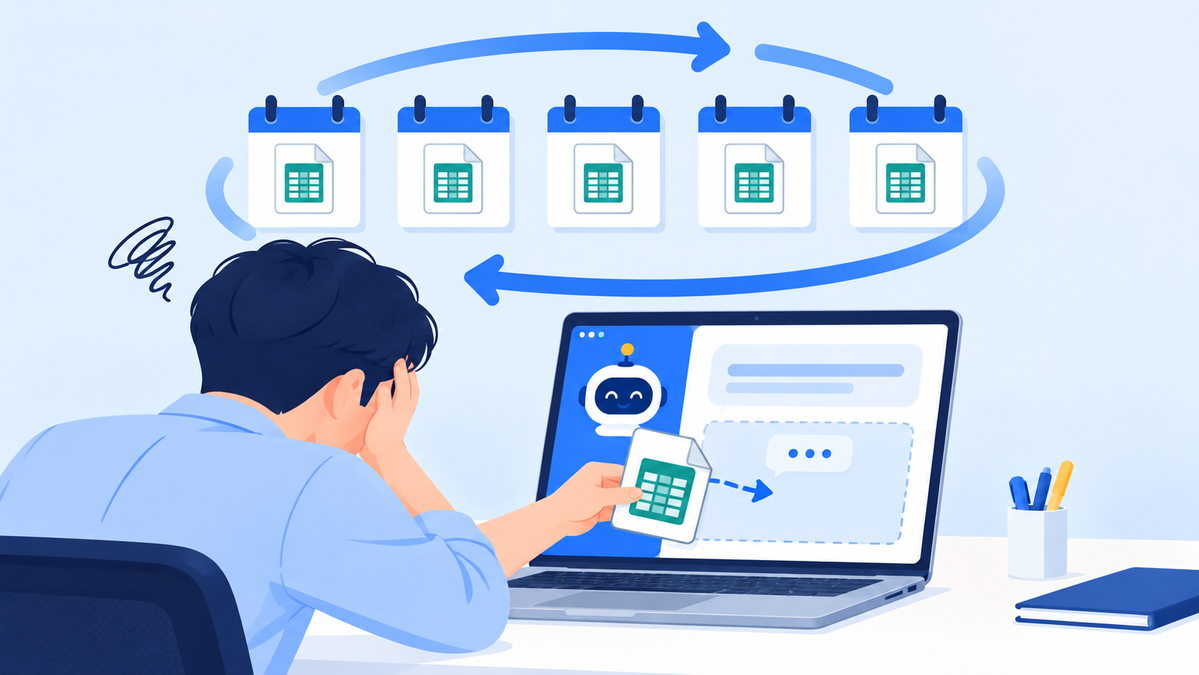
With one or two stores, headquarters can get by on a spreadsheet or two and the memory of the person in charge. But as the store count grows, there comes a moment when the same approach can't hold up. You have to check sales for many stores one by one and juggle everything at once, from delivery app setup and review management to supervisor inspection results and store inquiries.
Franchisor headquarters struggling with excessive workloads
You have to check sales for many stores one by one and juggle everything at once, from delivery app setup and review management to supervisor inspection results and store inquiries. When this continues, HQ staff spend the whole day just gathering data, leaving less and less time for actual operating decisions, and the vicious cycle repeats.
The first move most headquarters make at this point is to add headcount. Hiring one more person seems like it should double the processing speed, but in practice it doesn't. If data is scattered across systems, the new hire also has to gather information before writing any report. If the time spent gathering data grows along with the store count, more people is only a stopgap.
The fundamental reason headquarters needs an AI solution isn't to do the same work faster. It's to reduce the work that doesn't need doing at all.
2. Repetitive HQ tasks AI should take on first

The fastest results come from templated writing and response tasks. The notices, inspection summaries, store guidance messages, delivery review replies and CS response notes HQ staff handle every day differ in content but share a similar structure. The parts that truly need human judgment are surprisingly short, and the rest is often patterned.
Change 01
AI for delivery review replies
Review replies are considered one of the biggest time sinks in franchising. Post the same reply to every review and the brand voice falls apart; write each one differently and there's never enough time.
FDAM's AI review replies automate this to headquarters' standards. Set the reply tone in advance by choosing the persona that fits your brand from five options (Friendly owner / Professional / Upbeat / Attentive / Relaxed), and draft replies with a consistent feel are created for both positive reviews and complaints. HQ staff or store owners just review and post. Response quality becomes consistent, the burden on stores drops, and brand consistency holds without HQ policing every reply.
Change 02
AI for CS answers
Many of the inquiries stores send to headquarters are repeats. Supply order schedules, where to find a manual, notices about operating policy changes: it's common to answer today what you already answered yesterday. FDAM's CS AI automatically creates draft answers based on past response history. The HQ operations team only needs to review and refine them, and answer quality varies less from person to person.
3. How to turn sales and review data into HQ decisions
The question asked most often at headquarters is, "How are sales this week?" It's a short question, but answering it means gathering POS sales, delivery app sales and settlement data by channel. If that data lives in separate systems, answering takes time, and even after you answer, you have to repeat the same work next week.
Sales data: scattered channels on one screen
FDAM aggregates franchise stores' POS and delivery app sales on a next-day basis so headquarters can review trends by store and by period on a single screen. On top of that sits the AI assistant: just ask in plain language and you get an answer.
"Tell me the average sales of our Gangnam-area stores last month"
"Show me a sales trend graph for stores newly opened this quarter"
"List the stores whose sales declined over the past month"
Type questions like these and the results come back as reports or graphs. FDAM is the first franchise ERP in Korea with natural-language data queries.
Review data: from automated responses to operational diagnosis
After sales, reviews are the data headquarters looks at most often. But because reviews don't boil down to numbers the way sales do, teams often spend all their time responding and never get around to analysis.
In FDAM, review data works in two stages. First, AI review replies automate everyday responses to lighten the load on stores. The reviews that accumulate along the way remain as material for operational diagnosis. If phrases like "the food arrived cold" or "the packaging could be better" keep coming up at a particular store, headquarters can read that as an operating signal rather than just customer feedback.
Sales trends, review patterns and QSCV inspection results become far more meaningful when they accumulate together in one system. You can decide which stores to manage first based on data rather than a staff member's gut feeling.
4. Why AI belongs inside your franchise ERP
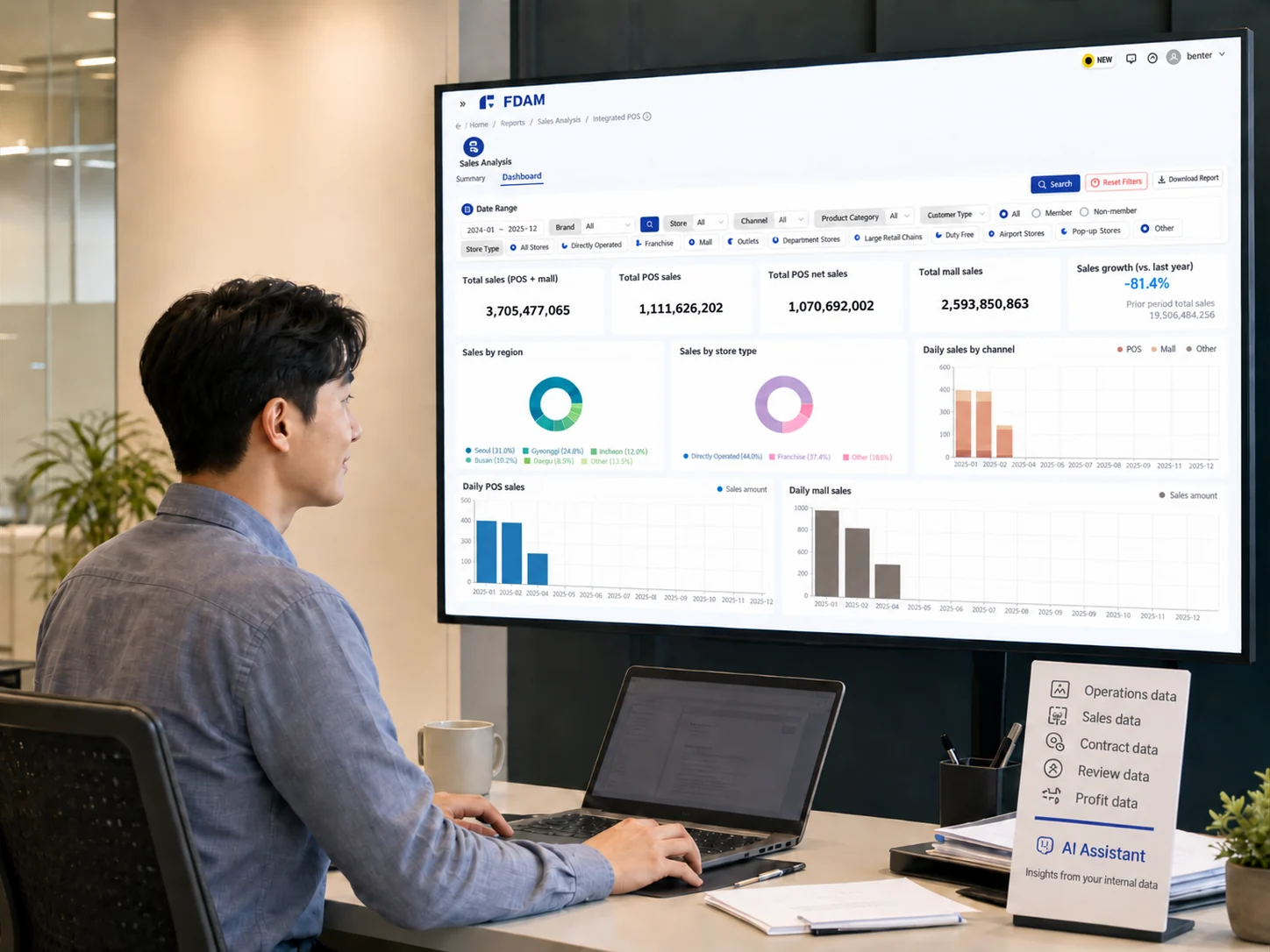
Some headquarters adopt AI tools on their own, bolting on a reply generator, a review analytics tool and a sales dashboard separately. That works in the short term. Over time, though, the limitation becomes clear: data piles up separately in each tool and never comes together as a headquarters asset.
FDAM approaches this differently. The AI assistant, AI review replies and CS AI sit on top of a franchise ERP that follows headquarters' workflow from sales management → opening management → operations management. Information entered at the franchise consultation stage carries straight through to contract, opening and operating data, and AI works on top of it, so a store's entire life cycle is managed within the same system.
That's also why headquarters on general ERPs move to franchise ERPs. General ERPs are strong at accounting and inventory management, but they don't cover franchise-specific work such as franchise sales, sending and tracking pre-disclosure documents, store inspections and HQ-to-store communication. Even with AI features, if franchise data doesn't flow in, the answers stay generic.
MS Benter has worked alongside franchisor headquarters for nearly 25 years. In this context, the fact that FDAM was built on that experience matters. You have to know what headquarters handles all day and where it gets stuck most often to attach AI features that fit exactly where they're needed.
Change 03
An AI assistant of your own, trained on your HQ data
What headquarters should be growing isn't AI itself, but "an AI assistant dedicated to your headquarters". If sales, contract, operations, revenue and review data are scattered across systems, any AI you attach will give generic answers. When you gather headquarters data in one place in FDAM, a franchise ERP, and manage it systematically, the AI assistant running on top of it gets smarter about your headquarters' situation over time. That's why year one differs from year three, and why the same solution produces different results at different headquarters.
5. Four things headquarters should check before adopting
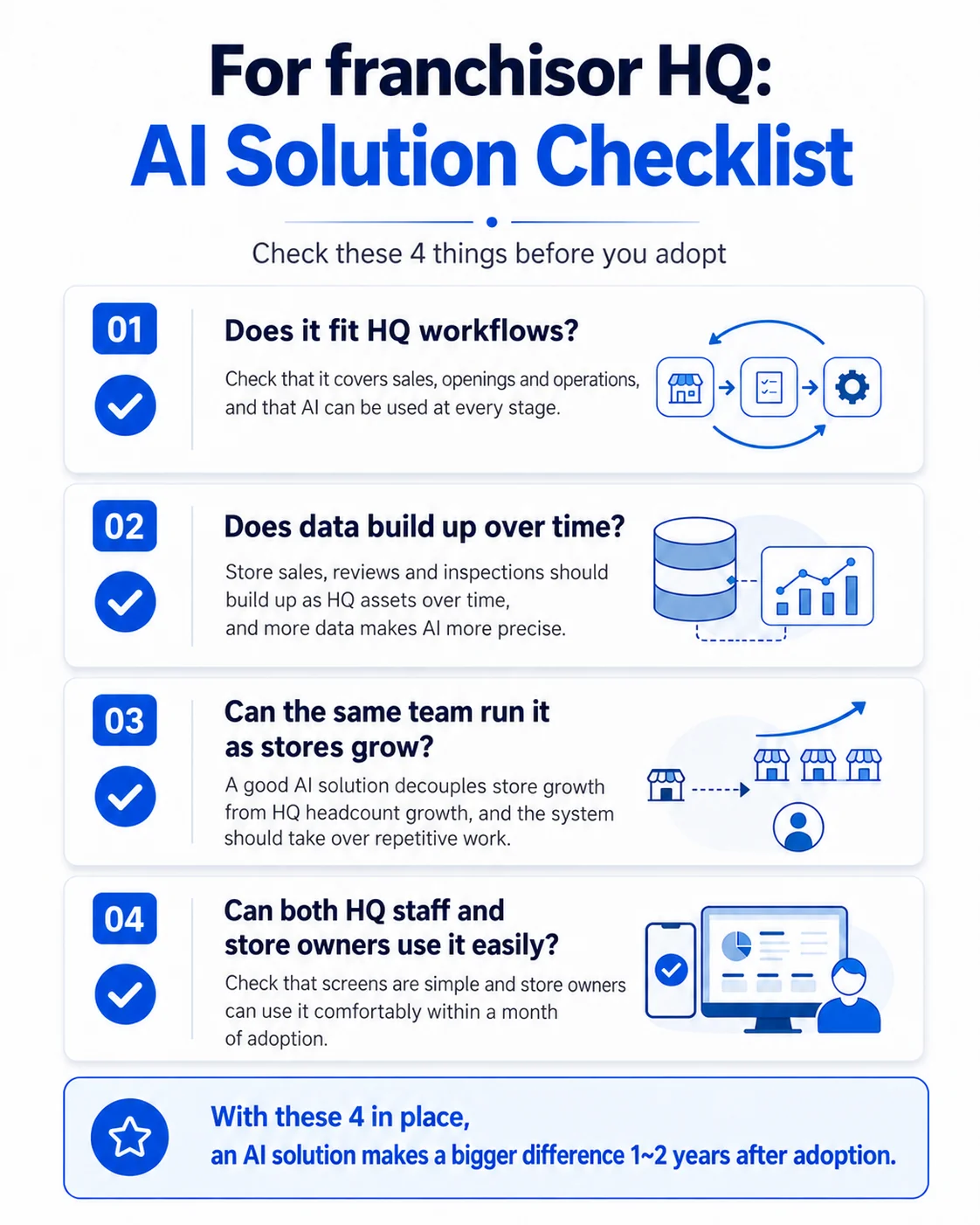
Finally, here are criteria worth reviewing for headquarters evaluating AI solutions.
01
Do the features mesh with headquarters' workflow?
No matter how many impressive AI features a product has, they won't get used if they're disconnected from the work HQ staff do every day. Check whether you can manage sales, openings and operations as a whole, and whether AI is available at every stage.
02
Is the structure built to accumulate data?
It shouldn't stop at one-off reply generation. Sales, reviews and inspection results by store should build up over time as a headquarters asset. Only when data accumulates does AI get smarter about your headquarters' situation.
03
Can you keep operating with the same team as the store count grows?
A good AI solution decouples the pace of store expansion from the pace of HQ headcount growth. If hiring pressure at headquarters rises as the store count grows, it's a sign the system isn't taking on enough of the work.
04
Can both HQ staff and store owners get comfortable with it?
If the HQ screens are complicated or store guidance is hard to follow, work won't get done in the system and will slip back to KakaoTalk and phone calls. Check whether there are features store owners use naturally within a month of adoption, and you'll have your answer.
With these four in place, an AI solution makes a bigger difference one to two years after adoption than right after it. Headquarters operations change in character once AI starts working on top of accumulated data.
Frequently asked questions
Q1. How are FDAM's AI features different from a general AI chatbot?
FDAM's AI works on top of headquarters' operating data (sales by store, reviews, franchise store information, inspection results and more). Where a general chatbot gives generic answers, FDAM's AI assistant queries headquarters data directly and returns results by store and by period as reports or graphs.
Q2. What kinds of questions can the AI assistant handle?
It handles natural-language questions about data accumulated in FDAM, such as sales, store operating status, trends for newly opened stores and stores with declining sales. Questions with specific conditions work too, like "average sales of Gangnam-area stores last month" or "a list of stores with declining sales this quarter."
Q3. Can the AI review reply persona be set differently for each store?
Yes. Headquarters can unify the brand voice across the board, or apply the five personas (Friendly owner / Professional / Upbeat / Attentive / Relaxed) differently to suit each store's character or region.
Q4. Can POS sales data be viewed in real time?
FDAM's unified POS sales view is aggregated on a next-day basis. Sales data through the previous day is organized by store and by channel on the HQ screen.
Q5. How long does it take to see results after adoption?
Automating repetitive tasks such as delivery review replies and CS responses saves time right after adoption. However, it usually takes one to two quarters for enough sales, review and inspection data to build up for the AI assistant to work in tune with your headquarters' situation.
START WITH FDAM
AI built around your HQ workflow,
starting with FDAM
A good place to start is looking at which tasks take up most of a single HQ staff member's day. That's where an AI solution can lighten the load first.
Learn more about FDAM 1:1 chat on KakaoTalk Call 1544-7120
Franchise HQ AI, FDAM, franchise ERP, AI review replies, HQ work automation, AI assistant, franchise AI solution, franchise store management, CS AI, franchise sales management