What FDAM's Inquiry Data Shows: How Franchisors Should Prep for AI Search
What franchisors need for the AI search era is operating evidence that is uniquely theirs
SUMMARY
What franchisor headquarters need to prepare for the AI search era is not a special technique for search visibility, but concrete operating evidence that only their own headquarters can speak to. Generative AI has already become the first place people look when searching for a franchise ERP, and FDAM saw the same shift in the sales inquiries it received over the past three months. Google's official guide to generative AI search, released in May 2026, likewise put content containing real experience and judgment that can't be found anywhere else at the core, rather than special technical tricks or mass-produced content.
The change showed up first in one small question on our inquiry form
When did you first notice that the way people search is changing?
When FDAM receives a sales inquiry, we also ask, "How did you hear about FDAM?" Lately, a steady stream of franchisor headquarters have answered that they learned about us through a generative AI recommendation or answer. This isn't a one-off coincidence: 28% of the inquiries we received over three months gave that answer.
The point isn't simply that we gained another acquisition channel. It means that the people at franchisor headquarters, FDAM's prospective customers, have started describing their industry, store count and current problems to AI and getting a shortlist of suitable solutions and comparison criteria first, before opening and comparing search results one by one. That is closer to a signal that the very order in which people gather information is changing.
People used to compare search results themselves. Now AI recommends the shortlist
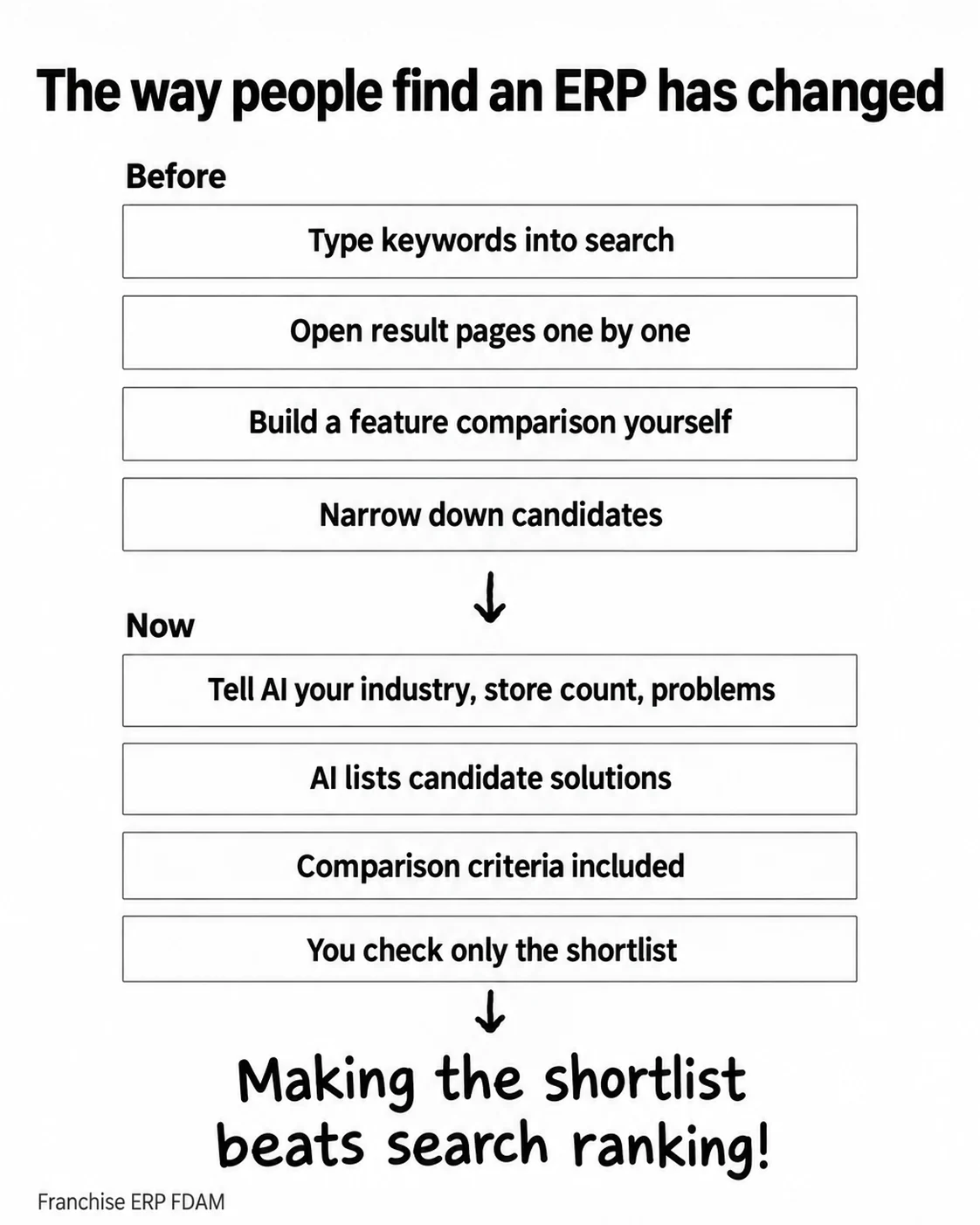
In the past, finding an ERP was a matter of "comparing it yourself" for the person at a franchisor headquarters. The process usually went like this.
First, they typed "franchise ERP" into the Naver or Google search box. A list of results came up. They clicked through the vendor pages near the top one by one. On each page they read the feature descriptions, looked at sample screens and, if needed, downloaded the brochure. After collecting three or five vendors this way, they built a comparison table and narrowed down the candidates.
Under this model, solution vendors cared about one thing: where they ranked in the search results. Being near the top of the first page meant a good chance of getting clicked, while slipping to the second or third page meant never being opened at all.
Today, the front end of that process has changed.
Instead of typing a short keyword into a search box, the person opens a generative AI tool such as ChatGPT, Gemini or Perplexity and describes their situation in full sentences. For example: "We're the headquarters of a café franchise and our store count keeps growing. Each staff member manages contracts and store inspections separately, and we're hitting the limits of that. Please give me a list of recommended franchise-specific solutions."
The AI reads that description, picks a few solutions that seem to fit the criteria, and summarizes their names and features. On top of that, it offers comparison criteria: "When evaluating solutions like these, compare the following items." The shortlist and comparison table that the person once had to build by hopping between pages now arrive in the very first step.
Of course, they still visit each vendor's website to check for themselves afterward. But by then, the candidates have already been narrowed to a handful.
Before your search ranking, what matters is whether your name makes the AI's shortlist.
Here's why that difference matters. On a search results page, even if your company sat near the bottom, there was still a chance someone would notice it while scrolling. But the shortlist AI provides is usually short, around three to five names. If your name isn't on it, the person moves on to the next step without ever knowing your company exists. You don't even get the chance to be compared.
And this change isn't happening only to people shopping for an ERP.
People researching your brand are already asking AI first, too
Think about who takes an interest in a franchisor headquarters. There are four broad groups.
First, prospective founders exploring a business. They start moving before they even know brand names. Rather than searching for a specific brand, they state their conditions and ask for recommendations. They ask AI questions like, "I want to open a café with my severance pay. Which brands don't have heavy upfront costs?" If you don't make the shortlist at this stage, your brand never enters consideration.
Second, prospective store owners about to sign. They already know your brand. What they want to confirm is whether the contract terms are fair, whether headquarters keeps supporting stores after opening, and how existing owners rate the brand. They used to dig through reviews in startup communities; now they type the brand name into AI and ask, "Summarize this brand's franchise terms and reputation."
Third, business partners. Companies looking to supply ingredients or packaging, or to handle logistics or interiors, first weigh whether the relationship will be stable. They use AI while looking into a company's size, track record and recent situation.
Fourth, job applicants. When a job posting catches their interest, they look into what kind of company it is. They used to check company profiles on job sites or employee reviews; now they type the company name into AI and ask first.
All four groups share one behavior. A new step has appeared: asking AI once before moving on to portal searches, community reviews or word of mouth. And to answer those questions, AI draws on information published on the internet, such as your website, blog, press releases, job postings and franchise recruitment pages.
When AI describes your brand, have you created the material it will draw on yourself?
Google's answer was surprisingly simple
By now you may be asking, "So what do we have to do to look good to AI?" The marketing industry has floated all sorts of techniques in response. Then, on May 15, 2026, Google published its first official guide on the topic.
Let's start with how Google says it works. When you search on Google, an AI-generated summary sometimes appears above the list of results. That feature is called AI Overviews, and the feature that lets you search conversationally is AI Mode. Google stated that these two features are not an entirely new, separate system. They use the data and ranking systems that Google Search has already built and generate answers on top of them.
One conclusion follows directly. A page that hasn't earned trust in regular search won't be cited in AI answers either. There is no separate AI-only channel; the evaluation a page receives in regular search carries straight over.
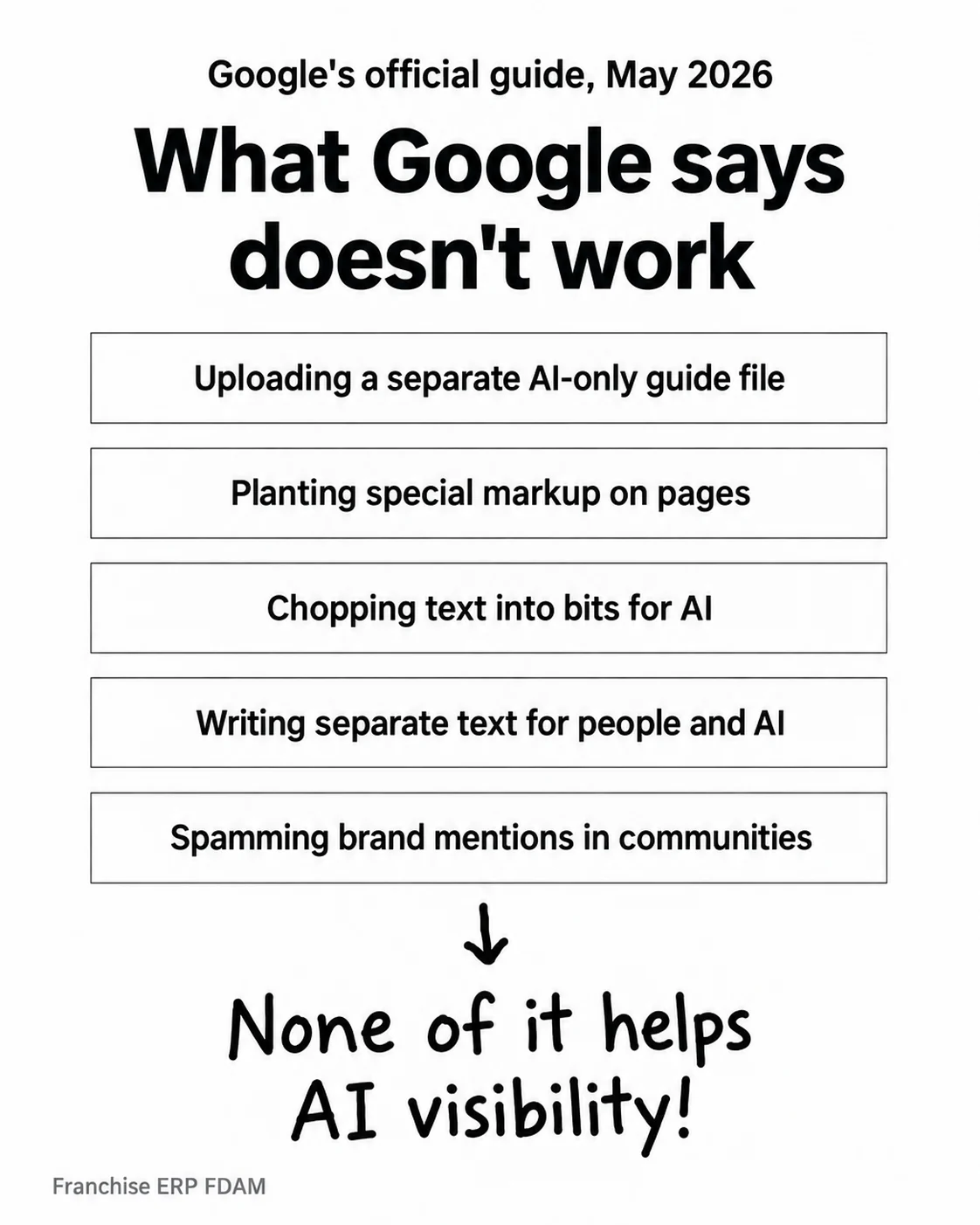
Next, Google stated that a range of techniques circulating in the industry have no direct effect on AI visibility. Specifically: uploading a dedicated instruction file to your site for AI to read, embedding special markup in pages, chopping content into small fragments so AI can digest it more easily, writing separate versions for people and for AI, and spreading your company name across communities and blogs to boost mentions. Google said none of these help visibility or ranking in its AI features.
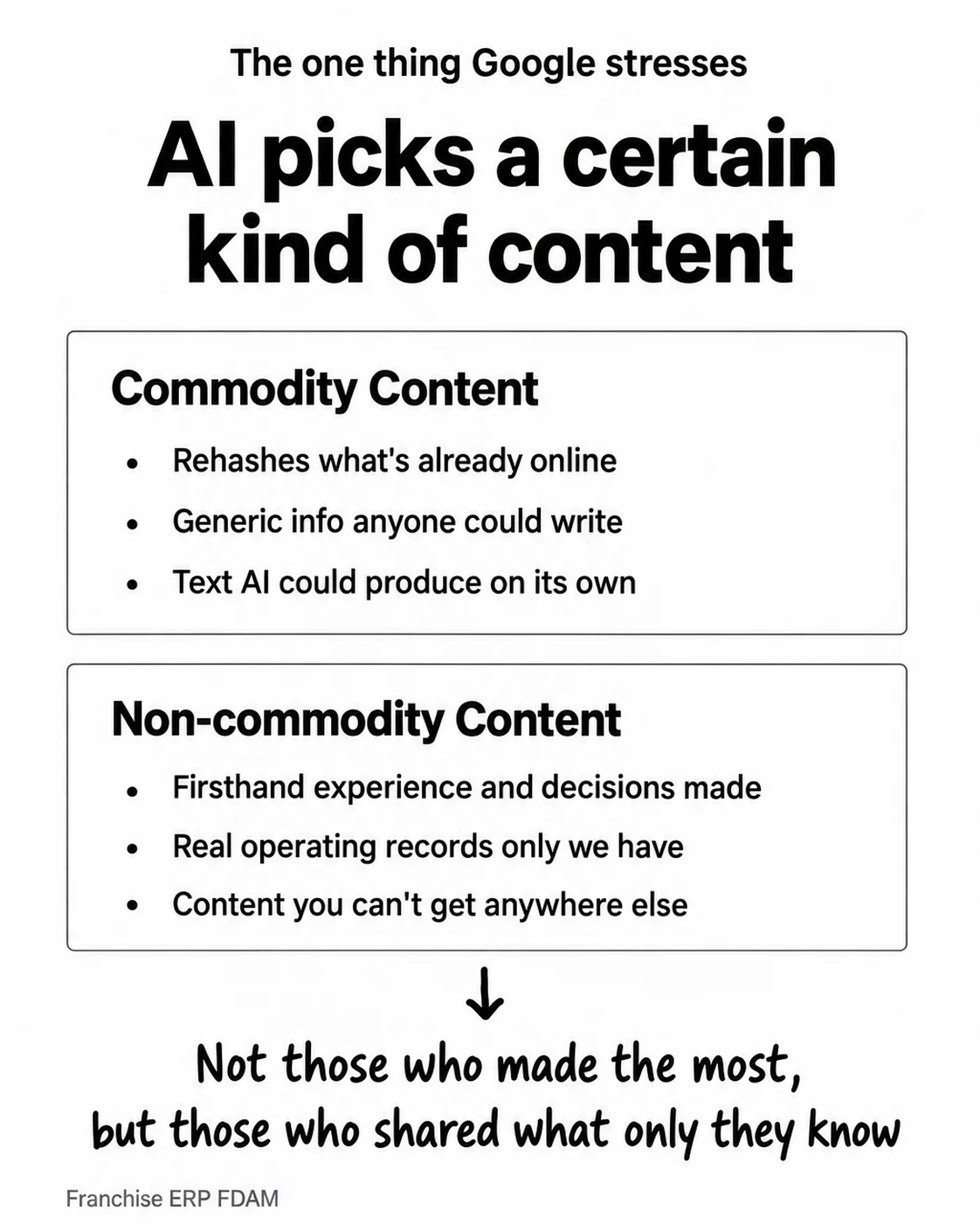
What it emphasized most instead was non-commodity content. The term may be unfamiliar, but the meaning is simple. A commodity is a common good you can buy anywhere, and non-commodity is the opposite: content you can't get anywhere else.
The contrast Google drew helps. An article that re-summarizes common knowledge already all over the internet, such as "Seven Things First-Time Founders Should Know," is commodity content. Anyone could write something similar, and AI could generate it on its own. By contrast, writing that captures a process you went through firsthand and the judgments you made along the way is non-commodity. Only that person or that company can write it.
Google also attached a warning: targeting every question people might ask and mass-producing similar pages for each one is a violation of its search policies.
The places AI picks aren't the ones that produced the most content, but the ones that published stories only they know.
Sentences that would fit on any brand's website
Translate this standard into the language of franchisor headquarters, and things become quite concrete.
Most headquarters websites and franchise recruitment pages contain similar sentences: systematic store support, stable operating systems, mutually beneficial partnerships. They're probably all true. The problem is that you could paste these sentences onto a competitor's page and no one would notice. From AI's point of view, sentences like these aren't usable material, because they contain no evidence that distinguishes your brand from others.
Here's what changes when you turn claims into evidence
Instead of "We provide systematic support to our stores"
It's better to show, step by step, what headquarters does and when, from the day the contract is signed to the day the store opens. Write down which documents owners receive after signing, how far headquarters is involved in choosing the interior contractor and setting the construction schedule, and how many days owner training lasts and what it covers. With this written down, prospective owners can picture the process ahead of them, and AI can describe the brand's opening procedure in concrete terms.
Instead of "We communicate closely with our stores"
It's better to explain the channels and frequency headquarters uses to reach store owners: how notices are sent, when and how recipe or operating guideline changes are announced, and who picks up an owner's inquiry and within how many days they reply.
Instead of "Our quality control is thorough"
It's better to disclose what store inspections cover and how often they happen. It's even better to go on and explain what items are on the checklist, who conducts the inspection, how results are shared with the owner, and when areas needing improvement are rechecked.
Instead of "We run a stable logistics operation"
It's better to explain the rules from order to store delivery: the order cutoff time, how long shipping takes after cutoff, how many deliveries per week, and the criteria for accepting returns or exchanges.
Instead of "Our headquarters operations are efficient"
It's better to show, within what you can disclose, which numbers you track and how they've changed over time. You don't need to publish every figure. Simply showing which metrics you manage conveys your level of operations well enough.
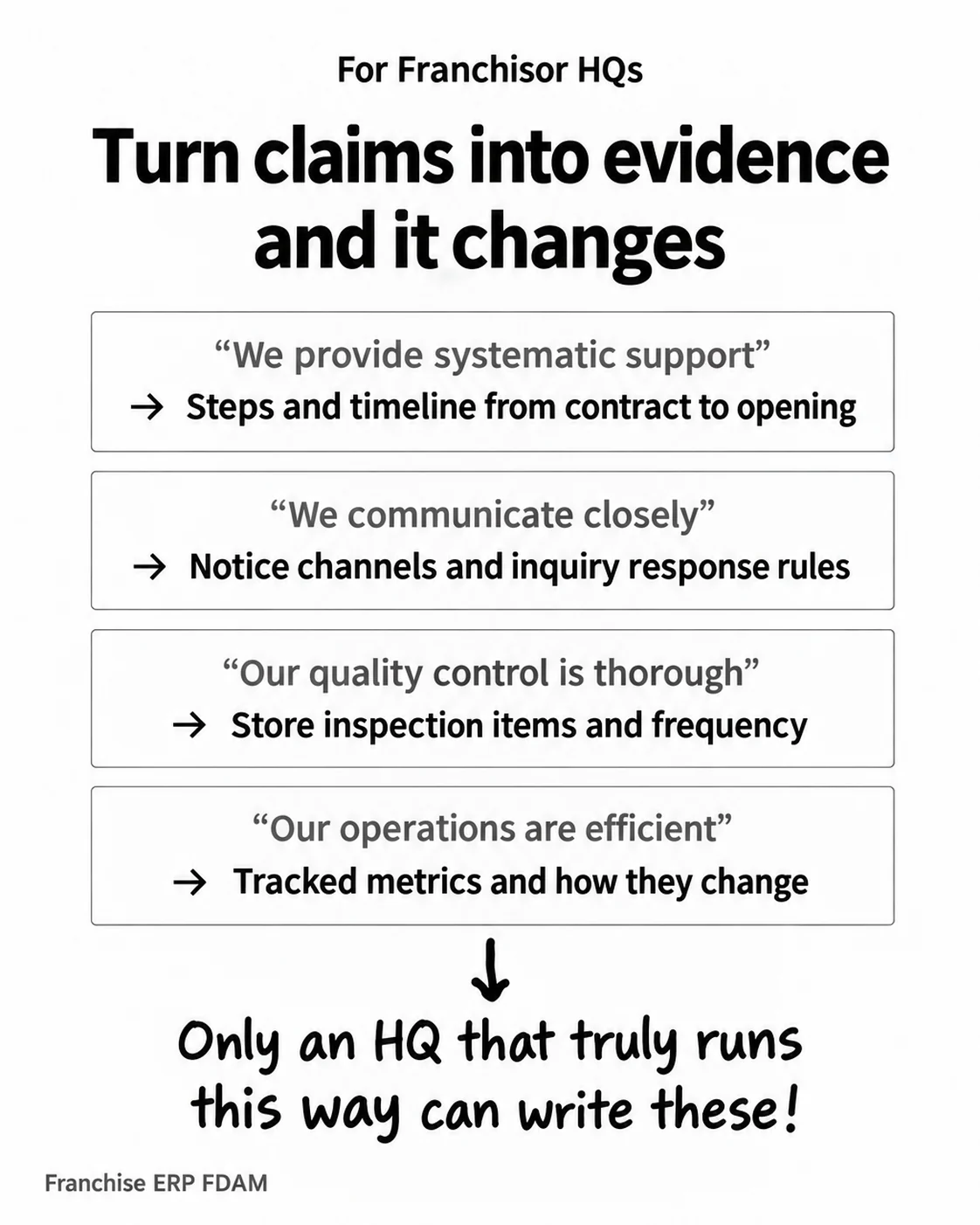
You'll see the common thread. The sentences on top are ones anyone can write; the ones on the right can only be written by a headquarters that actually operates that way.
But this is where most get stuck
To write the sentences below, that information has to exist as records inside the company. And this is exactly where many headquarters stall.
If the opening procedure lives only in someone's head, it can't be put into writing. If the order differs slightly from person to person, you first have to decide what your headquarters' standard procedure actually is. If inspection results are scattered across different formats every time, you can't say what has improved. If contract information is split across separate files, it takes time just to confirm how many contracts are in what status right now.
In the AI era, the headquarters with no evidence to share isn't the one that didn't create content. It's the one whose operations were never recorded.
That's why this isn't just a marketing problem. Organizing your operations becomes the very act of building the evidence you can explain to the outside world. Over roughly 25 years of watching franchise operations up close, it's also the scene we've encountered most often.
Five things you can check in 30 minutes today
These are checks you can run right now without elaborate preparation. Go through them one at a time, in order.
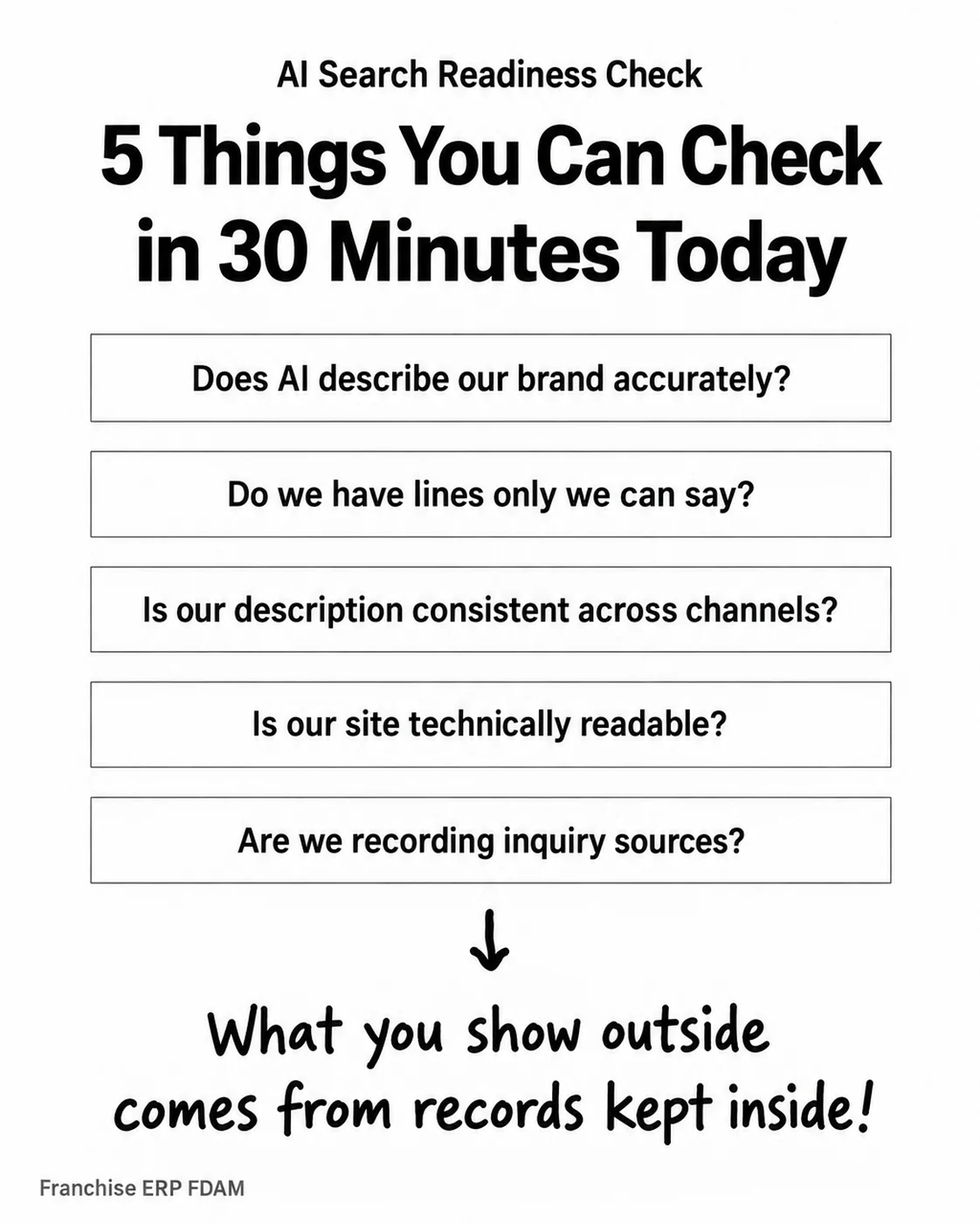
Is AI describing your brand accurately?
Open a generative AI tool such as ChatGPT, Gemini or Perplexity, type in your brand name, and ask, "Tell me about this brand." Then check the answer item by item. Are the industry and founding date correct? Are the signature menu items or services ones you currently sell? Do the franchise terms match your current standards? If anything is wrong, trace where that information came from. Usually the culprit is a press release from years ago, an introduction page that stopped being updated, or information about a store that has already closed.
02Does your website contain sentences only you could write?
Open your website and franchise recruitment page, read through the sentences one by one, and run a simple test. If you could paste a sentence onto a competitor's website and no one would find it odd, that sentence doesn't describe you. If such sentences make up more than half the page, AI lacks the material to describe your brand as distinct from others.
03Does your company description match across channels?
Lay your website's About page, blog bio, latest press release, franchise recruitment page and job postings side by side and compare them. It's more common than you'd think for basic information, such as founding year, description of business areas and flagship products, to differ from channel to channel. People skim past it, but AI struggles to decide which version to trust. As a result, it may describe your brand in hedged language or avoid mentioning it altogether.
04Is your site technically readable?
Just ask your web manager or the agency that runs your site to check two things. First, whether your site's key pages are properly indexed by search engines. You can check this in Google Search Console or Naver Search Advisor. Second, whether any settings blocking search crawlers are still in place. Sometimes a block added temporarily while building the site is never removed. No matter how good the content is, it can't be cited if it can't be read.
05Are you recording where inquiries come from?
Open your company's inquiry form or consultation intake form. Check whether it includes a question like "How did you hear about us?" and whether the answers are stored as selectable options. If staff just hear it on the phone and try to remember, nothing can be tallied later. It's even better to add generative AI as its own option. The 28% figure in this article exists only because FDAM has consistently collected answers to that question.
Frequently asked questions
Is there separate technical work we need to do for AI search?
Google's official position is that optimizing for generative AI search is not a separate task from existing search optimization, because Google's AI answer features run on top of its existing search systems. That said, this describes Google's services. Non-Google AI services such as ChatGPT and Perplexity gather information in their own ways, so Google's explanation can't be applied to every AI as is. Three things hold true everywhere: the quality of what you publish, uniqueness that can't be found elsewhere, and whether search crawlers can access your site.
Does publishing more posts increase the chance of being cited by AI?
Volume alone isn't a meaningful signal. In fact, Google explicitly classified churning out similar pages for every question format as a policy violation. With the same amount of time, it's better to write one piece containing what only you can say than several pieces of information available anywhere. For example, laying out the opening procedure your headquarters actually follows in one article is more likely to get cited than posting ten articles like "What to Check When Starting a Franchise."
If AI is describing our brand incorrectly, how do we fix it?
There's no way to ask AI services directly for a correction. Because AI refers to information published on the internet, you need to find the source of the incorrect description and fix that material first. Common culprits are old press releases, neglected introduction pages and information about stores that have already closed. Once you've cleaned up the sources, publish a page with accurate information properly on your own site. Just don't expect an instant change. The material AI references takes time to refresh, so updates show up over several weeks to several months.
Won't publishing operating data expose us to competitors?
You don't need to disclose every figure. The key isn't raw numbers but your operating methods and standards. Simply explaining the procedures you manage by, what you inspect and the criteria you judge by is distinctive enough. For example, you can explain what items your store inspections cover without disclosing sales figures. Headquarters decides how much to disclose. But to decide that, you first need organized data inside the company.
In the end, there was no new technique to learn
If you treat AI search as a new marketing assignment, it feels like a heavy lift. The terms are unfamiliar, and the methods keep changing.
Yet looking at the standards Google laid out, only one thing is required: being able to explain, in concrete terms, what you actually do well. It isn't about learning a new technique, but about how well you've kept a record of the work you were already doing.
As you work through the five checks above, most people get stuck at the same point. Not because they don't know the content, but because it's scattered and they can't pull it out. The opening procedure varies slightly by person, contract status sits in separate files, and inspection records exist but are hard to see in one place.
The evidence you can share with the outside world ultimately comes from the records you keep inside.
FDAM is an ERP for franchisor headquarters that brings sales management, store opening management and operations management into one place. Consultation history and contract progress, preparation items for each opening stage, store inspection results and franchise store information stay together in a single flow instead of scattering. Feel free to reach out, and we'll look together at how much of your headquarters' operations is being recorded today.
Phone 1544-7120 · Chat on KakaoTalk
Sources
Google Search Central, Optimizing your website for generative AI features on Google Search (May 15, 2026)
developers.google.com/search/docs/fundamentals/ai-optimization-guide
Google Search Central Blog, A new resource for optimizing for generative AI in Google Search (May 15, 2026)
developers.google.com/search/blog/2026/05/a-new-resource-for-optimizing
Written by · FDAM, franchise ERP
Franchise ERP, franchisor headquarters, AI search, generative AI, GEO optimization, franchise store management, operating data, FDAM