Delivery App Review Management: Keeping Your Brand Tone Consistent
Delivery app review management: practical standards for HQ to protect the brand's tone
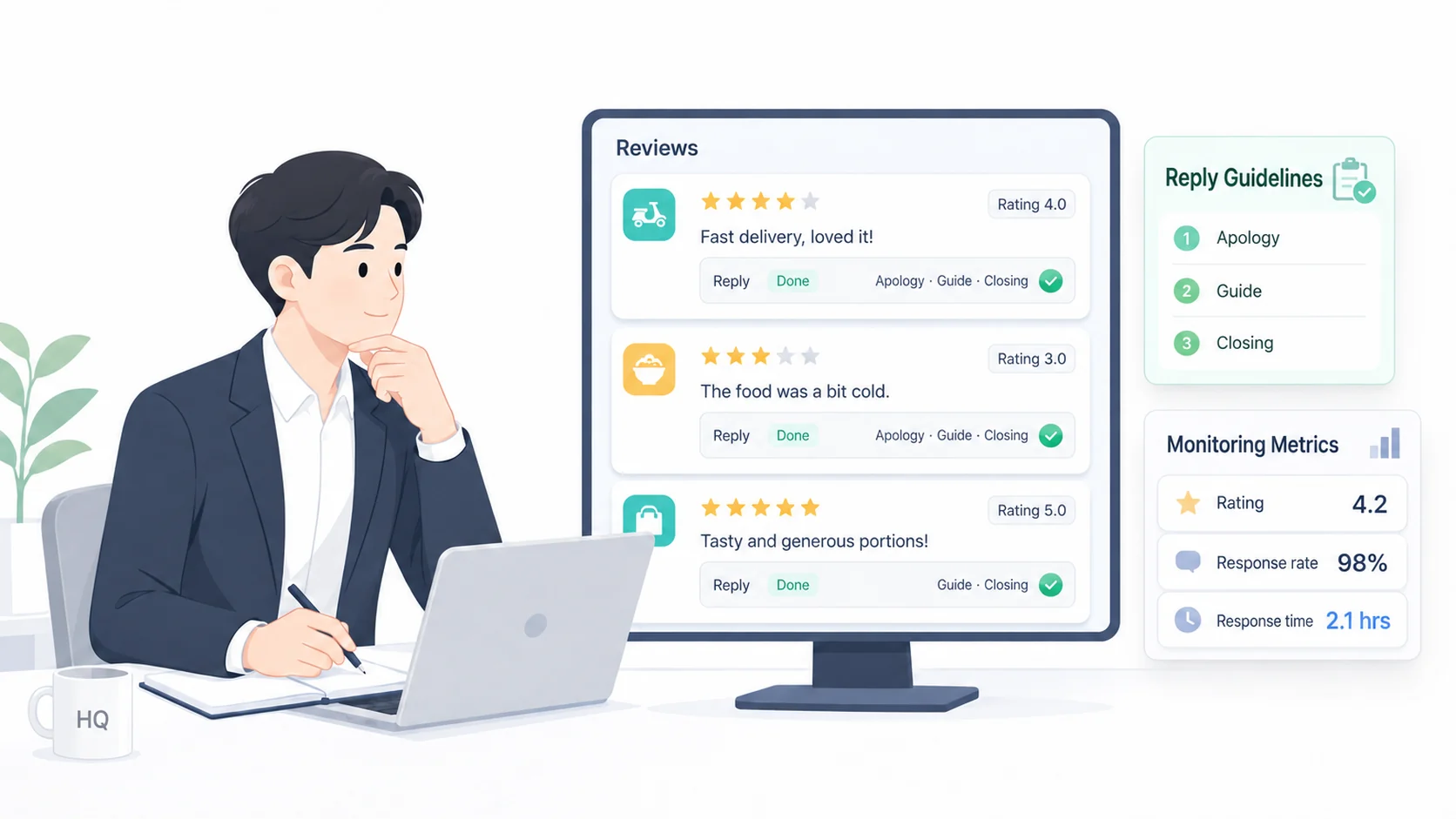
Image: HQ operations staff reviewing delivery app reviews together (featured image)
Delivery app review management is a practice in which store owners respond to reviews first, while HQ helps keep the brand tone and quality of those responses consistent. Star ratings and recent reviews directly influence consumers' ordering decisions, so if every store responds differently, trust in the brand wavers even though it's the same brand. In this post, we walk step by step through how franchisor headquarters can set and run review response standards, from response examples for each type of negative review to star rating management and monitoring metrics.
How delivery app reviews affect sales
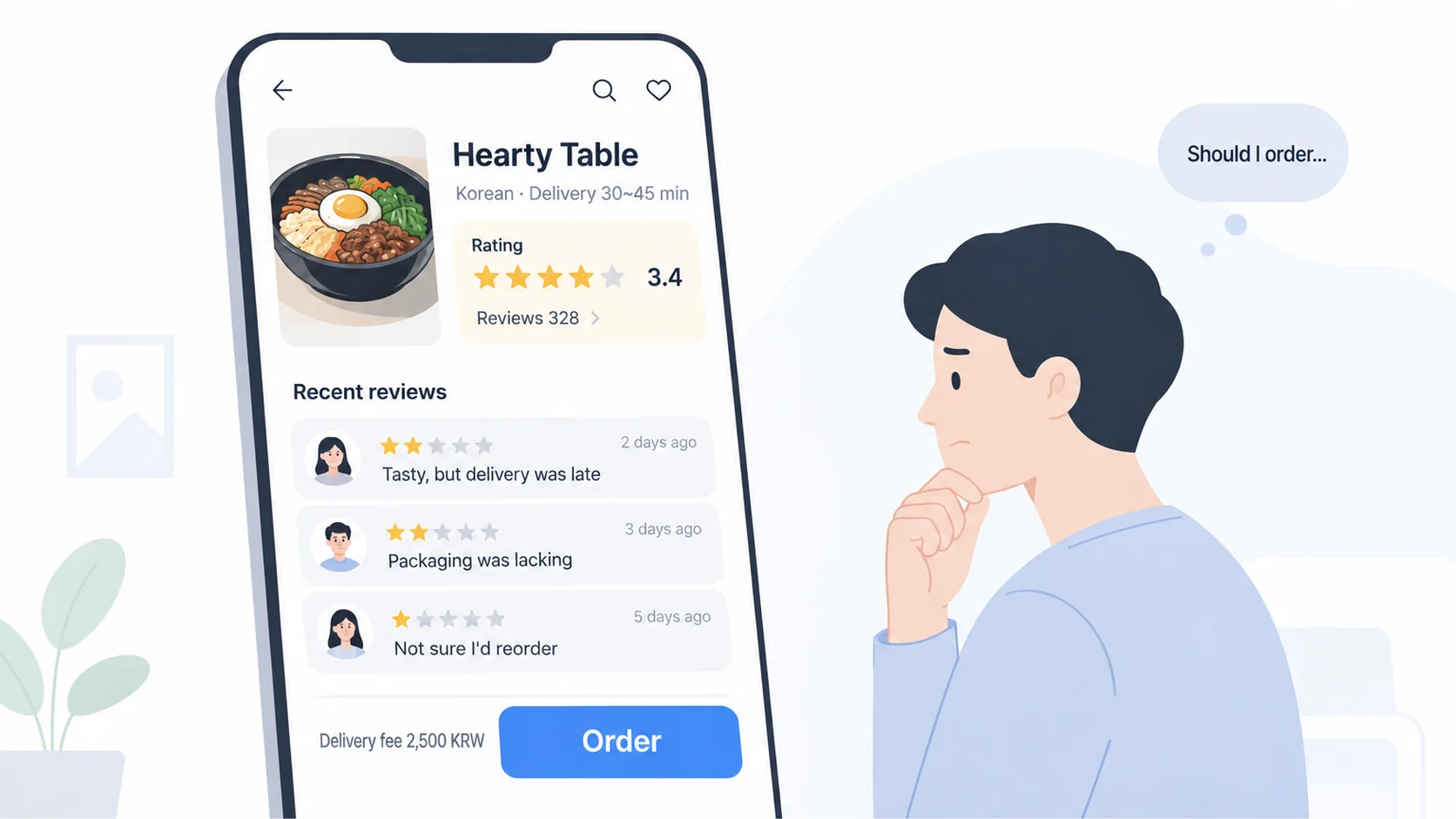
Image: A delivery app order screen with star ratings and recent reviews shown at the top
The bottom line: delivery app reviews drive order conversion as much as food quality does. Most consumers check reviews before ordering, and when one or two negative reviews sit at the top, people hesitate to order regardless of the actual taste or service. Low ratings also push a store down in search rankings, creating a vicious cycle that reduces new customers too. The problem is that as the number of stores grows, it becomes hard for HQ to keep track of every store's reviews. Leave responses unattended, and a small incident at one store can spread to the image of the whole brand.
Four steps for handling negative reviews
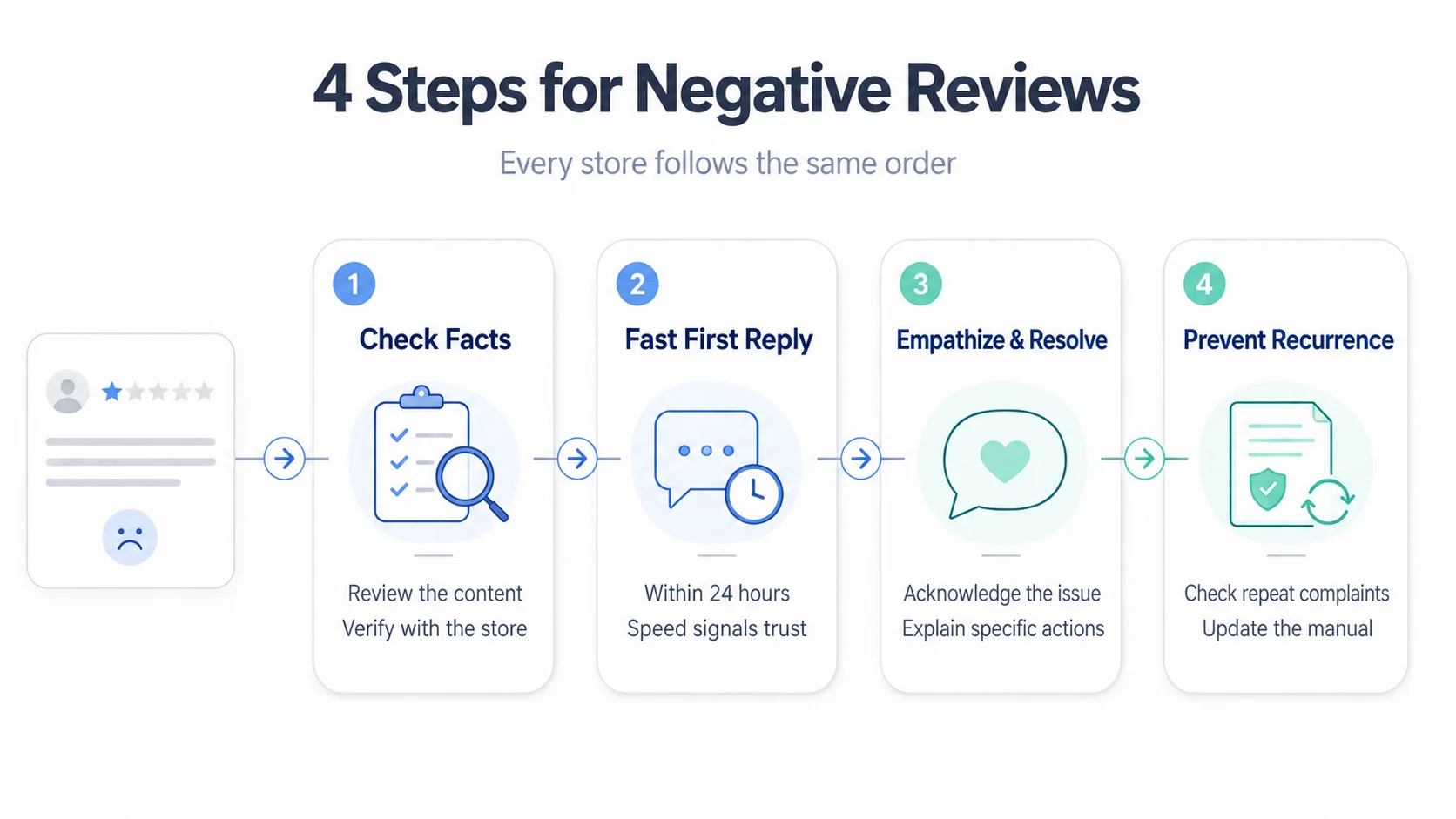
Image: Four-step diagram: verify facts → respond quickly → empathize and resolve → prevent recurrence
Handle negative reviews in four steps: verify the facts, respond quickly, empathize and resolve, and prevent recurrence. The key is for every store to apply this sequence the same way.
- Verify the facts: Check with the store whether what the review describes actually happened.
- Respond quickly: Replying within 24 hours is recommended. A fast response is itself a signal of trust.
- Empathize and resolve: Acknowledge the inconvenience and explain concrete actions rather than making excuses.
- Prevent recurrence: If the same type of complaint keeps coming up, reflect it in the operations manual.
Response examples by type of negative review
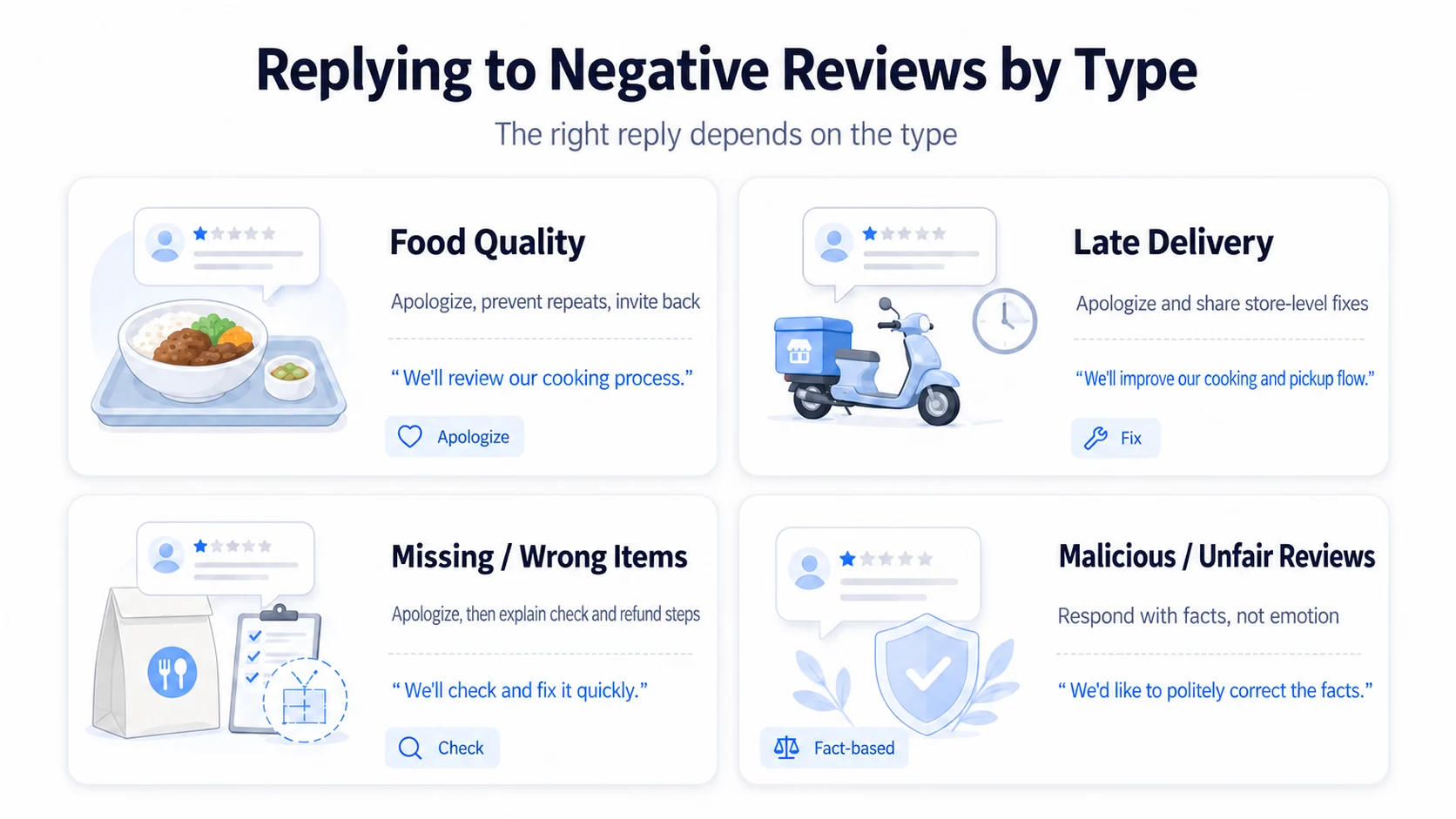
Image: Comparison table of sample responses by review type
Negative reviews call for different responses depending on the type. They typically fall into four categories: food quality, delivery delays, missing or wrong items, and malicious or unreasonable reviews. Preparing standard sample responses like the following for each type speeds up responses.
Food quality complaints: Apologize, then explain how you'll prevent it from happening again and invite the customer back. Example: "We're truly sorry your meal wasn't enjoyable. We're reviewing our cooking process, and we hope to make it up to you on your next order."
Delivery delays: Even if delivery is handled by a third party, it's part of the brand experience for the customer. Offer an apology along with what the store will do. Example: "We're sorry for the long wait. We'll be reworking our cooking and pickup flow during peak hours."
Missing or wrong items: Apologize immediately and clearly explain the compensation and verification process. Example: "We're very sorry that part of your order was missing. Please contact our customer service team so we can verify and resolve this quickly."
Malicious or unreasonable reviews: Don't respond emotionally. Reply politely, based on facts. If a review is clearly false or abusive, you can report it through the delivery app's customer service. Example: "We've looked into your comments, and we'd like to respectfully point out that some details differ from what happened."
How to create brand tone guidelines
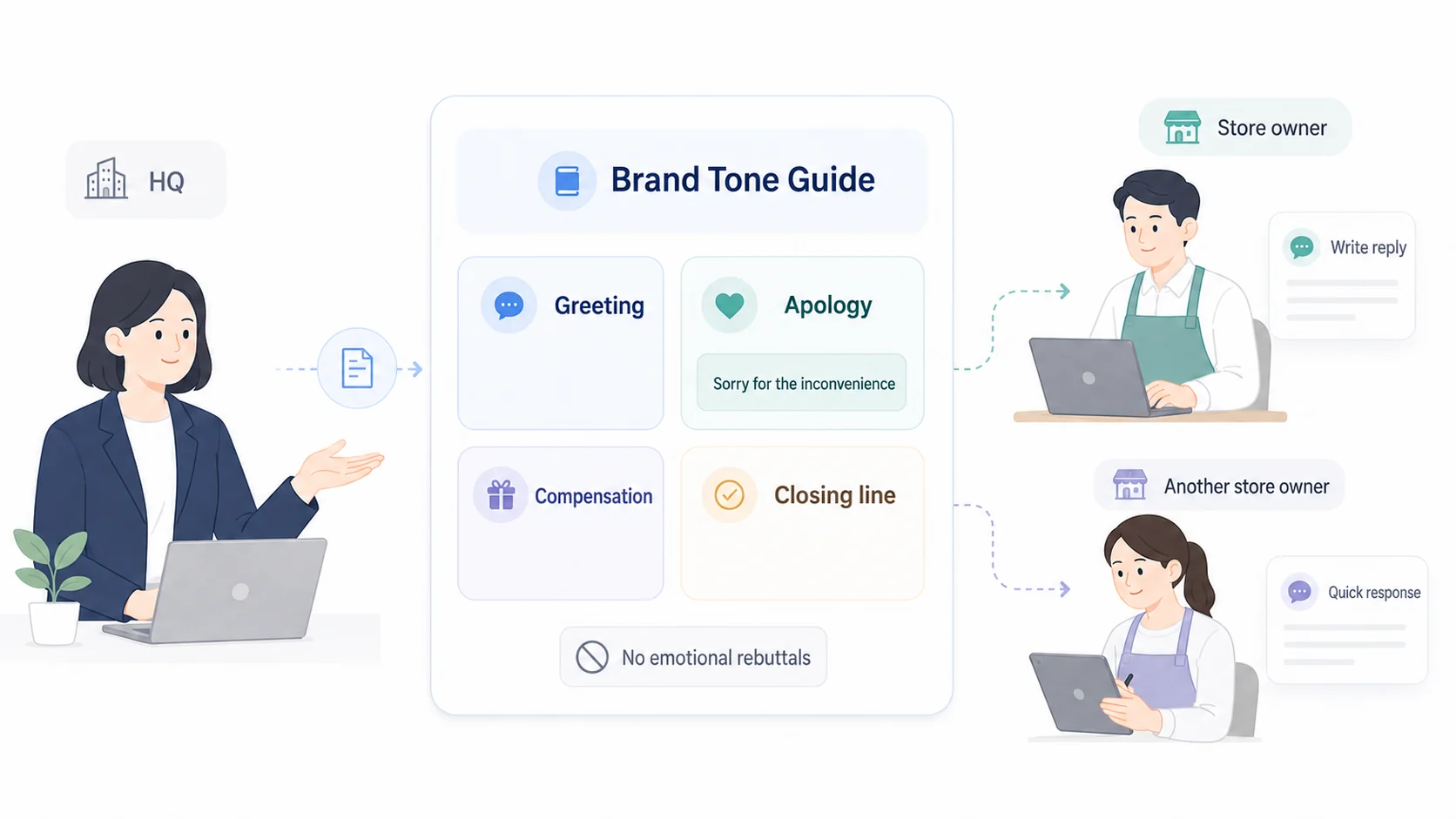
Image: A response tone guide organizing greetings, apologies, and compensation notices
Consistent responses come from a set of standard phrases for each situation. Create a response tone kit that organizes greetings, apologies, compensation notices, and closing lines by situation, and distribute it to stores. For example, standardize apologies as "We're sorry for the inconvenience," and designate emotional rebuttals as banned phrases. Add the type-specific sample responses above, and store owners can quickly write replies that fit the situation. With guidelines in place, the brand's voice stays steady no matter who writes the reply.
Five common mistakes store owners make when responding
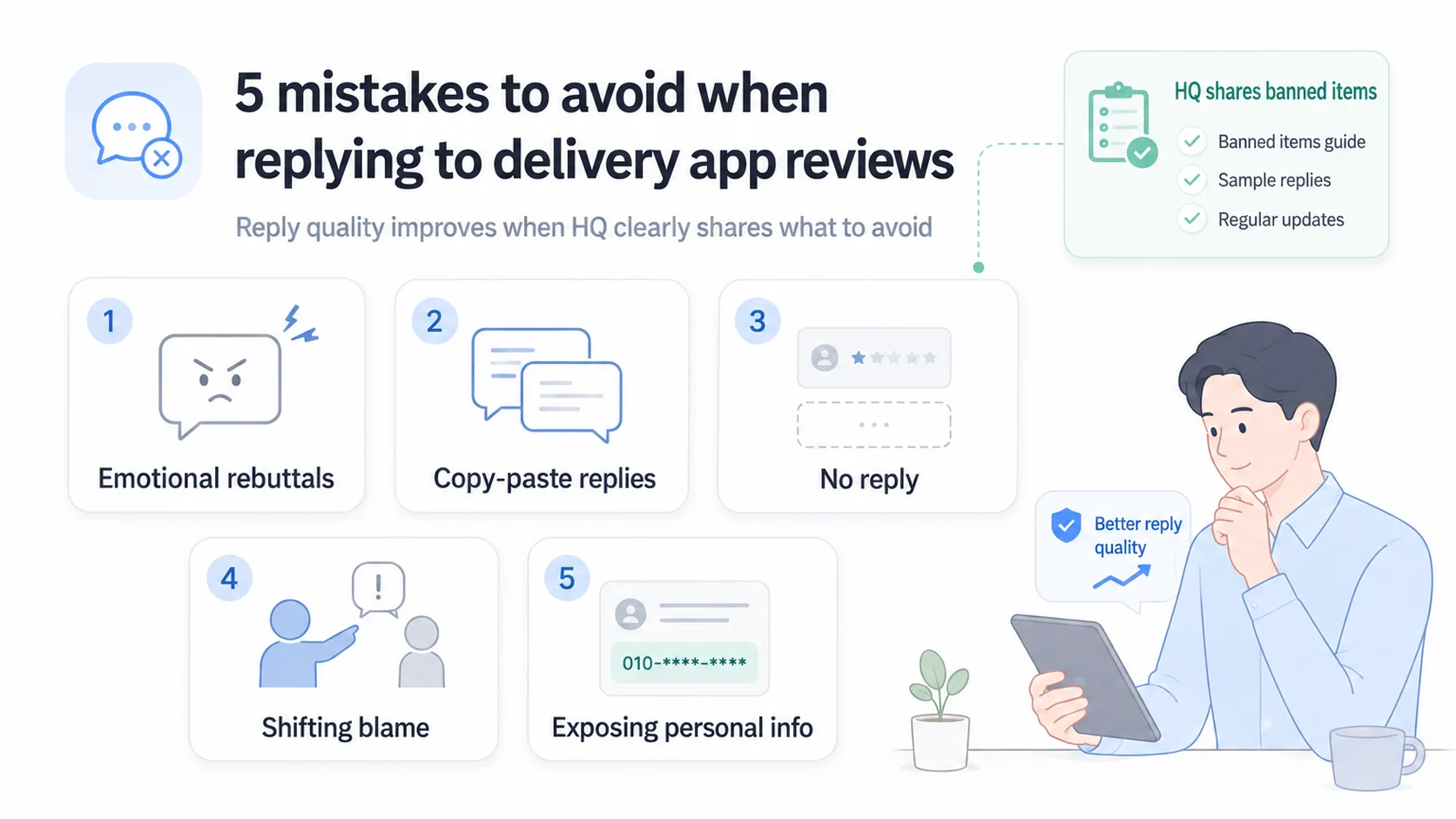
Image: Checklist of five review response mistakes to avoid
Emotional rebuttals, copy-and-paste replies, no response, shifting blame, and exposing personal information: these five must be avoided. They leave an even worse impression on other consumers who see the negative review.
- Arguing with a review emotionally
- Copying and pasting the same reply on every review
- Not responding to negative reviews at all
- Blaming the customer
- Exposing the customer's personal information in a reply
Simply having HQ clearly share these don'ts significantly improves response quality.
Operational tips for more positive reviews and higher ratings
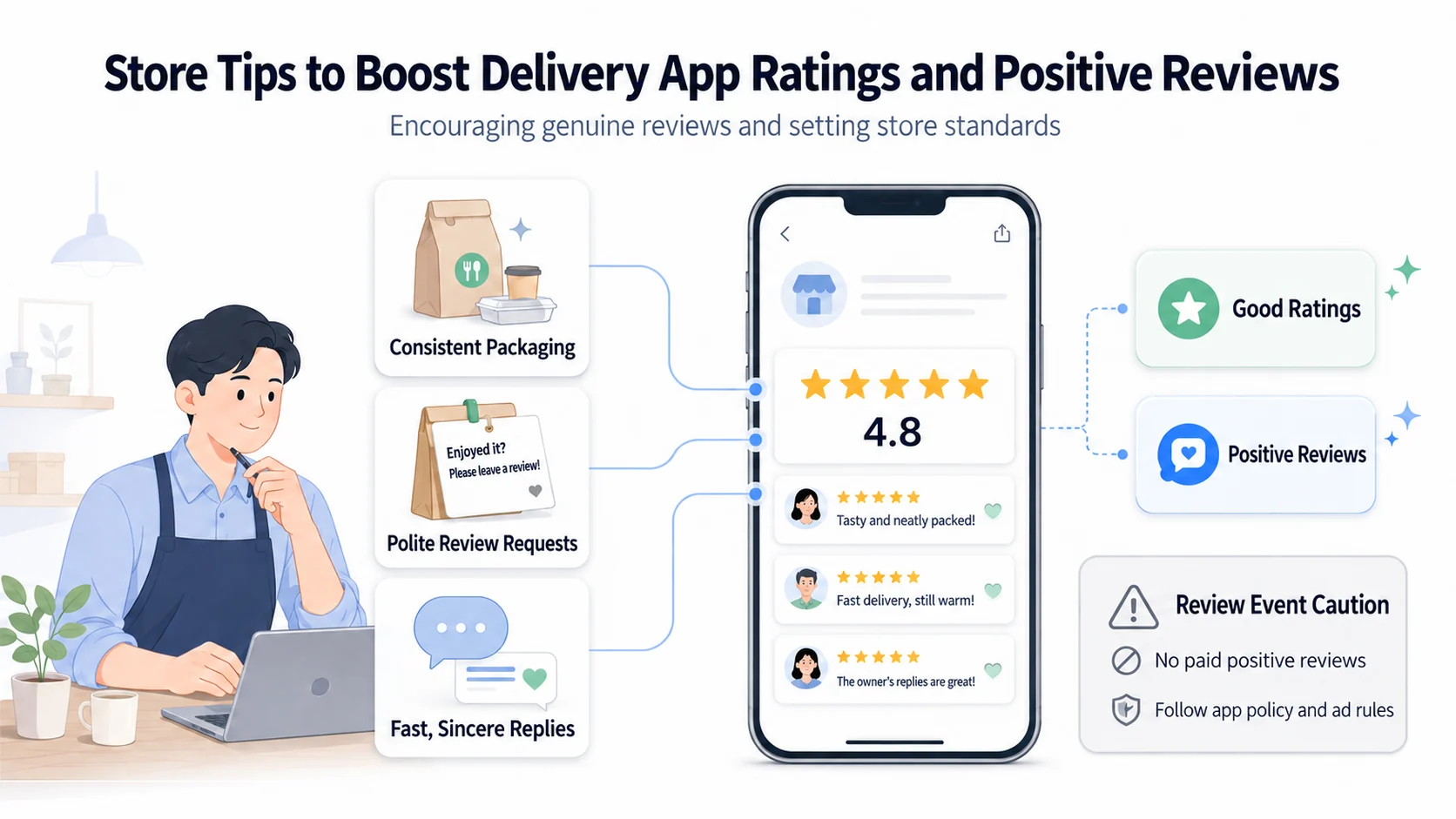
Image: Rating management tips such as packaging quality and review request messages
Ratings don't go up just by preventing negative reviews. You also need operations that encourage satisfied customers to leave reviews naturally. Keeping packaging and order contents consistent, and politely asking for reviews with an owner's note or a small printed message, are effective approaches. Fast, sincere responses also leave a good impression on other customers and can show up in your ratings.
That said, be careful when running review promotions. Offering incentives in exchange for positive reviews or ratings may violate regulations on labeling and advertising, and can be penalized under the delivery apps' own policies. HQ should define and share in advance what's allowed and how stores should word their requests, so stores don't take on risk through aggressive review promotions.
HQ's role is "support," not control
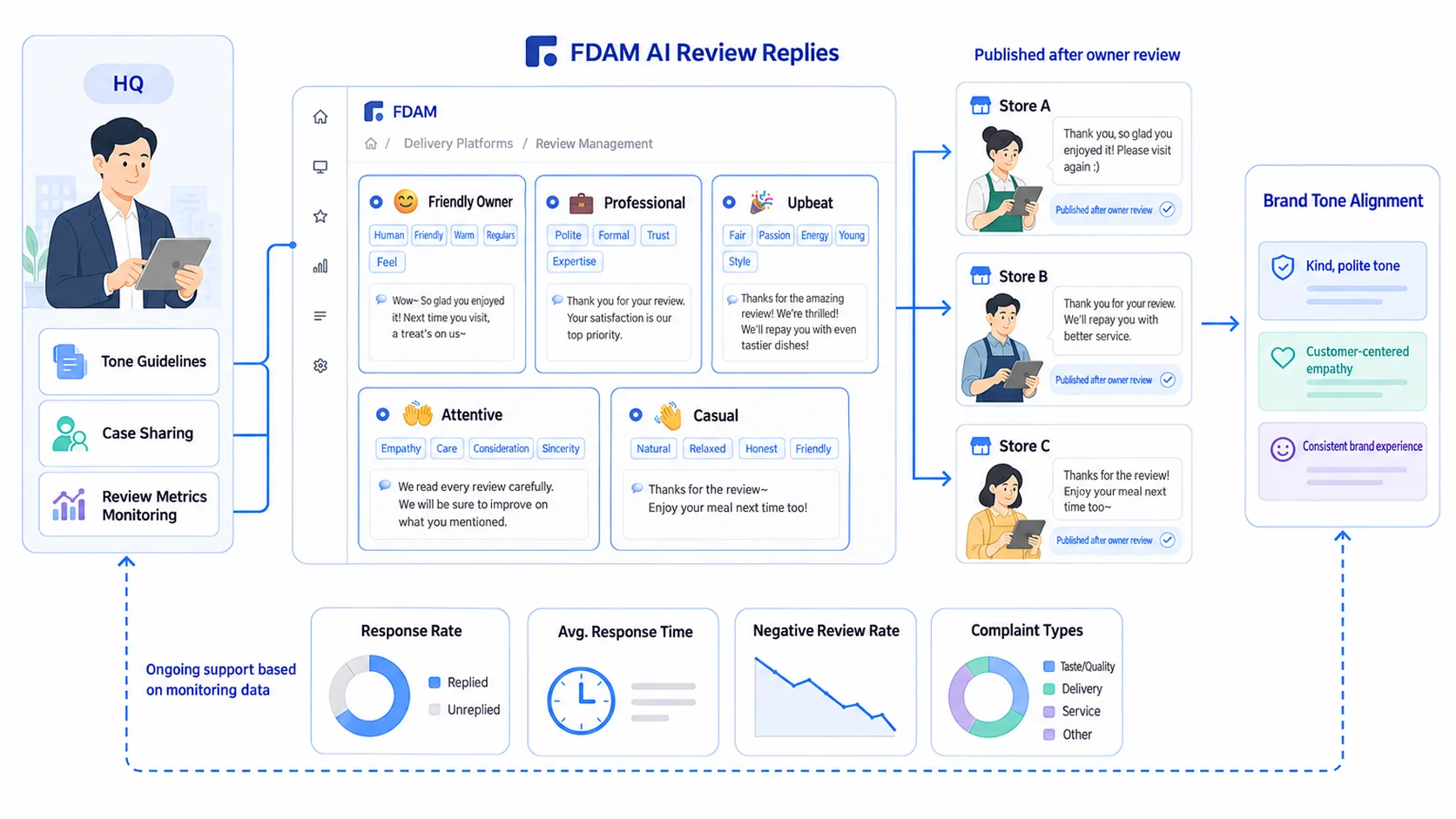
Image: An HQ system that supports responses through guide distribution, case sharing, and monitoring
Final responsibility for review replies lies with store owners, who know what happens on the ground. HQ's role is support that raises response quality. Having HQ write every reply on stores' behalf isn't realistic, and it's hard to reflect each store's circumstances. HQ is more effective when it focuses on raising quality by distributing tone guidelines, sharing good and problem cases, and monitoring recurring complaints.
Review monitoring metrics HQ should track
To make support systematic, you need to see it in numbers. Regularly checking each store's review response rate, average response time, share of negative reviews, and distribution of complaint types shows at a glance which stores need coaching. As these metrics build up, you can support stores with data instead of gut feel.
How to automate responses
However, as the store count grows, keeping up this support by hand gets harder. FDAM, an ERP for franchisor headquarters, has offered AI review replies since March 2026. Choose one of five brand personas, and it automatically drafts replies in that tone. Store owners review and post the final reply, creating a structure where HQ supports brand consistency and stores save time on responses.
An example adoption flow
Based on our experience supporting operations at many franchisor headquarters in the franchise IT field, improving review responses usually follows a similar path. First, HQ prepares and distributes tone guidelines and type-specific sample responses, and uses AI-drafted replies to reduce variation between stores. Then, by managing response rates and negative review share as metrics, store responses that were inconsistent at first gradually converge on the brand tone. The key isn't HQ controlling stores, but helping stores do well more easily.
Frequently asked questions
Should HQ respond to delivery app reviews?
It's best for store owners, who know their store's situation, to respond first. HQ supports response quality through tone guidelines and monitoring.
How quickly should we respond to negative reviews?
A first response within 24 hours is recommended. A fast response in itself builds trust with other consumers.
Reply quality varies by store. How can we make it consistent?
Create and distribute a set of standard phrases for each situation, and align the tone with AI-drafted replies to reduce variation between stores.
How should we handle malicious or false reviews?
Don't respond emotionally. Reply politely, based on facts. If a review is clearly false or abusive, you can report it through the delivery app's customer service.
Can we use review promotions to raise our ratings?
Offering incentives in exchange for positive reviews may violate labeling and advertising regulations as well as delivery app policies. It's safer for HQ to define what's allowed and communicate it to stores.
Want to bring your franchisor HQ operations together in one place?
Connect sales, contracts, store openings, and operations with FDAM, and support your stores' response quality too.
delivery app review management, franchisor headquarters, review responses, brand management, store management, franchise ERP, AI review replies, raising delivery app ratings, handling malicious reviews, FDAM