Data Makes the Difference: Real LSM Strategy with FDAM Franchise ERP
The concept of LSM (local trade-area marketing), success stories, and data-driven execution with the FDAM franchise ERP
LSM marketing, local trade-area marketing, franchise ERP, FDAM, trade-area analysis, franchise store management, store operations strategy, franchise success stories, HQ operations system, data-driven operations
Key takeaways · LSM is an approach to planning and executing marketing strategy tailored to the local trade area where each franchise store is located. · Even within the same brand, sales structure and menu preferences differ by trade-area type (office, college town, residential, tourist). · The basic LSM flow has three steps: analyze the trade area → compare with the HQ average → execute a tailored strategy. · FDAM accumulates store information in one place in a standardized format, providing the data infrastructure that LSM execution is built on. |
LSM (Local Store Marketing)is an operating approach in which headquarters plans and executes marketing strategy tailored to the characteristics of the local trade area where each franchise store is located. In a nutshell: "different customers in every area, different strategies." Brand consistency matters, but customers in Gangnam, in a college town and in a residential neighborhood are unlikely to want exactly the same things.
Seeing sales structure and menu preferences vary by trade area within the same brand is a familiar sight to any HQ operations team. Some menu items sell well in Seoul but get a weaker response in other regions; some stores are strongest on weekends while for others, weekday lunch is the golden hour. In this post, we walk through the concept of LSM, how it is executed, Korean success stories, and how FDAM, built by MS Benter after nearly 25 years focused on franchise IT, lays the foundation for executing LSM.
The starting point of an LSM strategy is accumulating store data in a standardized format.
1. What is LSM marketing?
LSM stands for Local Store Marketing: planning and executing marketing strategy tailored to the characteristics of the local trade area where a franchise store is located. Even within Seoul, customer profiles differ from one trade area to the next, and if HQ applies the same policy to every store, some stores' sales potential stays buried.
Example customer profiles by trade area · Office areas — Sales concentrated at weekday lunch, preference for quick meals, high share of takeout · College towns — Value for money matters, photo-worthy menu items are popular, strong in the evening · Residential areas — Family visits on weekends, high share of delivery orders · Tourist areas — Growing share of international customers, visuals matter, concentrated on weekends |
Differences in sales and menu preferences by trade area are easy to spot once you organize HQ data. The starting point of LSM is acknowledging that the HQ average hides store-level characteristics; in other words, an average cannot be the basis for store-level decisions.
2. How LSM works
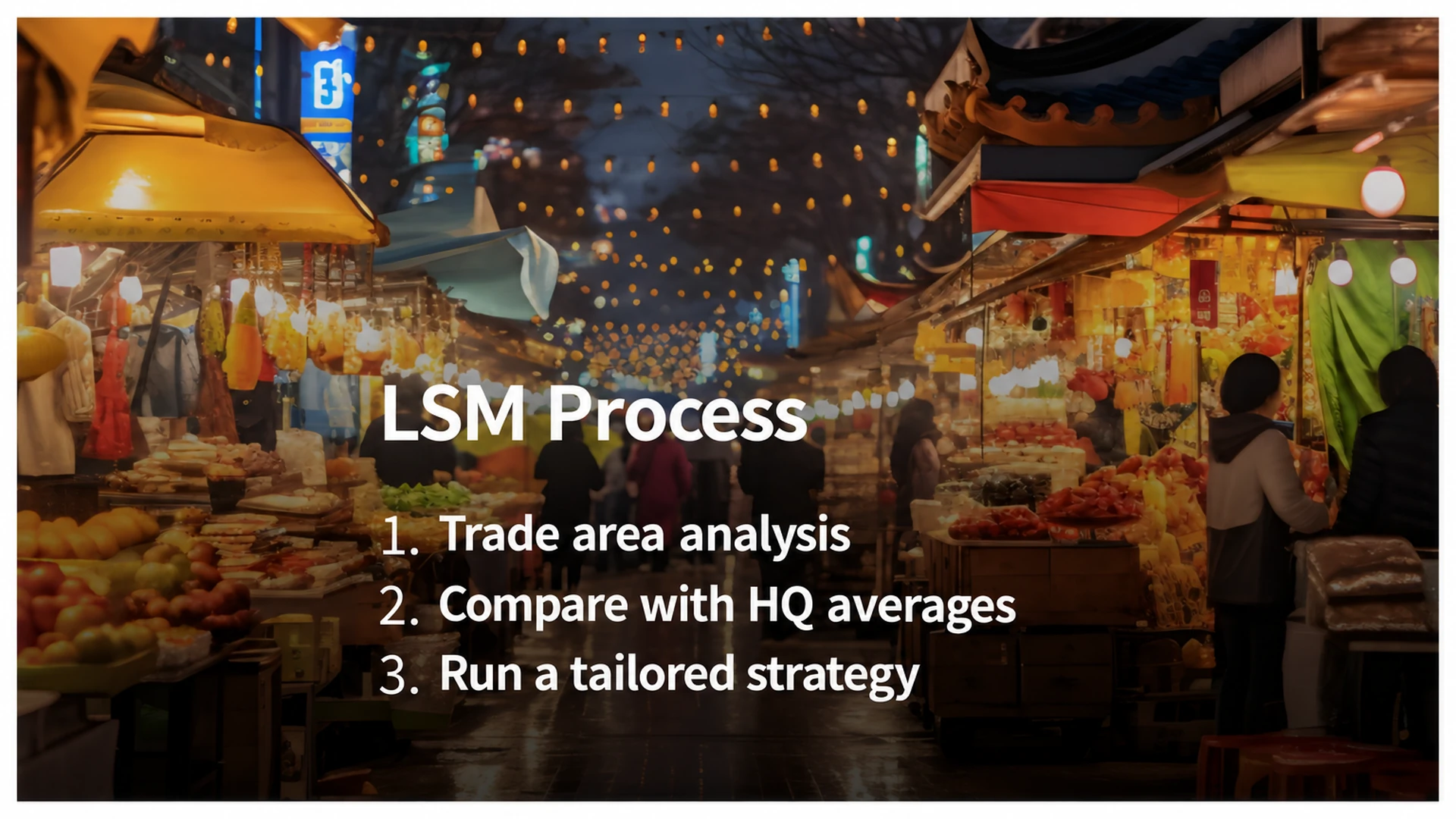
The basic LSM flow is three steps: analyze, compare, execute.
Step 1: Trade-area analysis
The first step is understanding who each store's customers are. Analysis of foot traffic, residential population and working population is the baseline, and you should also check sales patterns by time of day and day of week as well as the distribution of competitors. The strategy to apply depends on whether the store is in an office area, a residential area or a tutoring-academy district.
Step 2: Compare with the HQ average
Comparing each store's data with the overall HQ average reveals what makes that store distinctive. For example, if Store A's share of lunch sales is noticeably higher than the HQ average, it is likely in an office area and should strengthen its lunch set menu. If Store B's delivery share is much higher than the HQ average, optimizing delivery packaging and developing delivery-only menu items become the first priorities.
Step 3: Execute a tailored strategy
Based on the analysis, differentiate the menu lineup by trade area, run promotions targeted at slow time slots, and apply store concepts that fit the trade area. At this stage, LSM only works in the field if HQ provides guidance suited to each store rather than sending every store the same materials across the board.
3. LSM strategy in Korean success stories
Differentiating trade-area selection and store format is the core of LSM.
Mom's Touch: targeting secondary trade areas
Mom's Touch grew with a strategy of actively using side-street areas and second-floor locations that large franchises had largely overlooked. It targeted residential neighborhoods and areas near traditional markets with lower rents. Well-known examples include the Geumho store, located on a back street rather than a main road, and the Bongcheon Hyundai Market store, located inside a traditional market. It lowered startup costs with small to mid-size stores of 25–30 pyeong (about 83–99 m²) and boosted turnover at tourist-focused stores such as Myeongdong by installing conveyor belts.
As of 2023, it had surpassed 1,400 stores nationwide, continuing its rapid expansion among burger franchises while keeping startup costs lower than competitors. The key was not "let's enter every trade area" but the decision to "choose the trade areas that fit our brand".
Mega MGC Coffee: differentiating store types by trade area
Mega Coffee grew rapidly with a strategy of varying store types by trade area within the same brand. In office areas, it placed ultra-small takeout stores of 10–15 pyeong (about 33–50 m²) focused on fast pickup; in residential areas, 20–25 pyeong (about 66–83 m²) stores with seating encouraged families to stay; and in tourist areas, large stores of 50+ pyeong (165+ m²) offered photo spots and a wide menu.
As of 2024, it had surpassed 3,500 stores nationwide, and its app user base grew quickly. The key is "not attacking every trade area with a single model."Separating store formats to offer speed in office areas, comfort in residential areas and experiences in tourist areas changed how its franchise stores operate.
Bon IF (Bon Dosirak): small, delivery-focused stores
Bon Dosirak read the shift in consumer trends after COVID-19 and caught the wave by moving to small, delivery-focused stores. It expanded small stores of 20 pyeong (about 66 m²) or less, minimized dine-in operations and strengthened delivery and takeout capabilities. It also streamlined its menu around best-sellers, cutting cooking time as well.
After its 2024 rebrand, sales volume and revenue grew steadily, and it consistently ranks near the top among store owners as a "franchise I want to join." The key was abandoning the assumption that "eating out means eating in the store". It is a case of redesigning the store format itself to match a changing consumer environment.
4. LSM starts with systematic data management
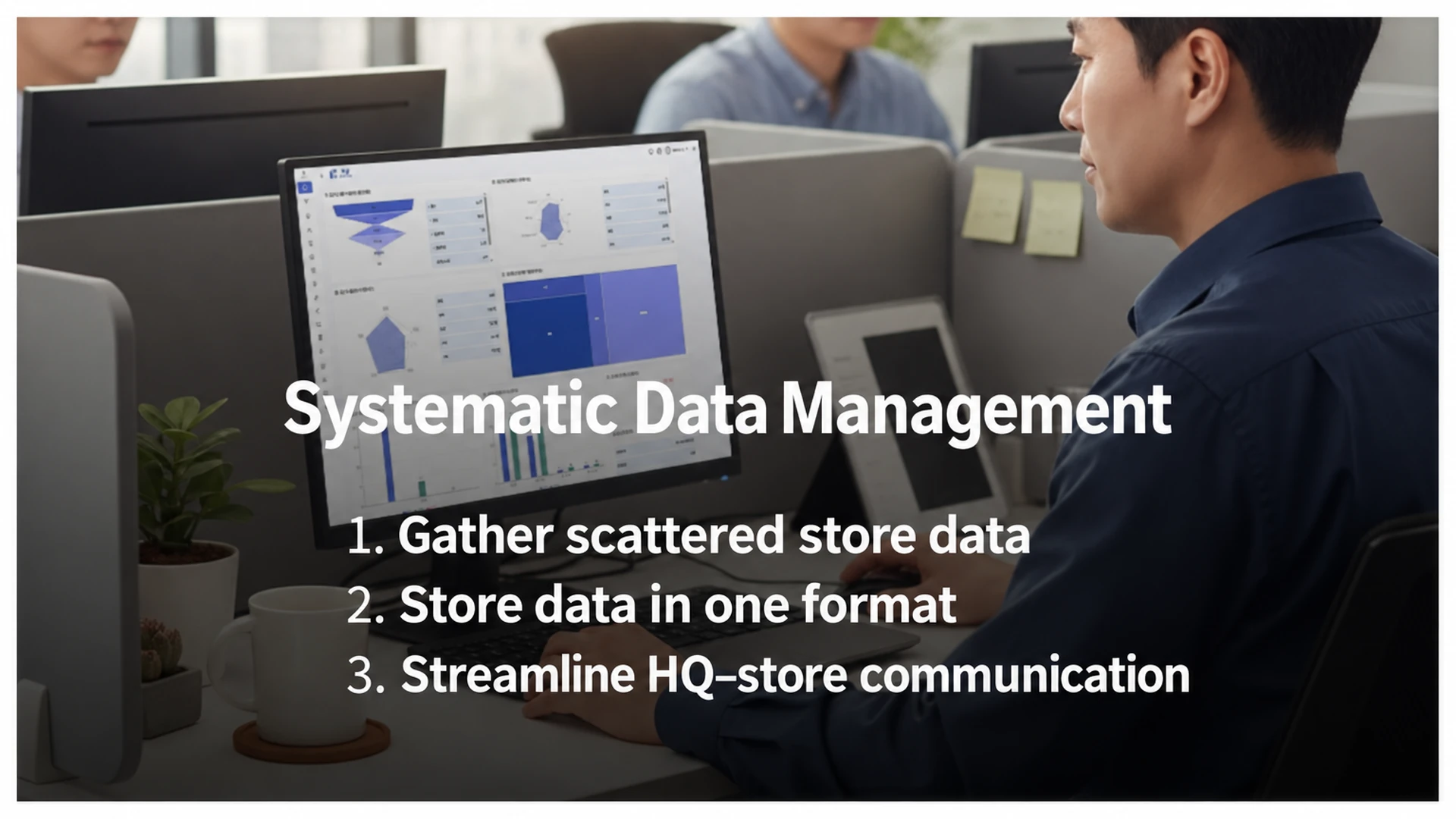
When standardized data accumulates, it becomes the basis for LSM decisions.
Many F&B headquarters share similar concerns: "We manage everything in Excel, so comparing stores gets harder as we grow," "Store information is scattered across departments, so we can't see the big picture," and "We only talk to store owners on KakaoTalk, so important information keeps getting buried." When it comes time to actually execute LSM, the biggest barrier is that the data to analyze is not in order.
Rather than a solution that leads with flashy analytics tools, MS Benter's FDAM is an HQ operations ERP that builds the foundation for executing LSM. Drawing on experience working with about 500 brands, its module design reflects how headquarters should organize store information to make it useful for decision-making.
What FDAM does
First, it brings scattered store information together in one place. Store details in Excel files, conversations with store owners on KakaoTalk, contracts in email and on paper: FDAM creates an environment where all of it can be managed in one place.
Second, it organizes data in a consistent format. When managing in Excel, each staff member enters data differently and each store has different fields, making comparison difficult. FDAM applies the same fields to every store, prevents missing required information and automatically records change history.
Third, it streamlines communication between HQ and stores. Instead of important information getting buried in group chats, the dedicated store app Sodamlets HQ deliver notices systematically and check in real time who has read them. Simply ask the AI assistant, the first to be built into a Korean franchise ERP, "Which stores had the highest share of lunch sales this quarter?" and the data that serves as the starting point for LSM analysis comes back organized instantly.
Example interview: supervisor at a chicken franchise headquarters "FDAM doesn't do LSM for us. But thanks to FDAM, we're now in a position to do LSM. It used to take ages just to find store information; now I can check it in a few clicks. That gave us time to focus on trade-area analysis and strategy." |
5. The system is where strategy begins
Designing a sophisticated LSM strategy matters, but the basic system to execute it comes first. Store information has to accumulate in a standardized format before you can compare the HQ average with store averages, and the same flow has to repeat before LSM decisions turn from one-off efforts into an operating routine.
FDAM organizes store information systematically, supports communication between HQ and stores, and manages data to consistent standards. In the end, the first step in executing LSM is creating an HQ operating environment where data flows.
Frequently asked questions
Q. Isn't LSM marketing something stores should handle on their own?
Neighborhood promotion for an individual store is the store owner's job, but designing store formats, menu lineups and promotion guides by trade area and delivering them to stores is HQ's role. When HQ turns its analysis of store data into guides, stores' ability to execute LSM rises with it.
Q. How many stores do we need before starting LSM?
What matters more than store count is whether HQ is accumulating store data to standardized criteria. If data builds up with the same fields and the same entry method, LSM accuracy improves as the number of stores grows.
Q. Does FDAM perform trade-area analysis itself?
FDAM accumulates the store operations data HQ already holds in a standardized format and provides an environment where you can ask the AI assistant questions in plain language to compare by store and by period. It is not a tool that collects external trade-area data, but the key point is that it organizes the internal HQ data that serves as the starting point for LSM decisions.
Q. How do we deliver LSM guides to stores?
FDAM integrates with Sodam, the dedicated store app, pushing notices, recipes and promotion guides written by HQ to stores. Read logs show which stores have checked the materials, so HQ can track LSM execution rates.
Q. How does the sales consultation work?
You can reach FDAM through the Contact sales page (/register), our KakaoTalk channel or our main line (1544-7120, Korea). We will walk you through a demo tailored to your HQ operating environment along with LSM execution scenarios.
The starting point for LSM
An HQ where data flows:
the FDAM franchise ERP
Learn more about FDAM Ask us on KakaoTalk