Past 50 Stores: 5 Real Reasons Franchise HQs Get Overwhelmed
We break down the five structural reasons franchisor headquarters become overloaded once they pass 50 stores. From the real bottlenecks in store openings, inspections, contracts and sales management to how to judge when it is time to adopt a franchise ERP, this guide draws on MS Benter's hands-on experience supporting more than 500 brands over 20 years.
A franchise HQ workflow bottleneck is what happens when a growing store count outpaces an operating model built on manual work. Typically, somewhere around 50 stores, bottlenecks appear all at once across core HQ functions: store opening management, QSCV inspections, contract management, sales reporting and staffing. The cause is not individual capability but the limits of the workflow structure itself.
"Up to 30 stores we somehow kept things rolling. Past 50, it feels like everything suddenly stopped."
This is one of the things we hear most often when consulting on franchise HQ operations. Over 20 years of working with more than 500 franchise brands, MS Benter has confirmed one thing: this problem does not arise because staff are lazy or lack ability. It is a predictable, structural problem that arises because the HQ's workflows were never designed to run 50 or more stores.
In this article, we analyze five workflow bottlenecks that franchisor headquarters actually face after passing 50 stores, and lay out the root cause and the way forward for each from a practitioner's point of view.
1. Store openings never get past the "manual relay"
What the problem really is
Opening a franchise store is one of the most complex jobs at a franchisor HQ. Dozens of detailed tasks, from trade-area analysis, interior design and construction supervision, equipment orders and store owner training to the initial logistics setup, must run in sequence and sometimes in parallel.
Back when the brand had 10 to 20 stores, a single opening manager could keep the whole process in their head. With only one opening underway at a time, one Excel sheet and a few phone calls were enough to manage it. But once you pass 50 stores, the situation changes fundamentally. Concurrent openings climb to three to five, and each one involves different internal teams and outside vendors.
The structural cause
Root cause
The opening process depends on one person's memory and Excel sheets rather than on a system. When interior vendor selection lives in file A, training completion in file B, and equipment order status in the manager's KakaoTalk chats, simply figuring out where a single opening stands becomes a job in itself.
 In fact, when one franchisor HQ ran its own analysis, more than 60% of opening delays traced back to "gaps in internal communication." Construction was finished but equipment had not been ordered; the training schedule was confirmed but the store keys had not yet been handed over. Openings get delayed exactly where information drops between the people responsible for each stage.
The way forward
The key to managing openings is that "who has to do what, by when" must be visible in one place.
When each opening's stage, owner and completion status appear on a single real-time dashboard, missed steps shift from "something you discover after it happens" to "something you prevent before it happens."
FDAM breaks the opening process into stages and tracks the owner, deadline and completion status of each stage in the system. Every task needed for an opening, including paperwork, interiors, training and logistics, is managed within one flow, so anyone can see immediately "where this opening is stuck right now."
2. QSCV inspections decay into a box-ticking routine
What the problem really is
When there were few stores, supervisors (SVs) visited often and could catch problems with their on-the-ground instincts. With a small store count, one SV could understand each assigned store in fine detail.
But once a single SV covers more than 15 to 20 stores, inspections change in nature. They degrade from "an act to improve the store" into "an act to leave a record." The visit itself becomes the goal, and inspection results stop translating into real store improvements.
The structural cause
Ticking a paper checklist and sending photos over KakaoTalk does not build up any data. That is the heart of the problem.
Even if the same store gets flagged for hygiene three months in a row, practically no one is in a position to spot that pattern. The HQ operations lead receives dozens of inspection sheets every month, but extracting a priority list of "which stores need focused attention right now" from them is yet another manual task.
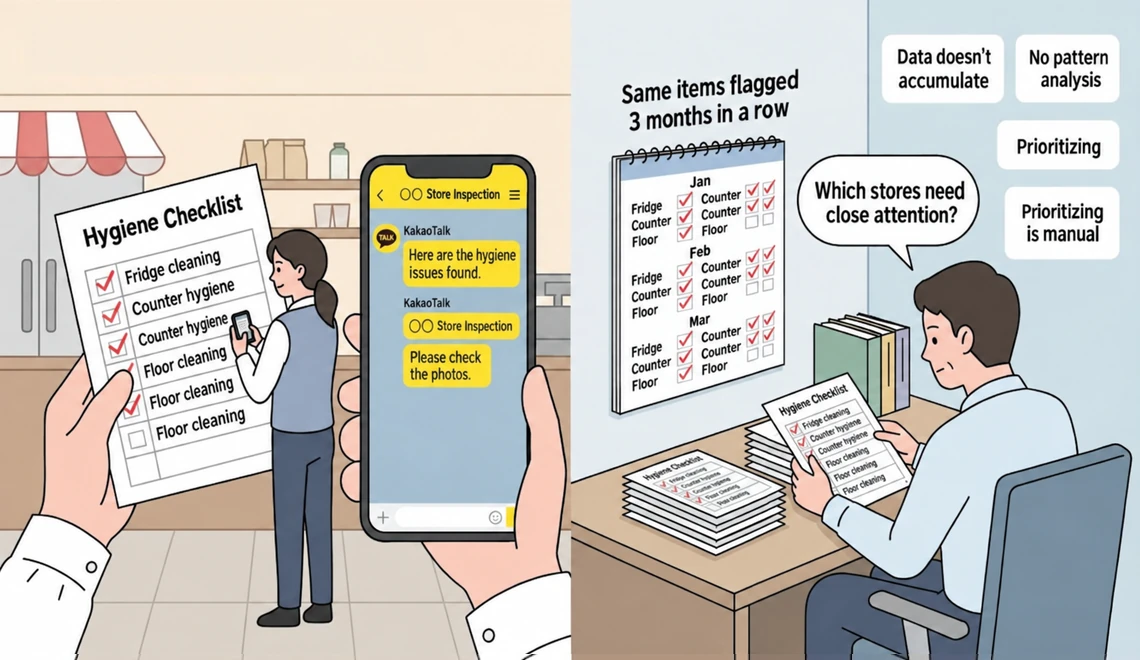 The real problem is not the inspection activity itself but a structure in which inspection results never connect to management decisions. Only when QSCV data is organized by store, by item and over time can you answer "which store needs which improvement" based on data.
The way forward
To restore the value of QSCV inspections, results must turn from "records" into "data you can analyze." With a mobile inspection system, the results an SV enters on site are reflected in the HQ system instantly. When the system automatically calculates score trends by store, repeat findings and improvement rates, the operations lead becomes the person who "interprets" data, not the person who "collects" it.
FDAM supports QSCV inspections through a mobile app and generates automatic reports from the results. Data entered by SVs in the field is aggregated on the HQ dashboard in real time, giving a one-glance view of operating quality across stores.
3. Franchise contract management becomes a legal-risk blind spot
What the problem really is
Contract management is the risk that builds up most quietly at a franchisor HQ. Past 50 stores, having one person track renewal dates, disclosure document delivery history and franchise fee collection from memory becomes practically impossible.
💡
Under Korea's Franchise Business Act, a franchisor must provide prospective franchisees with its franchise disclosure document at least 14 days before the contract is signed. Failing to meet this obligation can lead to corrective action by the Korea Fair Trade Commission. Yet in the field, it is not unusual for teams to move on with the assumption that "we probably sent it."
The structural cause
The biggest problem with manual management is that you cannot prove delivery history. In a dispute with a store owner, if HQ cannot clearly show "when, how and to whom the disclosure document was delivered," it ends up in a weak position. Renewal dates are the same story. If renewal dates are tracked in Excel and the person in charge leaves, things easily fall through the cracks during the handover.
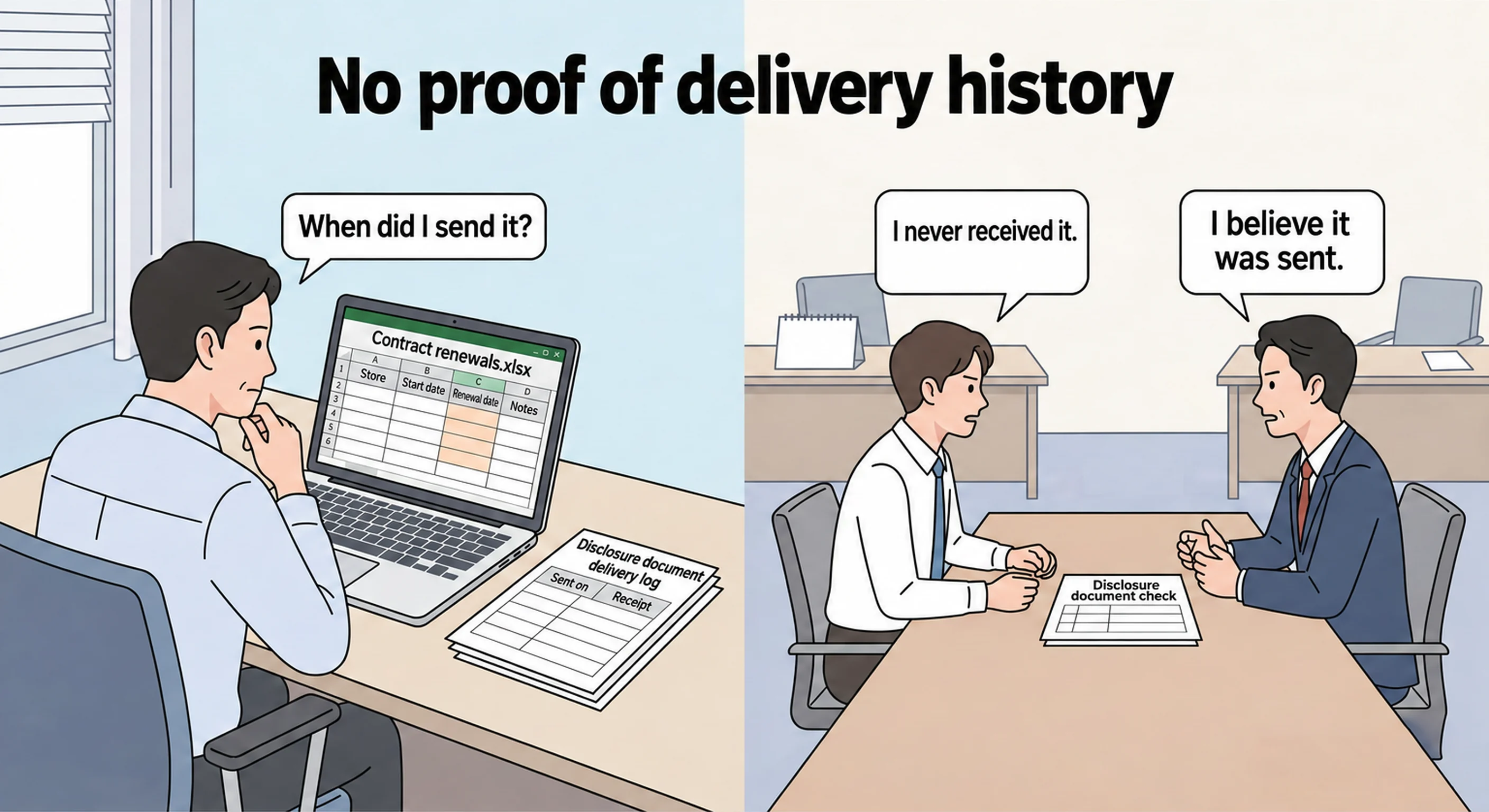
As the brand grows, this area shifts from "nice to have" to "dangerous to lack." Franchise contracts are not simple paperwork; they are a core management area that secures the HQ's legal safety.
The way forward
An e-contract system with disclosure document delivery tracking lets you manage legal compliance systematically. Signing dates, disclosure delivery timestamps and receipt confirmations are recorded automatically, so you can produce evidence immediately if a dispute arises.
FDAM includes disclosure document delivery history and e-signature contracts as standard. Upcoming renewal dates can be checked in the system in advance, so the contract schedule can be managed without relying on any one person's memory.
4. Scattered sales data means every report starts with "reconciling numbers"
What the problem really is
Sales data generated at store POS systems mostly reaches HQ the next day. A one-day lag is close to the industry standard, so that in itself is not the problem. The real problem is what happens after the data arrives.
If 50 store owners report sales via KakaoTalk or Excel, the HQ staffer spends half a day or more every Monday compiling the numbers, aligning formats and checking for errors. If it takes two days to answer when leadership asks "How are sales this month?", the data has effectively lost its value for decision-making.
The structural cause
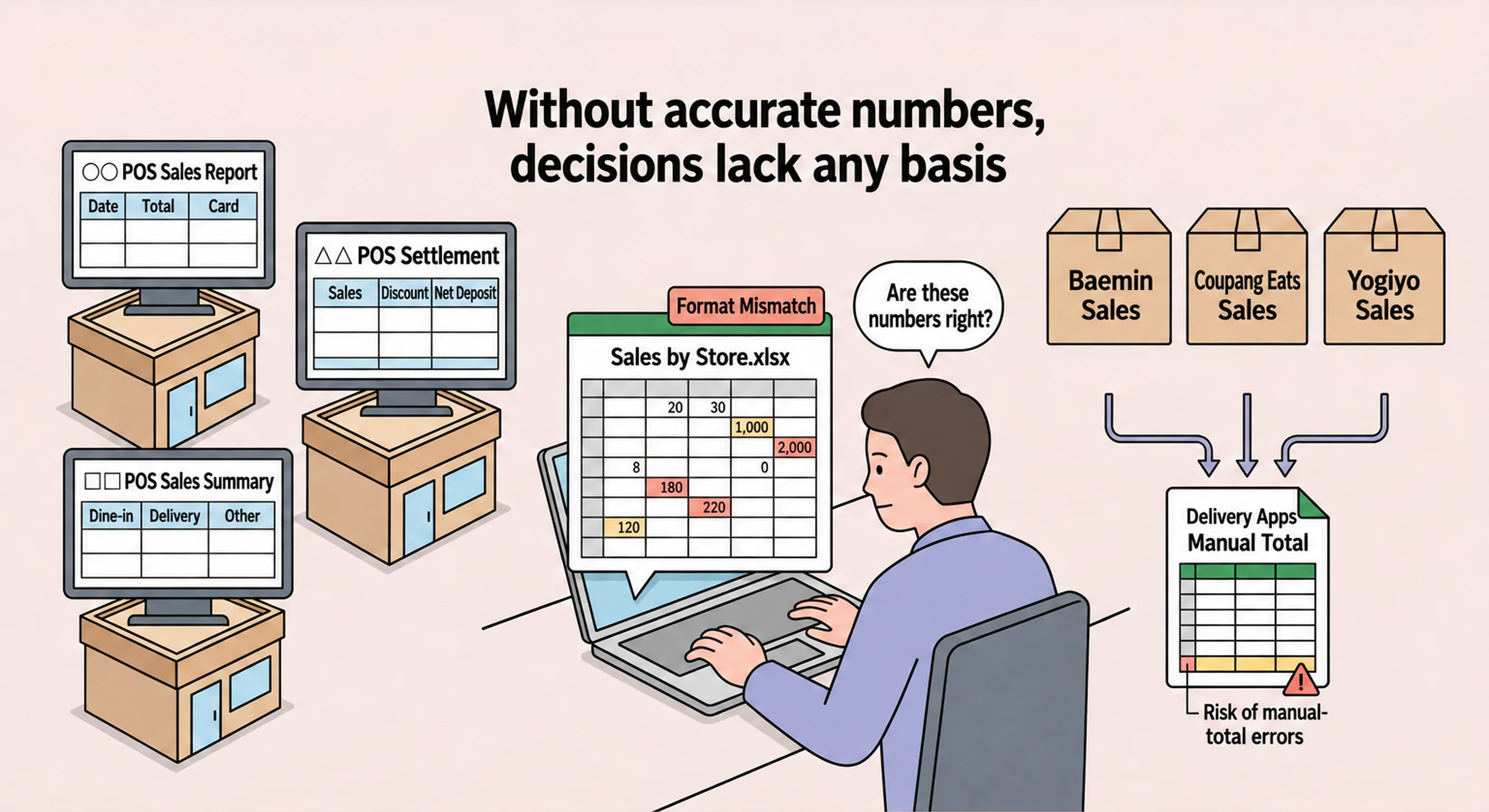
When stores use different POS systems or sales reports are not standardized and are compiled by hand, the reliability of the numbers themselves wavers. "Not knowing the exact numbers" means the same thing as "making decisions without evidence."
On top of that, delivery app sales and dine-in sales are frequently not tracked separately. To consolidate sales from multiple delivery platforms such as Baemin, Coupang Eats and Yogiyo by store, a staffer has to check each platform's settlement data individually and add them up by hand.
The way forward
Once POS sales are collected and aggregated automatically by a system, HQ staff no longer need to compile data by hand, even if the data still arrives the next day. Sales trends by store and by period are organized automatically, so staff can spend their time "interpreting numbers" instead of "gathering numbers."
FDAM automatically collects POS sales data and aggregates it by store and by period on the HQ dashboard. With manual compilation eliminated, the same team can understand and respond to sales performance faster. This is one of the most practical reasons brands with 50+ stores start looking at a franchise ERP.
5. HQ headcount stays flat while the types of work grow exponentially
What the problem really is
Many brands go from 50 to 100 stores faster than they went from 20 to 50. Once franchise sales gain momentum, the growth curve steepens, and HQ hiring cannot keep up with it.
Eventually, one person is doing sales, drafting contracts, managing openings and going out on supervisor visits. That is not multitasking; it is structural overload. When work concentrates in a specific individual, the whole function grinds to a halt when that person takes vacation or leaves.
The structural cause
"Just hire more people" is not that simple in reality. Franchise HQ work is highly industry-specific, so new hires need a substantial learning period before they can contribute. The bigger problem is that there is no manual to hand over. When processes live only in people's heads rather than in a system, existing staff have to walk every new hire through each step. During the ramp-up period, the burden on existing staff actually increases.
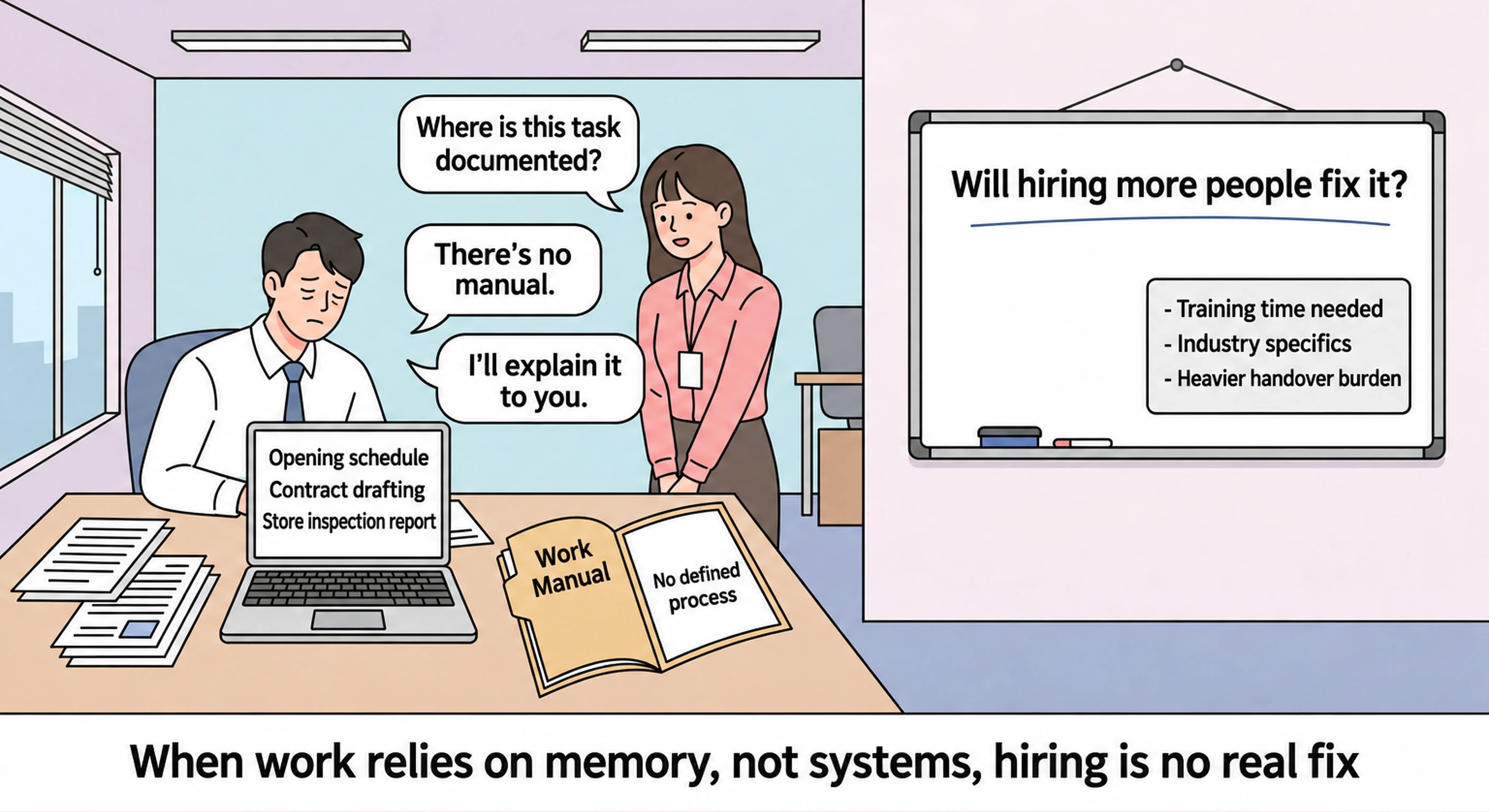
This is not a staffing problem but a workflow standardization problem. When processes are built into the system, new hires can learn the job naturally by following the system's flow.
The way forward
The value of a franchise ERP lies not in "cutting people" but in "letting the system handle work people don't need to do." Hand rule-based work such as repetitive data entry, schedule checks and status roll-ups to the system, and people can focus on what only people can do: judgment, relationship management and strategy.
FDAM connects the entire HQ workflow in one system, from sales management (consultations and contracts) to opening management (paperwork, interiors and training) and operations management (QSCV inspections, POS sales aggregation and store information management). Because processes are standardized in the system, new hires ramp up faster too.
How do you know when it is time to adopt a franchise ERP?
The right yardstick is not "store count" but "how many of the symptoms below apply to your current operations." Based on experience gained supporting more than 500 brands, MS Benter has put together the following self-assessment criteria.
Self-checklist: Is it time for a franchise ERP?
- □ Two or more store openings are underway at the same time
- □ QSCV inspection results are managed in Excel or KakaoTalk
- □ Contract renewal dates are tracked from one person's memory
- □ POS sales data is compiled by hand
- □ It is hard to systematically prove disclosure document delivery history
- □ Handing over work to a new hire takes more than two weeks
- □ Each HQ staff member manages more than 15 stores
- □ Collecting and organizing data for the monthly management report takes three days or more
- □ Delivery app sales settlements are checked platform by platform
- □ Certain functions could stall if a specific employee goes on vacation or leaves
✅ If three or more apply, your current workflow has already outgrown manual work. It is time to seriously look at upgrading your systems.
How FDAM tackles franchisor HQ workflow bottlenecks
FDAM is an ERP built specifically for franchisor HQ operations, managing the HQ's workflows in one integrated system. Whereas general-purpose ERPs are designed around manufacturing and distribution, FDAM is designed around the actual sequence of work a franchisor HQ goes through.
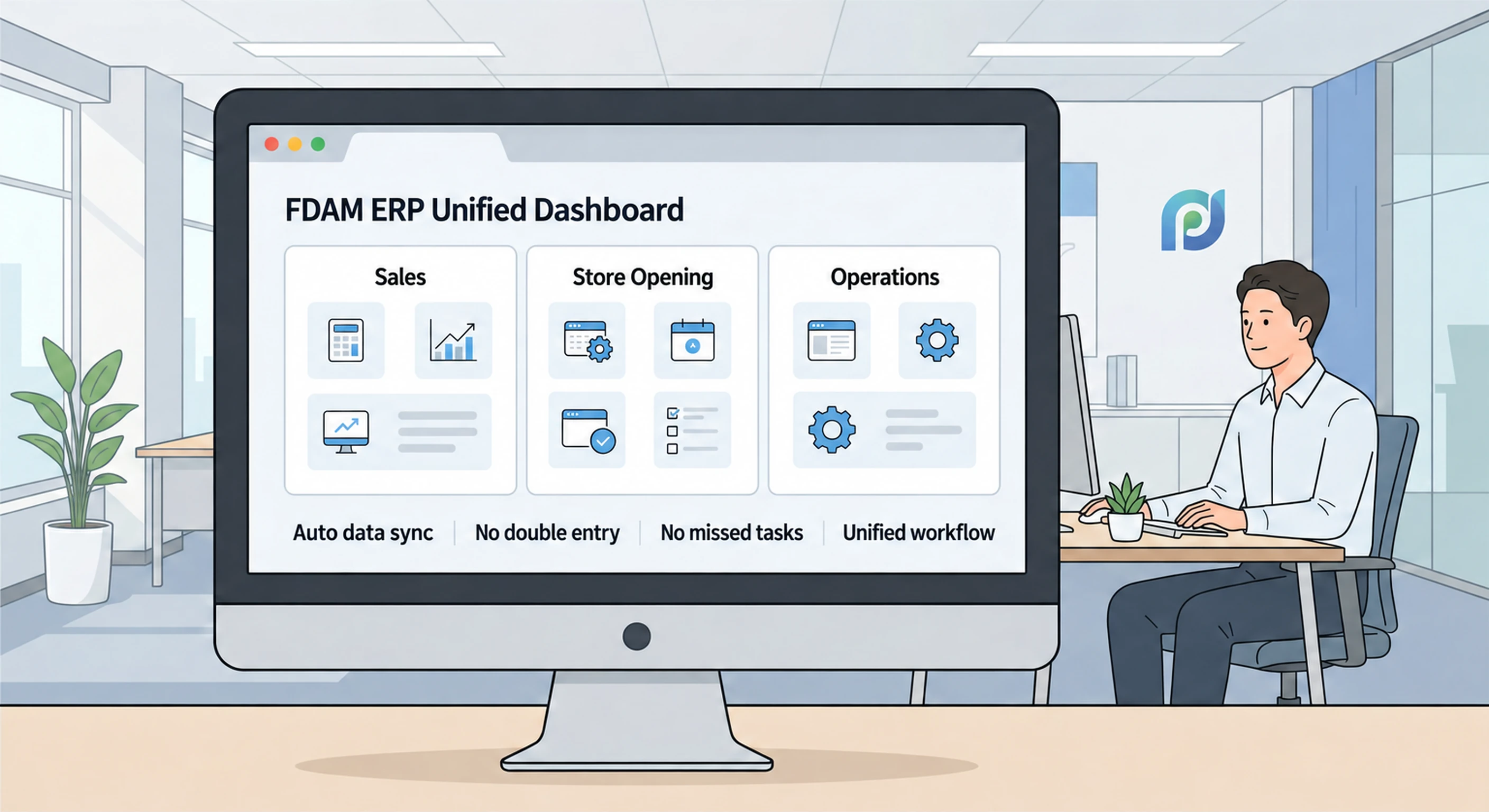
Sales management
Handles the entire franchise sales process in the system, from receiving franchise inquiries and tracking consultation history to providing the disclosure document in advance and signing e-contracts.
Opening management
Tracks every task needed for a store opening, including paperwork, interiors, training and logistics setup, stage by stage.
Operations management
Supports day-to-day HQ operations such as QSCV inspections, POS sales aggregation and store information management.
Because these three stages are connected in one system, store information collected during the sales stage carries over naturally into opening and operations without being re-entered. Since the data never breaks, missed tasks and duplicate entry are prevented by design.
Frequently asked questions (FAQ)
Q1. We only have 30 to 40 stores. Isn't it too early for a franchise ERP?
Whether bottlenecks are actually occurring matters more than the store count itself. If two or more openings are running at once, or QSCV inspections and contract management rely on manual work, you will feel the benefits even in the 30-store range. In fact, getting your systems in order before you pass 50 stores is more efficient, because it prevents the operational chaos that comes with growth.
Q2. Can't a general ERP or groupware handle franchisor HQ work?
General ERPs are optimized for manufacturing and distribution processes and do not support franchise-specific work such as franchise contract management, disclosure document tracking, QSCV inspections and opening process management. Groupware is a tool for internal communication and approvals, not for managing store operations. A franchisor HQ needs a dedicated franchise ERP designed around the industry's unique workflows.
Q3. Will adopting an ERP let us reduce HQ headcount?
The goal of a franchise ERP is not headcount reduction but freeing existing staff to focus on higher-value work. When the system handles rule-based work such as repetitive data cleanup, status checks and schedule tracking, the same team can manage more stores effectively. Indeed, the most common feedback from headquarters that adopted FDAM is: "Our headcount is the same, but the number of stores we can manage has grown."
Q4. Isn't the rollout complicated? Will our current operations be disrupted?
Because FDAM is specialized for franchisor HQ work, it has fewer initial setup items and a shorter ramp-up than general-purpose ERPs. Before rollout, MS Benter assesses the HQ's current processes and then applies the system step by step, by team and by function. Rather than switching all operations over at once, we start with the areas where bottlenecks are worst, minimizing disruption to ongoing operations.

Start data-driven franchise operations management today
If you want to find out whether your HQ's workflows have reached the point where they need a systems upgrade, start here.
📞 Contact: 1544-7120 (Korea)
This content is provided by MS Benter.
Franchise ERP, franchisor HQ operations, franchise store management system, FDAM, QSCV inspection automation, franchise contract management, franchisor HQ efficiency, franchise solutions, HQ workflow bottlenecks, when to adopt an ERP