
Key Takeaways · Franchise location training isn’t a one‑off event; it’s the first step in establishing brand operational quality. · Paper scorecards and Excel‑based training management create gaps in evaluation data and handover continuity. · When training data accumulates in the ERP, supervisors can deliver customized on‑site coaching. · FDAM provides a workflow that automatically links training schedules, assessments, and comments with franchise location master data. |
Franchise Location Training Systemrefers to the headquarters infrastructure that ensures the operational manuals delivered to franchisees function consistently on the ground. As the number of franchise locations grows, it becomes impossible for supervisors to closely manage every store, so the data accumulated during pre‑opening training determines the quality of coaching during operations.
One of the biggest dilemmas for headquarters operations teams is the gap between manuals and the field. If the carefully prepared training content isn’t applied consistently on site, the brand’s overall operational quality (QSC) begins to diverge store by store. Yet many headquarters still manage training data with Excel sheets and handwritten scorecards. MS Venter, with nearly 25 years focused on franchise IT,FDAMlet’s walk through how this workflow was transferred into a system, step by step.
Franchise location training must accumulate in the ERP to remain a headquarters asset.
1. Three Risks of Managing Franchise Location Training Without an ERP

Undigitized training records create management gaps during operations.
Many headquarters staff believe, “The training team handles training, and the operations team only manages post‑opening.” This data break may not seem critical short‑term, but it quickly drives up headquarters management costs over the long run.
Lack of Objective Evaluation Data
Paper scorecards aren’t digitized, preventing comparison of franchisee competencies by item or trend analysis, and making it hard for supervisors to prioritize coaching topics during store visits.
History loss and handover challenges
When a manager resigns or changes roles, there is no way to determine what training the franchisee received before opening or what gaps remain. If the franchisor headquarters loses a franchisee’s operational history, the operations team must start the same work from scratch.
Inefficiency due to duplicated tasks
Supervisors responsible for opening and those handling operations end up teaching or checking the same content redundantly. Because the information is trapped in Excel files, even with an ERP a single entry would be shared.
2. Data‑driven training process built with FDAM
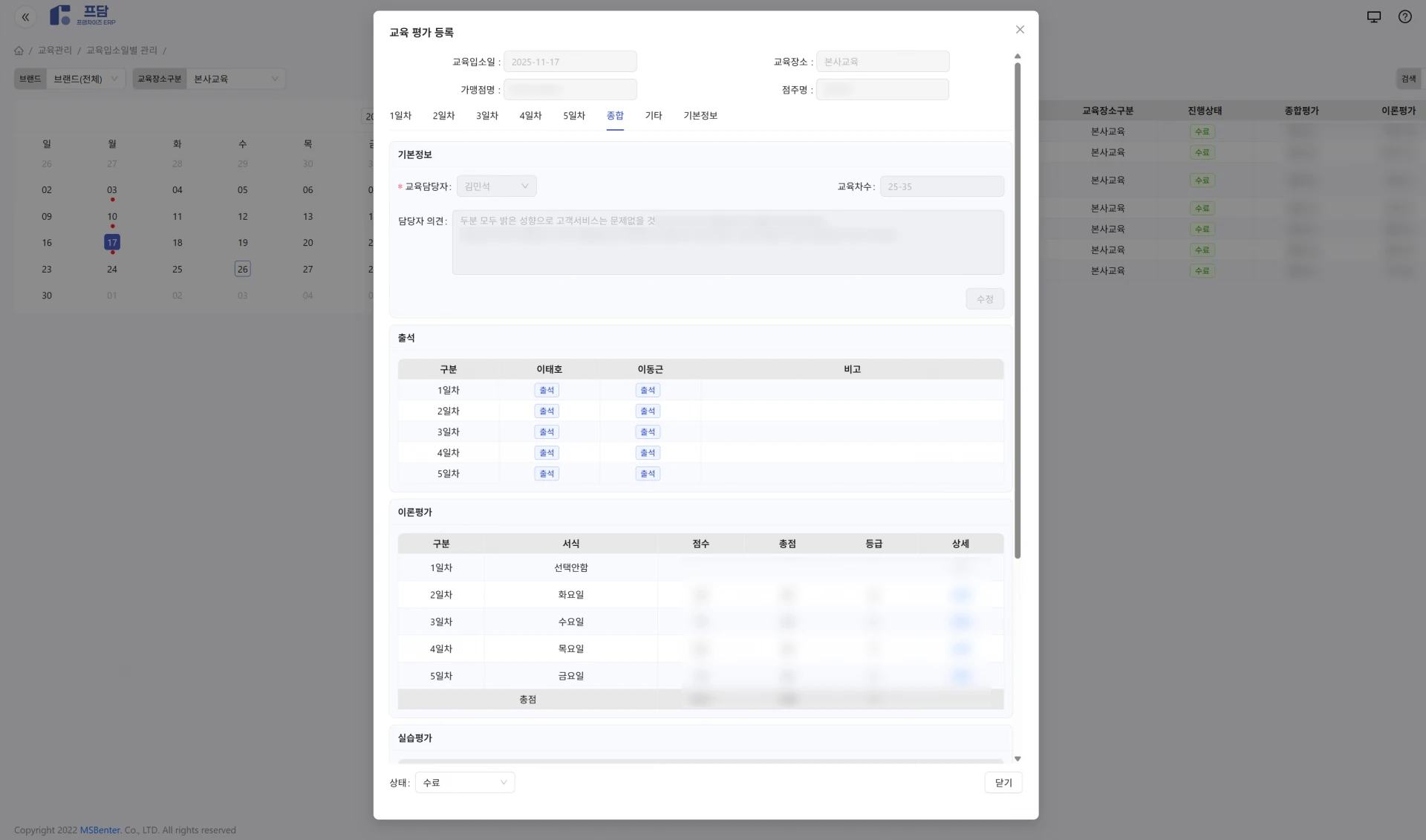
The training cohort and participant list sync instantly with the franchise location master data.
MS Venter’s FDAM goes beyond sales management to cover the entire franchise location lifecycle—from training to opening to operations—in a single system. Built on collaboration with roughly 500 brands, the workflow ensures training data flows seamlessly into the operational phase.
Step 1. Systematize training schedules and staffing
- Data integration— Instead of phone or KakaoTalk, creating a cohort in the system instantly links to the franchise location master record.
- Secure documentation— At renewal or during a dispute, you can instantly verify from system logs when and which curriculum was completed.
Step 2. Digital assessments with automatic scoring
On‑site staff check evaluation items (theory, practice, service mindset, etc.) on tablets or smartphones. The system automatically tallies scores based on weighting, reducing human error, and stores results in the cloud for real‑time access from any headquarters location.
3. Training data becomes core material for supervising

Training‑phase data serves as customized coaching material for supervisors.
FDAM’s real value appears after training, in the work of operations teams and supervisors. Scores and comments accumulated during training flow naturally into the Franchise Operations Management module, giving supervisors contextual insight into the franchisee before store visits.
"Demonstrates strong recipe acquisition skills but tends to become flustered when handling customer complaints."
When these training manager comments are delivered through the system to the responsible supervisor, you can focus coaching on CS response techniques rather than menu training during the first store visit.Data‑driven customized supervisingThis is the flow that gets created.
If you ask the FDAM AI Assistant—integrated for the first time in a domestic franchise ERP—"Show me the franchise locations with the lowest training scores this month," you’ll receive a list sorted by score along with priority rankings for each supervisor. The training data accumulated by headquarters is transformed into instantly actionable decision‑making material.
4. Implementing the system establishes the brand’s standards
Franchise location training isn’t a one‑off event. It’s the first commitment between headquarters and the franchisee and the launch point for brand operational quality. When the data gathered during training naturally feeds into operations, inspections, and CS response, headquarters can maintain consistent quality even as the number of franchise locations grows.
If you’re still filing training evaluation sheets in binders, start by converting those paper piles into live data. Once the workflow is established, the information becomes a growing asset for headquarters.
Frequently Asked Questions
Q. What are the biggest problems when you manage training with Excel instead of an ERP?
Individual franchisee evaluation results aren’t aggregated into statistics, history is lost when staff change, and multiple supervisors end up duplicating checks—creating major inefficiency. Consequently, the headquarters operations team must repeatedly re‑assess each franchise location from scratch.
Q. How are training records linked to the franchise location master data?
FDAM links prospective franchisee information entered during Franchise Sales Management to training cohort assignments, and the evaluation results are accumulated in the same franchisee master record. After opening, supervisors can view this entire flow in a single screen during Franchise Operations Management.
Q. How can supervisors use the training data?
Supervisors can review accumulated scores and comments before a store visit to prioritize coaching on each franchisee’s weak areas. They can also ask the AI Assistant in natural language for a score‑based list of franchise locations to quickly set visit priorities.
Q. Can training history serve as evidence in renewal negotiations or disputes?
The system‑recorded training completion dates, curriculum, and evaluation results provide objective proof of the support headquarters has offered to the franchisee. They become critical evidence during renewal or any dispute.
Q. How does the implementation consultation work?
You can contact FDAM via the implementation consultation page (franchiseerp.com/register), the KakaoTalk channel, or the main line (1544-7120). We’ll provide a demo and usage plan tailored to your headquarters’ training workflow.
Training builds the brand standard
Training management that fits our headquarters,
Check it in FDAM