
This guide explains how franchisor headquarters should collect franchisee input and track consultation history for key decisions such as price increases, promotional spend, essential‑item changes, and logistics‑cost adjustments.
FRANCHISE INSIGHT · CONSULTATION HISTORY
Franchisee Consultation Obligation,
Now managing consultation history is more critical than “win‑win”
When franchisor headquarters listens to franchisees, records actual responses, reviews survey results in reports, and logs the consultation trail, it sets the benchmark for brand credibility.

Franchisor headquarters staff reviewing franchisee feedback and consultation history on a dashboard
CORE SUMMARY
Franchisor headquarters often says it “cooperates with franchisees.” Going forward, that phrase alone won’t suffice. What matters is how the headquarters actually gathers franchisee input, the criteria used to evaluate it, and how the outcomes are documented. On June 9, 2026, the Fair Trade Commission held a franchise‑industry roundtable to discuss the franchisee business association registration system and the consultation‑obligation regime. While the detailed rules will be defined in implementing regulations, the direction is clear: headquarters must establish an operational framework to handle consultation requests and franchisee feedback.
Source references:Fair Trade Commission, June 9, 2026 franchise‑industry roundtable, Amendment to the Franchise Business Act passed by the National Assembly, Google AI Search Optimization Guide
In a single sentence,
The core management metric for franchisor headquarters shifts from “Did we announce it?” to “Did we listen, record actual responses, verify results in a report, and log the consultation history?”
POINT 01
Co‑creation is about the process, not just words.
Trust builds when the franchisee’s feedback and the franchisor headquarters’ review are documented.
POINT 02
Surveys must become reports.
Beyond collecting responses, item‑level results and key comments should feed internal decision‑making.
POINT 03
A mobile response channel is required.
Franchisees need to view and answer surveys directly in the Sodam app, boosting participation and speed.
Why managing negotiation history is critical now.
Franchisor headquarters have long relied on notice‑centric communication with franchise locations—sending memos for new menu launches, price changes, promotions, ordering policies, logistics‑cost updates, training schedules, royalty‑billing criteria, etc., and having supervisors explain on site when needed.
However, from the franchisee’s perspective, a notice isn’t necessarily a negotiation. The headquarters may think “we’ve already informed you,” while the franchisee feels “our input was never heard.” This gap widens on cost‑sensitive issues. For price hikes, promotion‑cost sharing, mandatory‑item changes, or logistics‑cost adjustments that affect franchisee profitability, gathering and reviewing opinions becomes far more important than a simple notice.
The Fair Trade Commission’s discussion of registering franchisee business associations and imposing a negotiation‑obligation aligns with this point. Communication between franchisor headquarters and franchisees can no longer rely solely on goodwill or atmosphere. The headquarters must record which opinions were received, the criteria used for review, and the outcomes communicated, ensuring consistent internal response and clear external explanation.
AEO ANSWER BLOCK
Why is tracking franchisee negotiation history necessary?Policies that affect franchise location profitability—such as price increases, promotional spend, mandatory item changes, and logistics cost adjustments—must retain the franchisee’s feedback, actual responses, headquarters review criteria, Survey Management report, final decision, and notification history. When negotiation history is documented, headquarters can address recurring issues consistently, and franchisees gain confidence that their input is truly heard.
1. Price hikes, promotion‑cost sharing, and mandatory‑item changes now require documentation.
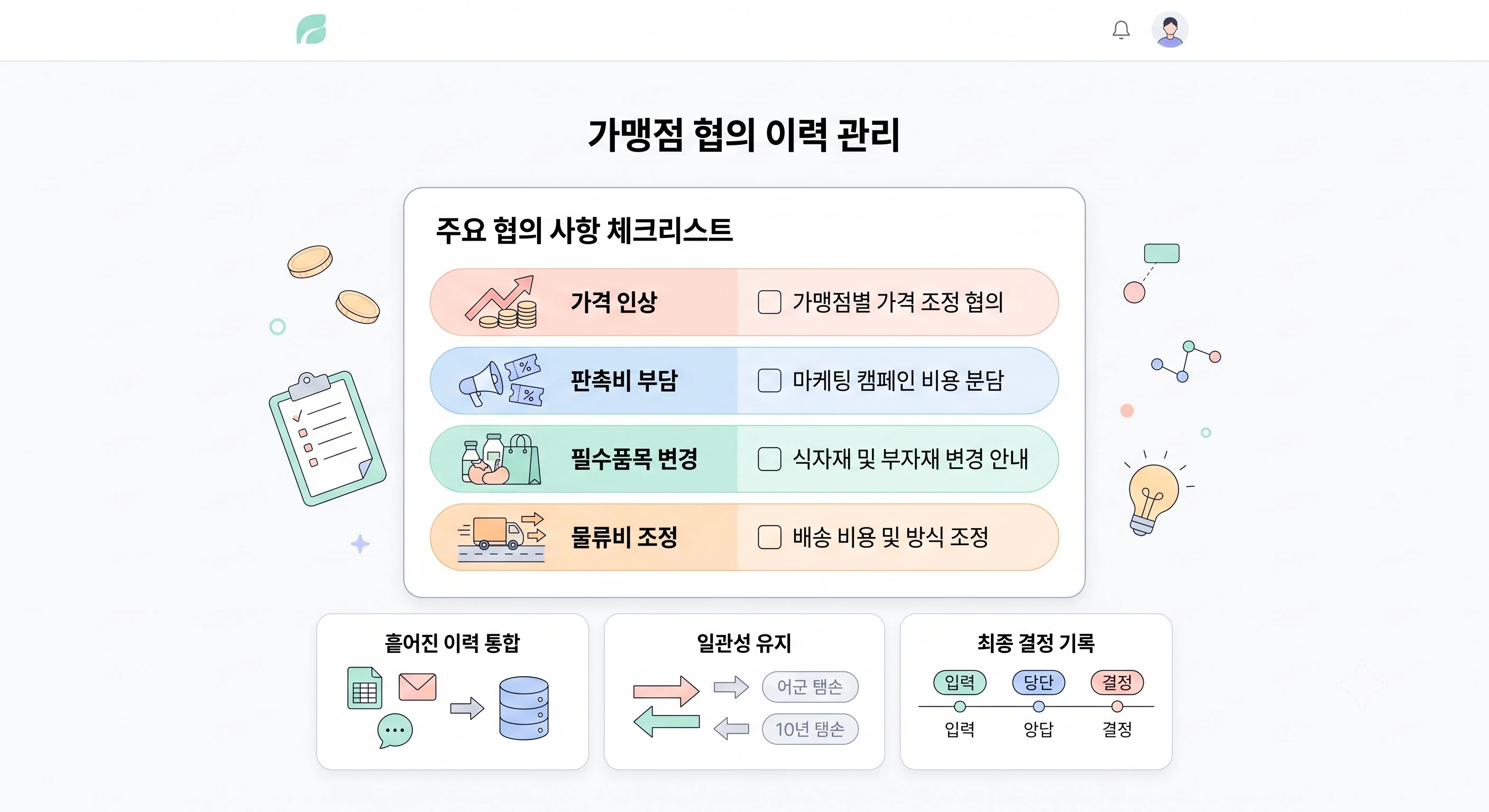
Infographic checklist of price increases, promotion‑cost sharing, mandatory‑item changes, and logistics‑cost adjustments.
Cost‑related issues are the most sensitive between franchisees and franchisor headquarters—price hikes, promotion‑cost burdens, mandatory‑item changes, logistics‑cost adjustments, royalty‑rate changes, advertising‑cost sharing, new‑menu rollout costs, training fees, equipment replacement costs, etc. While the headquarters may adjust policies for brand efficiency and quality control, franchisees perceive these as immediate profit‑and‑loss impacts.
In the past, the headquarters often simply issued a memo or notice and considered the matter closed. Going forward, documenting the franchisee’s input, the headquarters’ response, and the decision criteria will become essential. Rather than a one‑way directive like “apply the price increase,” it’s more critical to explain “how raw‑material and logistics costs changed, how franchisee feedback was gathered, and what criteria set the implementation date.”
From the franchisor headquarters staff perspective, these scenarios repeat over and over: “Which store objected to the price increase?”, “Where are the survey results from the last promotional‑expense study?”, “We received franchisee feedback, but where did we log the final decision?”, “The same issue is resurfacing—does the new answer match the previous one?” If you can’t answer immediately, the discussion trail gets scattered across memory, Excel files, email, group chats, and supervisors’ personal notes.
| Sensitive issue | Questions franchisees ask | Records the franchisor headquarters must keep |
|---|---|---|
| Price increase | Why does it need to be raised now? | Reason for the increase, feedback results, effective date |
| Promotional expense burden | Does it actually boost sales? | Willingness to participate, cost‑sharing criteria, results report |
| Required item change | Why must this item be used? | Reason for change, supply cost, alternative feasibility assessment |
| Logistics cost adjustment | Why is the burden higher only in our region? | Regional criteria, amounts before and after change, communication history |
| Royalty criteria | Is the calculation method clear? | Billing basis, justification for change, franchisee notification details |
2. Gathering franchisee feedback is an operational process, not a promotional event.
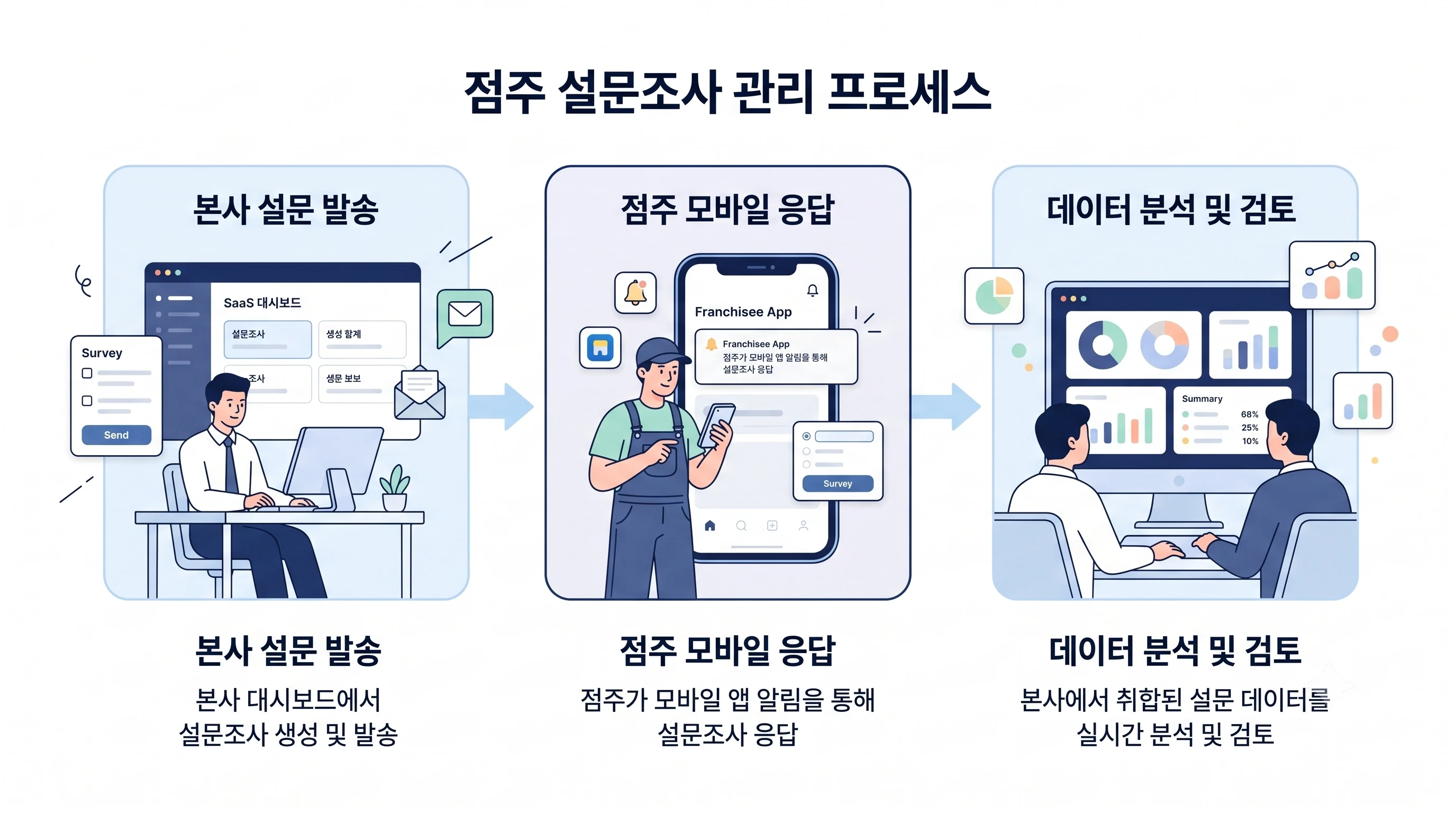
Process image showing the flow where the franchisor headquarters sends a survey and the franchisee responds via the mobile app
Collecting franchisee feedback isn’t just a one‑time survey. It’s a recurring management task that occurs each time the franchisor headquarters updates its operating policies. Whether you’re asking franchisees for input before launching a new menu, confirming participation in a promotion, gauging on‑site burden before a price change, or seeking opinions on mandatory item adjustments, all of these fall under this process.
The key is that gathering franchisee input doesn’t end with receipt. The franchisor headquarters must review response rates, major comments, reasons for objections, improvement requests, and whether the feedback will be implemented. Only then do franchisees feel that “the headquarters listened.” If you collect responses but never share outcomes, franchisees won’t see a reason to join the next survey.
Collaboration isn’t a slogan; it’s built into the process. There must be a channel for franchisees to voice opinions, the franchisor headquarters must evaluate those opinions, and then communicate the final decision and its rationale. This loop must be recorded as data, not just rely on an individual’s memory.
Franchisee feedback collection viewed as an operational process
· Pre‑notification: Explain why changes are happening so franchisees understand
· Mobile response: Franchisees view the survey in the Sodam app and submit their answers
· Results report: Review response rate, key comments, objection reasons, and non‑response status
· Results communication: Clearly convey the final decision, implementation status, effective date, and follow‑up actions
3. Essential consultation‑history data the franchisor headquarters must retain
Managing consultation history isn’t just archiving survey files. It must link when a policy was proposed, who was notified, which franchisee gave which feedback, the criteria the franchisor headquarters used to evaluate it, and how the final outcome was communicated. This linked data enables consistent responses when the same issue recurs.
For example, imagine you ran a logistics‑cost adjustment survey. Simply recording “65% in favor, 35% opposed” isn’t actionable. You need to know which regions showed the most opposition, whether objections stemmed from cost burden or delivery delays, what mitigation the franchisor headquarters considered, and how the final implementation date was set.
| Category | Management Item | Content to Record |
|---|---|---|
| 01 | Agenda Information | Agenda name, purpose, background, related cost items, planned effective date |
| 02 | Target franchise location | All franchise locations, specific brand, specific region, locations using particular items |
| 03 | Response channel | Sodam app, survey link, in‑person consultation, phone, email reply |
| 04 | Response status | Response rate, non‑responding franchise locations, pro/contra ratio, regional reactions |
| 05 | Result report | Item‑by‑item response results, key comments, reasons for opposition, internal report summary |
| 06 | Headquarters review | Review department, review criteria, feasibility of implementation, alternative considerations |
| 07 | Final decision | Implementation status, effective date, before‑and‑after changes, exception criteria |
| 08 | Result notification | Notification date, notification channel, confirmation status, follow‑up inquiry handling |
Risks the franchisor headquarters often overlook
· Survey responses were received, but the result report and final outcomes were never recorded
· Franchisee objections are scattered across group chats, emails, and call logs, making them hard to locate later
· Different staff members gave conflicting answers to the same issue
· Regions or locations with high levels of opposition were not tracked separately
4. Maintaining a record of consultations is the standard for preserving internal consistency at the franchisor headquarters
Consultation history management isn’t just for external responses; it’s essential for maintaining consistent internal operations. At the franchisor headquarters, the operations, logistics, procurement, marketing, training, supervisory, and executive teams all work together. Because a single policy change touches multiple departments, lacking a documented history can lead to divergent interpretations of the same issue.
For example, a survey on promotional event participation might be reported by the marketing team as “high participation,” perceived by supervisors as “significant on‑site complaints,” and interpreted by operations as “requiring exception handling for non‑participating stores.” When the survey data, result report, key comments, final decision, and exception criteria are consolidated in one place, cross‑departmental interpretation gaps are minimized.
Moreover, keeping a history preserves response quality even when staff change. The biggest risk in franchise operations is losing context during personnel turnover. Without knowing prior opinions or the criteria behind past answers, a new representative may repeat the same mistakes. Consultation history turns individual memory into a franchisor headquarters asset.
5. FDAM Survey Management lets you structure franchisee feedback
FDAM SURVEY REPORT
Survey Topic · Response Rate · Key Comments · Result Report
Item
Response
Report
Price Adjustment
Agree 64%
Creation Complete
Promotional Participation
Disagree 31%
Review required
Essential items
42 comments
Summary completed
Overall response rate
76%
Report status
Confirmed
Dashboard on the FDAM Survey Management screen that displays survey topics, response rates, key comments, and result reports.
FDAM Survey Management enables franchisor headquarters to systematically collect and manage franchise location feedback. Headquarters can create surveys on a wide range of topics, including price increases, promotional events, operational policy changes, training satisfaction, support requests, essential item updates, logistics cost adjustments, and royalty rate revisions.
Collecting franchisee responses lets you see not only simple yes/no votes but also store‑specific feedback, brand reactions, regional issues, non‑responding locations, and recurring requests. In a mandatory consultation flow, the survey results become critical operational data, demonstrating that headquarters did not decide unilaterally but gathered and reviewed franchise location input.
A key advantage of FDAM Survey Management is that response data can be viewed as formatted reports. Headquarters can synthesize the main comments, track response rates by item, and use the findings in internal reports. It moves beyond mere data collection to become actionable decision‑making material.
| Use Cases | Insights Available Through FDAM Survey Management |
|---|---|
| Gathering Feedback Before Policy Changes | Yes/No stance, reasons for opposition, requests to adjust implementation dates, and improvement suggestions |
| On‑the‑ground Reactions to Price Increases | Regional cost burden, projected impact per franchise location, and concerns about customer reactions |
| Survey of Promotional Event Participation | Interest in participating, feasible cost‑sharing range, and reasons for non‑participation |
| Collecting feedback on required item changes | Quality satisfaction, supply cost burden, requests for substitute items, delivery issues |
| Review survey result reports | Response rate, key comments, item‑by‑item response status, internal reporting materials |
6. The Sodam app serves as the direct response channel connecting franchisees and franchisor headquarters
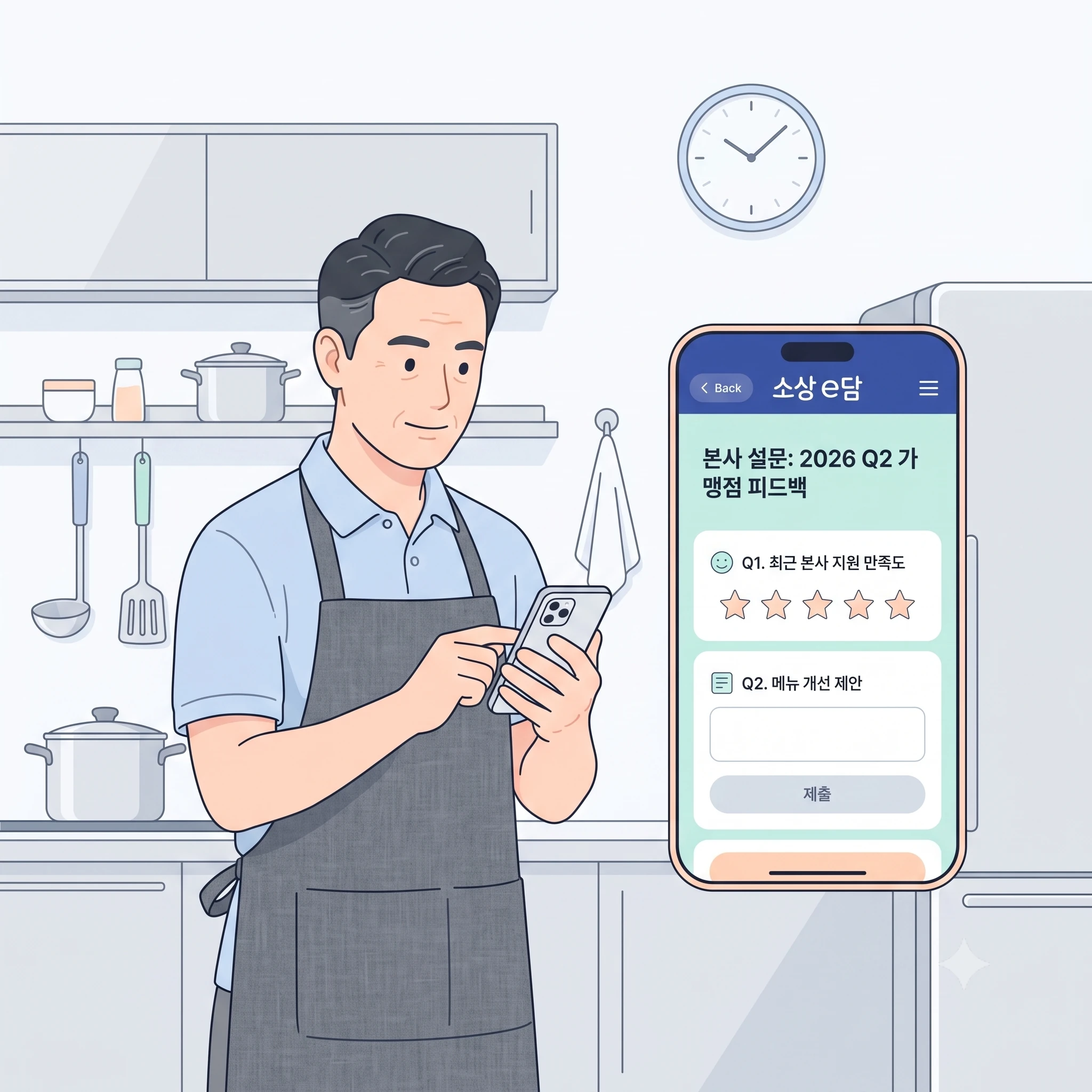
Franchisee viewing and responding to a franchisor headquarters survey on the Sodam (Sosangidam) app
For franchisees, accessibility is paramount. Even a well‑designed survey loses participation if franchisees find it hard to view or the response process is cumbersome. Franchisees running stores prefer to check and answer directly on their mobile devices rather than opening separate documents or logging into a PC.
The Sodam app becomes the mobile gateway for franchisees to view headquarters notices and requests and to submit survey responses. When franchisor headquarters creates surveys in FDAM and franchisees answer instantly via the Sodam app, the feedback collection process becomes much smoother.
In other words, franchisor headquarters can design surveys in FDAM, review results in reports, and enable franchisees to respond easily through the Sodam app. Once this workflow is established, gathering franchisee input shifts from manual effort to a systematic headquarters operation.
FDAM + Sodam app workflow
· Franchisor headquarters: create survey topics and questions in FDAM
· Franchisee: view and answer the headquarters survey on the Sodam app
· Franchisor headquarters: monitor response rate, key comments, and non‑response status in FDAM
· Franchisor headquarters: conduct internal review and communicate results based on the survey report
7. Managing negotiation history with Excel and group chats is cumbersome.
Many franchisor headquarters initially manage franchisee feedback with Excel and group chats. This works quickly and conveniently when the number of franchise locations is small. However, as the franchise network grows and issues recur, the limitations become clear. It becomes difficult to determine which surveys are current, which franchise locations have responded, the main reasons behind dissenting opinions, and whether final results have been communicated.
Group chats are great for instant communication but unsuitable for record‑keeping. As messages accumulate, locating important comments becomes hard, and systematically tracking who said what is cumbersome. Phone calls or on‑site visits capture field context, yet without documentation they are difficult to share internally at headquarters.
Negotiation history should be “readily searchable data,” not just “somewhere stored material.” It must link franchise locations, agenda items, respondents, comments, status, result reports, and final notices so that headquarters staff can answer the same question consistently.
Common issues with manual management
· Survey result files exist, but the final outcomes are managed separately.
· Franchisee objections appear only in chat rooms and are not reflected in internal reports.
· Staff must manually check for non‑responding franchise locations.
· It’s difficult to locate the responses given during previous policy changes.
· When a staff member changes, the negotiation context and franchisee requests disappear together.
8. The franchisor headquarters’ competitive edge comes from negotiation data, not from “win‑win” language.
FROM SLOGAN TO DATA
Before
Win‑win language focus
We declare “We collaborate with franchisees,” yet the collection and handling of feedback are fragmented.
After
Negotiation data focus
Mobile responses, survey result reports, review outcomes, and final guidance histories are managed centrally by the franchisor headquarters.
Infographic comparing the shift from win‑win language‑based management to negotiation‑data‑driven management.
Going forward, franchisor headquarters must build trust with franchisees beyond abstract win‑win messages. It matters which feedback the headquarters received, the criteria used for review, and the outcomes communicated. Franchisees want to verify that their input was actually considered, not just automatically oppose every decision.
Using FDAM Survey Management together with the Sodam app lets you streamline everything from gathering franchisee feedback to mobile responses and reviewing result reports. Headquarters can monitor response rates and key comments by survey topic, while franchisees submit their thoughts easily via mobile. Headquarters then record the final decision and guidance history, creating a reference for recurring issues.
The franchisee negotiation obligation flow isn’t just a burden for headquarters. It can raise operational standards and build data‑backed trust with franchisees. A headquarters with a record of negotiations can respond more calmly when conflicts arise, because discussions are based on documented records rather than emotions.
9. 30‑day action plan to establish a negotiation‑history management system
Negotiation‑history management doesn’t need to be perfect from the start. The priority is to standardize recurring issues. Headquarters should first target agenda items directly tied to costs—price increases, promotional expenses, mandatory item changes, logistics fee adjustments—and fix the workflow from feedback collection to result communication.
Week 1: Categorize items for discussion
Classify agenda items that affect franchisee profitability, such as price increases, promotion expenses, essential supplies, logistics costs, royalties, training, and new menu launches.
Week 2: Build a standard survey template
Create a standard survey that includes pros/cons, reasons for opposition, cost responsibility, requested implementation dates, improvement suggestions, and additional inquiry fields.
Week 3: Establish guidelines for managing mobile responses and non‑responses
Define the Sodam app response flow, overall response rate, regional response rates, re‑notification criteria for non‑responding stores, and the deadline.
Week 4: Implement result reporting and archival procedures
Compile the survey result report, final decision, implementation status, effective date, and follow‑up contact point, and archive the negotiation history for each agenda item.
10. Franchise headquarters negotiation history management checklist
The checklist below evaluates how systematically the franchisor headquarters manages franchisee feedback and negotiation records. It’s less about whether you’ve ever run a survey and more about whether franchisee responses, result reports, and outcomes are linked to each store.
| Category | Check question | Verification material |
|---|---|---|
| 01 | Do you separately categorize major agenda items that affect franchisee profitability? | Agenda classification table, policy change list |
| 02 | Is there a standard procedure for collecting franchisee input before a policy change? | Survey templates and dispatch criteria |
| 03 | Can franchisees actually respond to surveys via the Sodam app? | Mobile response screen and response logs |
| 04 | Can you view response status by franchise location and identify non‑responding stores? | Response rate dashboard and non‑response list |
| 05 | Do you review survey results in report format and use them for internal reporting? | Survey results report |
| 06 | Do you document the franchisor headquarters review criteria and the rationale for final decisions? | Internal review notes and approval history |
| 07 | After a decision, do you notify franchisees of the outcome and implementation date? | Result announcement, app notifications, and acknowledgment logs |
| 08 | Can you search past negotiation records to respond consistently to the same issue? | Item history and processing log by responsible party |
Managing negotiation history is an operational issue, not a legal‑risk response
Viewing the franchisee consultation duty solely as a legal‑team task can delay responses. In reality, negotiation history is generated daily by operations, marketing, logistics, and supervisors. Price‑increase notices, promotional survey invitations, essential‑item change feedback, logistics‑cost adjustment inquiries, training satisfaction surveys, and headquarters support requests all become data for negotiation history.
The key isn’t waiting for a legal determination of “how far we must go.” It’s about how systematically the franchisor headquarters manages communication with franchisees, ensures consistent responses to recurring issues, and integrates franchisee input into corporate decision‑making.
Now, win‑win must be proven with data and records, not just rhetoric. If the franchisor headquarters can collect franchisee feedback, capture actual responses, view survey results in reports, and log the negotiation process, policy changes become a boost to operational competitiveness rather than a burden.
Frequently Asked Questions
Q. Is managing negotiation history essential?
A. Issues that affect franchisees—price hikes, promotional spend, essential‑item changes—often require documented feedback and processing. Consistent internal handling also depends on a clear history. Linking franchisee comments, actual responses, headquarters review, final outcomes, and notification records is safer than merely posting notices.
Q. How should we prepare for the franchisee consultation duty?
A. Detailed requirements will be defined in subordinate regulations, but from an operational standpoint, categorize items that may trigger consultation requests, standardize how franchisee input is gathered (including mobile response channels), set internal review criteria, and define report and notification templates.
Q. In what situations can FDAM Survey Management be used?
A. It’s useful for gathering input before policy changes, measuring participation in promotional events, checking reactions to price adjustments, assessing training satisfaction, compiling franchisee requests, collecting essential‑item change feedback, and confirming on‑site opinions on logistics‑cost adjustments. Survey results can also be turned into reports for internal briefing.
Q. What can the Sodam (Sosangidam) app actually do?
A. Franchisees can view and answer the surveys sent by headquarters in the Sodam app. This streamlines the feedback loop between headquarters and franchise locations, making communication faster and more convenient. Headquarters creates the survey in FDAM, and franchisees respond through the Sodam app.
Q. Why are survey result reports important?
A. Simply collecting responses isn’t enough. Headquarters must review key opinions, response rates, reasons for dissent, and item‑level results in a report format to inform internal analysis and decision‑making. The report serves as proof that franchisee input was gathered and evaluated.
Q. Can we rely on group chats or phone calls for feedback?
A. While instant communication helps, it falls short for negotiation‑history management. It’s hard to track who said what, how headquarters reviewed it, and how the final decision was communicated. Critical issues should be captured through dedicated surveys and a formal history system.
Q. How can we improve survey response rates?
A. Clearly state the survey’s purpose, design short mobile‑friendly questions, and communicate both the response deadline and when results will be shared. Most importantly, follow up with franchisees on the decisions made after the survey to motivate future participation.
Q. Which department should manage negotiation history?
A. This isn’t just a legal‑team task. In reality, negotiation history is generated by Operations, Supervisors, Marketing, Logistics, and Purchasing together. Headquarters should designate a lead department for each agenda item, while responses and outcomes for each franchise location should be managed centrally in one system.
FRANCHISE COMMUNICATION · FDAM + Sodam
Your franchisee feedback,
Is it getting lost behind announcements?
Negotiating with franchisees can no longer be managed solely through simple notices or phone calls.
Feedback collection, actual responses, result reports, review outcomes, and final notices must all be recorded as data.
If you want to gather franchisee feedback, capture actual responses, verify results in reports, and archive the negotiation process as data, try using FDAM Survey Management and the Sodam app.
Request a Implementation Consultation※ This content provides general information from the operational management perspective of franchisor headquarters. Specific legal conclusions may differ based on individual circumstances and applicable enforcement orders, notices, or contract structures.