
How 62 Bodapon lawsuits highlight franchise dispute prevention and franchisor headquarters data management

What matters more than a single contract clause is a record that can explain the decision.
Key points at a glance
Franchise disputes arise fromchanging fees or penaltiesrather than the changes themselves,and how those changes were decided, communicated, and documentedare the starting point. The recent lawsuit by 62 former Bodapon franchisees in the UK illustrates this precisely. In practice, disputes grow not because a system exists or not, but because records exist or not. This article distills eight operational principles the franchisor headquarters must adopt, and shows how to consolidate scattered data into a single source of truthCreating an auditable processthat can be explained
When a contract clause boomerangs
Franchisor headquarters changing sales commissions or cost‑sharing standards is a normal part of management. When costs rise or market conditions shift, maintaining existing policies can become untenable, and sometimes a franchisor must impose penalties on a franchise location’s operational errors to protect brand quality and legal standards. The issue isnot the change itself but the way the change is implemented.
If you alter fees without assessing the impact on franchise location profitability, shift costs without adequate explanation or consultation, or impose penalties that far exceed minor mistakes, the franchisor headquarters’ policies will quickly trigger large‑scale franchise disputes. After watching franchise IT for roughly 25 years, I can say most breakdowns occur not because a policy is missing, but because the decision’s justification cannot be proven.
1. What happened at Bodapon in the UK?
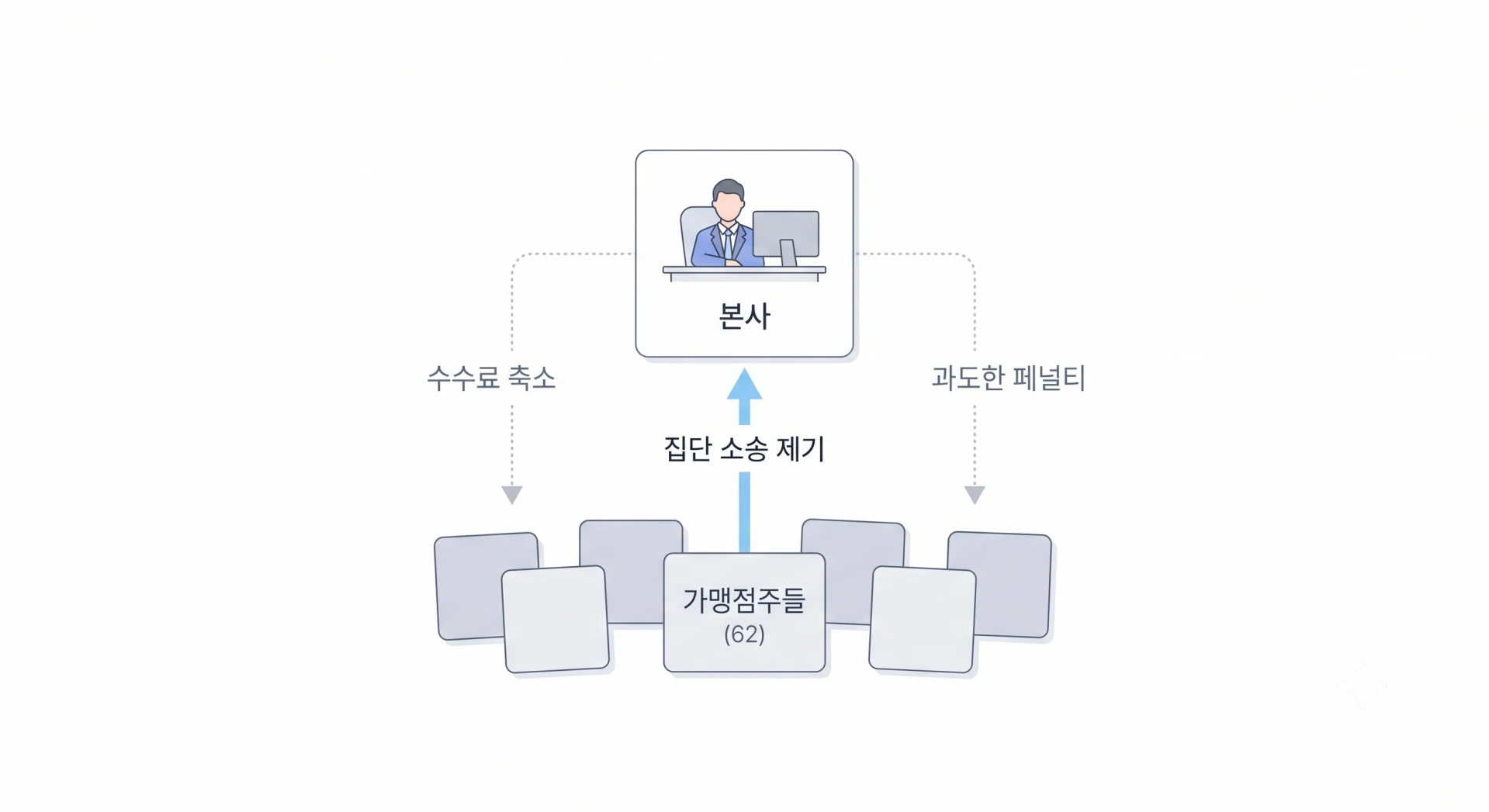
Hold on, what is a “penalty”?
In this article, “penalty” broadly refers to any monetary sanction the franchisor headquarters imposes when a franchise location violates contract or operational standards. In Korea, it’s usuallyearly termination fee, liquidated damages(a pre‑determined amount for contract breaches such as forced purchase or non‑compete), recovery feeThese appear in those forms. Though the names differ, they all represent money flowing from the franchise location to the franchisor headquarters.
Sixty‑two former franchisees of the UK mobile carrier Vodafone filed a high court lawsuit against Vodafone in 2024. That represents about 40% of the 167 franchisees previously involved. The franchisees’ claims fell into three main categories. They said Vodafone unilaterally reduced thesales commissions it paid themwhich hurt store profitability, imposed thousands of pounds in penalties and recovery fees for minor administrative errors, and pressured them to take out loans or apply for government aid to stay afloat.
They alleged that Vodafone earned up to £85 million in unjust profit through these practices. This is the franchisees’ claim and not a court‑determined finding. The most contentious issue was Vodafone’s penalty system. According to a Guardian report, Vodafone set a goal for its internal security officer toencourage higher recovery feeswas reportedly established. In one case, Vodafone’s actual loss was £7.08, yet the franchise location was hit with a £10,000 penalty, according to the claim.
Vodafone stated that its penalties were not intended to generate profit but to protect customers and ensure regulatory compliance. However, franchisees complained that reduced commissions and repeated recoveries pushed personal debt beyond £100,000. The franchisor should focus not on the size of the amounts but on whether a system that rewards staff for imposing more penalties turns sanctions intoa revenue stream for the franchisorinstead of a quality‑control tool. That structure was the real trigger of the dispute.
2. How the lawsuit ended — even a win leaves costs behind

Vodafone and the 62 franchisees settled the 19‑month court battle through a pre‑trial agreement. The terms and amount were confidential, and VodafoneTerms that do not acknowledge legal liabilityIt was. Therefore, this settlement cannot be read as confirming Vodafone's wrongdoing or as indicating that the franchisor headquarters' operations were flawless. Nonetheless, the expenses already incurred remain undeniable.
Nineteen months of litigation response, external attorney and investigation fees, repayment of past recoveries (Vodafone disclosed a £4.9 million VAT‑inclusive refund to the entire franchise network), four franchise business unit investigations, brand reputation damage from media coverage, eroded trust among existing franchise locations and prospective owners, and a complete overhaul of internal operating procedures. In summary:The cost of managing a dispute after it erupts far exceeds the expense of preventing it.Moreover, most of these costs are intangible—damage to reputation and trust—that are hard to quantify in monetary terms, even if the lawsuit ends in a settlement."A headquarters that treats its franchise locations this way"That headline lingers in prospective owners' search results for a long time. The only way to reduce costs the headquarters cannot control is to manage decision‑making processes up front so disputes never arise.
3. Similar structures exist domestically

There is no domestic case identical to Vodafone’s legal relationship. However, multiple instances have been confirmed where costs affecting franchise location earnings were imposed without prior consultation, or where sanctions were disproportionately severe relative to the actual violation. This is not a matter to dismiss as a foreign market difference. In Korea, decisions that alter profit structures are repeatedly communicated without explanation each year, and many of those incidents turn into disputes. The three cases below employ different mechanisms but share the same outcome: reduced real earnings for franchise locations and broken trust.
① Unilateral passing of mobile gift‑card fees— The Fair Trade Commission in 2025 sanctioned An House, which operates Mega MGC Coffee, for forcing franchisees to bear the full fee of mobile gift certificates. Franchisees signed contracts without knowing about this burden because it was not disclosed in the information statement. The commission issued a corrective order, including a ban on forced equipment purchases, and imposed a fine of 2,229,200,000 won. If the Boryeong case reduced the commission the franchisor paid, this case increased the costs the franchisee must bear. The method is opposite, but the result is the same: the franchise location’s net profit was reduced without explanation or negotiation.
② 50% price hike on essential items followed by dispute mediation— In 2025, a headquarters in Gyeonggi Province switched suppliers and announced a 50% price increase for essential items, prompting 14 franchise locations to file for dispute mediation. The mediation resulted in the headquarters drastically lowering the increase and applying it retroactively to all locations. Unlike Vodafone’s outcome, this case was resolved at the mediation stage without litigation. The headquarters explained the need for the hike, and franchisees considered inflation and freeze periods to reach a reasonable level.
③ A 50‑million‑won penalty for purchasing off‑spec market items elsewhere— Pizza & Company, which runs Banolrim Pizza, included a clause that imposed a 50 million‑won penalty if pizza‑staple skewers and disposable forks were bought from any supplier other than the designated one. These were ordinary items readily available on the market. The FTC deemed this a forced purchase, issuing corrective orders and a fine. While the legal structure differs from Vodafone’s, the principle is the same: when penalties exceed actual loss, merely having the clause in the contract does not eliminate dispute risk.
And this is not an isolated incident. According to data released by Gyeonggi Province in 2026, of the 106 franchise disputes handled in 2025, 26 (about 25%) involved abuse of the headquarters’ bargaining power, and 22 of those were settled through mediation.One in four casesThat’s what it means.
4. Seven operating principles for headquarters to prevent the same issues
The current Enforcement Decree of the Franchise Business Act requires consultation with franchisees when changing transaction terms—such as detailed items, prices, quantities, quality, or counterparties—in a way that disadvantages the franchise location owner. This does not automatically apply to every fee or penalty change; each issue needs legal review. However, as a safe operating principle, apply the same procedure to royalties, payment fees, promotional expenses, and refunds.
Before the change, calculate the profit impact for each franchise location.
Using an overall average is a trap. The impact of the same fee change varies with sales, rent, labor costs, delivery share, and cost ratio. You must assess each store individually, especially for locations projected to turn loss, new stores before recouping investment, and multi‑unit franchisees’ cumulative burden. A 1 % fee adjustment is not the same as a 20 % drop in operating profit.
Provide documentation of the reason for the change and the calculation basis.
Simply saying “the market has changed” is insufficient. Along with reasons such as rising costs, platform fees, or legal obligations, you must disclose the formula used to derive the burden amount. Include the prior standard, the new standard, the calculation method with examples, cost‑sharing rules, effective date, and any exemption criteria.
'Notice' and 'feedback collection' are distinct.
Sending a notice does not complete the consultation. You need to track questions, objections, alternatives, and response status. For major changes, combine briefings, surveys, representative meetings, and individual consultations, and avoid retroactive application or last‑minute notices for transactions that have already occurred.
Implement a pilot and a grace period.
Rather than a blanket rollout, pilot the change at selected franchise locations to observe actual profit effects and adjust the formula. Allow a sufficient grace period for new policies, and separate the effective dates for existing contracts versus new contracts.
Penalties should be proportional to actual loss and severity of violation.
Do not set the amount solely on the fact of a violation. Consider actual damages, intent or negligence, first versus repeat offenses, and whether immediate correction was made. Structure the notice to progress from correction request, warning, then sanction for repeat offenses, define internal caps and mitigation criteria, and require a second‑level approval to prevent unilateral penalties by a single staff member.
Run a separate appeals process.
If the same staff who imposed the penalty also decides on the appeal, objectivity is lost. The process should include violation notice, explanation period, first‑level review, separate senior reviewer for second‑level assessment, written notice, and a rapid reversal of any incorrectly imposed penalty.
Continuously track profitability after changes.
Headquarters must look beyond its own revenue. Compare franchise locations’ cost ratios, operating profit, receivables, order volumes, closure inquiries, and complaints before and after changes, and for stores that deteriorate sharply, consider counseling, payment deferrals, or temporary assistance rather than blanket penalties.
5. Why can’t most franchisor headquarters prove this?

You might think, after reading this far, “We have our own procedures,” but disputes don’t arise solely because procedures are missing.The procedures exist, but they’re fragmented.It falls apart. In practice, notices are sent by email, franchise location feedback comes through messenger, contracts reside on the manager’s PC, and approvals are recorded verbally.
When a dispute erupts under these conditions, headquarters can’t answer questions like: which franchise locationwhenwhether notice was given, whether the franchisee reviewed the document, what feedback was received and how headquarters responded, who approved the change, how the franchise location’s profitability shifted before and after implementation, what the basis and evidence for any penalty were, and how appeals were handled. The ability to answer these instantly determines whether a dispute is settled through mediation or drags into a 19‑month lawsuit.
6. How does FDAM fill this proof gap?
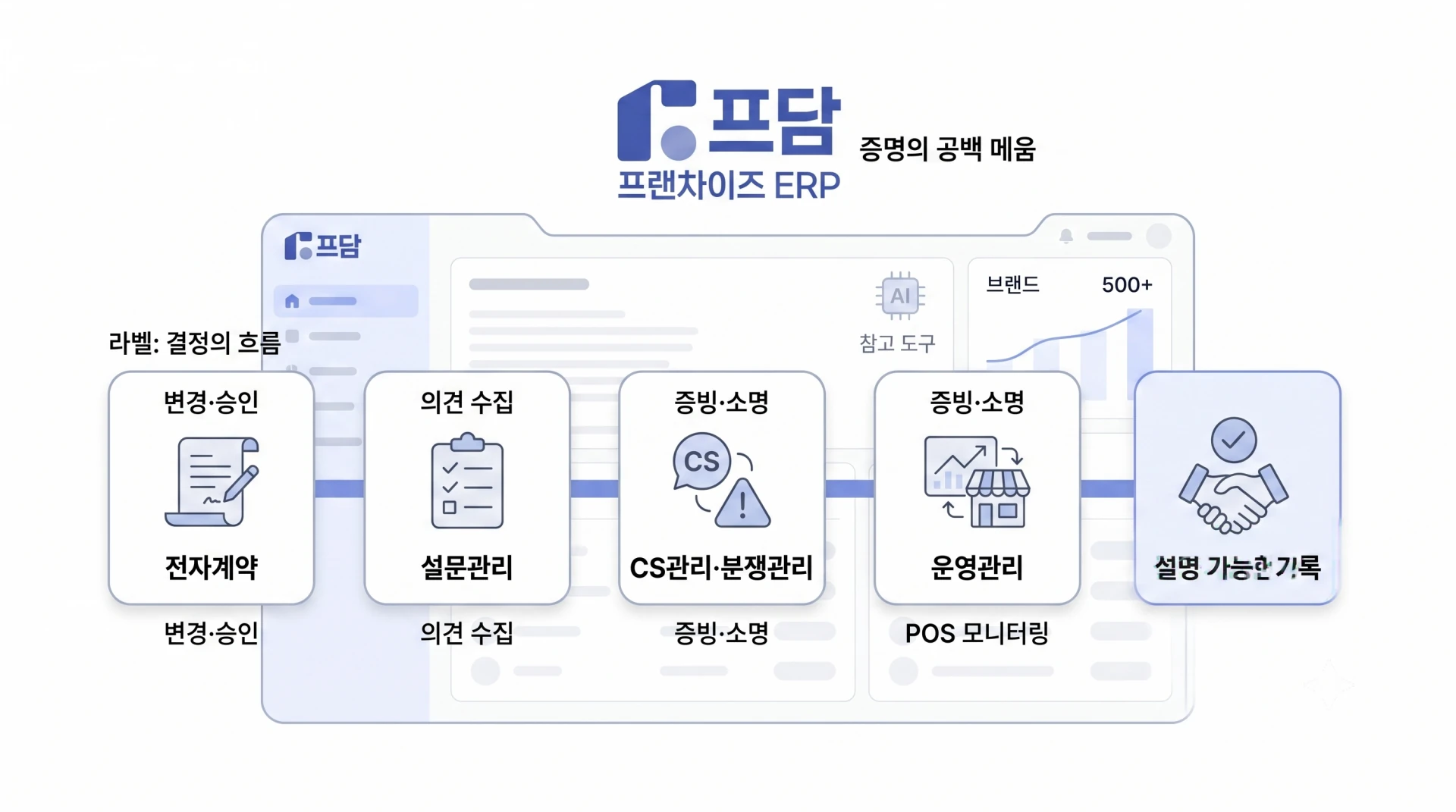
FDAM is a headquarters‑focused operational ERP that consolidates and standardizes Franchise Sales Management, Store Opening Management, and Franchise Operations Management in one platform. Unlike generic ERPs or POS analytics that only display sales dashboards, FDAM provides the tools needed to prevent franchise disputes.Connects the entire decision flow into a single stream.That’s the role of a franchise‑specific ERP. Decades of experience with roughly 500 brands inform this flow design.
Mapping the eight principles outlined earlier to FDAM’s features looks like this:Contract and condition changesare logged in the e‑contract module, preserving change history and approval workflow, with automatic alerts 30 days before contract expiration.Feedback collectionIt uses the Survey Management feature to gather and review franchise location opinions and response status on proposed changes.Penalty documentation and appealsIt consolidates violation facts, inspection history, evidence, and resolution outcomes into a single workflow within Customer Service Management and dispute management.Post‑implementation monitoringIt tracks store‑by‑store changes using POS sales aggregation and franchise location information within Franchise Operations Management.
Especially, the feature that aligns directly with this topic isdispute management.It stores the entire history—from receipt through review, action, and outcome—in a single place, organizing it in an auditable format that shows who made what decision, when, and on what basis. Moreover, the AI integrated for the first time in a domestic franchise ERP serves as a decision‑support tool, not as an autonomous decision‑maker.
In practice, this difference becomes stark the moment a dispute arises. When data are scattered, headquarters only begins digging through email archives, employee PCs, and messenger logs after receiving a lawsuit or mediation notice, often finding that the crucial notification timestamps or approval evidence are missing. By contrast, when contracts, announcements, surveys, inspections, and processing histories are consolidated, headquarters can present a chronological record of when notices were sent, what feedback was received, and who made decisions on what basis—significantly strengthening its negotiating position in mediation tables.
The issue grows as the number of franchise locations increases. With a few dozen stores, a manager’s memory and personal files can cope, but at scale each location ends up with different notification times and response statuses for the same change. Fragmented records then become a liability, generating conflicting statements. This is why a headquarters‑wide consistent record‑keeping system is essential.
Let us be clear on one point: FDAM does not automatically guarantee the legal validity of contracts or policies. It simply records whether headquarters’ decisions were data‑driven, properly communicated, reviewed, approved, and what occurred after implementation. A quality franchise ERP’s role is not to make penalties easier to impose, but to make headquarters’ judgmentsconsistent and explainableand to detect risk signals before they turn into disputes.
A single clause in a contract versus 19 months

In the Boryeong case, the head office shouldn’t stop at asking, “Did the contract grant authority to make changes?” It must also assess how much the franchisee’s profit declined, whether the reasons and calculations were explained, if the feedback was actually reviewed, whether penalties were proportionate to the error, if there was an appeal and mitigation process, whether the manager’s performance evaluation avoided excessive recoupment, and whether vulnerable franchise locations received separate support. You need to be able to answer these questions.
If a franchise location cannot accept a change and headquarters fails to substantiate it, a single contract clause can evolve into a long‑running dispute. This underscores the need to link contracts, announcements, surveys, operational data, and processing history into a unified record.Verify franchise location profitability and establish a transparent, explainable process., which is the most practical dispute‑prevention strategy.
Create an "explainable headquarters" with FDAM
If you’d like to learn more about implementation or request a demo, feel free to contact us.
Frequently Asked Questions
Q. If the contract grants amendment authority, can the franchisor headquarters unilaterally change the fee?
Depending on the contract terms and what is being changed, legal review may be required. In particular, if you alter essential items’ price, quantity, quality, or trading partner in a way that disadvantages the franchisee, current enforcement regulations require consultation. Even with authority, prior notice, profit‑impact analysis, a reasonable basis, and a consultation process are essential.
Q. How should franchise location penalties be determined?
Base penalties on actual loss, intent, repeat offenses, corrective actions, and brand impact. Rather than imposing a large fine upfront, start with education, corrective requests, warnings, and escalate to sanctions for repeated violations. Include an appeal and mitigation process.
Q. Can franchise ERP prevent franchise disputes?
ERP does not directly block legal disputes. However, by consolidating profitability before and after changes, notices and survey responses, contract and document versions, approvals, and CS and dispute handling records, the franchisor headquarters can objectively justify decisions and spot warning signs before disputes escalate.
Source · The Guardian (2026.07.16) / Fair Trade Commission Policy Briefing (2025.10.01, AnHouse) / Gyeonggi Province (2025.05.06, Essential Item Dispute Mediation) / Gyeonggi Province (2026.03.03, Abuse of Trading Position) / Fair Trade Commission (2025.09.07, Pizza & Company) / National Law Information Center (Franchise Business Act Enforcement Decree). The legal content in this text is general reference material for headquarters operations and does not substitute legal counsel for specific contracts or disputes.