
In the AI search era, franchisor headquarters must equip themselves with unique operational evidence
SUMMARY
In the AI search era, franchisor headquarters need not invest in separate search‑visibility technology but in concrete operational evidence only they can provide. Generative AI is already the first stop for decision‑makers seeking franchise ERP solutions, and FDAM’s adoption inquiries over the past three months confirm the same trend. Google’s official generative‑AI search guide released in May 2026 also emphasizes content grounded in real‑world experience and judgment—rather than special tech tricks or mass‑produced assets—as the core differentiator.

Even a single question on the inquiry form showed the shift first
When did you first notice that search behavior was changing?
When we receive an inquiry, FDAM asks, “How did you hear about FDAM?” Recently, a steady stream of franchisor headquarters have answered that they discovered us through generative‑AI recommendations or responses. It wasn’t a one‑off; 28% of the inquiries received in the last three months cited AI as the source.
We’re not just saying that one more acquisition channel has been added. Prospective FDAM users—franchisor headquarters decision‑makers—are now describing their industry, the number of franchise locations, and current challenges to an AI before they even open each search result. The AI then returns a shortlist of suitable solution candidates and comparison criteria. This shift signals a fundamental change in the order in which information is gathered.
Previously, decision‑makers compared search results directly; now they get AI‑generated recommendations.
In the past, a franchisor headquarters representative’s path to finding an ERP was a manual “direct comparison.” The typical flow looked like this.
First, the representative typed “franchise ERP” into Naver or Google. A list of results appeared. They clicked each top‑ranking vendor page, read feature descriptions, viewed screenshots, and downloaded brochures as needed. After gathering three to five options, they compiled a comparison chart to narrow the candidates.
In that model, the vendor’s only concern was ranking position. Being near the top of the first page dramatically increased click‑through likelihood, while slipping to the second or third page often meant no clicks at all.
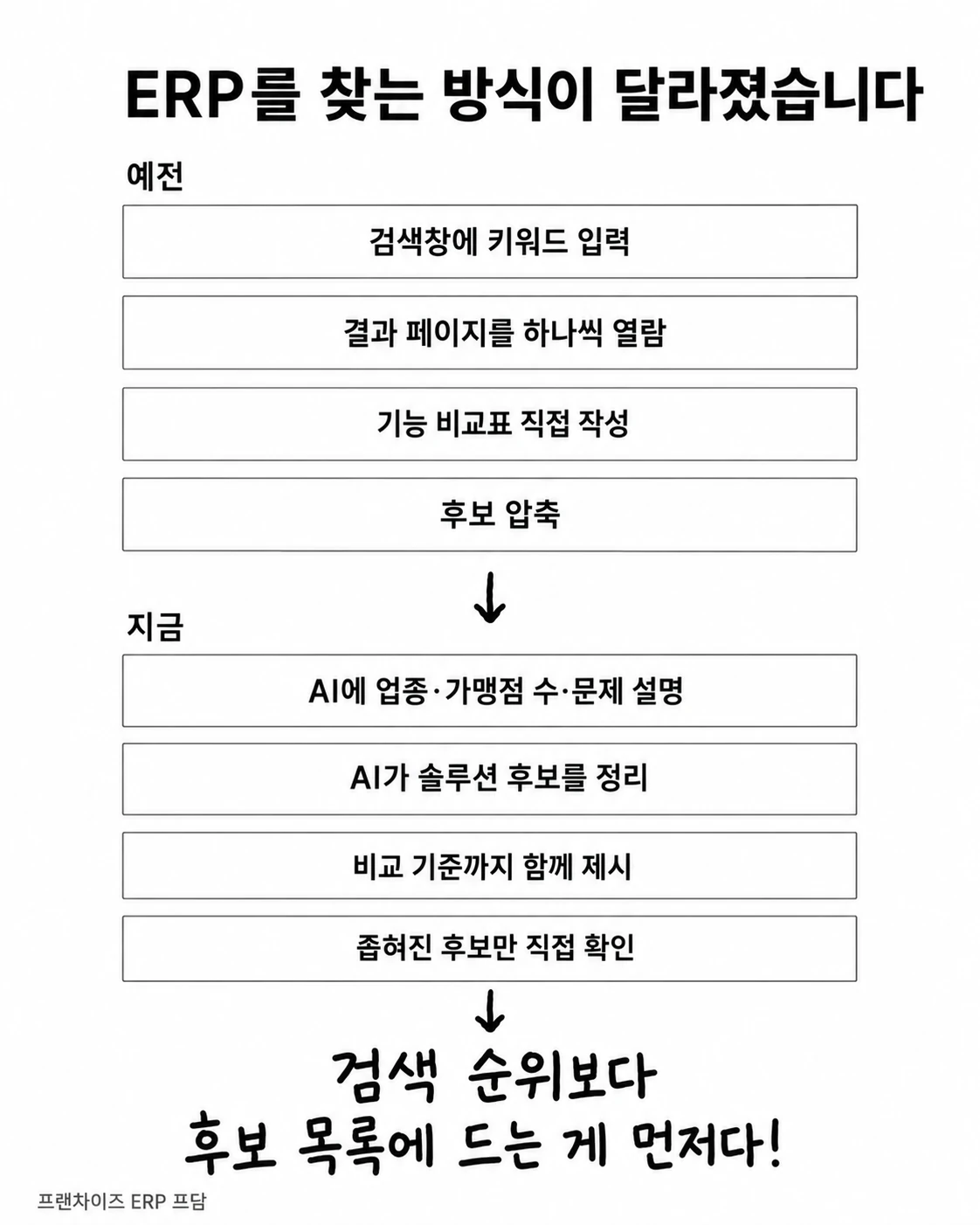
Today, the front end of that process has changed.
Instead of entering short keywords, the representative opens a generative AI tool—ChatGPT, Gemini, or Perplexity—and describes their situation in a sentence. For example: “We are a café franchise headquarters with a growing number of franchise locations. Managing contracts and store inspections by individual staff is reaching its limit. Please provide a list of franchise‑specific solution recommendations.”
The AI reads the description, selects a few fitting solution candidates, and returns their names and key features. It also supplies comparison criteria, such as “When evaluating these solutions, consider the following factors.” Previously, the decision‑maker had to build that candidate list and comparison matrix manually; now they receive it at the very first step.
Of course, the representative still visits each vendor’s website to verify details, but by then the shortlist is already narrowed.
Placement in search rankings matters less than whether a solution appears on the AI‑generated shortlist.
This difference matters because, even if our company appears lower on the search results page, a decision‑maker can still spot us by scrolling. In contrast, AI‑generated candidate lists are usually only three to five items long. If our name isn’t on that short list, the decision‑maker moves on without ever knowing we exist, eliminating any chance for comparison.
And this shift isn’t limited to decision‑makers looking for ERP solutions.
People researching our brand are already asking AI first.
Consider who is interested in franchisor headquarters. There are four primary groups.
First, prospective entrepreneurs exploring a startup.These individuals act before they even know a brand name. Rather than searching for a specific brand, they describe their criteria and ask AI for recommendations. For example, “I want to open a café with my severance pay and need a brand with low upfront costs.” If our brand doesn’t surface at this stage, we never enter their consideration set.
Second, prospective franchisees about to sign a contract.They already know our brand but want to verify that the terms are fair, that the franchisor will continue supporting them after opening, and that existing franchisees have a good reputation. In the past they scoured community forums; today they simply type the brand name into AI and ask, “Summarize this brand’s franchise terms and reputation.”
Third, partner companies.Suppliers of raw materials, logistics firms, or interior designers first assess whether a partnership would be stable. They use AI to research company size, business history, and recent performance.
Fourth, job candidates considering a hire.When a posting catches their eye, they research the company. Previously they read corporate profiles and employee reviews; now they ask AI, “What’s it like to work at [Company Name]?”
All four groups share a new step: before turning to portal searches, community reviews, or personal referrals, they ask AI first. AI then pulls publicly available content—our website, blog, press releases, job ads, and franchise recruitment pages—to craft its answer.
Have we prepared the content that AI will use to describe our brand?
Google’s answer was surprisingly simple.
Reading this far likely raises the question, “What do we need to do to appear well to AI?” Marketers have long debated tactics, but on May 15, 2026 Google released its first official guide on the topic.
First, Google explains how it works. When you search, an AI‑generated summary may appear at the top of the results—called an AI Overview—while the conversational search experience is known as AI Mode. Google says these features aren’t separate systems; they reuse the same index and ranking signals from traditional search and then generate answers on top of that data.
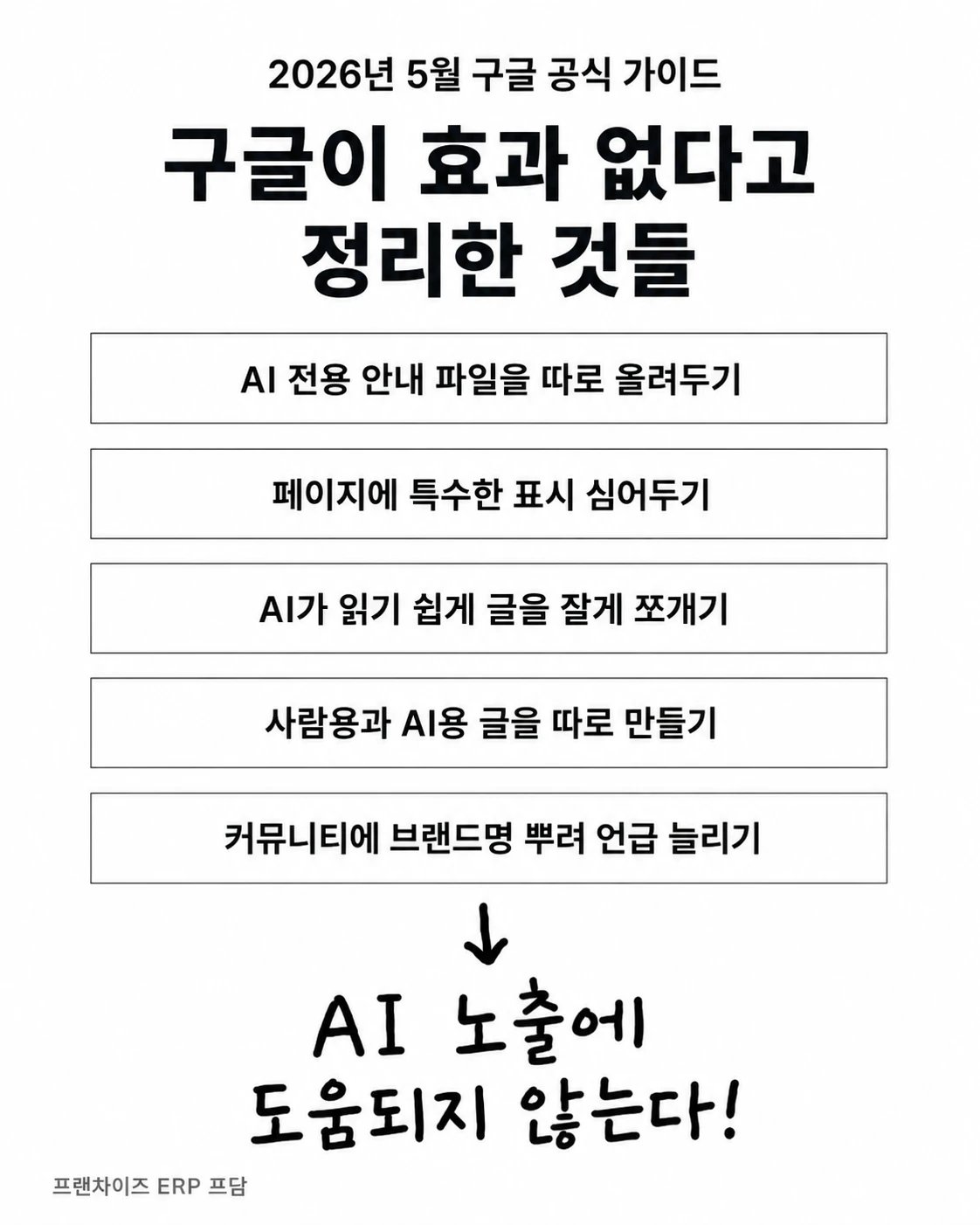
The takeaway is clear: pages that don’t earn trust in standard search won’t be cited in AI answers. There’s no separate AI‑only gateway; the same ranking signals apply.
Google also clarified that many industry‑wide tactics don’t directly affect AI exposure. Specifically, adding a dedicated AI instruction file to your site, embedding special markers, breaking content into short snippets, creating separate versions for humans versus AI, or inflating brand mentions across forums and blogs do not improve AI rankings or visibility.
Instead, the point we emphasized most isnon‑commodity contentThe term may be unfamiliar, but its meaning is simple. Commodity refers to everyday items you can buy anywhere; non‑commodity is the opposite—it denotes content you can’t find elsewhere.
Google’s example helps clarify. A piece that simply reorganizes common knowledge already scattered online—like “Seven Things Every Startup Founder Should Know”—is commodity content. Anyone can write it, and AI could generate it automatically. In contrast, an article that captures a firsthand experience and the judgments made at the time is non‑commodity, because only that person or company can produce it.
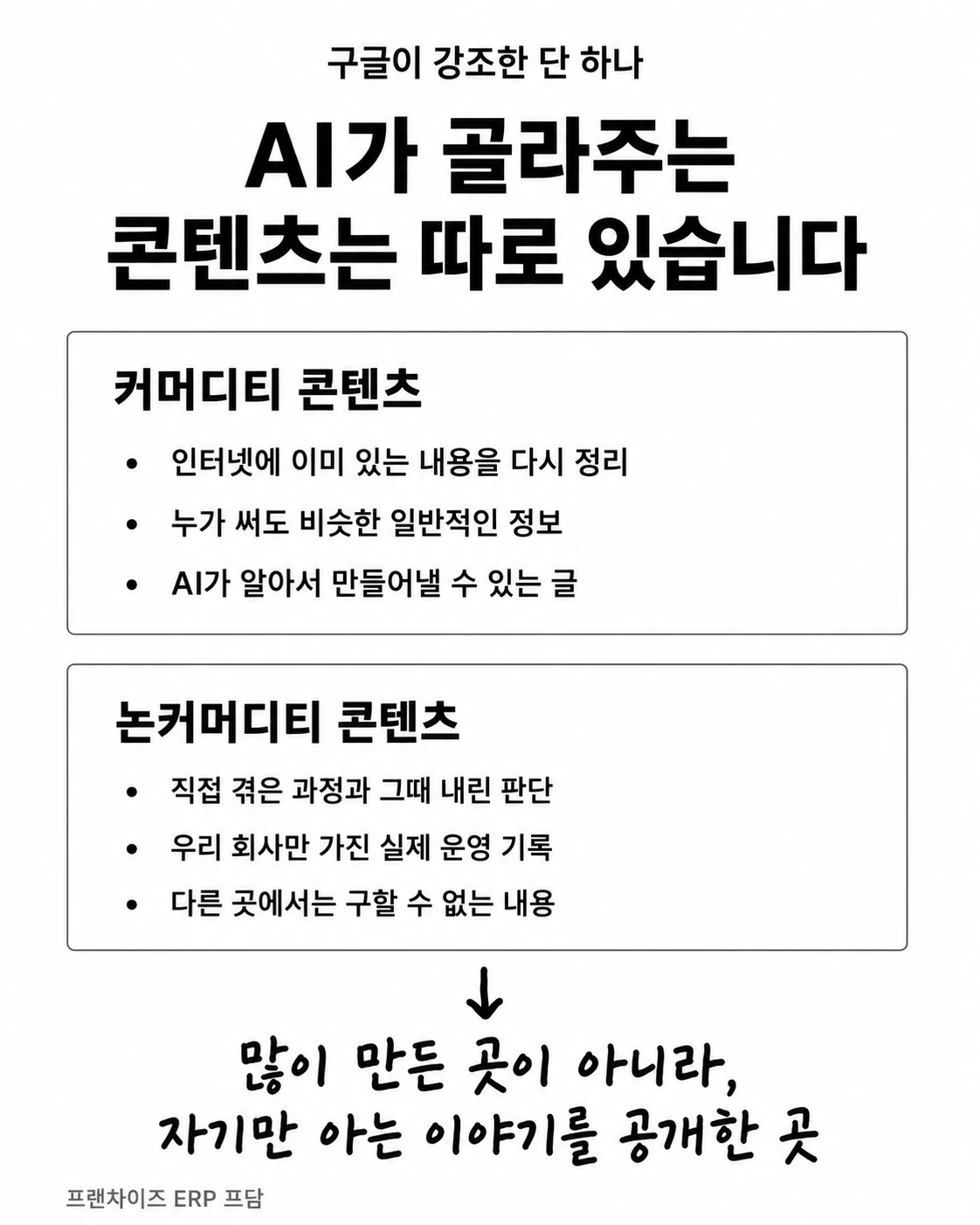
Google even added a warning: creating a large number of similar pages by targeting every possible user question violates its search policies.
AI favors sources that publish unique, proprietary stories—not just high‑volume content producers.
Sentences that feel natural on any brand’s website.
When we translate these criteria into franchisor headquarters language, the narrative becomes much more specific.
Most franchisor headquarters homepages and franchise recruitment pages feature similar language: systematic franchise location support, stable operations systems, and mutually beneficial partnerships. Those claims are probably true. The problem is that copying those sentences onto a competitor’s page goes unnoticed, yet AI sees them as generic filler. They provide no distinguishing evidence for our brand versus others.
When we replace the statements with concrete evidence, they look like this:
Instead of “We support franchise locations systematically,”
It’s better to outline, step by step, what the franchisor does from the moment the contract is signed until the store opens. Detail which documents the franchisee receives after signing, how the franchisor participates in selecting interior contractors and scheduling construction, and what the training program covers and its duration. This lets prospective franchisees visualize the process and enables AI to describe the brand’s opening procedure precisely.
Instead of “We communicate closely with franchise locations,”
It’s better to specify the channels and frequency the franchisor uses to inform franchisees—how announcements are delivered, when and how updates to recipes or operating guidelines are communicated, and who handles inquiries and within how many days they receive a response.
Instead of “Our quality control is rigorous,”
Specify the inspection items and frequency. List the checklist items, who conducts the inspections, how results are communicated to franchisees, and when follow‑up checks occur for any required improvements.
Instead of “We operate stable logistics,”
Describe the ordering rules from purchase order to store receipt: the order cutoff time, lead time to shipment, delivery frequency per week, and the criteria for returns or exchanges.
Instead of “Our headquarters operations are efficient,”
It's better to show the numbers you're tracking and how they've changed, within what can be disclosed. You don't need to publish every figure. Simply indicating which metrics you're managing conveys your operational level adequately.
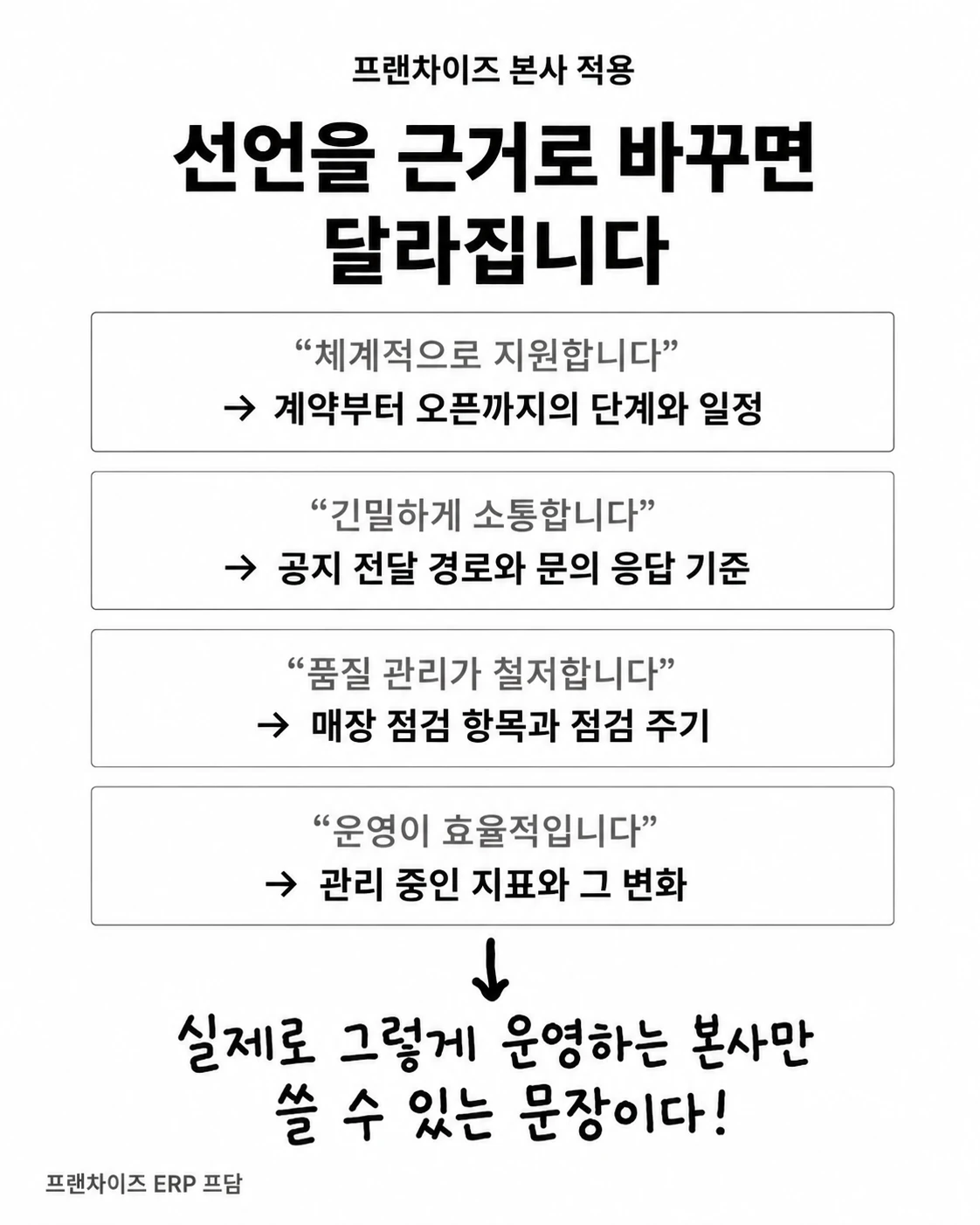
You'll see the commonality. The sentence on the left is generic, while the one on the right can only be written by headquarters that actually operate that way.
But most get stuck at this point.
To use the statement below, the information must be recorded within the company. Many headquarters halt at this stage.
If the opening procedure exists only in someone's head, it can't be documented. When each person follows a slightly different order, you first need to define what constitutes the headquarters' standard process. If inspection results are scattered across varying formats each time, you can't tell what's improved. When contract information is split across multiple files, even checking the current number of cases and their statuses takes time.
In the AI era, a headquarters without evidence to share isn’t one that hasn’t created content; it’s one whose operations aren’t documented.
So this isn’t just a marketing issue. Organizing operations creates the evidence you need to explain your business externally. In the 25 years we’ve observed franchise operations, this is the scenario we encounter most often.
Five items you can review in just 30 minutes today.
A quick audit you can start right away without elaborate preparation. Follow the steps in order and check each one.
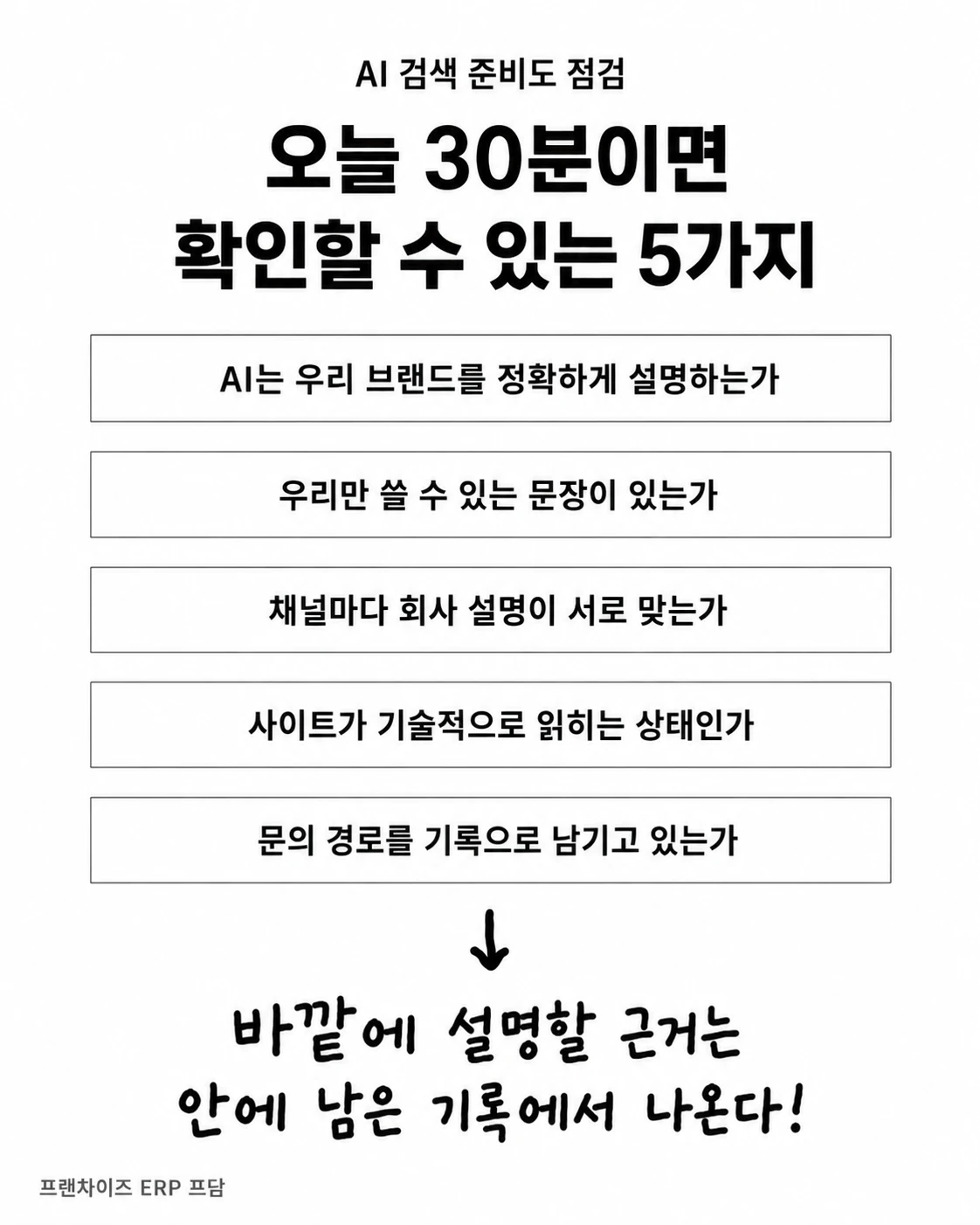
Is AI accurately describing our brand?
Open a generative AI tool like ChatGPT, Gemini, or Perplexity, enter our brand name and ask, “Tell me about this brand.” Review the response item by item. Check whether the industry and founding date are correct, whether the flagship menu or service is currently offered, and whether the franchise terms match current standards. If any information is wrong, trace its source. Often the error stems from outdated press releases, neglected update pages, or closed‑store listings.
Does our website contain any proprietary language?
Open our corporate site and franchise recruitment page, read each sentence, and run a simple test. If you can paste a sentence onto a competitor’s site without anyone noticing, that sentence isn’t uniquely describing us. If more than half of our copy passes this test, AI lacks sufficient material to differentiate our brand from others.
Are our company descriptions consistent across channels?
Place the corporate ‘About Us’ page, blog intro, recent press release, franchise recruitment page, and job posting side by side and compare. You’ll often find discrepancies in founding year, business scope, or flagship products. People may skim, but AI struggles to decide which version to trust. As a result, it may use uncertain language when describing our brand or avoid mentioning it altogether.
Is our site technically readable?
Ask the person in charge or the agency that manages the site to verify two things. First, confirm that the main pages of our site are properly indexed by search engines; you can check this in Google Search Console or Naver Search Advisor. Second, make sure there are no settings that block search‑engine crawlers, as a temporary block set during development may remain. No matter how good the content is, it won’t be cited if it can’t be read.
Are inquiry channels being logged?
Review our company’s inquiry form or contact‑submission template. Check whether it includes a “How did you hear about us?” field and whether the responses are stored as selectable options. Relying on an agent’s memory during a call can’t be aggregated later. Adding a dedicated generative‑AI option to the choices is even better. The 28 % figure cited in this article was possible because FDAM continuously collected responses to that question.
Frequently Asked Questions
Do we need any separate technical work for AI search?
Google’s official stance is that adapting to generative‑AI search is not a separate task from regular SEO; the AI answer feature runs on top of the existing search system. That explanation applies only to Google services. AI platforms that are not Google, such as ChatGPT or Perplexity, gather information in their own ways, so Google’s guidance can’t be applied wholesale. Across all platforms, three factors matter: the quality of publicly available content, uniqueness that can’t be found elsewhere, and whether search crawlers can access our site.
Does publishing more articles increase the chance of AI citation?
Volume alone isn’t a valid signal. Google even classifies generating multiple similar pages for each query as a policy violation. If you spend the same amount of time, it’s better to produce one comprehensive piece that contains information only we can provide rather than many generic articles. For example, a single guide outlining our headquarters’ actual opening procedures is more likely to be cited than ten separate posts titled “Things to Check When Starting a Franchise.”
How do we correct AI when it misrepresents our brand?
There’s no direct way to request a correction from the AI service. Because AI pulls from publicly available information, you must locate the source of the inaccurate description and update that material. Out‑of‑date press releases, neglected intro pages, or information about closed locations are common culprits. After cleaning up the sources, publish accurate pages on our site. Changes won’t appear instantly; it can take weeks or months for the AI to refresh its references.
Will sharing operational data expose us to competitors?
You don’t need to disclose every metric. What matters is the methodology and standards, not the raw numbers. Describing the procedures you use, what you inspect, and the criteria you apply provides unique insight. For example, you can explain how store audits are conducted without revealing sales figures. The scope of disclosure is up to headquarters. However, defining that scope requires having organized internal data first.
In the end, there was no new technology to learn.
Treating AI search response as a new marketing initiative feels overwhelming—terminology is unfamiliar and methodologies keep evolving.
Google’s guidelines boil down to a single requirement: you must be able to clearly articulate what you’re already doing well. It’s not about learning new technology; it’s about documenting existing practices effectively.
When you check the first five items, you’ll usually hit the same bottleneck—not because the information is missing, but because it’s scattered. Opening procedures vary by manager, contract statuses live in separate files, and inspection logs exist but aren’t consolidated in one place.
The evidence you use to explain things externally ultimately comes from the records you keep internally.
FDAM is a headquarters‑only ERP that consolidates sales management, store opening management, and operations management for franchisor headquarters. Consultation history, contract status, step‑by‑step opening tasks, store inspection results, and franchise location information remain in a single workflow instead of being scattered. Contact us to see how far our headquarters’ operations are recorded.
Inquire about FDAM implementation
Phone 1544-7120 · KakaoTalk chat
Reference
Google Search Central – Optimizing Your Website for Generative AI Features on Google Search (May 15, 2026)
developers.google.com/search/docs/fundamentals/ai-optimization-guide
Google Search Central Blog – A New Resource for Optimizing for Generative AI in Google Search (May 15, 2026)
developers.google.com/search/blog/2026/05/a-new-resource-for-optimizing
Written by FDAM Franchise ERP