
How to Accurately Aggregate Sales Using a Standard Menu Name Even When Delivery App Menu Names Differ

You can consolidate delivery app sales under a standard menu name even if the app’s menu names differ.
CORE SUMMARY
· Consolidating franchise delivery menus means standardizing the various delivery app menu names entered by each franchise location into a single franchisor headquarters standard menu name, enabling precise aggregation of brand‑wide menu sales.
· Without a standard menu name, the same item is split into multiple entries, distorting menu‑level sales rankings and promotion performance analysis.
· FDAM supports aggregation of POS and delivery app sales based on the franchisor headquarters standard menu name, helping reduce labor and aggregation errors.
Franchise delivery menu consolidation is the data‑management task of standardizing the disparate delivery app menu names entered by each franchise location into one franchisor headquarters standard menu name, so the brand can accurately track sales by menu. It may seem enough to download each app’s menu sales and merge them, but in practice it’s far more complex.
The challenge is that even identical items can have completely different names across franchise locations on delivery apps. The franchisor headquarters standard menu name is "Jokbal"but franchise locations add variations like “Top‑Rated Warm Jokbal,” “Store‑Recommended Jokbal,” or “Tender Front‑Leg Jokbal” to make them more appealing to consumers. While effective for marketing, these variations cause the headquarters to count the same item as separate menus.
As the share of delivery sales in total store revenue grows, this issue becomes increasingly critical. Offline sales can be consistently tracked through POS aggregation, but delivery sales fluctuate because each franchise location may operate multiple delivery apps, each with its own menu naming conventions. To set a unified brand‑wide menu strategy, the headquarters needs a single standard that covers both offline and delivery channels.
This article outlines why consolidating franchise delivery menus is challenging, what problems arise without a standard menu name, why typical consolidation methods generate recurring errors, and how FDAM addresses each step.
Why is franchise delivery menu consolidation difficult?
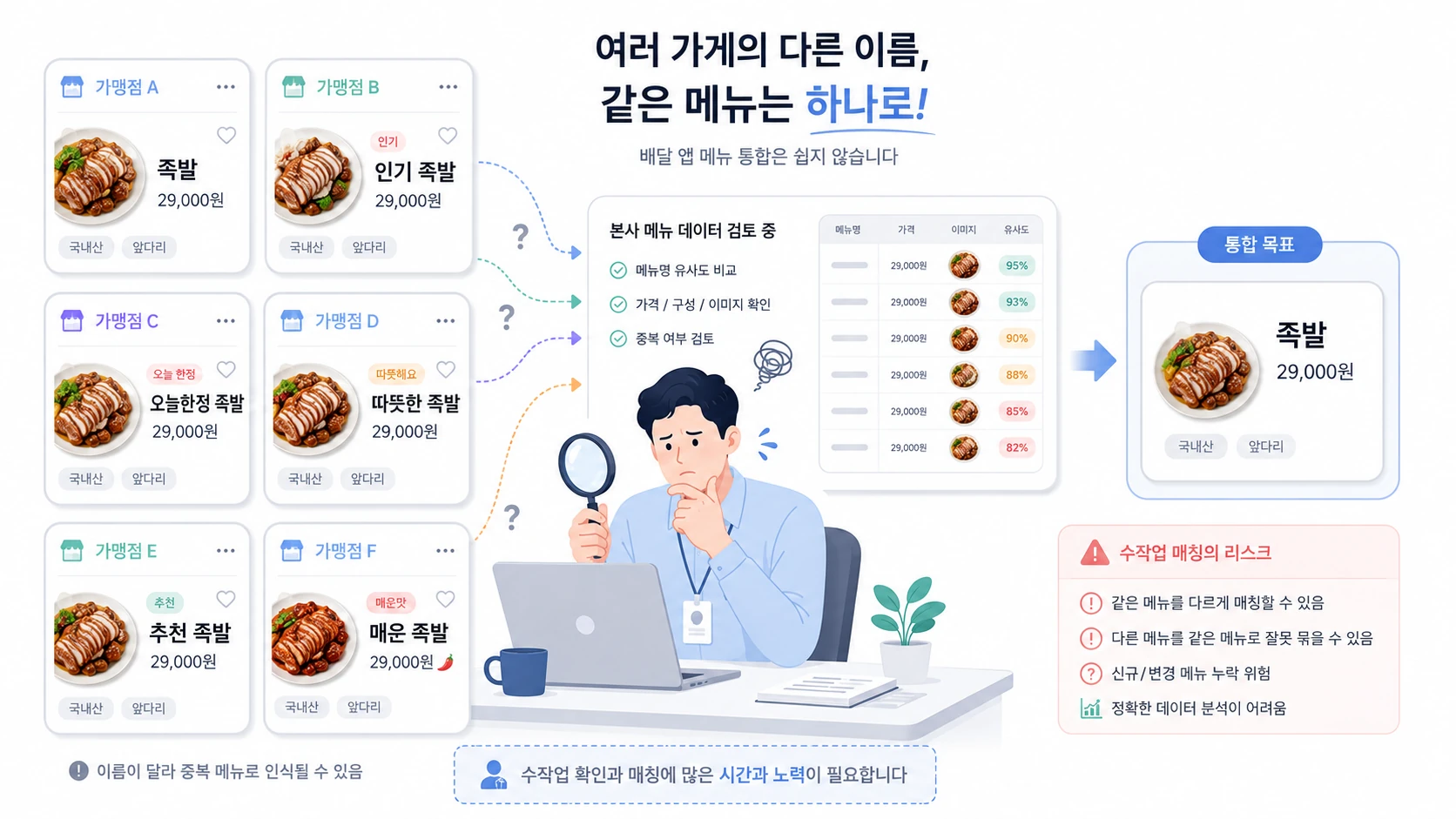
Inconsistent delivery app menu names across franchise locations create aggregation errors for the headquarters.
The franchisor headquarters must view menu sales across the entire brand—to identify top‑selling items, high‑performing regions, and post‑promotion impacts—so brand‑level decisions can be made.
However, delivery app menu names are often set freely by each franchise location. To attract customers, locations may prepend terms like “Popular,” “Recommended,” “Warm,” or “Today’s Special.” These descriptors make sense for store operations and marketing, but they translate directly into aggregation errors for the headquarters.
From the franchisor headquarters perspective, identical pork‑leg dishes should be consolidated, but the data treats them as separate items. Consequently, staff must re‑standardize menu names or manually match similar items. This not only consumes time but also raises the risk of missing or duplicate counts.
The issue doesn’t end with one employee’s effort. The marketing team must decide which items to promote, the product team must evaluate which items to keep or retire, and executives need a clear view of the brand‑wide sales flow. If the underlying per‑menu sales data is inaccurate, every subsequent decision inherits that error.
The bigger challenge is that the discrepancy changes each month. One month Store A may add a new tagline, the next month Store B uses a different phrasing. The matching rules you set last month may no longer apply. As a result, you end up repeating similar work monthly while constantly re‑validating new variations.
Recurring issues without a standard menu name
· Identical items are split across multiple entries
· Sales rankings by item become distorted
· Promotion performance analysis loses accuracy
· Headquarters reports no longer align with on‑site data
· Staff must manually clean up menu names each time
Without a standard menu name, sales analysis becomes unstable
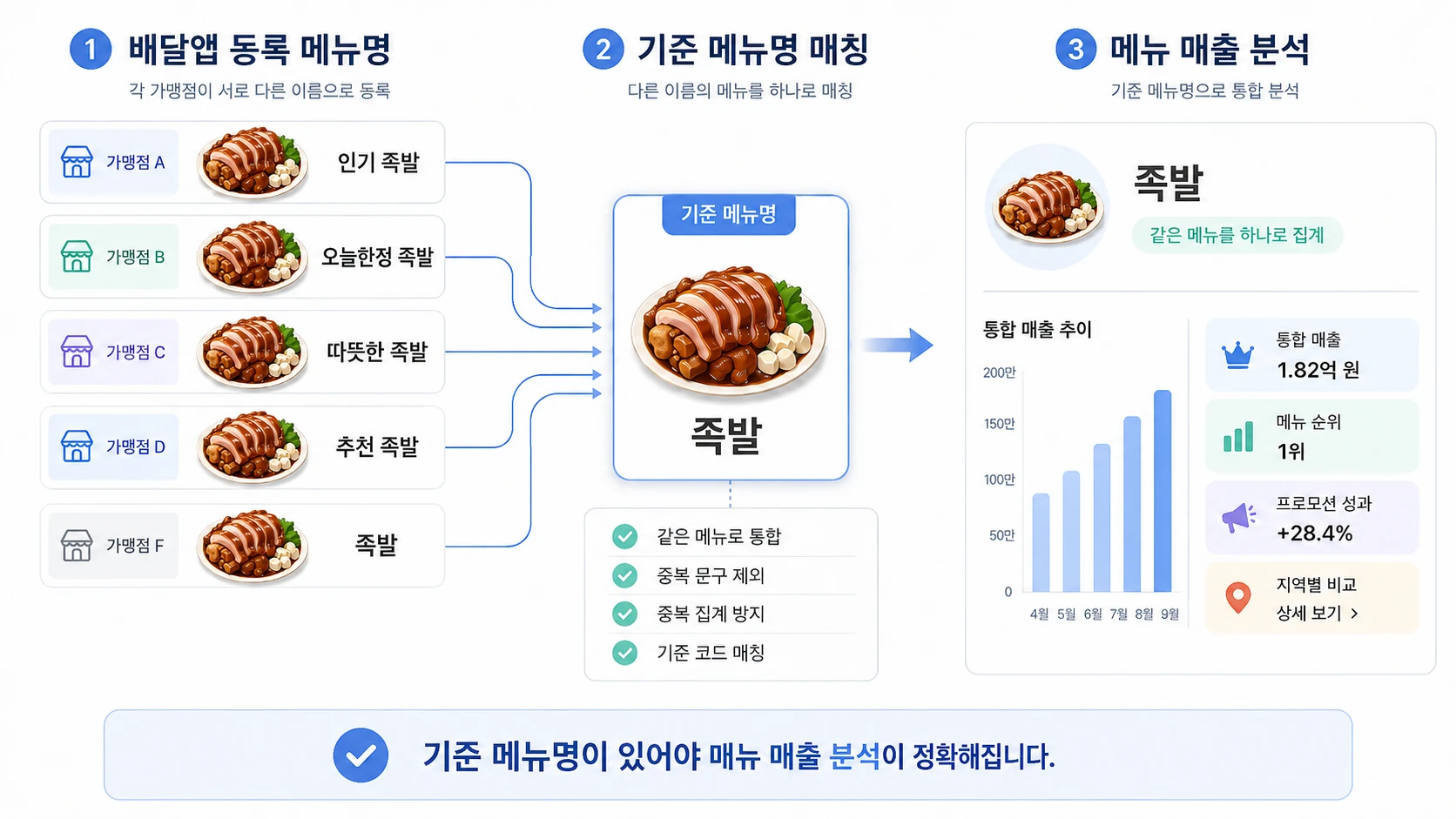
What matters is the standard menu name managed by the franchisor headquarters, not the name displayed on delivery apps.
In menu sales analysis, the important factor is not the "name shown on delivery apps" but"the standard menu name managed by the franchisor headquarters"If the headquarters’ standard menu name is "Jokbal," then regardless of any promotional wording on delivery apps, the final aggregation should count all sales under Jokbal, allowing an accurate view of brand‑wide item sales.
Establishing a standard menu name resolves the following four issues.
Uniformity independent of each store’s labeling— Even if delivery‑app listings differ, they are grouped as the same item.
Identify the overall menu ranking across the brand— It shows exactly which items are selling best
Compare performance before and after a promotion— Consistent criteria are required to assess performance changes
Report figures align with on‑site data— Headquarters reports accurately reflect actual store conditions
Without a standard menu name, ranking by item sales becomes unstable, promotion analysis turns inaccurate, and headquarters reports no longer match on‑site data. Consolidating franchise delivery menus isn’t just clerical work—it’s critical data management that drives menu strategy, promotion decisions, new‑item launches, and underperforming‑item reviews.
When the baseline shifts, strategy shifts with it
For example, imagine you’ve launched a new item. To gauge early response you need a precise sales trend for that item. If each delivery app lists the item under a slightly different name, the early data becomes distorted—strong performance may appear weak, or inflated numbers may be reported. If investment and marketing budgets are allocated based on those skewed figures, the impact ripples beyond a single sales report to next season’s menu strategy.
Why do typical aggregation methods repeatedly produce errors?
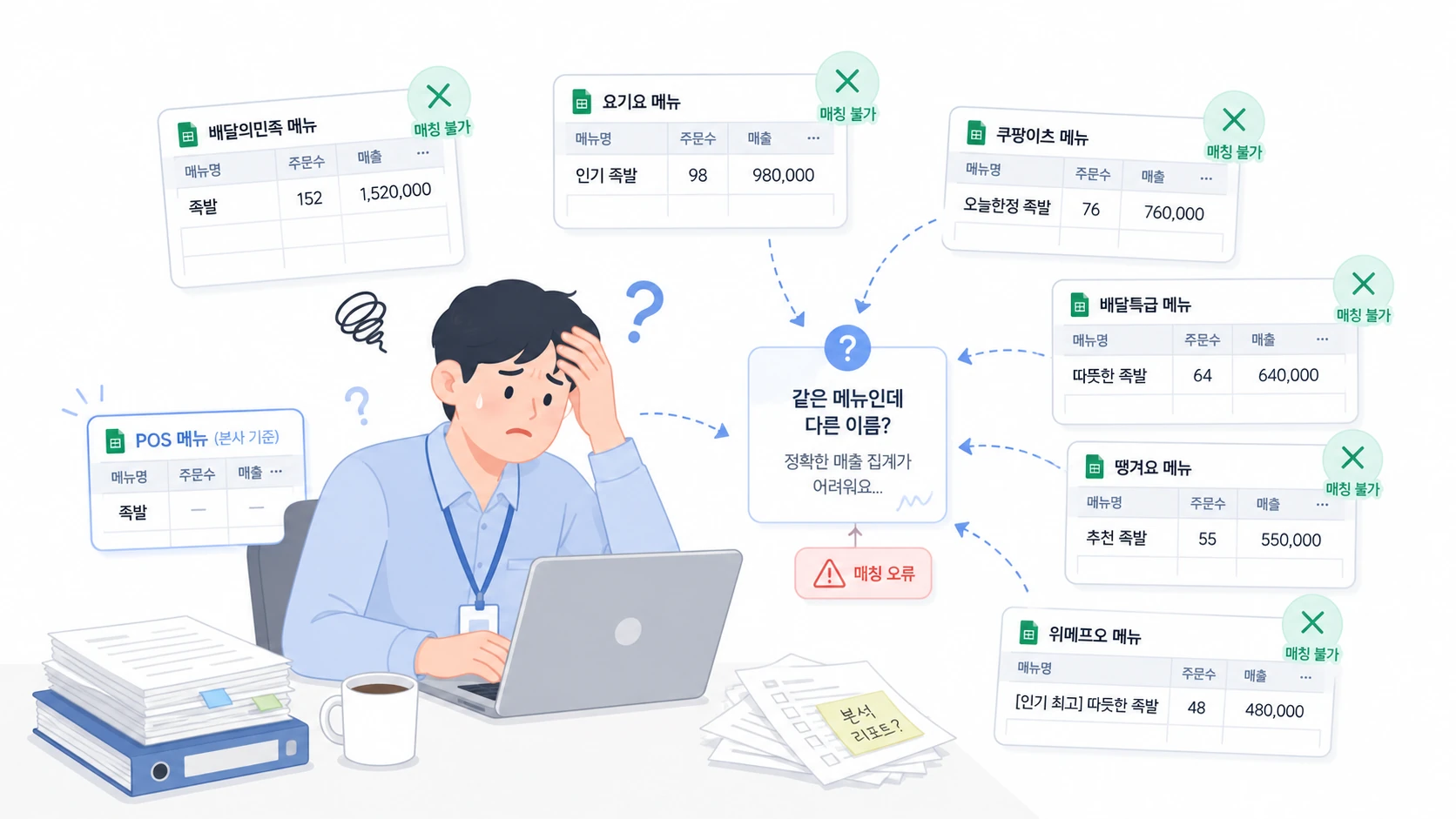
Managing separate files for each store and menu amplifies errors as the number of locations and items grows
Many headquarters download data from delivery apps and split it into individual files. Even when a system pulls sales data, mismatched menu names often require manual cleanup during the final analysis stage.
When POS sales and delivery‑app sales are combined, matching menu names becomes even more crucial. If POS records an item as "Jokbal" but a delivery app lists it as "Top‑Rated Warm Jokbal," you must align the two entries to see total brand sales. Otherwise, POS sales stay separate from delivery‑app sales, and headquarters end up evaluating fragmented data instead of the full picture.
This approach burdens franchise headquarters that need precise, item‑level sales analysis. As stores and menus increase, errors don’t shrink—they grow, because more combinations must be managed without a consistent standard.
More data means a heavier cleanup workload
If a store used only one delivery app, standardizing names would be simple. In reality, most stores operate multiple apps, each with slightly different item names. Across the brand, the combination of "menu count × store count × app count" creates countless unique name variations.
Imagine a staff member manually reconciling those combinations each month—errors quickly become obvious. Even if you reopen last month’s matching sheet, new names or changed spellings force you to start over. Changing the responsible person doesn’t solve the problem; when the reference lives in memory or personal files, the moment that person leaves, the baseline collapses.
FDAM aggregates delivery menu sales using the standard menu name.
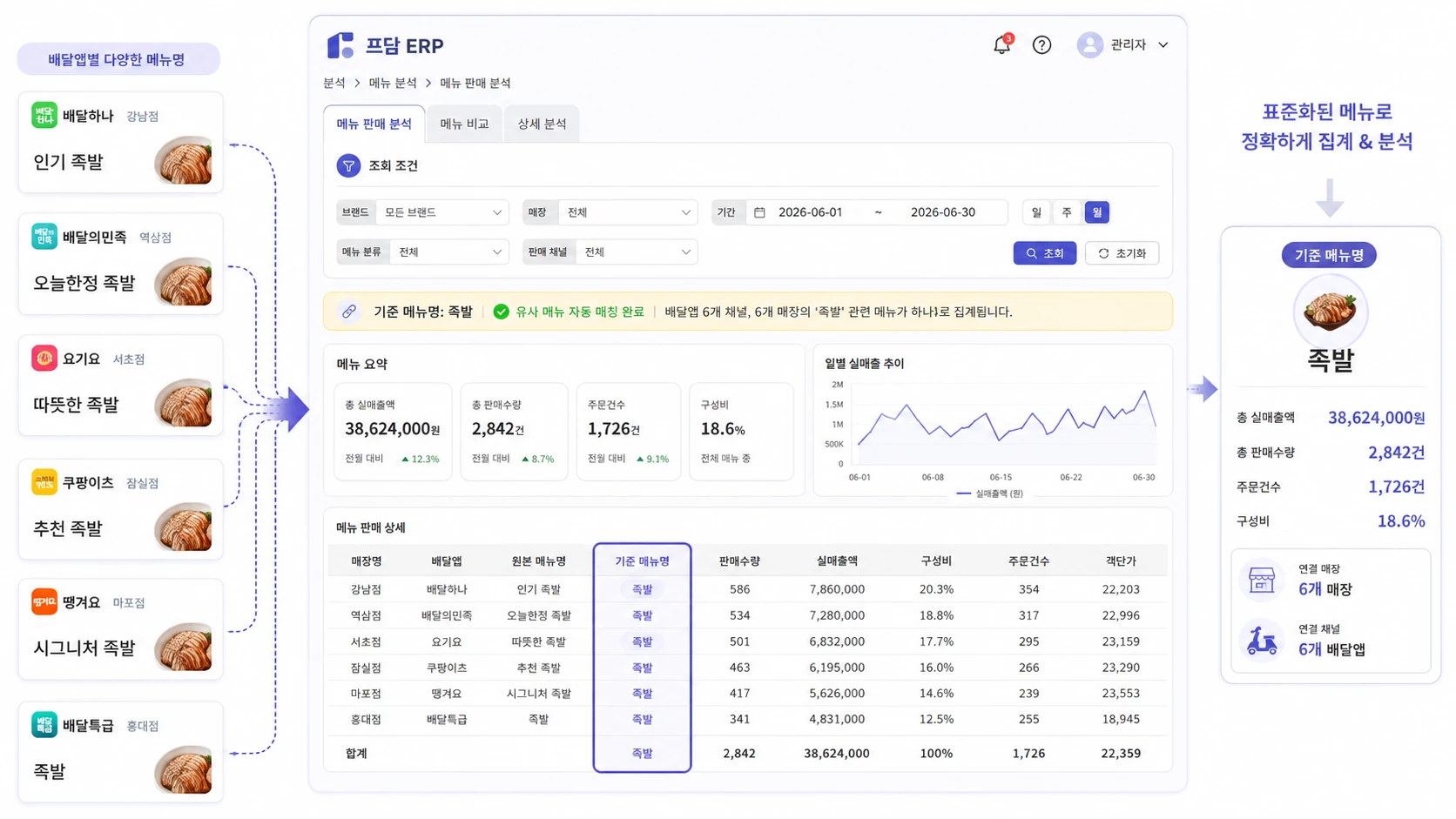
FDAM helps you consolidate delivery‑app and POS sales based on the franchisor headquarters’ standard menu names.
FDAM is an enterprise‑grade operations ERP for franchisor headquarters that supports aggregating sales by standard menu names—an essential metric for menu revenue analysis. Even when each franchise location registers different menu names in delivery apps, FDAM lets you roll up sales using the headquarters’ standard names, reducing errors and variance in menu‑level reporting. For example, variously named pork‑trotter items on delivery platforms can all be grouped under the standard menu name “Jokbal” to view consolidated sales.
This approach creates three major changes for franchisor headquarters operations.
Change 01
Standard menu name matching
Even if delivery‑app listings differ by location, you can group them under the headquarters’ standard menu name to view unified sales.
Change 02
Integrated POS and delivery‑app view
You can review POS and delivery‑app revenue side‑by‑side using the same standard menu name, eliminating the need to juggle separate data sets.
Change 03
Combined table and dashboard reports
Staff can inspect numeric values per menu in a table while using dashboards to track sales trends and composition ratios.
This method dramatically improves workflow efficiency for headquarters staff. It eliminates the need to manually reconcile each menu name or manually group similar items. FDAM is accessible on PC, tablet, and mobile, so users see consistent data regardless of where they work.
Once standard menu names are established, the impact varies by department. Marketing can measure promotion‑targeted menu performance with precise numbers, product teams can compare regional and seasonal menu results to identify new or underperforming items, and operations can pinpoint which menus drive strong delivery sales at each location to prioritize field support. Although each department has its own focus, the underlying insight stems from a single set of standard menu names.
One more point: FDAM’s role is to manage and apply the standard menu names, while strategic decisions about menu composition, pricing, and promotions remain the franchisor headquarters’ responsibility. The tool ensures data accuracy, but how you act on that data is up to the headquarters. Decisions grounded in precise numbers inspire greater confidence in outcomes.
When you compare, the differences appear in accuracy and labor time.
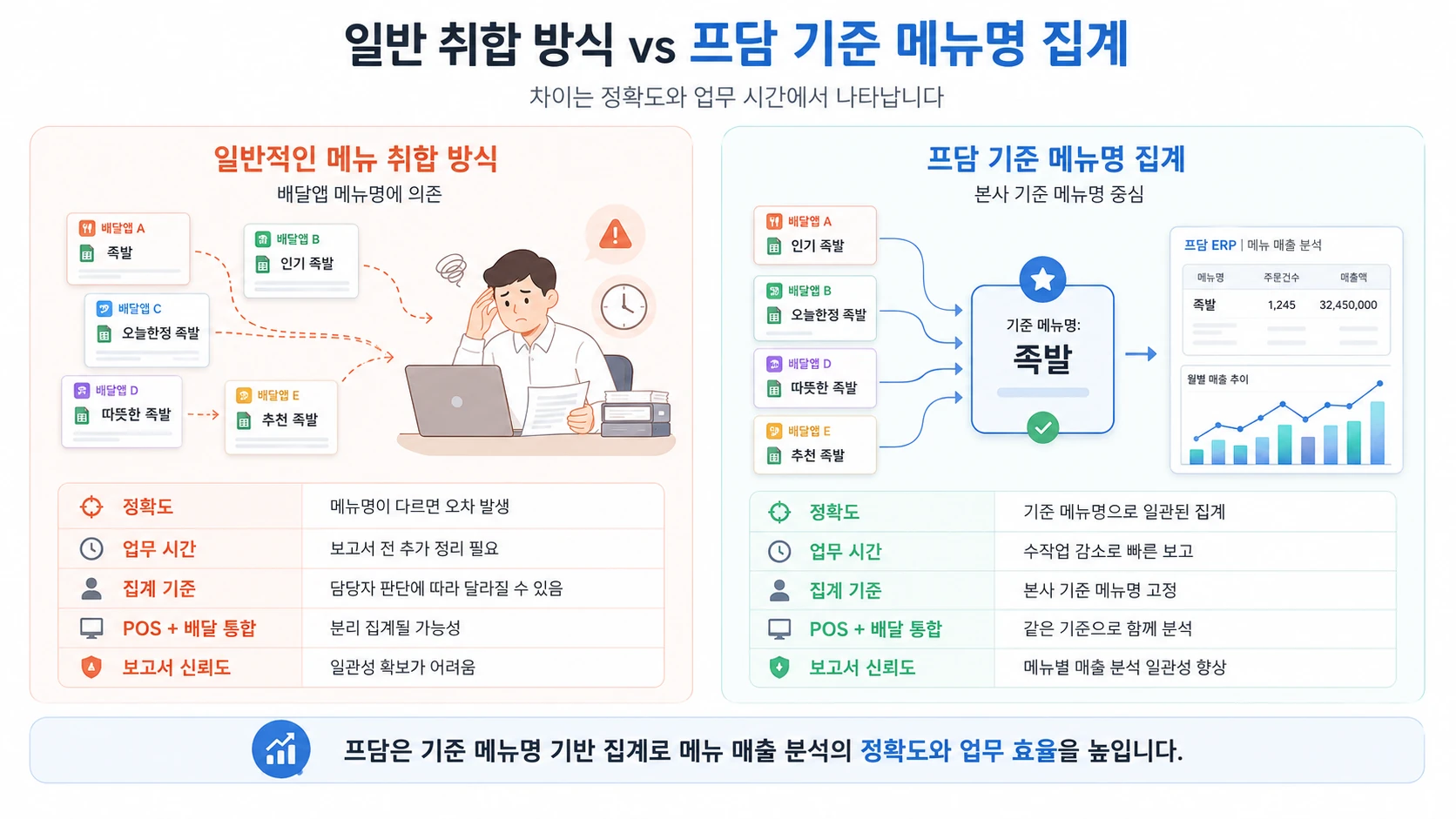
Whether standard menu names are used clearly affects both accuracy and the time required for work.
Typical menu aggregation relies on the menu names registered in delivery apps. If the name differs even slightly, it’s treated as a different item, and staff must re‑organize the data. FDAM aggregates sales by a standard menu name, so even when the delivery‑app name varies, you can view sales per menu aligned with headquarters standards.
Same situation, different outcome.
Imagine you need to prepare a month‑end menu sales report. Without a standard menu name, headquarters first downloads sales files from each delivery app. Then staff visually scan the names, grouping similar ones one by one. As the number of locations grows, the list of names to verify expands, and ambiguous entries are classified based on individual judgment. By the time the report is finished, a lot of time has already passed and other tasks are delayed.
When headquarters aggregates by a standard menu name, the workflow flips. Sales from each delivery app are already aligned to the standard names, so staff can immediately view rankings and trends without any matching work. They glance at the detailed numbers in the table, scan the dashboard for overall patterns, and use the remaining time to ask, “Why did this item sell well?” or “What should the next promotion be?” Both scenarios occur on the same day, but one spends time reconciling data while the other spends time interpreting it.
| Category | Typical aggregation method | FDAM standard‑menu aggregation |
|---|---|---|
| Menu name basis | Use delivery‑app registered name | Unify to headquarters standard name |
| POS & delivery‑app data | Often aggregated separately | Checked together under standard name |
| Potential for error | Different names cause errors | Errors reduced even if registered names differ |
| Staff workload | Manual cleanup required each time | Time saved on cleanup |
| Report format | Compile individually, then create separately. | Provide tables and dashboards simultaneously. |
Because FDAM aggregates by standardized menu names, menu‑level sales analysis stays consistent. Even when viewing POS sales together with delivery‑app sales, the baseline doesn’t shift, boosting the credibility of headquarters reports. For headquarters that previously struggled managing POS sales and separately consolidating delivery‑app menus, FDAM’s standardized menu aggregation offers a practical improvement.
Franchisor headquarters should manage reference data rather than individual menu names.
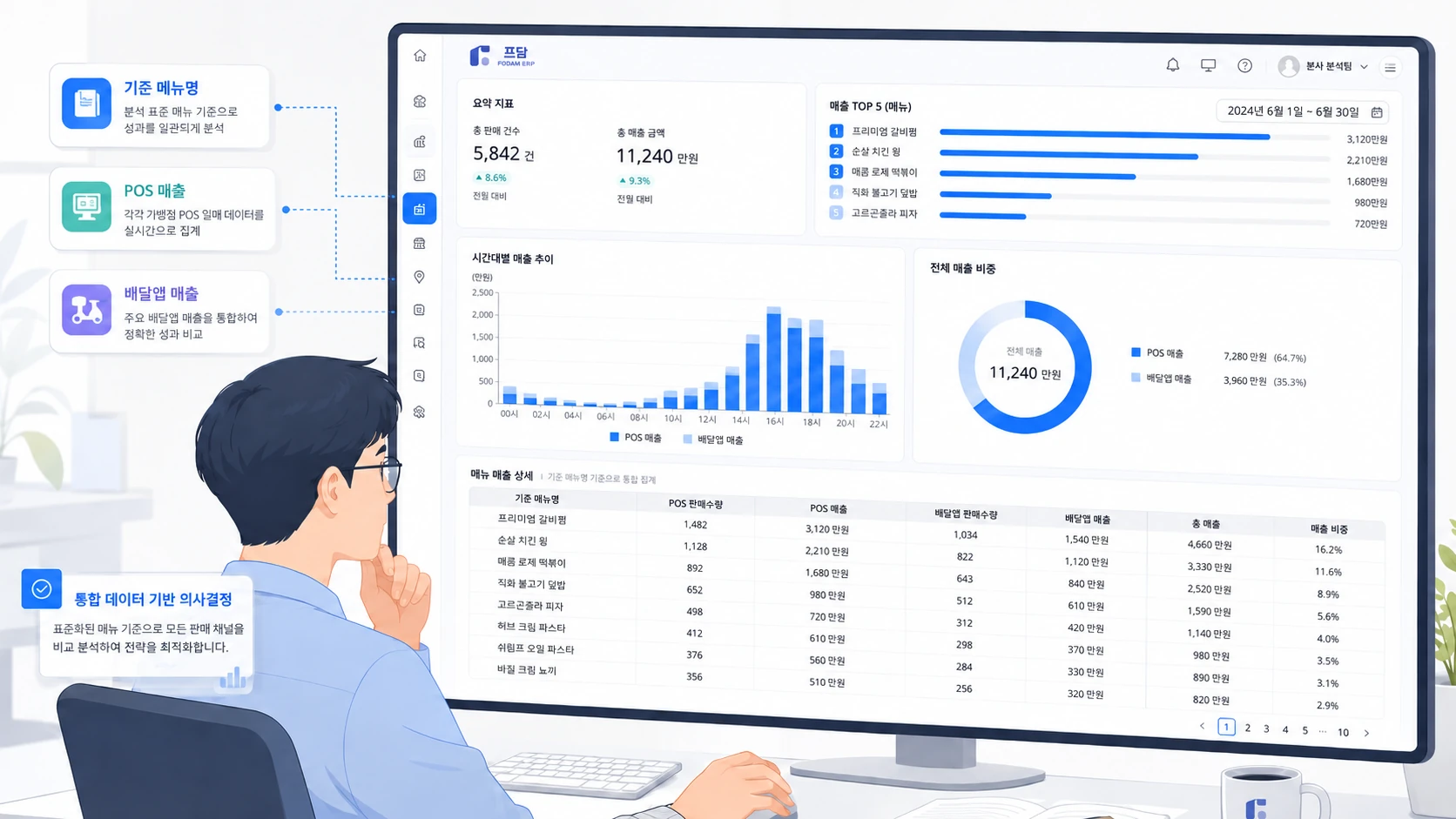
Accurate menu sales analysis starts with reference data.
Franchisor headquarters analyze menu sales not just to see what sells best. Precise menu‑level data lets you evaluate new‑product performance, identify regional favorites, and measure promotion impact. It also enables rapid detection of declining sales for specific items so you can adjust operations. All of these decisions depend on accurate reference data.
Delivery‑app menu names can change freely for store operations and marketing, but headquarters reports must consolidate them under standardized menu names. This is the core of franchise delivery‑menu aggregation and the point where a franchise‑focused operations ERP diverges from generic management systems.
Since 2007, MS Venter has built franchise‑specific software, and that field experience informs the design of reference data. We’ve repeatedly seen how a single menu name can affect the overall credibility of headquarters reports. That’s why FDAM handles standardized menu aggregation within the Franchise Operations Management workflow.
Check your headquarters’ delivery‑menu data this way.
Can you view the brand‑wide menu sales ranking on a single screen right now?
Do you view POS sales and delivery‑app sales together using the same menu baseline?
Does the menu‑matching standard stay consistent even when the responsible staff changes?
When evaluating new‑menu performance, can you trust the numbers as they are?
The more “No” answers you have to these questions, the greater the gap between apparent and actual menu sales data. Conversely, if you can confidently answer “Yes” to each, your headquarters already has a stable decision‑making foundation that isn’t shaken by varied menu entries.
To sum up, the principle for franchisor headquarters when aggregating delivery‑app menus is simple: leave the storefront name to the store, and always start headquarters decisions with standardized menu names. Once this principle is embedded, menu strategy, promotion planning, and new‑product reviews all rely on the same data set.
Frequently Asked Questions
Q. Why is it difficult to consolidate delivery menu items across franchise locations?
Because each franchise location may register different menu names in the delivery apps. Even identical items can be counted separately if promotional copy is added, leading to errors in headquarters analysis.
Q. Why is a standard menu name important?
A standard menu name lets you group sales for the same item even when delivery apps use different registrations. This enables accurate analysis of item sales rankings, promotion performance, and new‑item results.
Q. How does FDAM address this issue?
FDAM helps headquarters aggregate delivery‑app sales using the standard menu name. It also provides reports that combine tables and dashboards so you can view detailed data alongside overall trends.
Q. Can we still aggregate using the standard menu name when operating multiple delivery apps?
Even if each delivery app uses different registrations, you can group them by the headquarters’ standard menu name, making it usable for headquarters that run several platforms simultaneously.
Q. Do we need to continuously maintain the standard menu name as stores expand or new items are added?
Yes. As you add items or open new franchise locations, you should update the standard menu name system accordingly. FDAM supports ongoing management of this standard within Franchise Operations Management.
FDAM · FDAM
Delivery sales analysis shaken by inconsistent menu names,
Start from the standard again
If delivery‑app menu names vary by franchise location, you need a standard‑menu‑centric approach. Instead of spending each month reconciling names, use FDAM to verify menu sales accurately and devote that time to shaping your menu strategy.