Key Takeaways · Headquarters tasks become complex because management is fragmented across departments, not because of data volume. · Manual, Excel‑based work causes delayed information sharing, missed inspection results, and breaks in handovers. · FDAM links sales, opening, and operations in one system so every department works from the same data. · Inspection, contract, training, and sales data are consolidated in one place, turning them into the basis for headquarters‑level decision‑making. |
Franchise ERPis a headquarters‑only operating system that unifies sales, store opening, and operations in a single platform, allowing data needed for franchise location management to flow across departments. As the number of franchise locations grows, relying on separate Excel files and messenger apps leads to duplicate entries and frequent omissions of the same franchise location information.
From MS Venter, which has spent nearly 25 years focused on franchise‑IT deployments,FDAMis a solution that replicates the headquarters workflow in the system. In this article we’ll examine the problems of manual processes, how FDAM transforms headquarters operations, and the workflow changes before and after implementation.

The starting point for headquarters work is an environment where every department works from the same data.
1. Turning intuition‑based headquarters work into data‑driven processes
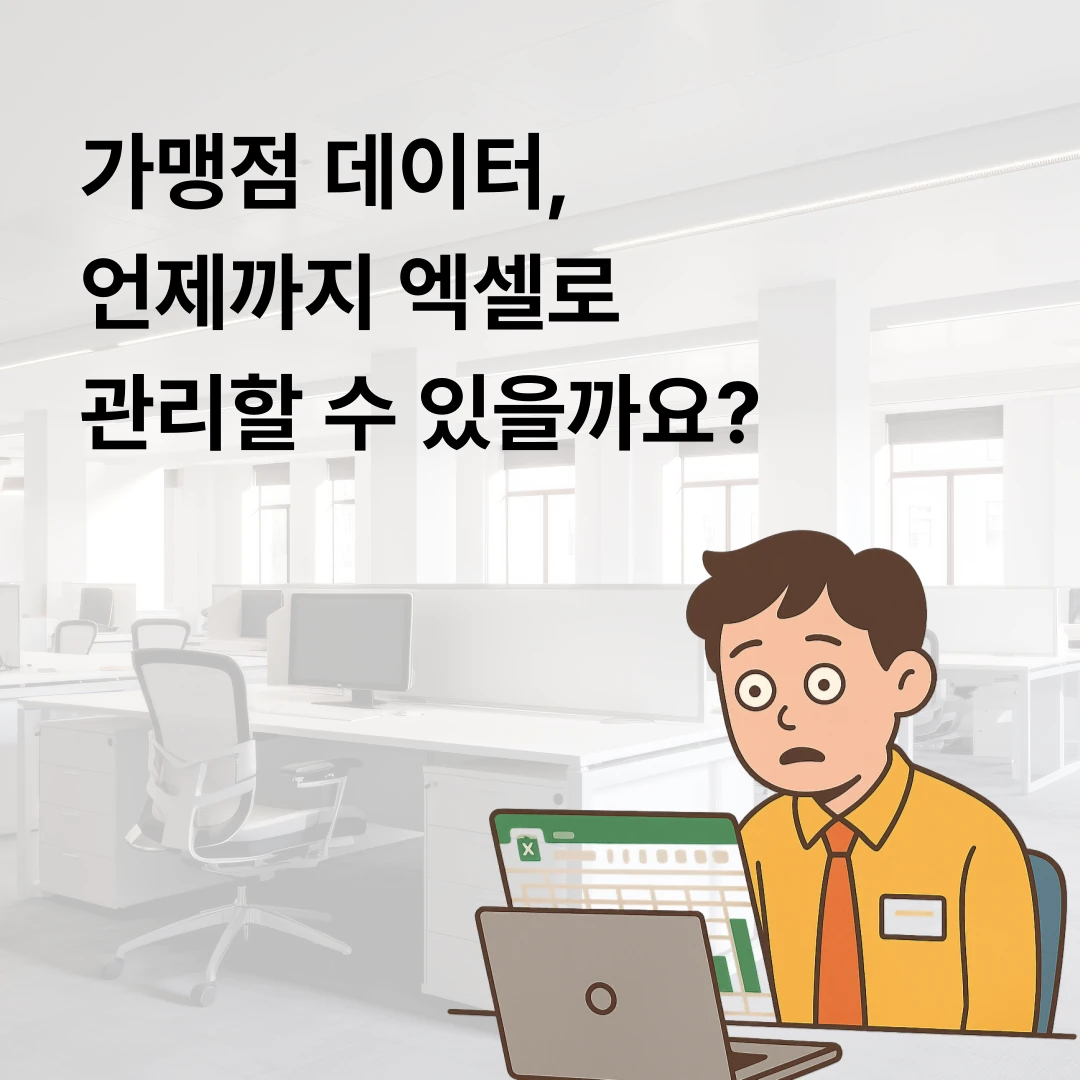
Excel‑centric manual work easily creates departmental silos.
If you’ve ever tried to manage all franchise location data in Excel, you’ve likely felt the limits. When different departments each handle the same franchise location’s information—management, training schedules, contracts, inspection results—the work overlaps and omissions are common.
FDAM was designed to eliminate these silos. It moves manual, Excel‑based tasks into a system workflow and provides a shared view of data for all departments. It turns intuition‑driven headquarters work into'data‑centric structure'Transitioning tasks is the first step toward standardizing headquarters operations.
2. Common problems faced by franchisor headquarters

As the number of franchise locations grows, the limits of manual management become clear.
When the franchise count is low, Excel can handle operations to some extent. However, as the number of franchise locations increases and multiple new franchise contracts are processed simultaneously, operational complexity rises rapidly. If all tasks remain manual at that point, Excel files pile up, making it hard to locate data, and handovers become difficult when staff change.
The limitations of headquarters operations caused by manual work · Information sharing across departments is slow. · Inspection results are not reflected promptly. · Contract, training, and sales data are scattered. · Work relies solely on individual effort. |
In this structure, even adding staff rarely yields sufficient efficiency. Therefore, franchisor headquarters must implement systems to standardize operations, and considering the unique nature of franchise businesses,Choosing an ERP tailored to franchisor headquarters rather than a generic ERPIt is efficient to do so because tasks unique to franchising—such as Franchise Business Act compliance, headquarters‑franchise location communication, and QSCV inspections—must be embedded in the system from day one for smooth operations.
3. How FDAM transforms headquarters workflows

Sales → Opening → Operations flow seamlessly within one system.
FDAM is less a simple management tool and more a system that integrates the headquarters’ workflow. Drawing on collaborations with roughly 500 brands, the modules reflect the actual ways headquarters operate.
Franchise Sales Management
From prospective franchisee consultations through contract signing, each step accumulates in a single system. Integrated e‑franchise contract functionality shortens lead time, automatically records the 14‑day contemplation period required by the Franchise Business Act, and provides evidence for dispute resolution.
Store Opening Management
Interior work, training, and paperwork are automatically linked within the system. The open‑checklist reduces step‑by‑step omissions, and tasks continue smoothly even when the responsible staff changes.
Franchise Operations Management
When QSCV inspection results are entered on site, they are saved automatically and the franchise location’s operational data can be viewed on a single screen. For the first time among Korean franchise ERP solutions, the integrated AI assistant will instantly return a consolidated answer by franchise location and manager when you ask, “Show me this month’s pending improvement requests.”
Because every department works from the same screen, you can see at a glance who has completed what, and the effort of compiling separate reports is greatly reduced.
4. FDAM Implementation: Changes to Headquarters Workflow

Time spent processing data shifts to headquarters decision‑making.
| Category | Before Implementation | After Implementation (FDAM ERP) |
|---|---|---|
| Work Method | Department‑by‑department Excel management | Real‑time information sharing via ERP |
| Inspection Results | Document and email aggregation | On‑site entry reflected instantly |
| Handover | Manual document transfer | Automatic history logging in ERP |
| Reporting Method | Gather each team's data | View in real time on the dashboard |
Headquarters that adopt FDAM see a clear reduction in time spent preparing inspection reports, and errors that previously arose in inter‑departmental communication are eliminated.
Chicken franchise headquarters operations manager "It used to take half a day just to locate a file, but now FDAM lets us access it instantly—making things convenient and streamlining cross‑department collaboration." |
5. When moving inefficient manual tasks to a system

As the business scales, "how you work" determines headquarters competitiveness.
As the franchise business grows, the key concern for headquarters isn’t "how many people work" but"how you work"That’s it. FDAM standardizes routine headquarters tasks and provides a data‑driven decision‑support system.
When you shift areas that have relied on human experience to a system, headquarters operations become a streamlined flow, creating a foundation that maintains consistent operational quality even as franchise locations multiply. It also transforms the value the headquarters delivers to its franchise locations.
Frequently Asked Questions
Q. At what franchise location count should we consider implementing an ERP?
A more critical metric than the number of franchise locations is whether the headquarters’ operating model relies on human memory. If the same task is handled differently by each staff member or information is lost during handoffs, it’s a clear signal to consider implementation regardless of franchise size.
Q. How do a standard accounting ERP and a franchise ERP differ?
Standard ERPs focus on common corporate functions such as accounting, HR, and inventory. Franchise ERPs are built around tasks unique to franchisor headquarters—compliance with franchise law, recruiting and opening new franchise locations, headquarters‑to‑franchise communication, and QSCV inspections.
Q. Can the sales, opening, and operations modules be implemented separately?
FDAM is designed so that the Franchise Sales Management, Store Opening Management, and Franchise Operations Management modules are automatically linked within a single system. Using the integrated workflow yields a far clearer efficiency gain than deploying the modules separately.
Q. How do we migrate existing Excel data?
Existing Excel sheets containing prospective franchisee data and franchise location information can be imported into the system during the initial setup. During the implementation consultation, we’ll review the headquarters’ data structure and recommend the optimal migration method.
Q: How does the implementation consultation work?
You can inquire about FDAM via the implementation consultation page (franchiseerp.com/register), the KakaoTalk channel, or the main line (1544-7120). We’ll provide a demo and usage plan tailored to your headquarters’ operating environment.
Turn headquarters daily operations into a system
Headquarters tasks once done by intuition,
Now shift them to data.