
How K‑Food 4 giants redefined categories in China
FRANCHISE INSIGHT · GLOBAL EXPANSION
K‑Food 4 Giants Find Differentiation in China by Redefining Categories
From a single menu to a K‑Food experience and cultural space — Analysis of BBQ Village, Myungryun Jin Sa Galbi, Yoa Jeong, and Samjin Eomuk
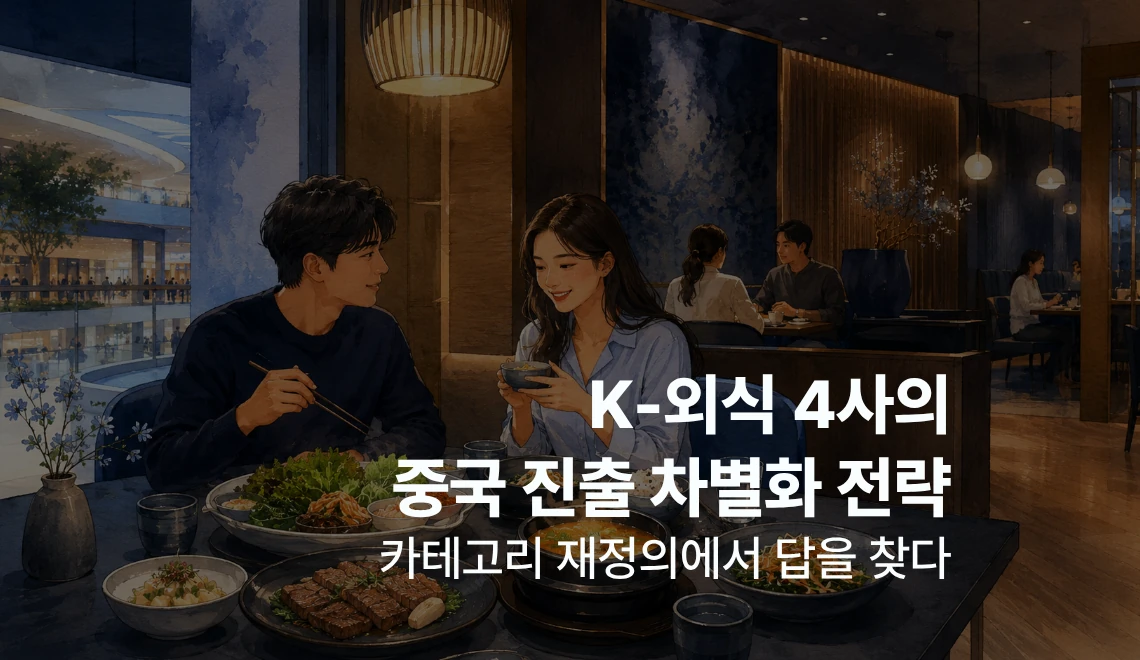
K‑Food dining spaces reshaped around premium districts (concept image)
CORE SUMMARY
Recent K‑Food entrants in China are moving away from single‑menu sales towardcategory redefinitionconverging on that approach. They use familiar entry points like eomuk, chicken, galbi, and ice creambut position themselves as K‑Food experience, culture, and spaceto elevate their brand. Premium district placement, master franchise collaboration, and local digital platform validation are common patterns
The strongest differentiation strategy for K‑Food brands in China is category redefinition. Instead of selling a single menu, they redesign the positioning to become a space that offers new experiences and culture. This article analyzes four K‑Food companies that entered China with differentiated concepts after 2024, summarizes the common patterns found, and outlines implications for headquarters operations.
Reconfiguring the Chinese market: Structural changes facing K‑Food
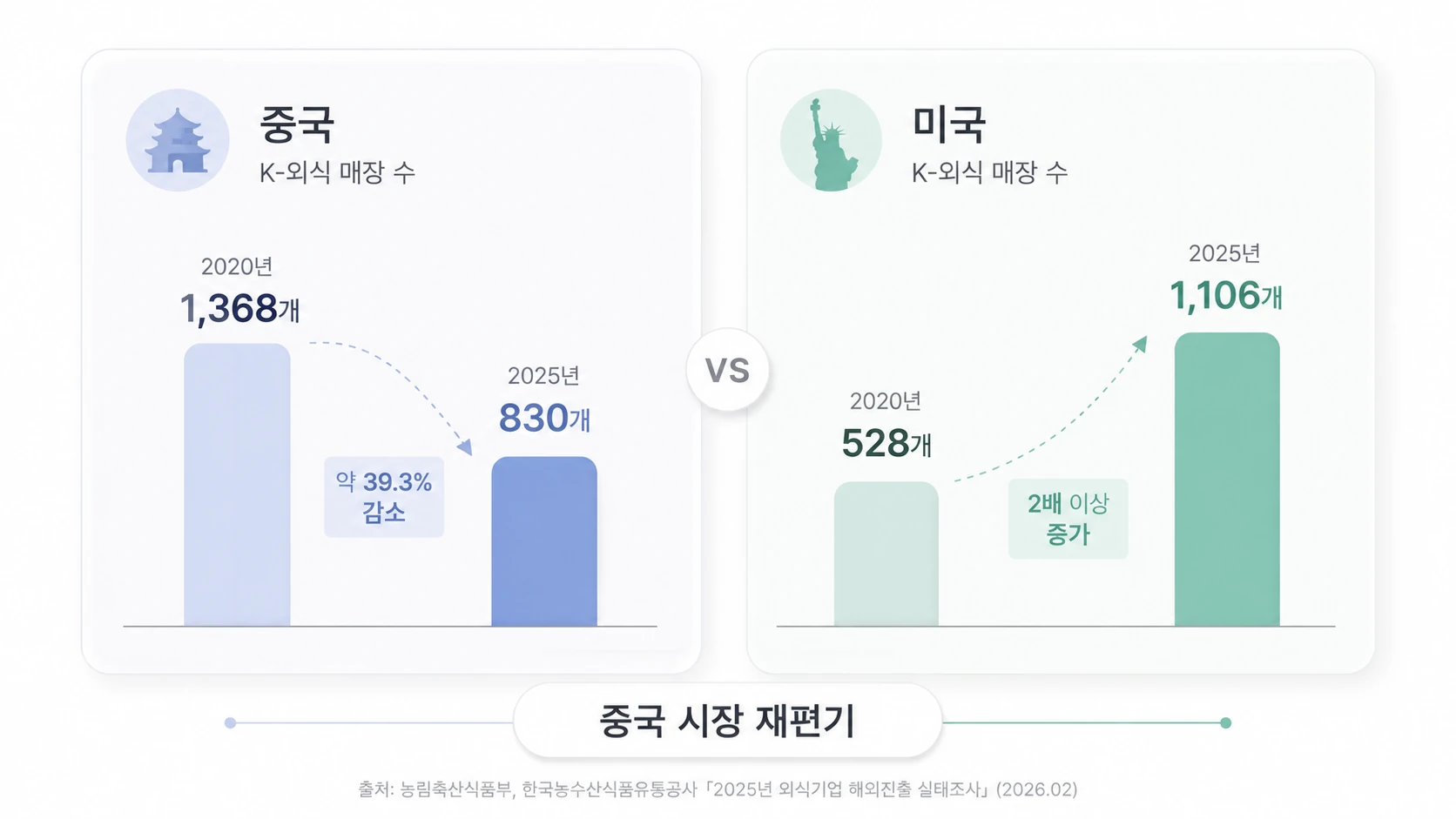
K‑Food store counts in China fell about 40% over five years, yet differentiated brands are accelerating entry
According to the "2025 Overseas Expansion Survey of Food Service Companies" released by the Ministry of Agriculture, Food and Rural Affairs and the Korea Agro‑Fishery & Food Trade Association in February 2026, domestic K‑Food stores in China were 1,368 in 20201,368in 2025830 locationsby abouta 39.3% decreaseIt did so. During the same period, U.S. stores grew from 528 to 1,106, more than doubling and capturing the leading market position for K‑food.
The root cause of the market contraction is intensified competition from local dining brands. Indigenous Chinese brands have rapidly evolved in price, menu, and store operations, rendering the strategy of simply copying popular Korean dishes ineffective. Nevertheless, recent K‑food cases that have re‑entered or newly entered China with differentiated concepts are being reported one after another. The common denominator is clear.they redefined the category rather than just the menuIt is.
Case 1. BBQ Village – from a chicken franchise to a gateway for K‑food
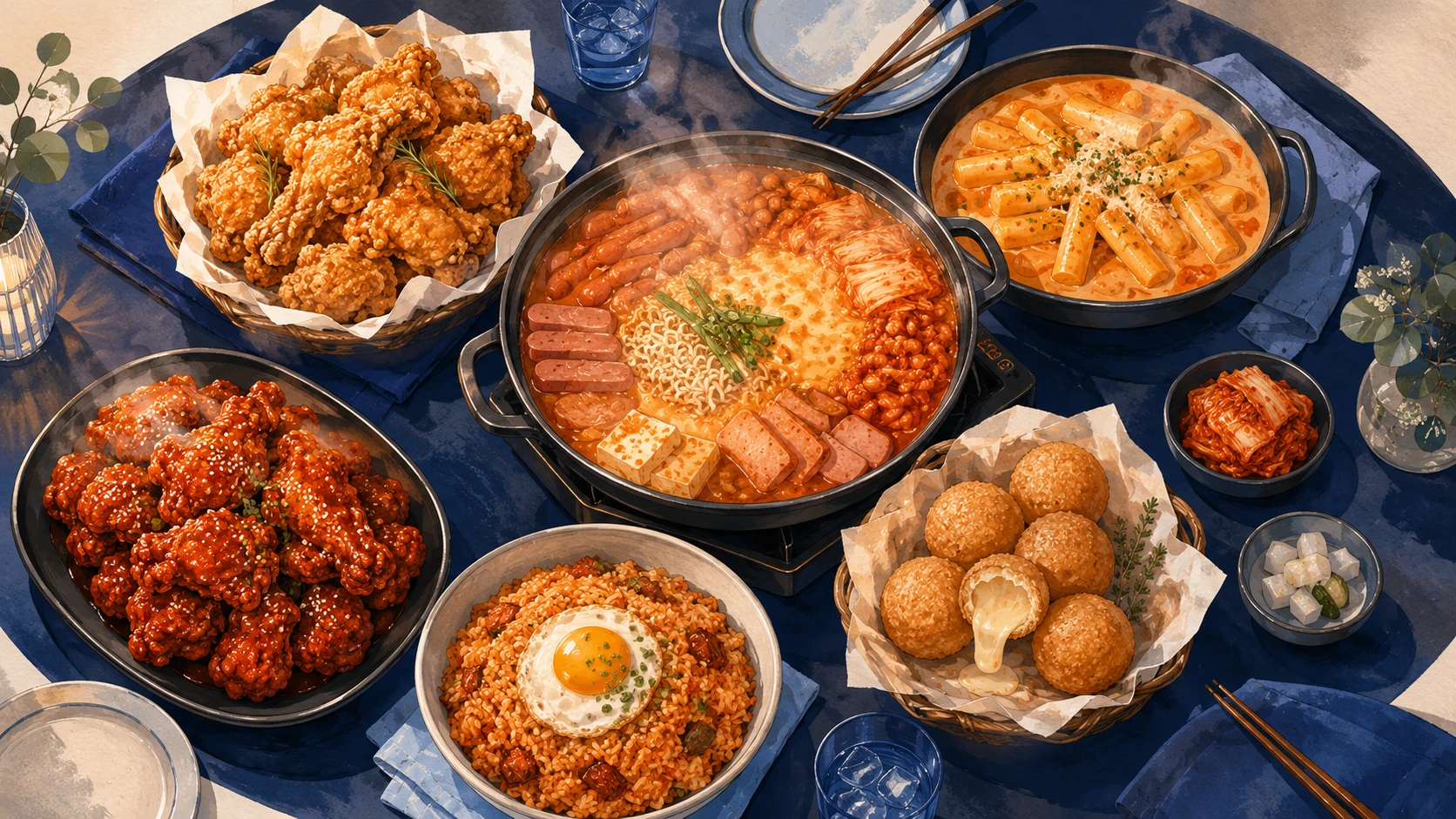
Concept image showing a layout where chicken serves as the entry point to experience a full range of Korean cuisine in one place
Genesis BBQ opened the 'BBQ Village Shenzhen Haider Wanshanghui' at the premium mall Wanshanghui (MixC Life) in Bao’an District, Shenzhen, Guangdong, in January 2026. After withdrawing from China during the THAAD dispute, BBQ re‑entered with a concept that is a ‘village’ rather than a traditional chicken shop.
The store menu includes the K‑chicken lineup such as Golden Olive Chicken, Seasoned Chicken, Cheezling, and Honey Garlic,Budae Jjigae, Samgyetang, Rose Tteokbokki, Kimchi Fried Rice, Kimchi Pancake, and Cheese BallsIt gathers these Korean dishes in one location. Using chicken as a familiar entry point, the concept expands to the broader Korean cuisine, allowing guests to sample four to five K‑food items in a single visit.
Shenzhen, with a population of about 17.98 million, is one of China’s three major high‑income cities and is dubbed ‘China’s Silicon Valley’ for its concentration of IT, finance, and advanced manufacturing. Starting from this hub, BBQ is collaborating with partners in Guangdong and Hubei to develop delivery‑only menus and ready‑to‑eat products, aiming for 10,000 stores in China by 2030.
Change 01
'One chicken'from'K‑food course experience'Instead of deepening a single category, we elevated the category itself one level up.
Case 2. Myeongryun Jin Saga BBQ – From an unlimited‑refill rib joint to a K‑BBQ cultural space.
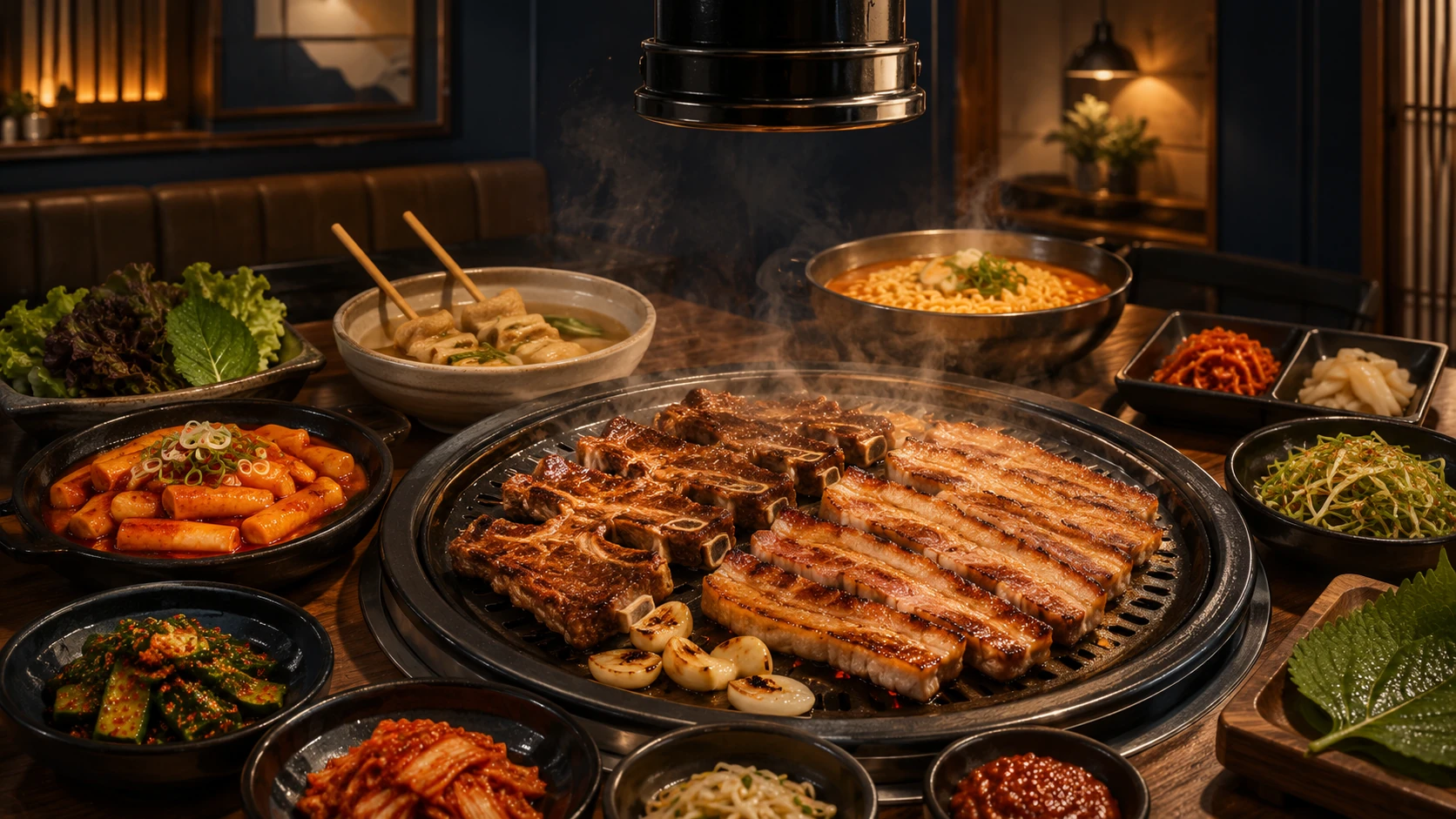
A K‑food cultural course that blends main meats with snack‑style sides (concept image).
After opening its first Shanghai Intinglu location in July 2024, Myeongryun Jin Saga BBQ expanded into China by launching a second outlet in Dalian Lospu in December of the same year. The menu composition is particularly noteworthy.
The signature pork ribs are seasoned with 22 natural ingredients, including plum, and the menu also features pork belly, neck, fresh rib, and chicken ribs.Side dishes such as tteokbokki, skewered fish cakes, chicken, vegetable tempura, kimchi rolls, and Han River ramen.These snack‑style sides are served together. The flow of a Korean meal—main (meat) → side (snack) → finish (ramen)—is transformed into a single course experience.
The Dalian Lospu outlet occupies a 173‑pyeong space in the popular Roosevelt Shopping Mall, designed to accommodate up to 200 guests. The company positioned the venue not just as a restaurant but as a cultural space, proclaiming its mission to spread K‑BBQ culture across China. The snack‑style sides lower the menu‑decision burden for first‑time Chinese visitors, acting as a barrier‑reduction tool.
Case 3. Yojang – From yogurt ice cream to a healthy pleasure dessert.

A participatory K‑dessert that lets customers mix over 50 toppings (concept image).
Premium dessert brand Yojang signed a master franchise agreement in the first half of 2025 and opened its Shanghai flagship and Suzhou second outlet. It then expanded to locations such as Shenzhen Mix City, reaching 20 stores in 7 countries—Australia, Hong Kong, China, Japan, Singapore, and the United States—within a year of its overseas launch.7 countries, 20 storeswere surpassed.
Yojang’s differentiation hinges on two core pillars.
Participatory dessert experience
A customization framework that lets customers mix over 50 toppings—fresh fruit, granola, chocolate shell, honey, and more—according to their taste. The act of creating the menu itself is commodified, rather than simply receiving it.
Healthy Pleasure Trend Connection
Aligned with the global lifestyle trend of "Managing health happily," we positioned it as a dessert that you enjoy while taking care of yourself, rather than just a simple ice cream.
The visually polished look that reflects the global dessert trend spreading through social media sparked organic growth on Chinese platforms like Xiaohongshu and Douyin. The company plans to launch its first Chinese franchise in the second half of 2026, targeting 100 stores by year‑end.
Case 4. Samjin Fish Cake – From snack to K‑Fish Cake Bakery & Café
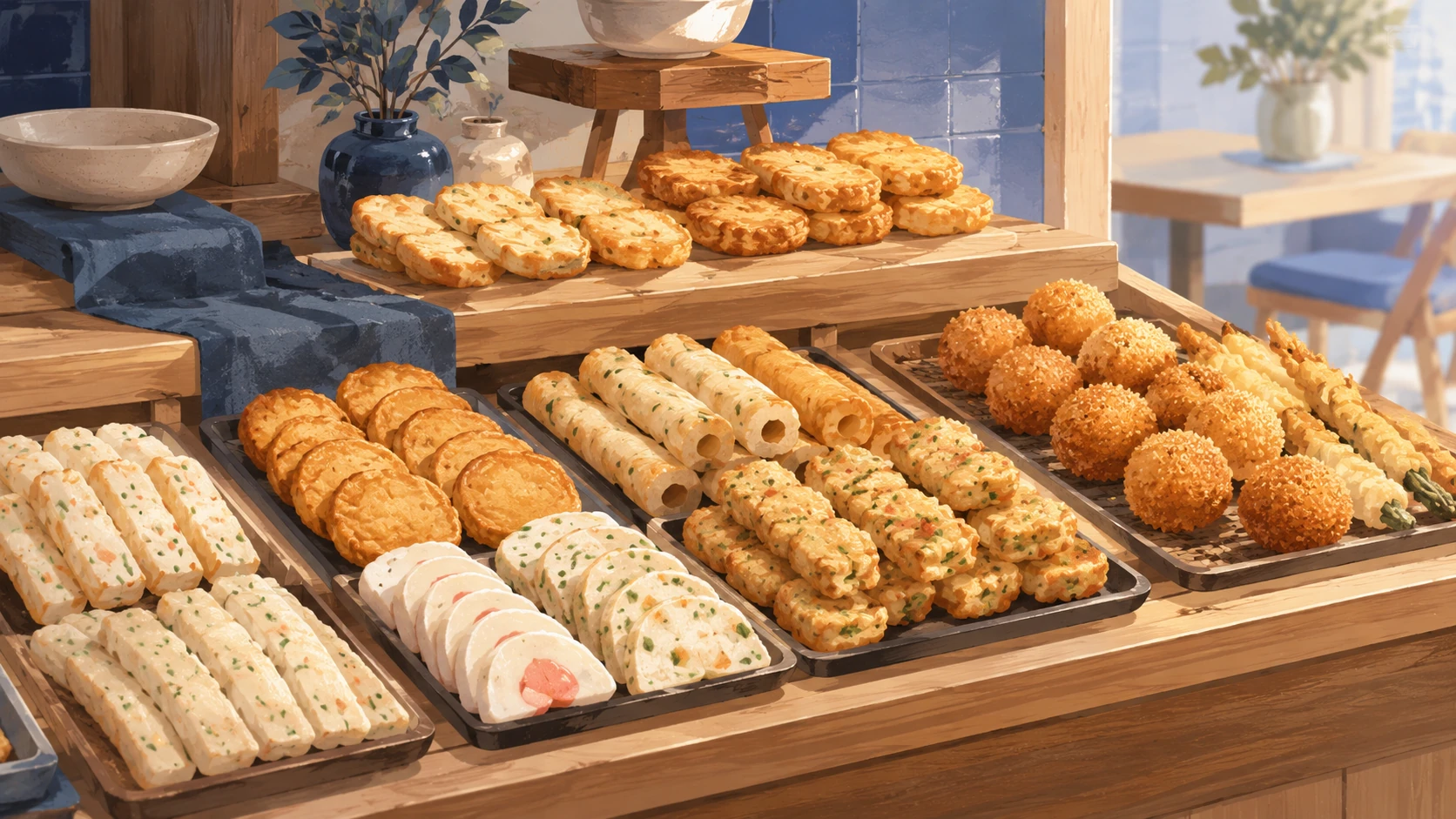
Bakery‑style store that displays fish cakes like bread, lowering entry barriers (concept image)
The latest example is Samjin Foods’ first Chinese outlet, Samjin Fish Cake, opened in May 2026 at TASKIN MALL, a prime shopping district in Changsha, Hunan. Instead of a plain fish‑cake snack shop,"K‑Fish Cake Bakery & Café"entered the market as a hybrid culinary space.
The store featured a bakery‑style UX that displays fish cakes like bread and seating that lets customers enjoy both a meal and café culture. By translating the Korean snack category of fish cake into the familiar "bakery" language for Chinese consumers,the barrier of "food never tried before" was replaced with a "familiar store experience"—one example.
Immediately after opening, the outlet ranked first among new Korean‑food listings in the Changsha area on the Chinese review platform Dianping, quickly validating the market. The company plans to expand K‑Fish Cake culture across mainland China from this launch.
Four common patterns identified across the four cases
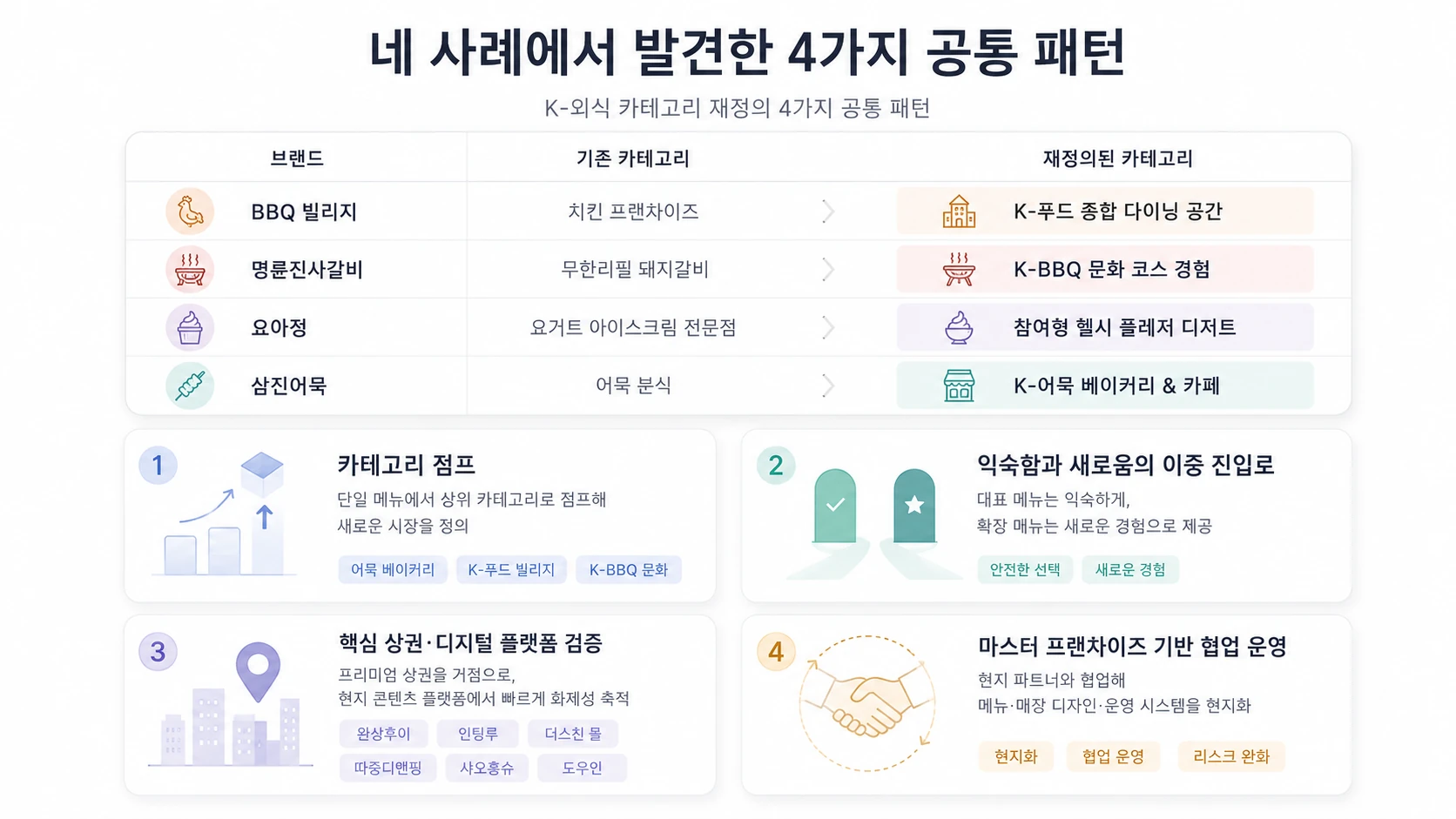
Four common axes of the category‑redefinition strategy that run through the four cases
A cross‑case comparison reveals the following differentiation formula.
Category Jump
Eomuk → K-Eomuk Bakery, Chicken → K-Food Village, Galbi → K-BBQ Culture. Rather than selling a single menu, we leap to a higher-level category, redefining the market. This is a strategy that shifts the competitive dimension.
Dual Entryway of Familiarity and Novelty
The core menu serves as a familiar entry point, while side and expansion items deliver a new K-Food experience simultaneously. This structure offers local first‑time visitors both a 'safe choice' and an 'adventure' at the same time.
Validate Core Market and Local Digital Platforms
Leverage premium first‑tier and emerging first‑tier urban districts—such as Shenzhen Wanshanghui, Shanghai Intinglu, and Changsha Dushin Mall—as hubs, and rapidly generate early buzz on local content platforms like Douyin, Xiaohongshu, and DOUIN.
Master franchise‑based collaborative operations
Yoajung, BBQ, Samjin Fish Cake, and Myeongnyun Jinsagalbi all localized their menu, store design, and operating systems through collaboration with local master franchise partners. This approach reduces direct entry risk for the headquarters while quickly absorbing local know‑how.
Category redefinition starts at the franchisor headquarters, not the franchise location.

The category‑redefinition strategy leads to global expansion only when the headquarters’ operating infrastructure can support it.
Reinterpreting the above cases from the headquarters’ operational perspective makes one fact clear.Category redefinition is a decision made by the headquarters system, not by individual franchise locations.That’s the point.
Redefining a category means redesigning the entire headquarters operating system across countries—including menu composition, pricing policy, staff training, local marketing execution, and aggregation and analysis of sales data by store. In overseas expansion using a master‑franchise model, precise data sharing and operational standardization with local partners determine success or failure.
Operational challenges faced by headquarters in overseas expansion
· Inefficiency from franchise sales, consultations, and e‑contract histories being managed separately by country
· Complexity of aggregating and settling franchise location sales across multiple countries and currencies
· Localizing the headquarters’ standard operating manual (QSCV) and managing audit data
· Managing franchise‑law‑based records such as pre‑provided documents and contract‑expiry notifications
Direction of change
The headquarters’ operating methods that work in Korea must be flexibly adaptable to local currency, language, tax, and store environments. This is not merely a system implementation but the headquarters’ global operational capability itself—the final piece that links the category‑redefinition strategy to actual revenue.
MS Venter’s franchisor‑specific ERPFDAM (FDAM)Our integrated platform gives franchisor headquarters a systematic environment to manage franchise locations—covering Franchise Sales Management, Store Opening Management, Franchise Operations Management, QSCV inspections, POS sales aggregation, and electronic contract history. Built on 25+ years of franchise IT expertise and data from over 500 brands, it is Korea’s first AI‑powered franchise ERP, with multilingual and multi‑currency capabilities in development for overseas expansion.
Frequently Asked Questions
Q. What is the most effective strategy for K‑food brands to differentiate themselves in the Chinese market?
A. Redefining categories has emerged as the most consistent winning approach in recent cases. Rather than selling a single menu item, position the brand around a ‘culture, experience, space’ unit, elevating it one level higher. Deliver a familiar signature menu alongside a fresh K‑food experience within the same location.
Q. Which model—master franchise or direct launch—is more advantageous?
A. All four examples in this article adopted the master franchise model. It sharply reduces early‑entry risk by quickly securing local market insight, permits, logistics, and workforce networks. However, the HQ must have fully refined operating standards and data‑management systems for partner collaboration to run smoothly.
Q. What HQ system should a company considering overseas expansion examine first?
A. The four critical pillars are: Franchise Sales Management and consultation history, electronic contract and pre‑provided document records, franchise location sales data aggregation, and the QSCV standard inspection process. These areas must be standardized to Korean norms so that consistent operating manuals can be delivered to local partners, and future multi‑country data integration becomes possible.
Q. Is FDAM suitable for overseas HQs?
A. FDAM is a franchise‑HQ‑only ERP that unifies the entire cycle—from Franchise Sales Management through Store Opening Management to Franchise Operations Management. Multilingual and multi‑currency support is expanding, and for HQs preparing for overseas expansion, FDAM can help assess how to standardize Korean operating standards and convert data into assets at this stage.
FRANCHISE ERP FDAM
For companies expanding globally
First things to prepare
25 years of franchise IT know‑how and
Start with an AI‑based operating system—FDAM.