
FDAM Article đź’«

Franchise Location Management Program: 3 Must‑Haves for Headquarters and AI ERP FDAM

Key Takeaways

· A franchise location management program is a headquarters‑only solution that lets the franchisor headquarters handle contracts, openings, operations, communication, and improvement for its franchise locations in one place.

· Compliance with the Franchise Business Act starts with automatically generating required documents, issuing them electronically, and tracking view histories in a single workflow.

· When headquarters‑issued notifications, recipes, surveys, CS, and QSCV checks are processed bidirectionally via the franchise location app, operational efficiency increases.

· The FDAM franchise ERP supports AI‑assistant‑driven natural‑language queries to instantly identify missing or incomplete items.

Franchise Location Management ProgramRefers to a headquarters‑only solution designed so franchisor headquarters can manage a franchise location’s contracts, openings, operations, two‑way communication, and improvements from a single platform. It unifies the entire franchise location lifecycle—from Franchise Sales Management through Store Opening Management, operational checks, and data analysis. As the number of franchise locations grows, relying on spreadsheets, messengers, and individual notes becomes untenable; establishing a standardized operating system is now a core infrastructure requirement for headquarters.

In this article we examine the areas headquarters must evaluate when reviewing a franchise location management program, and explain how the Smart AI ERP FDAM for franchisor headquarters operates within that flow.

Headquarters operations team reviewing franchise location status with the management program

A franchise location management program provides the infrastructure that consolidates headquarters operations.

1. What Is a Franchise Location Management Program?
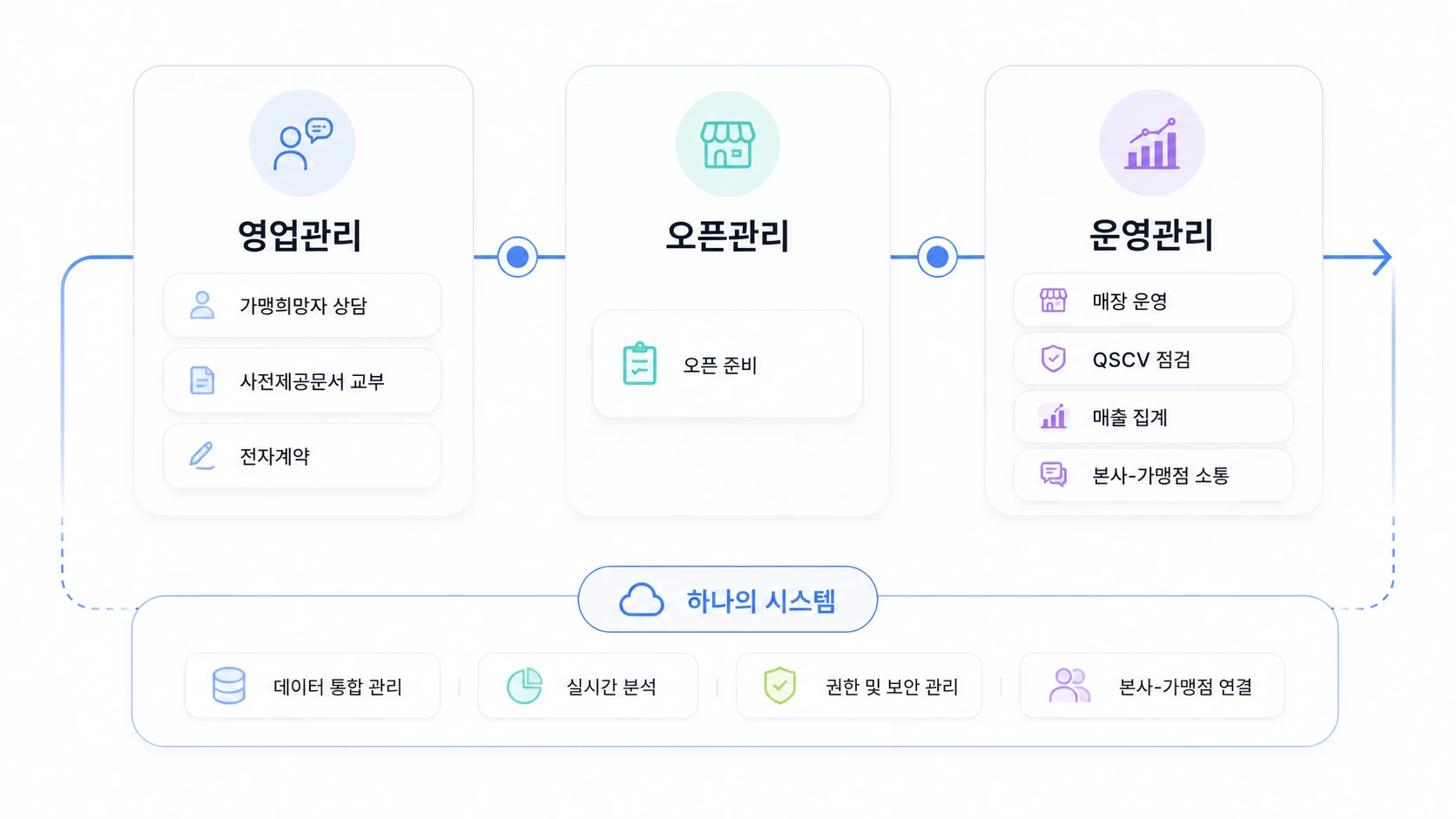
Diagram summarizing the workflow of a franchise location management program

The sales, opening, and operations processes are linked within a single system.

A franchise location management program differs from a generic ERP. While a generic ERP handles universal functions such as accounting, HR, and inventory, a franchise location management program is built around franchise‑specific tasks like Franchise Business Act compliance, recruiting and preparing new locations, headquarters‑to‑location communication, and QSCV inspections.

From the headquarters perspective,Franchise Sales Management → Store Opening Management → Franchise Operations ManagementThe franchise location lifecycle must be captured end‑to‑end in the system. When the flow—from prospect consultations through pre‑document issuance, e‑contracts, opening prep, daily operations, inspections, and sales aggregation—remains seamless, any headquarters staff can maintain consistent quality, and all data accumulates in one place for informed decision‑making.

2. Franchise Business Act Compliance: The Starting Point for Franchise Location Management
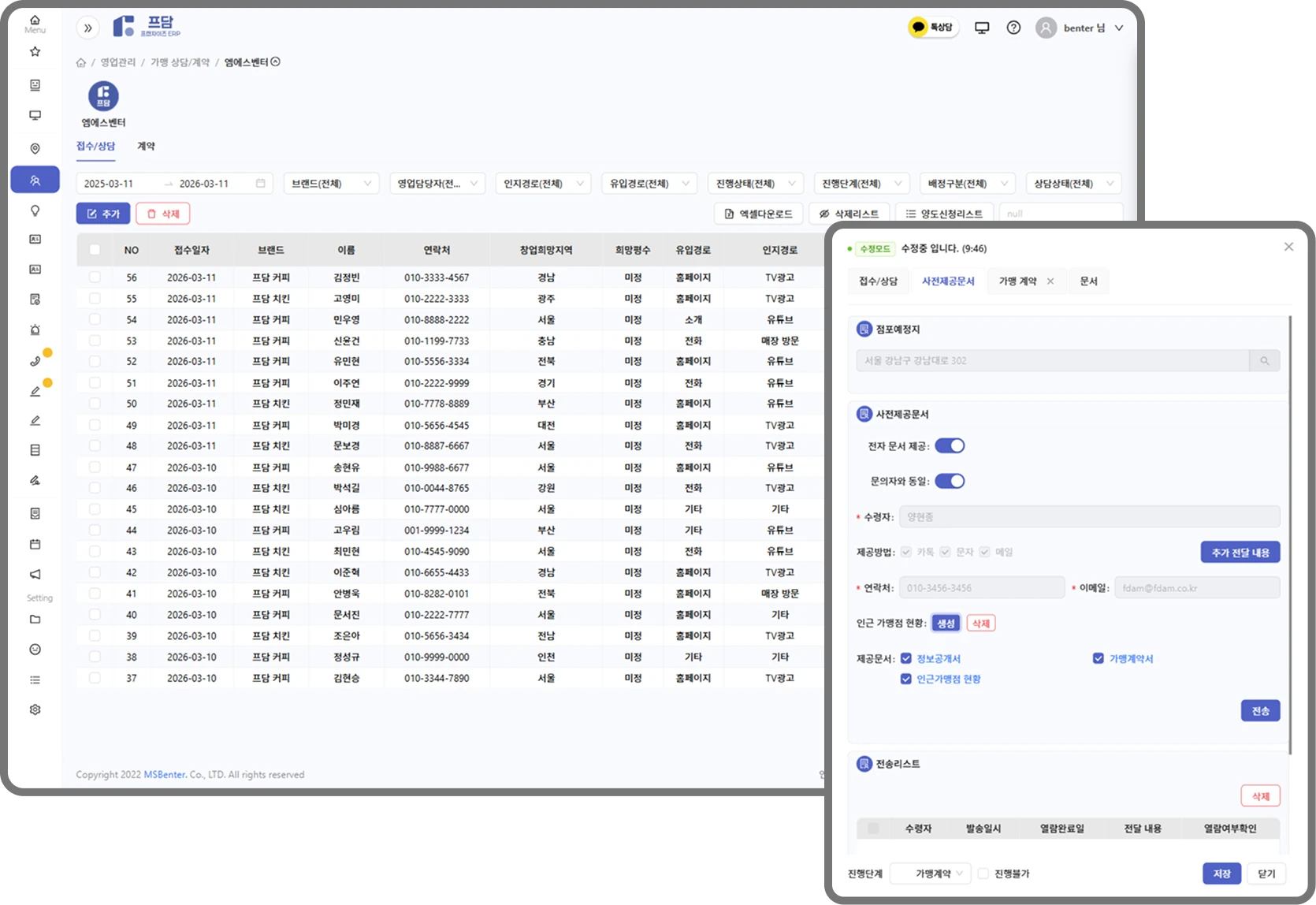
Electronic delivery screen and view‑history list for pre‑provided documents

Dispute response is possible only when the flow of pre‑provided documents is recorded in the system.

The Franchise Business Act requires franchisor headquarters to obligatorily provide pre‑provided documents such as the information disclosure statement and nearby franchise location status documents to prospective franchisees. A franchise agreement can be signed only after 14 days have passed since the documents were delivered in paper or electronic form, and failure to follow this procedure can lead to fines or corrective orders, making it a top priority for franchisor headquarters sales staff.

In practice, as sales staff grow and consultation volume increases, tracking who received which document, when, and whether the prospective franchisee actually opened it becomes increasingly difficult. Using a hybrid of paper and email means missing records or disputes take extra time to locate evidence.

FDAM streamlines this processPre‑provided document auto‑creation → electronic delivery → view‑history verificationWe have integrated it into a single workflow. Based on the prospective franchisee information entered by the franchisor headquarters sales representative, pre‑provided documents are generated automatically and delivered via email and mobile link. Because the prospective franchisee’s view timestamp is recorded, the basis for calculating the 14‑day consideration period is clear, and the record can serve as evidence if a dispute arises later. This structure organizes the foundational elements of the franchise business within the Franchise Sales Management stage of the system.

3. Connect franchisor headquarters and stores with a franchise location management app
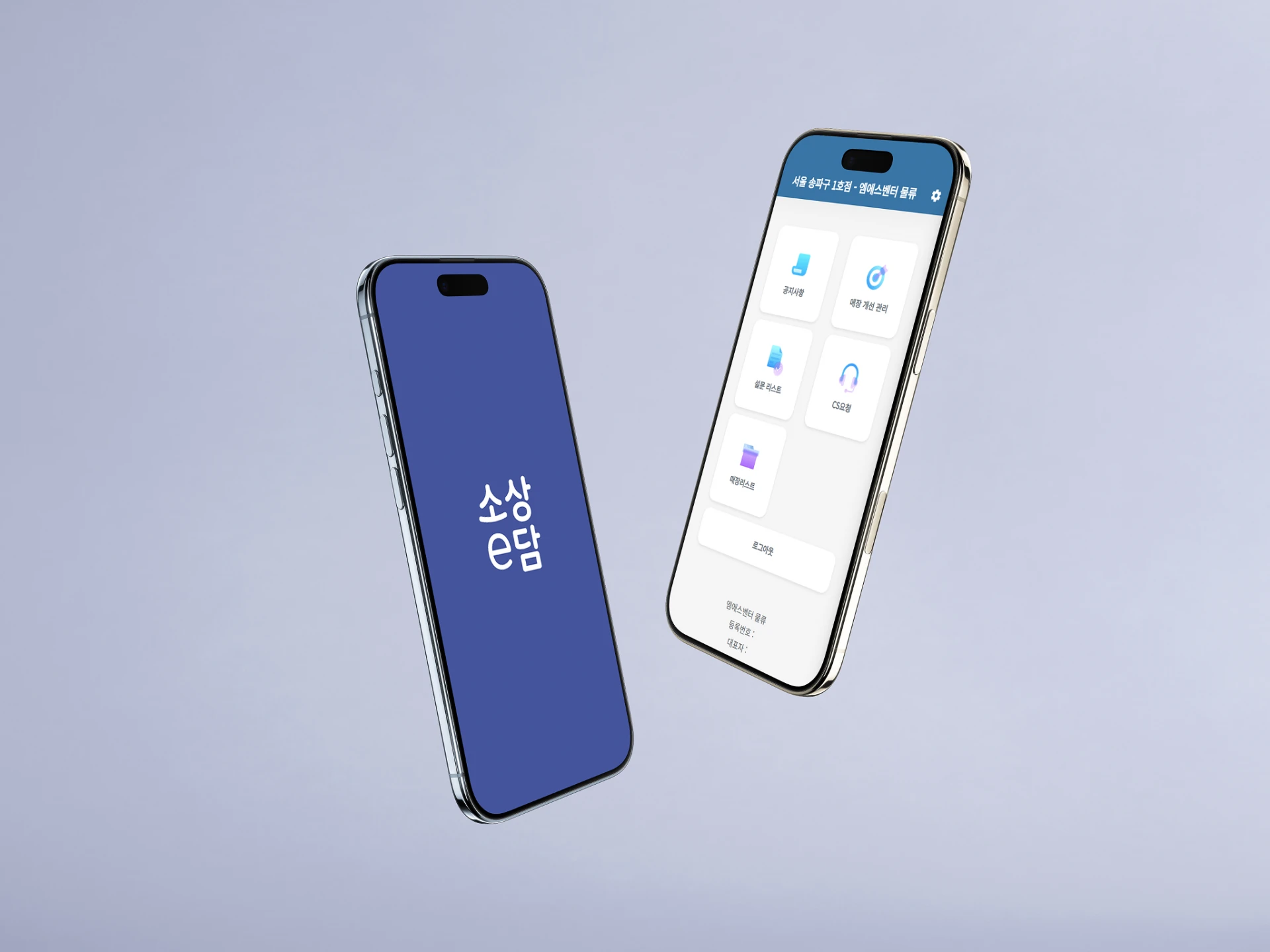
Franchisee can view franchisor headquarters notices and new‑menu recipes via the mobile app

A structure where franchisor headquarters and stores exchange information on the same app is required.

Communication is actually the biggest pain point in franchise location management. Group KakaoTalk chats are fast but the records scatter, official email has low open rates, and phone calls consume a lot of time. When meticulously crafted new‑menu recipes and promotion notices don’t reach stores, or when a franchisee’s improvement request gets stuck in an unknown department, it’s a common issue for any franchisor headquarters.

FDAM operates as a paired system of the franchisor headquarters ERP and a franchise location‑only app. The franchisee uses the franchise location management app.Sodam (Sosangidam)Through Sodam, franchisees can view headquarters notices, recipe files, survey responses, CS inquiries, and QSCV on‑site inspection results all on one screen and process them. When a new menu launches, videos and manuals are distributed together; surveys gather store feedback; and the franchisee’s CS inquiries and response history are accumulated directly in the franchisor headquarters ERP.

QSCV inspections go beyond record‑keeping to generate improvement requests. Any deficiencies noted by a headquarters SV on‑site are issued as improvement tasks with assigned owners and deadlines, and the franchisee’s corrective actions are tracked within the same workflow. Keeping a record of what headquarters demanded and how the store responded is critical.

4. Use AI to instantly assess franchise location management status
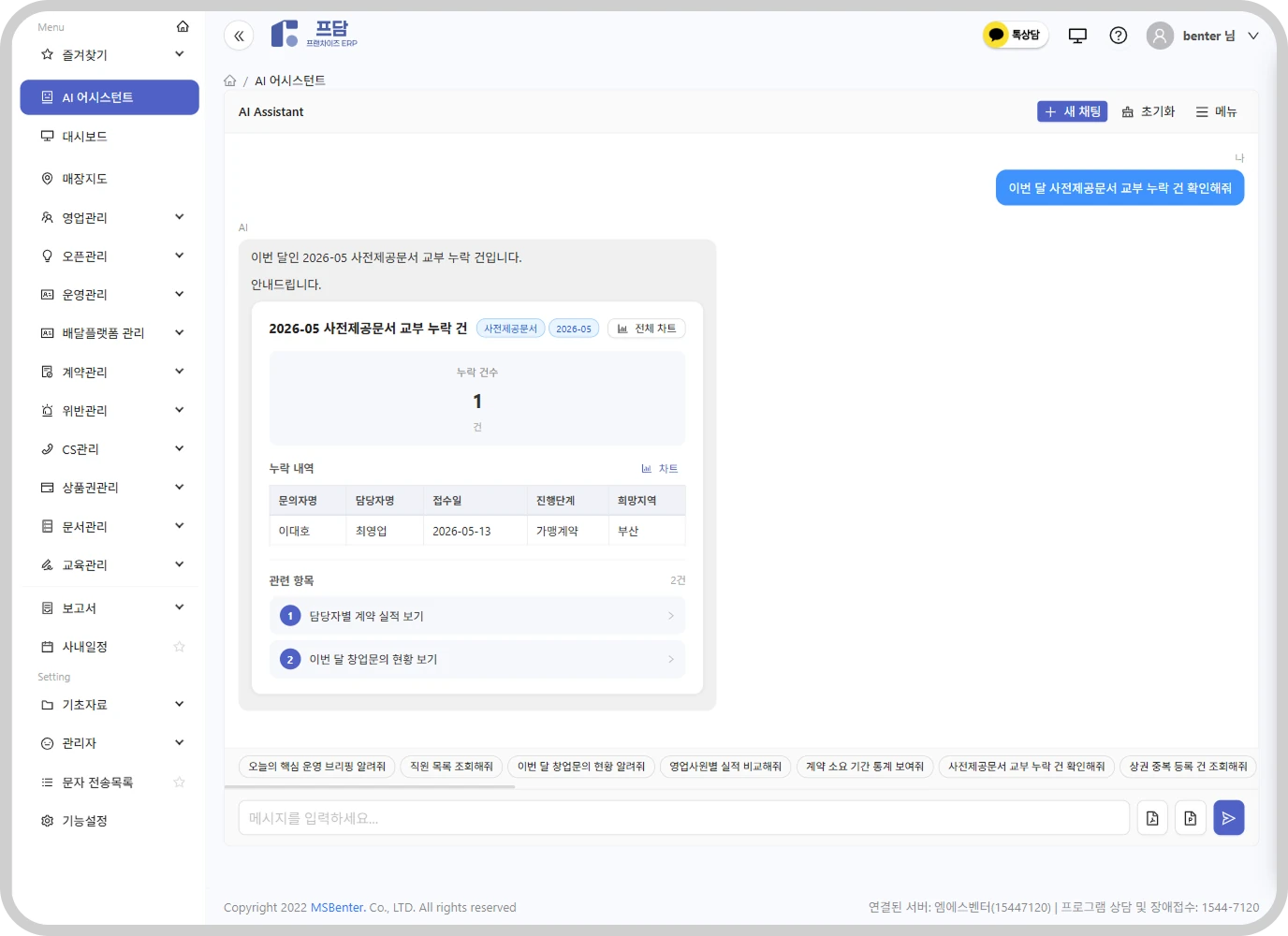
Screen where the FDAM AI assistant answers operational status questions in natural language

An AI assistant that answers natural‑language queries with tables and charts reduces operational time.

Once data accumulates in the franchise location management program, the next challenge is how quickly needed information can be retrieved. If a headquarters executive asks about missing items or progress on improvements just before a meeting and the responsible staff must hunt through multiple screens and compile Excel files, decision‑making will inevitably be delayed.

FDAM lets headquarters query operational data in natural languageAI AssistantIt’s built in. No need to set search criteria or create a new report—just ask as you normally would and you’ll get an answer.

AI Assistant Sample Questions

· “Show me this month’s missing pre‑provided documents” → Summarize the cases that missed the 14‑day review period, were not viewed, or were not sent, in a table.

· “Give me the status of this month’s unfinished improvement requests” → List QSCV improvement requests that are overdue or unprocessed, broken down by responsible party and franchise location.

· “Show the top and bottom 5 franchise locations by last quarter sales” → Compile POS sales data (next‑day aggregation) into a graph.

Reducing the time from status assessment to problem resolution also signals higher‑quality decision‑making at the franchisor headquarters. The operational expertise we’ve built over 25 years in franchise IT forms the foundation for determining which data to collect and how to structure it to be most useful from the franchisor headquarters perspective.

5. Smart AI ERP for franchisor headquarters, FDAM
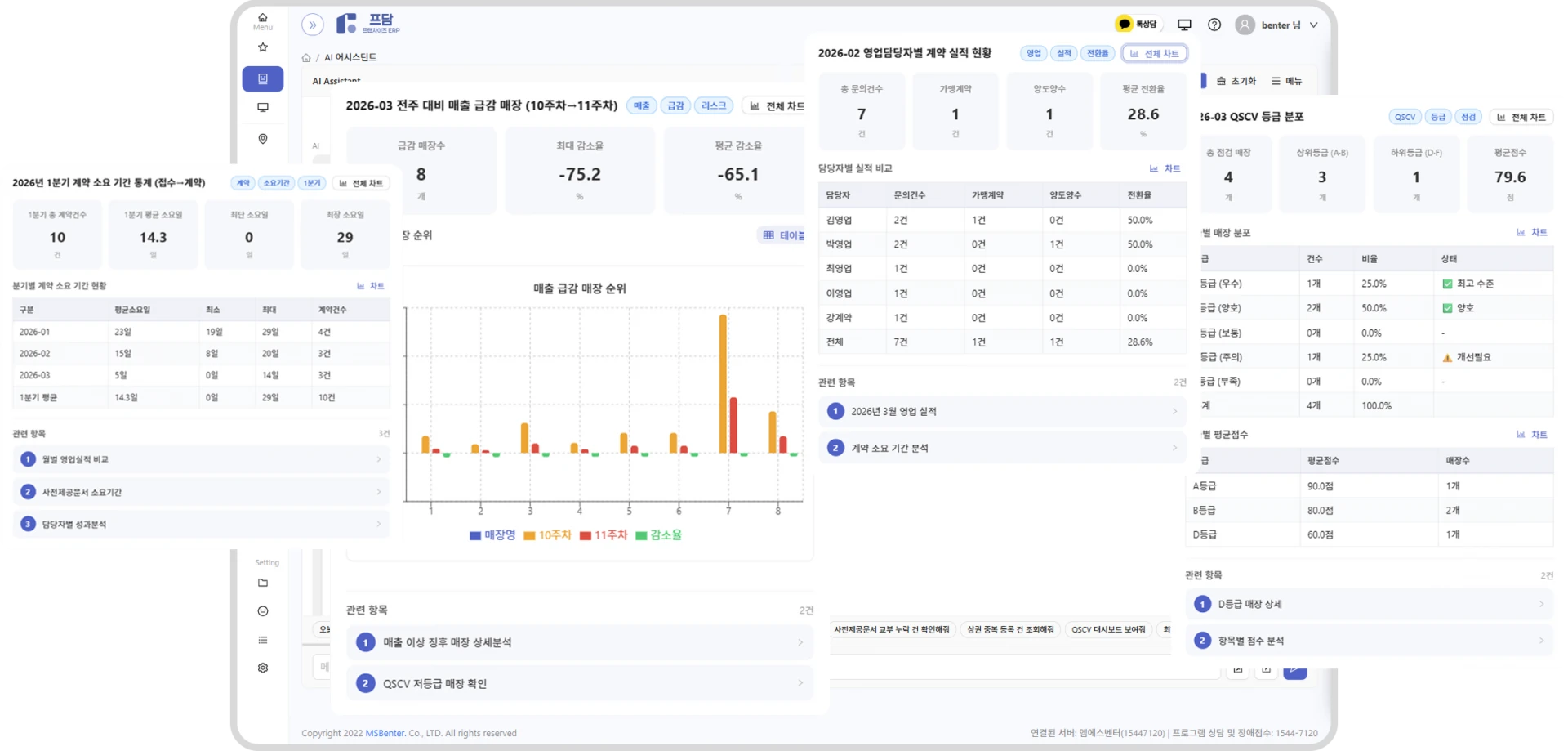
Smart AI ERP FDAM introduction image for franchisor headquarters

FDAM is a franchise ERP designed to enable AI use across the franchisor headquarters’ workflow.

When evaluating a franchise location management program, franchisor headquarters often fall into the trap of focusing on feature comparisons for generic functions like accounting or HR. The tasks that headquarters face daily and that a standard ERP can’t address are compliance with the Franchise Business Act, two‑way communication with franchise locations, and store‑level data management. The first step is to determine whether the system was built from the ground up for franchisor headquarters workflows or merely tacked on a store‑management module to a generic solution.

FDAM leverages collaboration with roughly 500 brands to replicate the franchisor headquarters workflow—from Franchise Sales Management through Store Opening Management to Franchise Operations Management—directly in the system. It is also the first domestic franchise ERP to embed AI capabilities. Because the pre‑provided document workflow, the franchise location app Sodam, and the AI assistant operate within the same platform, headquarters can substantially cut the time and staff needed for franchise location management.

Frequently Asked Questions

Q. How do a standard ERP and a franchise location management program differ?

A standard ERP focuses on corporate‑wide functions such as accounting, HR, and inventory. In contrast, a franchise location management program is built around tasks unique to franchisor headquarters—compliance with the Franchise Business Act, recruiting and preparing franchise locations for opening, headquarters‑to‑location communication, and QSCV inspections. That distinction is the core difference.

Q. Does the electronic delivery history of pre‑provided documents have legal effect?

The Franchise Business Act permits pre‑provided documents to be delivered in paper or electronic form, and when the system logs the access timestamp, that record can serve as evidence for calculating the 14‑day deliberation period and for dispute resolution.

Q. Must the franchise location management app be implemented as a separate solution?

FDAM bundles the franchisor headquarters ERP with the franchise location‑only app Sodam into a single package, eliminating the need for separate solutions for communication and operations. Notices, recipes, surveys, customer service, and QSCV field checks are all handled within one app.

Q. What data does the FDAM AI assistant use to generate its responses?

Answers are generated from internal headquarters operational data. Ask natural‑language questions about sales, store‑opening, or operations data, and receive results formatted as tables, charts, or reports.

Q. How does the franchise location management program implementation consultation work?

FDAM can be queried via the implementation inquiry page (franchiseerp.com/register), the KakaoTalk channel, or the main phone line (1544-7120). We’ll provide a demo tailored to the headquarters’ operating environment and walk through usage scenarios.

Systematizing franchise location management

For franchisor headquarters
Smart AI ERP, FDAM

Terms of Use

Article 1 Purpose

These Terms of Use govern the conditions and operational rules for using the services of "Site Name" (hereinafter referred to as "the Site").

Article 2 Definitions

Key terms used in these terms are defined as follows.

1. Member: An individual who agrees to these terms, provides personal information to register as a member, enters into a usage agreement with the Site, and uses the Site.
2. Usage Agreement: The contract concluded between the Site and a member regarding Site usage.
3. Member ID ("ID"): A unique combination of letters and numbers assigned to each member for identification and service access.
4. Password: The combination of letters and numbers selected by the member to verify identity and protect the member’s rights.
5. Operator: The entity that creates and manages the website offering the service.
6. Termination: The act of a member canceling the usage agreement.

Article 3 Supplemental Rules

The Operator may issue separate operational policies as needed; if these policies overlap with these terms, the operational policies will take precedence.

Article 4 Formation of the Usage Agreement

1. The usage agreement is formed when a person registers as a member, agrees to these terms, and the Operator accepts the registration request.
2. Anyone registering as a member indicates agreement to these terms by reading them during the Site registration process and selecting the "I Agree" option.

Article 5 Service Use Application

1. Individuals registering as members must provide all required information requested by the Site (such as user ID, password, nickname, etc.).
2. Members who use another person’s information, submit false data, or otherwise fail to provide authentic personal information have no rights to use the Site and may be subject to penalties under applicable law.

Section 6: Privacy Policy

The operator does not retain members' passwords provided at sign‑up, and related matters are governed by the site’s privacy policy.
The operator strives to protect members’ personal information, including registration data, in accordance with applicable laws.

Member privacy is handled according to the privacy policy set by applicable law and the site.

However, the operator assumes no responsibility for information exposed due to the member’s own fault.
If a member posts or distributes illegal content—such as material that violates public morals or national security—the operator may, upon request from relevant authorities, review the member’s data and submit it to those authorities.

Section 7: Operator Obligations

(1) When a member’s opinion or complaint is deemed legitimate, the operator must address it as promptly as possible. If personal circumstances prevent immediate action, the operator will make a best effort to follow up with a notice, message, or email after the fact.
(2) To ensure continuous and stable site operation, the operator may require the site to repair or restore equipment without delay when failures or losses occur. In cases of force majeure or unavoidable circumstances affecting the site or operator, site operation may be temporarily suspended.

Section 8: Member Obligations

(1) Members must comply with the terms of this agreement, all site policies, notices, operational guidelines, and applicable laws, and must not engage in actions that interfere with site operations or damage the site’s reputation.
(2) Unless expressly authorized by the site, members may not transfer, gift, or use their service rights or contractual status as collateral to any third party.
(3) Users must exercise great care in managing their ID and password and may not allow third parties to use their ID without the operator’s or site’s consent.
(4) Members must not infringe the intellectual property rights of the operator, the site, or any third party.

Section 9: Service Availability

(1) Service is generally available 24 hours a day, 365 days a year, unless technical or operational constraints arise. The site may temporarily suspend service for scheduled maintenance, upgrades, or replacements on dates and times announced by the site. Planned interruptions will be posted on the site’s homepage, so please check regularly.
(2) The site may also suspend service temporarily or permanently without prior notice in the following situations:
- Urgent system inspections, upgrades, replacements, or malfunctions
- Force‑majeure events such as national emergencies, power outages, or natural disasters
- When a telecommunications provider ceases service as stipulated by the Telecommunications Business Act
- If excessive traffic or other issues disrupt normal service use, the service may be unavailable.
③ When service interruptions occur as described in the preceding clause, the site will notify members in advance via announcements or similar notices. If the interruption is caused by circumstances beyond the site’s control and advance notice is impossible, the site will provide notice after the fact.

Article 10 – Termination of Service Use

â‘  A member who wishes to terminate the usage agreement with the site must submit a cancellation request online personally. Separately, termination of the site usage agreement itself must be handled independently of the site access termination.
② Upon submission of the cancellation request, any site‑related programs provided by the site are automatically removed from the member‑management interface, and the operator can no longer view the applicant’s information.

Article 11 – Restriction of Service Use

Members may not engage in any of the following actions. If a member does, the site may restrict the member’s service access, take appropriate legal measures, terminate the usage agreement, or suspend service for a specified period.
① Registering false information during sign‑up or when updating member details.
② Interfering with another person’s use of the site or misappropriating their information.
③ Impersonating site administrators, staff, or affiliates.
④ Infringing on the personal rights or intellectual property of the site or any third party, or disrupting business operations.
⑤ Illegitimately using another member’s ID.
⑥ Collecting, storing, or disclosing another member’s personal data without their consent.
⑦ Engaging in conduct that can be objectively judged as criminal.
â‘§ Any other actions that violate applicable laws and regulations.

Article 12 – Management of Posted Content

â‘  The operator is responsible for managing and operating all posts and materials on the site. The operator must continuously monitor for inappropriate content, and upon discovering or receiving a report of such content, must delete it and issue a warning to the member who posted it.
Members are responsible for the content they post; therefore, members must not publish material that violates these terms of use.
② If a public authority such as the Information and Communication Ethics Committee issues a corrective request, the operator may delete or relocate posts without the member’s prior consent.
③ The criteria for determining inappropriate content are as follows.
- When the content severely insults or defames another member or a third party.
- When distributing or linking to content that violates public order or good morals.
- When the content encourages illegal copying or hacking.
- When it is advertising intended for profit.
- When the content is objectively recognized as being linked to criminal activity.
- When it infringes copyright or other rights of other users or third parties.
- When it is deemed to violate other applicable laws.
- If the site or its operator receives a request from a third party to halt a post because of alleged defamation, intellectual‑property infringement, or similar rights violations, the post may be temporarily taken down (transmission stopped). The site will follow any lawsuit, settlement, or other decision by the relevant authority that is submitted concerning the requester and the poster.

Article 13 Retention of Posts

If the site operator must discontinue the site due to unavoidable circumstances, they will give members prior notice and make reasonable efforts to facilitate the transfer of posts.

Article 14 Copyright in Posts

① The copyright of a post submitted by a member on the site belongs to that member. The site may not commercially use the post without the poster’s consent, except for non‑profit purposes, and the site retains the right to display the content within the service.
② Members may not commercially use materials posted on the service, such as by arbitrarily processing or selling information obtained through the service.
③ The operator may delete, relocate, or reject registration of any content posted or uploaded by a member that is judged to fall under any of the items listed in Article 12, without prior notice.

Article 15 Liability for Damages

â‘  All civil and criminal liability arising from the site is primarily the responsibility of the member.
② The site will not compensate for damages that result from force majeure events such as natural disasters, or from the member’s intentional or negligent actions.

Article 16 Disclaimer

â‘  The operator is exempt from liability for any loss of expected benefit, or for damages arising from the selection or use of service materials provided by the site.
② The operator is exempt from liability for interruptions caused by the site’s service infrastructure or by telecommunications services provided by other carriers, and any damages related to the site’s service infrastructure are governed by the site’s terms of use.
The operator assumes no responsibility for any material that members store, post, or transmit.
If service disruptions occur due to a member’s fault, the operator is not liable.
The operator is not responsible for any activities—such as data transmission or other community interactions—between members or between members and third parties, whether inside or outside the service.
The operator does not guarantee the authenticity, reliability, or accuracy of material posted or transmitted by members, nor any content that members can obtain from this site.
If members trade goods or conduct other transactions through the service, the operator is not liable for any resulting damages.
The operator bears no responsibility for any disputes that arise between members or between members and third parties, unless the operator is at fault.
The operator is not liable for member losses caused by system failures during equipment maintenance, inspections, repairs, or replacements, or software operation, unless caused by intentional wrongdoing or gross negligence; nor for failures due to third‑party attacks, undiscovered viruses, or other force‑majeure events beyond the operator’s control.

Supplementary Provisions

These terms <Effective from the site launch date>.

Privacy Policy

MS Venter (hereinafter referred to as “the Company”) establishes and publishes these privacy processing guidelines to protect data subjects’ personal information under Article 30 of the Personal Information Protection Act and to address related concerns promptly and smoothly.

Article 1 (Purpose of Personal Information Processing)
The Company processes personal information for the purposes listed below. Collected data will not be used for any other purpose, and if the purpose changes, the Company will obtain separate consent in accordance with Article 18 of the Personal Information Protection Act and take any other required actions.

1. Website membership registration and management
Personal information is processed to confirm membership intent, verify identity for member‑only services, maintain and manage membership status, conduct limited identity verification, prevent fraudulent use, verify parental consent for children under 14, provide notices, handle inquiries, and address complaints.

2. Provision of goods or services
Personal information is processed for product delivery, service provision, sending contracts and invoices, delivering content, offering personalized services, identity and age verification, payment processing and settlement, and debt collection.

3. Complaint handling
Personal information is processed to verify the complainant’s identity, confirm the nature of the complaint, contact for fact‑finding, and notify the outcome of the handling process.

Article 2 (Processing and Retention Period of Personal Data)
The Company processes and retains personal data only for the period required by law or the period consented to by the data subject at the time of collection.
The specific processing and retention periods are as follows:

1. Website membership registration and management: until the member withdraws from the website.
However, if any of the following circumstances apply, data will be retained until the circumstance ends:
1) Ongoing investigations or inquiries related to violations of applicable laws: until the investigation or inquiry concludes.
2) Outstanding creditor‑debtor relationships arising from website use: until those relationships are fully settled.

Article 5 (Rights of Users and Their Legal Representatives and How to Exercise Them)

Data subjects may exercise any of the following privacy rights with the Company at any time.
1. Request to access personal data
2. Request correction of errors or inaccuracies
3. Request deletion
4. Request suspension of processing
These rights can be exercised by submitting a written request, calling, emailing, or faxing the Company, and the Company will act without undue delay.
If a data subject requests correction or deletion of personal data, the Company will refrain from using or disclosing that data until the correction or deletion is completed.
The rights in paragraph 1 may also be exercised through a legal representative or an authorized agent, provided a power of attorney in the format specified in Appendix 11 of the Enforcement Rules of the Personal Data Protection Act is submitted.
Data subjects must not violate applicable laws, including the Personal Data Protection Act, by infringing on the personal data or privacy of themselves or others that the Company processes.

Article 6 (Categories of Personal Data Processed)
The Company processes the following categories of personal data:

1. Website membership registration and management
Required items: company name, full name, title, phone number, email
Optional items: referral source, awareness channel

2. Provision of goods or services
Required items: company name, full name, title, phone number, email
Optional items: referral source, awareness channel

3. During the use of internet services, the following personal data items may be automatically generated and collected.
IP address, cookies, MAC address, service usage records, visit logs, error usage records, etc.

Article 7 (Destruction of Personal Data)
â‘  The company shall promptly destroy personal data that is no longer needed due to the expiration of the retention period or achievement of the processing purpose.
② If, after the consented retention period has expired or the processing purpose has been achieved, the personal data must be retained under other laws, the company shall preserve it by transferring it to a separate database or storing it in a different location.
③ The procedures and methods for destroying personal data are as follows.
1. Destruction Procedure
The company selects the personal data subject to destruction and, with approval from the company’s personal data protection officer, destroys the data.
2. Destruction Methods
The company destroys electronically stored personal data using methods such as low‑level formatting to make records unrecoverable, and destroys paper records by shredding or incineration.

Article 8 (Measures to Ensure the Security of Personal Data)
The company implements the following measures to ensure the security of personal data.
1. Administrative measures: establishment and implementation of internal management plans, regular employee training, etc.
2. Technical measures: management of access rights to personal data processing systems, installation of access control systems, encryption of unique identifiers, etc., and installation of security programs.
and other encryption, security program installations.
3. Physical measures: access control for computer rooms, data storage rooms, etc.

Article 9 (Installation, operation, and refusal of automatic personal data collection devices)
(1) The company uses cookies to store user information and retrieve it as needed in order to provide personalized services.
(2) A cookie is a small piece of data sent by the server (http) that runs the website to the user's browser, and it may also be stored on the user's hard drive.
a. Purpose of using cookies: to analyze each service and website visited by the user, usage patterns, popular search terms, secure connection status, etc., and to deliver optimized information to the user.
b. Installing, operating, and refusing cookies: Tools menu at the top of the web browser>Internet Options>You can refuse cookie storage by adjusting the options in the privacy menu.
c. Refusing cookie storage may make it difficult to use personalized services.

Article 10 (Personal Data Protection Officer)
(1) The company designates a Personal Data Protection Officer who oversees all personal data processing activities and handles data subject complaints and remediation as follows.

â–¶ Personal Data Protection Officer
Name: O Manseok
Title: Representative
Contact: 1544-7120
※ This connects to the personal data protection department.

â–¶ Personal Data Protection Department
Department: Development Team
Contact Person: Lee Seongjae
Contact: adffewr@benter.co.kr

Data subjects may direct any privacy‑related inquiries, complaints, or requests for redress arising from use of the company’s services to the privacy officer or the responsible department. The company will respond and address such inquiries without delay.

Article 11 (Request for Access to Personal Data)
Data subjects may submit a request to access their personal data under Article 35 of the Personal Information Protection Act to the department below. The company will strive to process access requests promptly.

â–¶ Department for Receiving and Processing Access Requests
Department: Operations Team
Contact: O Chae‑hyun
Email: boram03@benter.co.kr

Article 12 (Remedies for Rights Violations)
Data subjects may contact the following agencies for redress or counseling regarding personal data breaches.

â–¶ Personal Data Breach Reporting Center (operated by Korea Internet & Security Agency)
- Scope: Reporting personal data breach incidents, requesting counseling
- Website: privacy.kisa.or.kr
- Phone: 118 (no area code needed)
- Address: 3rd Floor, Personal Data Breach Reporting Center, 9 Jinheung‑gil, Naju‑si, Jeollanam‑do 58324 (Bitgaram‑dong 301‑2)

â–¶ Personal Data Dispute Mediation Committee
- Scope: Filing personal data dispute mediation requests, collective dispute mediation (civil resolution)
- Website: www.kopico.go.kr
- Phone: 1833‑6972 (no area code needed)
- Address: 4th Floor, Government Complex Seoul, 209 Sejong‑daero, Jongno‑gu, Seoul 03171

▶ Supreme Prosecutors' Office Cyber Crime Investigation Unit: 02‑3480‑3573 (www.spo.go.kr)
â–¶ Cyber Safety Division, National Police Agency: 182 (http://cyberbureau.police.go.kr)

Article 13 (Implementation and Amendment of the Privacy Policy)
This privacy policy takes effect on January 31, 2024.