
Franchise ERP FDAM, How It Links From Consultation to Operations

Franchise ERP links the entire franchisor headquarters workflow into a single stream.
CORE SUMMARY
✓ Franchisor headquarters work proceeds through Franchise Sales Management, Store Opening Management, and Franchise Operations Management; when information breaks between stages, management costs rise as staffing expands.
✓ Unlike generic corporate ERP, Franchise ERP is built to manage both the headquarters organization and the many franchise locations outside the headquarters.
✓ FDAM is a headquarters‑focused operational ERP that connects prospective franchisee consultations, electronic franchise agreements, opening preparation, QSCV inspections, and sales aggregation within a single data flow.
✓ When evaluating Franchise ERP adoption, prioritize whether information from an earlier stage flows unchanged into the next stage rather than counting feature numbers.
Franchise ERP is software that handles the entire franchisor headquarters process—from startup consultation and franchise agreement to opening preparation and franchise location operations—within one system. Unlike typical departmental software or accounting programs, Franchise ERP is designed for the dual structure of headquarters and franchise locations.
This article examines where franchisor headquarters workflows actually break, the structure of a Franchise ERP that bridges those gaps, andFDAMhow it connects Franchise Sales Management, Store Opening Management, and Franchise Operations Management, followed by the criteria you should verify when considering implementation.
Points Where Franchisor Headquarters Work Breaks
Franchisor headquarters struggles not because of workload volume, but because each stage relies on different tools, causing information gaps.
Tools Scattered Across Stages
Startup inquiries live in personal Excel files, consultation notes in text editors and messengers, preliminary documents in email, contracts on paper, opening prep in another spreadsheet, and inspection checklists and sales data in separate systems. Because each stage uses a different tool, the linking role falls to individuals.
The problem is that this linkage depends on human memory and manual effort. When a staff member changes, the consultation history disappears, and tracking when and how inquiries were handled becomes difficult. Verifying the conditions of a specific franchise location’s contract and any opening‑day issues requires digging through multiple files and the memories of several people.
These costs grow as the number of franchise locations increases. Scaling staff proportionally to store growth is often impractical. Consequently, headquarters must choose between adding personnel or moving the entire workflow onto a system—this is precisely the point where Franchise ERP becomes a viable option.

When tools change at each stage, the burden of linking information falls on people.
What franchise ERP is and why it differs from standard ERP.
Franchise ERP is a system designed to manage the franchisor headquarters organization and also oversee the many franchise locations outside the headquarters.
Typical corporate ERP focuses on internal processes such as accounting, HR, and procurement. Because its purpose is to organize data generated within the organization, it does not include functions for managing separate business entities outside the organization. In contrast, a franchisor headquarters operates a dual structure that must manage both its internal organization and the numerous franchise locations linked by contractual relationships.
This distinction carries over into practical functions. Tasks such as issuing pre‑provided documents, managing electronic franchise contracts, conducting QSC inspections per franchise location, and aggregating franchise sales are unique to franchise operations and are often absent from standard corporate ERP feature sets. Handling these tasks with generic collaboration tools requires adding separate forms and procedures, leading to the same fragmentation problems repeatedly.
Therefore, the market serving franchisor headquarters offers solutions that are built from the ground up on the franchise business structure.Franchise‑specific ERPexists as a separate option. When evaluating it, the key criterion isn’t the number of features but how naturally the system mirrors the franchise‑specific workflow from consultation through operations.

Franchise ERP handles both the franchisor headquarters organization and the franchise location network.
FDAM: an operations ERP for franchisor headquarters that connects sales, store opening, and ongoing operations.
FDAM (Fdam)is a headquarters‑focused operations ERP that consolidates and standardizes franchisor tasks in one place. Here, F stands for Franchise.
FDAM’s design principle prioritizes sequence over feature count. It structures headquarters work into three stages—Franchise Sales Management, Store Opening Management, and Franchise Operations Management—so that data entered in an earlier stage flows directly into the next.
FLOW
Franchise Sales Management
Manages prospective franchisee consultations, pre‑provided documents, and electronic franchise contracts.
Store Opening Management
The franchisor headquarters itemizes and tracks document, interior, and training progress.
Franchise Operations Management
Manages QSCV inspections, POS sales aggregation, and franchise location information together.
The resulting state is straightforward: who did what, when, is recorded and instantly viewable. Even if the responsible person changes, the consultation history, contract terms, and opening‑stage progress remain in the system, preventing information loss during handoffs. Because it supports PC, tablet, and mobile, staff can work from the office or the field using the same data.
In the next two sections we’ll first dive into Franchise Sales Management, then cover Store Opening Management and Franchise Operations Management.

FDAM is designed so data from each preceding step flows into the next.
Franchise Sales Management — from prospective franchisee consultation to electronic franchise agreement
The top priority in the Franchise Sales Management stage is ensuring that consultation histories become a corporate asset rather than personal records.
FDAM's Franchise Sales Management consists of prospective franchisee management, startup inquiry management, pre‑provided documents, and electronic franchise contracts. When a startup inquiry arrives, it is registered as a lead (prospective franchisee), and consultation status and history continuously accumulate. You can view each representative’s pipeline and consultation progress, and see which stage experiences the most attrition.
Pre‑provided documents are directly tied to legal risk. FDAM can generate documents and send them via KakaoTalk, email, or SMS, andrecords the view timestampBecause the delivery and access times are logged, the records serve as evidence when the delivery moment must be verified later. Since pre‑document delivery is a legally critical step in franchise operations, confirming that this audit trail is automatically captured is essential when evaluating a franchise ERP.
When consultations convert to contracts, they transition to electronic franchise agreements, reducing the need to print, mail, or exchange paper contracts, andautomatic alerts 30 days before contract expirationwhich helps prevent missed renewal dates. As contract volume grows, manual tracking of expiration dates becomes error‑prone; this alert feature mitigates that risk.

Consultation histories and contract data reside in the headquarters system, not in individual representatives’ files.
Store Opening Management and Franchise Operations Management — standardized openings and integrated inspection and sales.
The key in the Store Opening Management and Franchise Operations Management phases is whether opening‑preparation quality is maintained by system‑recorded standards rather than individual experience.
Store Opening Management comprises document management, interior management, and training management. The franchisor headquarters drives this phase. The headquarters itemizes and tracks required documents, interior progress, training schedules, and evaluation results up to store opening. Preparation challenges stem not from the complexity of items but from reliance on individual memory instead of documented records. As the number of openings grows and staff turnover occurs, this approach shows clear limits. With FDAM, opening‑preparation tasks are managed item‑by‑item, allowing you to monitor progress, spot missing steps, and transfer the full history during handover, reducing variance in opening quality.
Franchise Operations Management includes QSCV inspections, POS sales aggregation, and franchise location information management. This covers post‑opening oversight. Inspections follow Quality, Service, Cleanliness, and Value criteria, with results recorded and tracked per franchise location. Paper checklists fall short because they don’t verify whether previously noted issues were resolved; accumulating inspection history in the system makes verification possible.
POS sales data is linked to the inspection results, so you can view both in a single workflow, making it easy to correlate operational quality with revenue performance. Franchise location information is standardized at the franchisor level, speeding up the retrieval of data needed for support or scheduling inspections. When evaluating a franchise ERP, confirm that inspection and sales data reside in the same system and are aligned by store.

Inspection results and sales data are displayed together on one screen.
Key criteria to assess when considering a franchise ERP implementation
Start by identifying the franchisor headquarters’ most frequent pain points before deciding whether to adopt a franchise ERP.
CHECK
✓ Headquarters that struggle to scale staff as franchise locations increase
✓ Headquarters seeking to standardize frequent openings and opening quality
✓ Headquarters that want to boost operational quality by viewing inspections and sales side by side
✓ Headquarters that must manage contractual and pre‑delivery documentation to mitigate legal risk
If two or more of these conditions apply, a review is worthwhile. Conversely, if your biggest bottleneck is logistics and inventory, start with a logistics ERP such as Mulri-dam before evaluating FDAM.
FDAM offers optional modules for Customer Service Management, Survey Management, and dispute handling, allowing you to tailor the solution to your brand’s needs. Its AI can draft reply templates for reviews; the franchisee handles the primary response while headquarters ensure brand tone consistency.
If you need two‑way communication between headquarters and franchise locations,Sodam (Sosangidam)You can review it together. This franchise location communication app handles notices, recipe sharing, surveys, CS requests, and QSCV on‑site inspections, linking FDAM headquarters management with field communication.
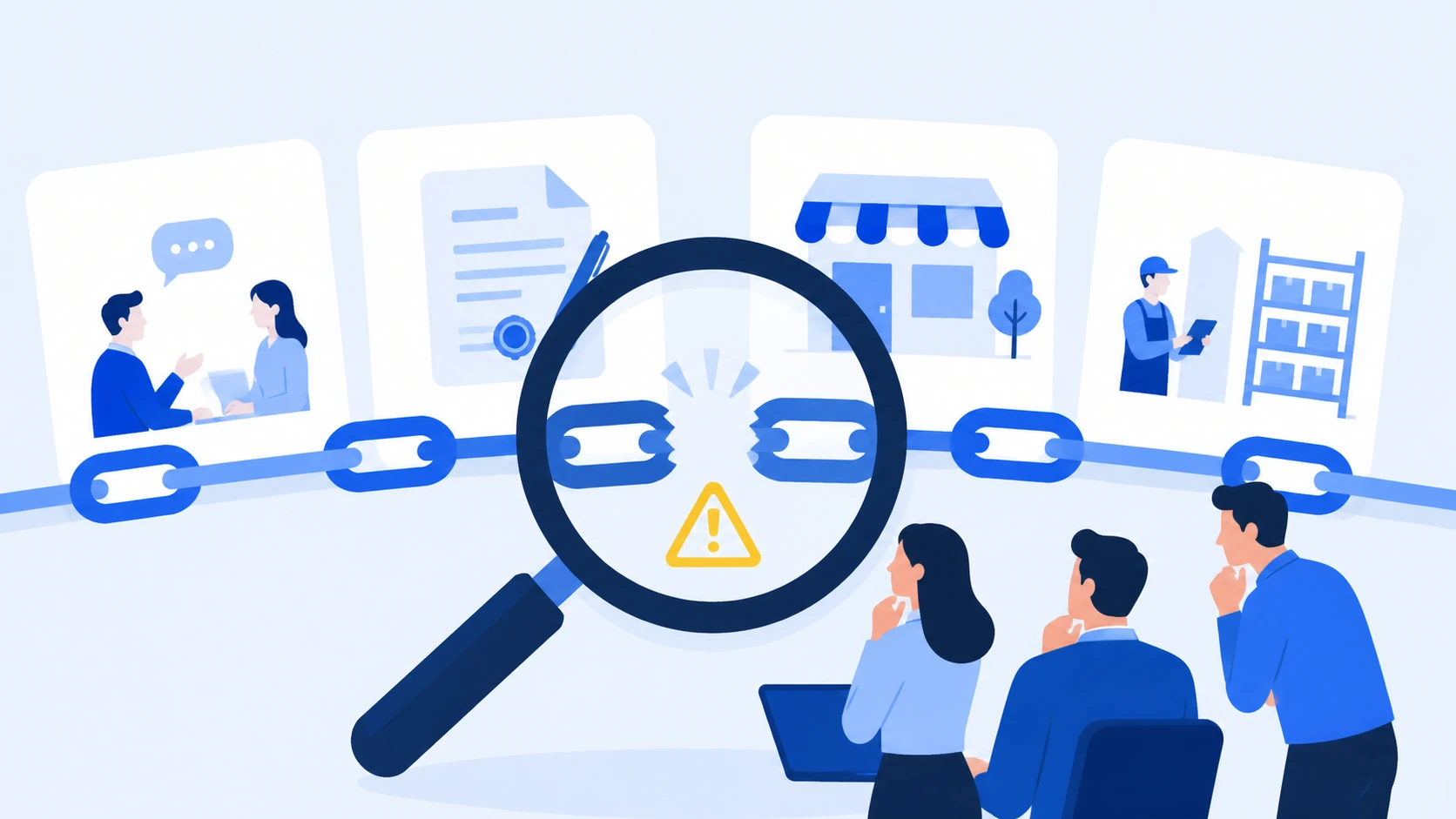
The starting point for evaluating adoption is to identify the workflow step that breaks most frequently right now.
Frequently Asked Questions
Q. Which feature should be evaluated first when adopting a franchise ERP?
A. First, pinpoint the steps in your current workflow where breakdowns or omissions occur most often, and verify how the system connects those points. If managing consultation histories is the issue, prioritize the Franchise Sales Management feature; if inconsistencies in opening quality are the problem, focus on Store Opening Management.
Q. How do we migrate franchise location data that was previously managed in Excel or on paper?
A. Existing data—such as franchise location information and consultation histories—must be organized to match the system’s standards before migration. During the adoption consultation, we first assess the format and scope of the data you’re currently managing.
Q. Does an early‑stage brand with a limited number of franchise locations still need a franchise ERP?
A. Establishing standards for consultation, contracting, and opening early on reduces the burden of re‑engineering your management framework as the number of franchise locations grows. Setting these criteria before openings become frequent makes later expansion smoother.
Q. How does a franchise ERP differ from a franchise location communication app?
A. A franchise ERP is a system the franchisor headquarters uses to manage consultation, contract, opening, and operational data, whereas a franchise location communication app handles two‑way interactions—announcements, surveys, on‑site inspections—between the headquarters and franchise locations. While their roles differ, using them together creates a seamless flow between headquarters management and field communication.
The franchisor headquarters’ work is essentially a single, continuous flow. It starts with consultation, moves through contracting and opening, and proceeds to operations. Ensuring that this flow isn’t interrupted is why you evaluate a franchise ERP.
Identify the point in your headquarters’ workflow that breaks most often right now.
MS Venter has been developing franchise‑specific software exclusively since 2007, and leveraging experience building over 500 brands and a government‑certified franchise IT research institute, we created FDAM.
Inquire about FDAM adoptionContact 1544-7120 · msb@benter.co.kr