
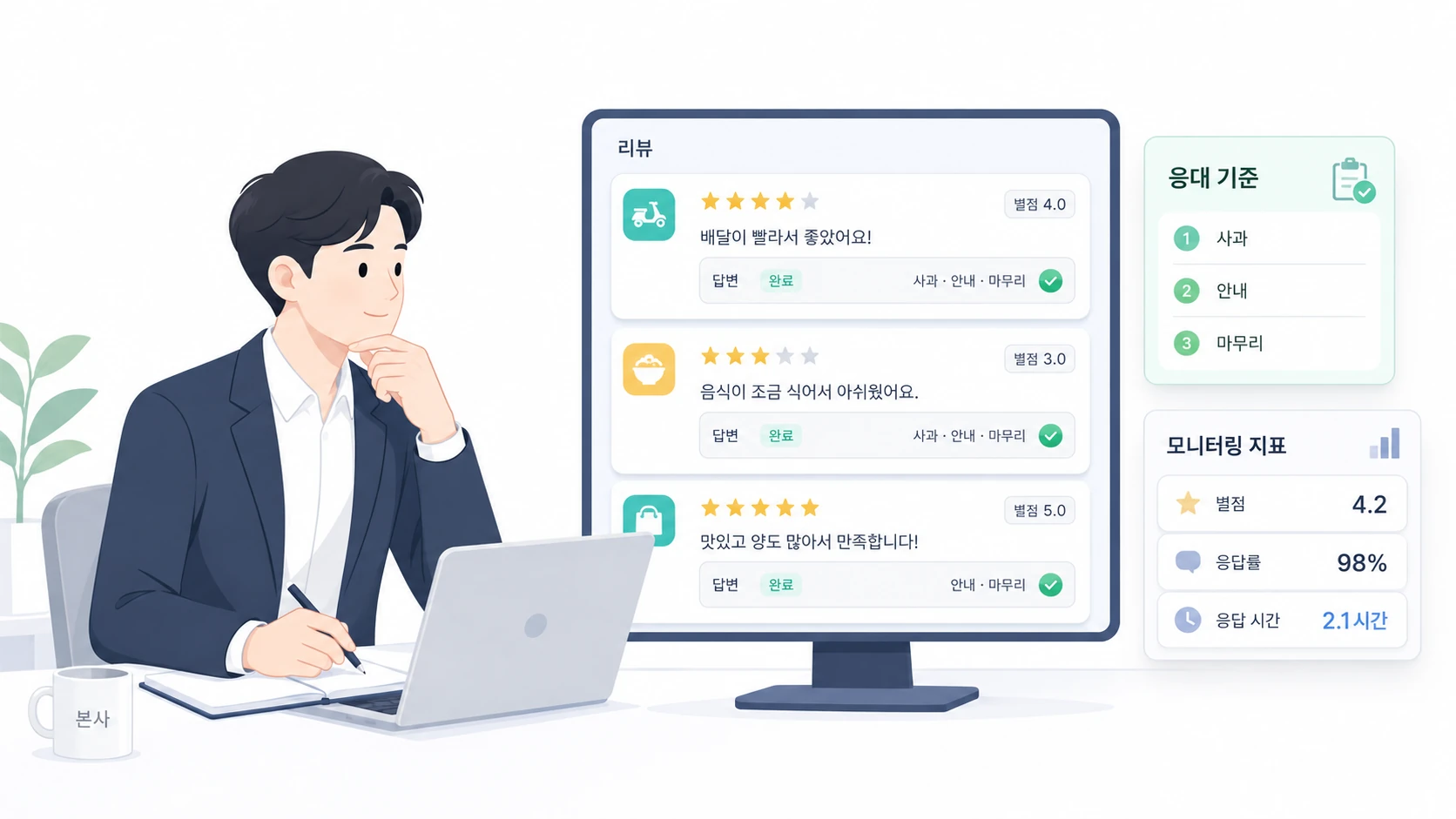
Image description: Headquarters operations staff reviewing delivery app review screens (featured image)
Delivery app review management starts with the franchisee responding to reviews, while the franchisor headquarters ensures that the tone and quality of those responses remain consistent across the brand. Because star ratings and recent reviews directly influence consumer ordering decisions, inconsistent responses erode brand trust even within the same franchise system. This article outlines how franchisor headquarters can establish and operate review‑response standards—from sample replies for different negative‑review types to star‑rating management and monitoring metrics.
Impact of delivery app reviews on sales
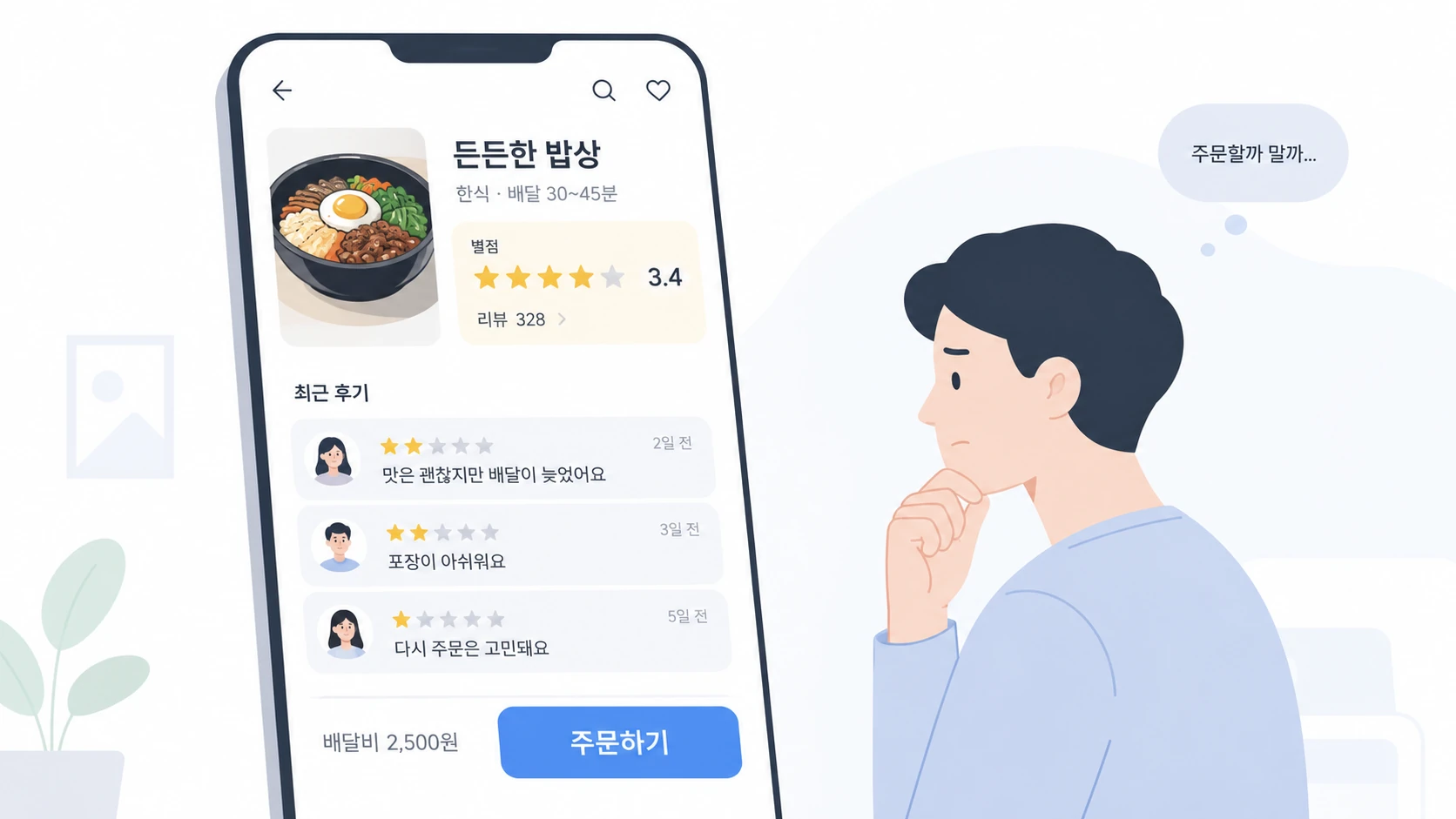
Image description: Delivery app order screen with star rating and latest reviews displayed at the top
Bottom line: delivery app reviews drive order conversion just as much as food quality. Most consumers check reviews before ordering, and a few negative reviews at the top can deter orders regardless of actual taste or service. Low star ratings also push the location down in exposure rankings, creating a vicious cycle of reduced new traffic. The challenge grows as the number of franchise locations expands—headquarters can’t manually monitor every review. Neglected responses let isolated incidents damage the brand’s overall image.
Four‑step process for handling negative reviews
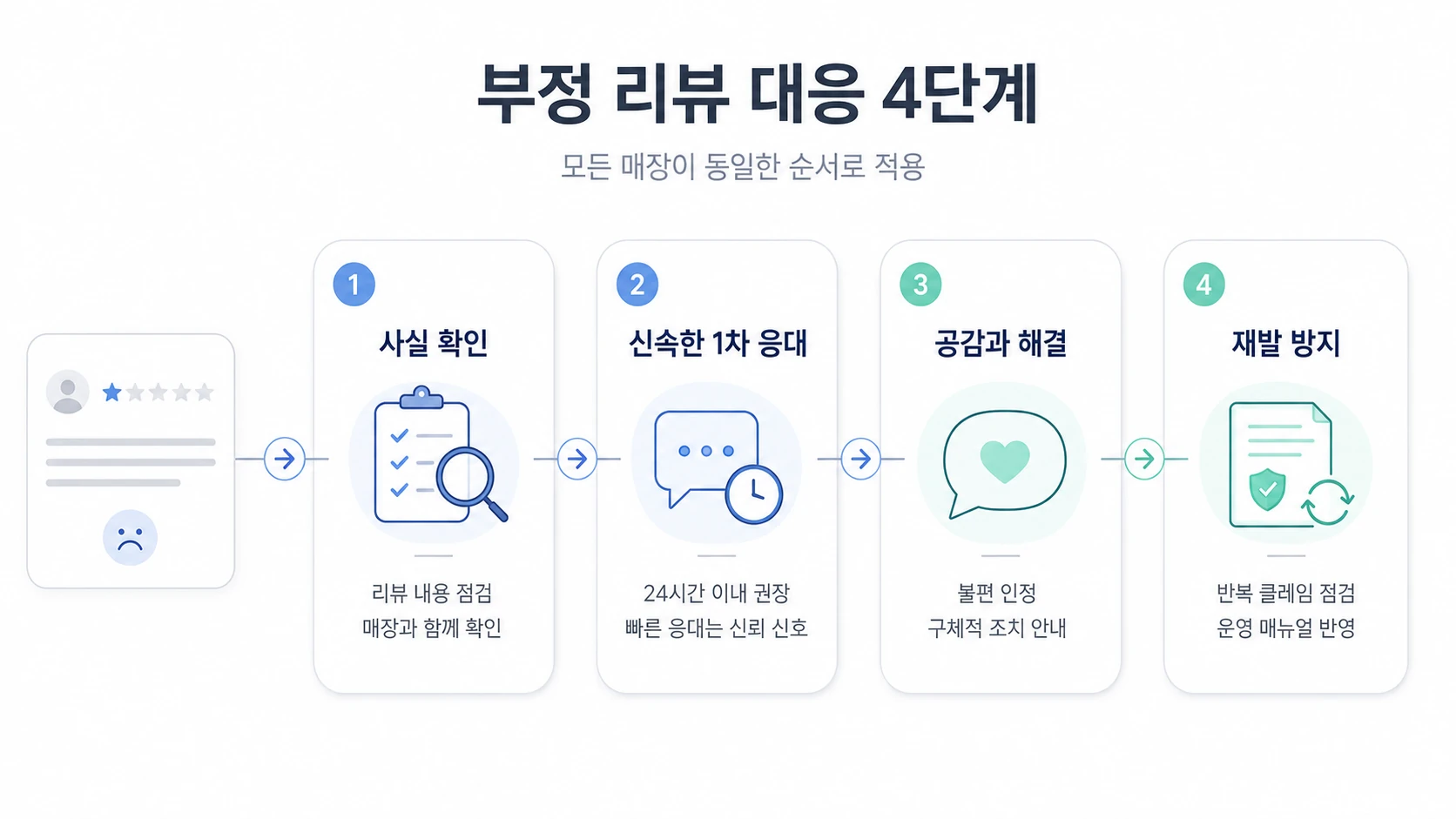
Image description: Fact‑check → Rapid response → Empathy & resolution → Prevention diagram
Negative reviews are addressed through fact‑checking, rapid first‑response, empathy with resolution, and prevention of recurrence. Applying this sequence uniformly across all franchise locations is essential.
- Fact‑checking— Verify with the franchise location whether the review reflects an actual incident.
- Rapid first‑response— A reply within 24 hours is recommended; quick acknowledgment signals trust.
- Empathy & resolution— Acknowledge the inconvenience and provide concrete corrective actions rather than offering excuses.
- Prevention of recurrence— If the same type of claim repeats, we incorporate it into the operations manual.
Examples of responses by negative review type
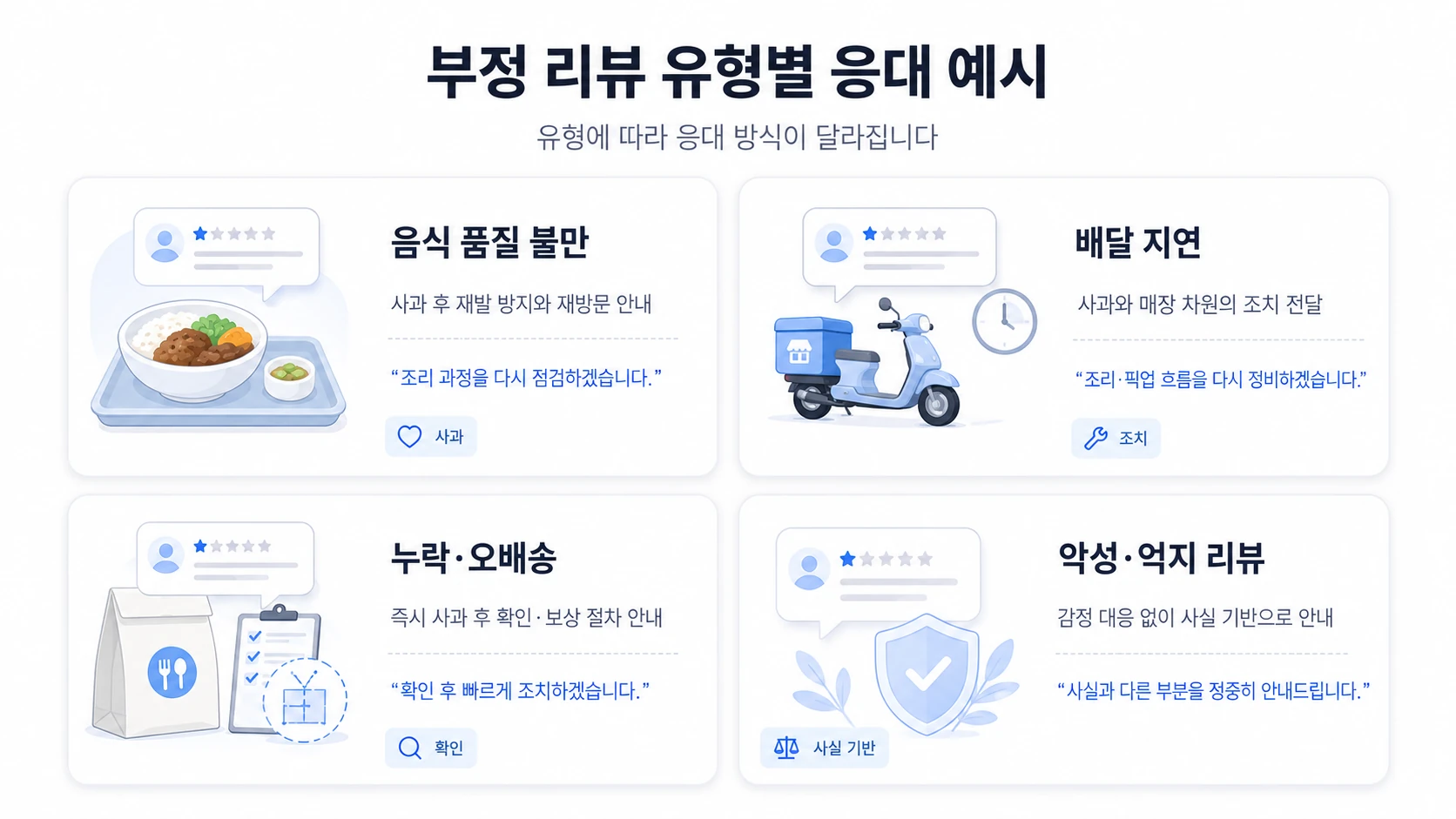
Image description: Comparison table of example response phrases by review type
Negative reviews require different responses depending on the type. Typically, they fall into four categories: food quality, delivery delay, missing or misdelivered items, and malicious or coerced reviews. Having standard example phrases for each type speeds up responses.
Food quality complaint— Apologize and explain prevention measures while inviting a return. Example: "We’re truly sorry you couldn’t enjoy your meal. We’re re‑examining our cooking process, and we’ll make sure your next visit is better."
Delivery delay— Even if it’s a third‑party delivery, it’s still a brand experience. Apologize and outline store‑level actions. Example: "We apologize for the wait. We’ll reorganize our cooking and pickup flow during peak times."
Missing or misdelivered items— Apologize immediately and clarify compensation and verification steps. Example: "We’re sorry the item you ordered was missing. We’ll investigate and act quickly—please contact Customer Service."
Malicious or coerced reviews— Respond calmly and fact‑based. If the claim is clearly false or abusive, you can report it to the delivery app’s customer service. Example: "We’ve reviewed your comments and found discrepancies. We’re providing the correct information respectfully."
How to create a brand tone guide
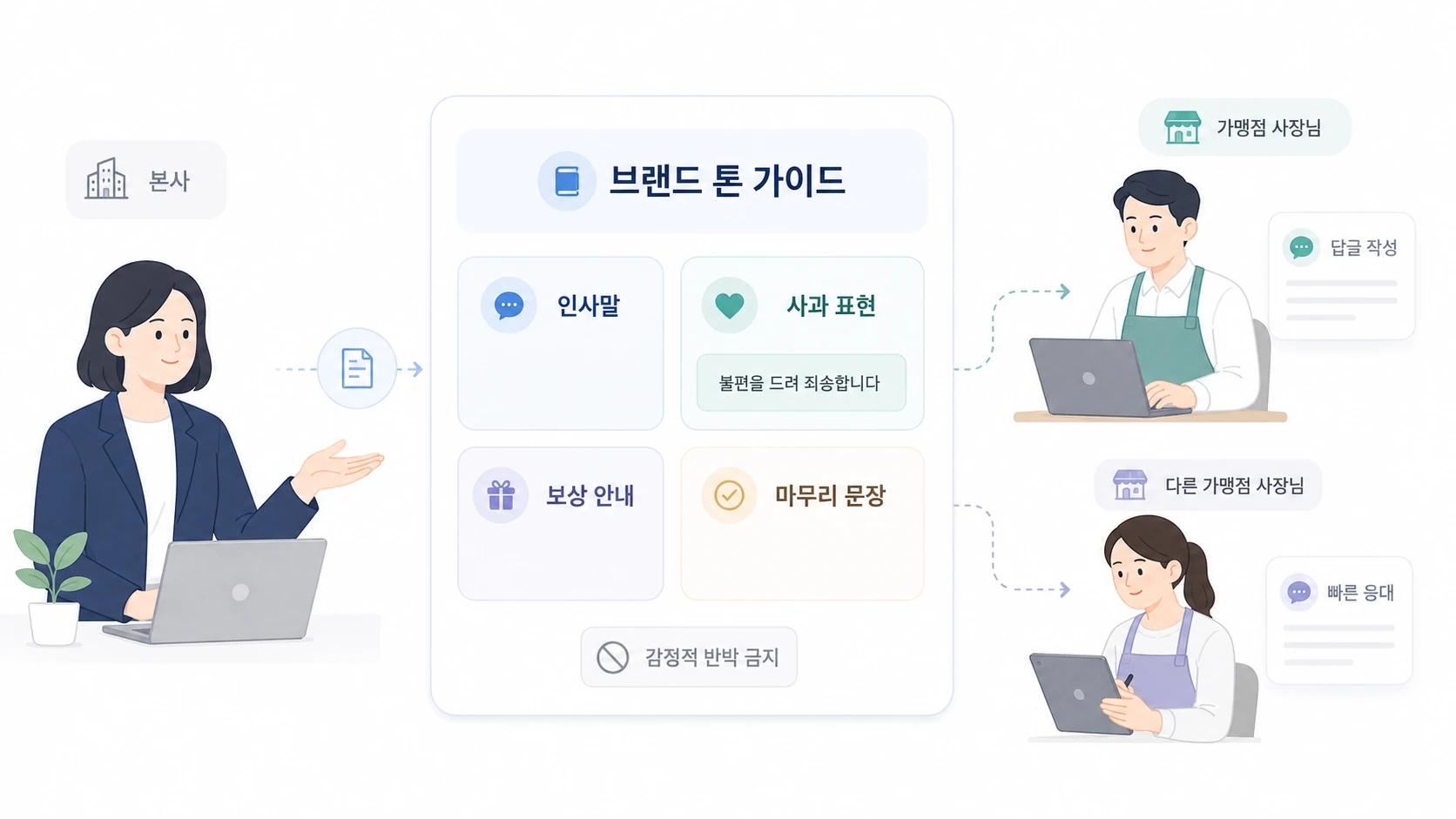
Image description: Response tone guide with greetings, apologies, compensation, and closing statements
Consistency in responses comes from a set of standard phrases for each situation. Build a response tone set that includes greetings, apology wording, compensation instructions, and closing sentences, then distribute it to franchise locations. For instance, standardize the apology as "We’re sorry for the inconvenience," and ban emotional rebuttals. Adding the type‑specific examples above lets franchisees draft replies quickly. With a guideline, every reply stays true to the brand voice.
Five common mistakes franchisees make when responding
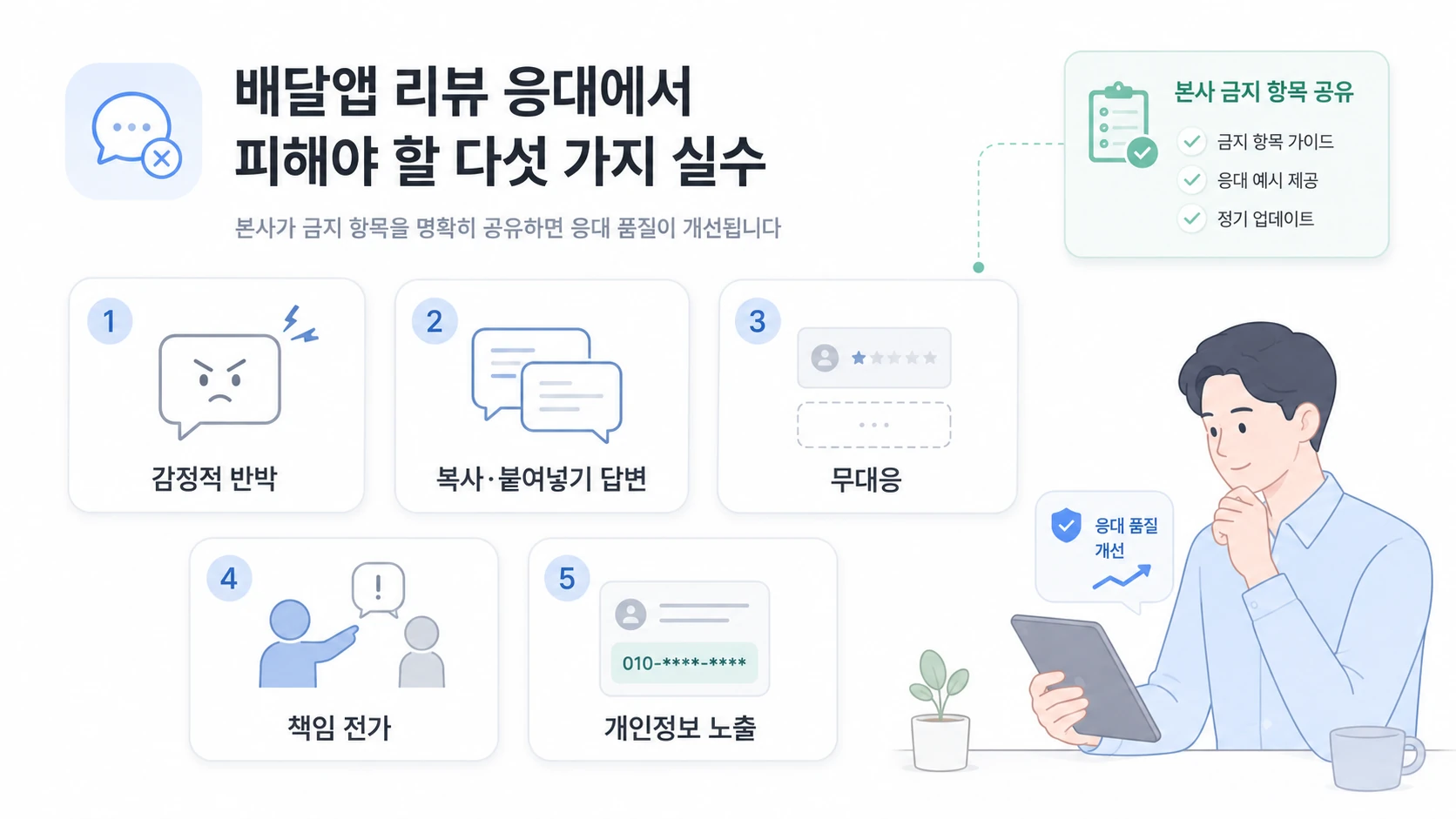
Image description: Checklist of five review response mistakes to avoid
Avoid emotional rebuttals, copy‑paste responses, no engagement, blame shifting, and personal data exposure—these five pitfalls leave a worse impression on other consumers who read the negative review.
- Responding to a review with emotion
- Copying the same phrase into every review
- Ignoring a negative review entirely
- Shifting responsibility onto the customer
- Revealing the reviewer's personal information in a reply
Simply sharing these prohibited practices with the franchisor headquarters dramatically improves response quality.
Operational tips for boosting positive reviews and star ratings
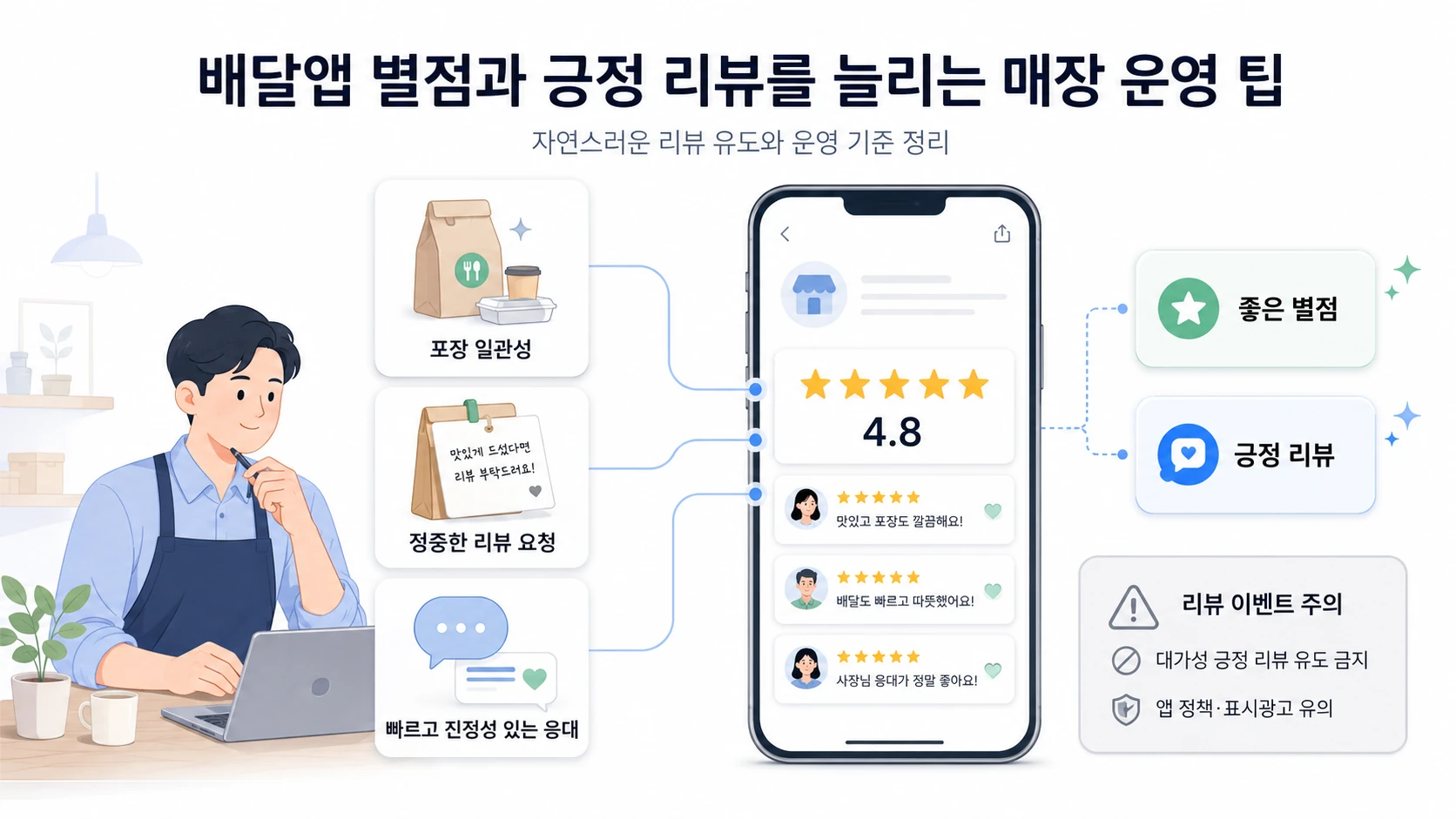
Image description: Packaging condition and review‑request prompts—operational tips for star‑rating management
Star ratings rise only when negative reviews are prevented and satisfied customers are encouraged to leave feedback. Consistent packaging and menu presentation, coupled with polite review requests in owner notes or brief signage, are effective. Prompt, sincere responses also leave a positive impression that can boost ratings.
However, caution is needed when running review incentives. Offering rewards for positive reviews or ratings can violate disclosure and advertising rules and may trigger penalties from delivery‑app policies. The franchisor should pre‑define acceptable limits and provide clear guidance to franchise locations to avoid risky review events.
The franchisor’s role is support, not management
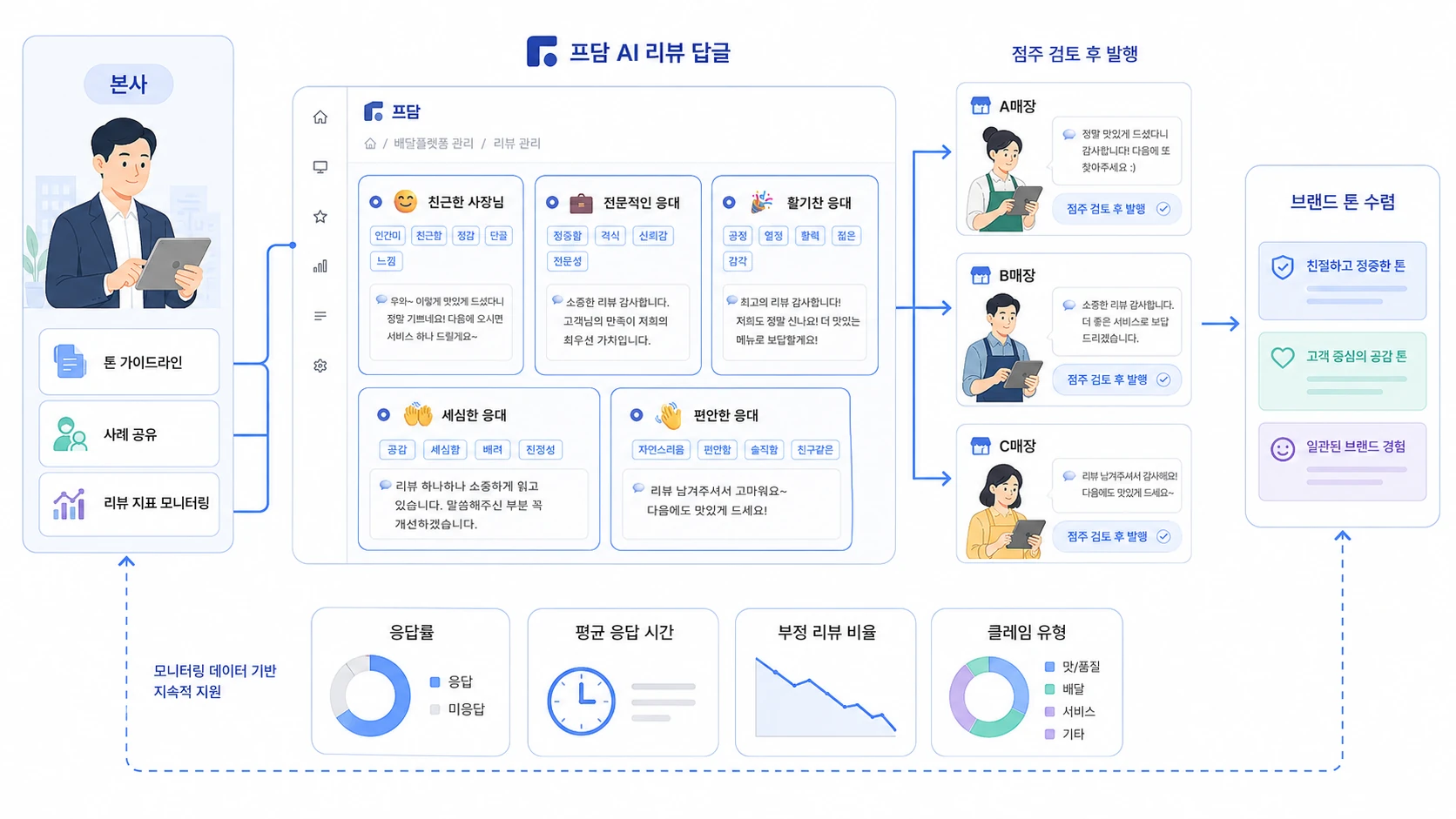
Image description: The franchisor supports responses through guide distribution, case sharing, and monitoring
The franchisee owns the final responsibility for review replies, while the franchisor supports quality improvement. Having the headquarters write every reply is unrealistic and fails to reflect local nuances. Instead, the franchisor should focus on distributing tone guidelines, sharing best and problematic cases, and monitoring repeat complaints to elevate quality.
Review monitoring metrics the franchisor should track
To systematize support, metrics must be quantifiable. Regularly checking each franchise location’s reply rate, average response time, negative‑review ratio, and claim‑type distribution reveals which sites need coaching at a glance. Accumulating these metrics turns intuition into data‑driven support.
Automating responses
As the number of franchise locations grows, manual support becomes unsustainable. From March 2026, the franchisor’s ERP, FDAM, will offer an AI review‑reply feature. By selecting one of five brand personas, the system auto‑generates a draft reply in the appropriate tone. The franchisee reviews and publishes the final message, ensuring brand consistency while saving time on response preparation.
Implementation Flow Example
Drawing on our experience supporting multiple headquarters in franchise IT environments, improving review responses typically follows a similar pattern. First, the franchisor headquarters distributes tone guidelines and example scripts for each scenario, then leverages the AI draft reply feature to reduce response variance across franchise locations. By tracking response rates and negative review ratios, initially inconsistent responses gradually converge toward the brand tone. The key is not to micromanage each franchise location, but to empower them to perform better with minimal friction.
Frequently Asked Questions
Should the franchisor headquarters respond to delivery‑app reviews?
The first response should come from the franchisee who understands the local context. The franchisor headquarters supports response quality through tone guidelines and monitoring.
How soon must a negative review be answered?
A first response within 24 hours is recommended. Prompt replies build trust with other consumers.
How do we standardize reply quality across franchise locations?
Create scenario‑specific standard script sets, distribute them, and use the AI draft reply feature to align tone, thereby reducing variance between locations.
How should we handle malicious or false reviews?
Respond politely and fact‑based, avoiding emotional counter‑attacks. If the review is clearly false or contains profanity, proceed with the delivery‑app customer‑service reporting process.
Is it acceptable to boost star ratings through review events?
Offering incentives for positive reviews can violate disclosure, advertising regulations, and delivery‑app policies. It is safest to have the franchisor headquarters define the permissible scope and communicate it to franchise locations.
Want to consolidate franchise headquarters operations in one place?
Connect sales, contracts, openings, and operations with FDAM, and extend support to franchise location response quality.