

Delivery review management involves monitoring customer reviews on delivery apps and responding with replies as an operational task,AI‑generated delivery review repliesrefers to the feature that automatically drafts replies in the brand’s tone during this process.
The higher a franchise location’s share of delivery sales, the more impact each review carries. Most customers check the rating and reply before ordering, so responding to reviews isn’t just customer service—it directly drives new orders. From a franchisor perspective, there’s an additional challenge: reply tone and quality vary widely between locations.
Key Takeaways
While the primary responsibility for app review replies rests with the franchisee, the brand’s reputation requires a headquarters‑level intervention. FDAM supports both franchisee‑authored and headquarters‑authored replies, managing everything from monitoring and draft suggestions to review and posting within a single workflow. By standardizing replies into five brand tones, the brand voice stays consistent even as the number of locations grows.
Why Delivery Reviews Are a Headquarters Issue
A delivery‑app review doesn’t stay confined to a single store’s reputation. Customers often compare multiple locations by brand name rather than searching for a specific address, so a low rating or a perfunctory reply at one outlet can tarnish the entire brand’s image. The signage may differ, but the brand name is the same.
Thus, review responses are both a franchisee’s customer‑service task and a brand‑asset concern that franchisor headquarters must manage. As the number of franchise locations grows, the total volume of reviews the headquarters must oversee also rises. Inconsistent responses across stores erode the trust the brand has built, which is why leaving review management solely to individual locations is insufficient.
Clarifying the Responsibility Structure
The first responsibility for delivery‑app review replies belongs to the franchisee who runs the store, because they know the order details and customer context best. However, that doesn’t mean the headquarters should stay hands‑off. Since the brand’s overall image is at stake, a mechanism for headquarters to intervene in replies is essential.
FDAM supports both approaches. Franchisees can post their own replies, and headquarters can also draft and publish replies directly. This enables the headquarters to handle missed reviews or respond to sensitive feedback on behalf of the brand. The primary responsibility stays with the franchisee, but the system also gives headquarters the ability to ensure brand consistency—a distinction that sets FDAM apart from many review‑automation tools that operate only at the individual‑store level.
Why Replies Vary
Franchisees juggle kitchen, floor, packaging, and delivery pickup duties. When 10–20 reviews accumulate daily, spending just 1–2 minutes per reply can consume 20–40 minutes each day. After peak periods, a negative review may receive only a brief “We’re sorry” or be left unanswered altogether.
The problem emerges when those inconsistencies mix within a single brand. If Store A replies thoughtfully while Store B replies perfunctorily, customers experience different brand impressions at each location. Brand trust then hinges on an individual’s writing skill and daily workload, creating a vulnerability: the lack of predictable, consistent brand communication.
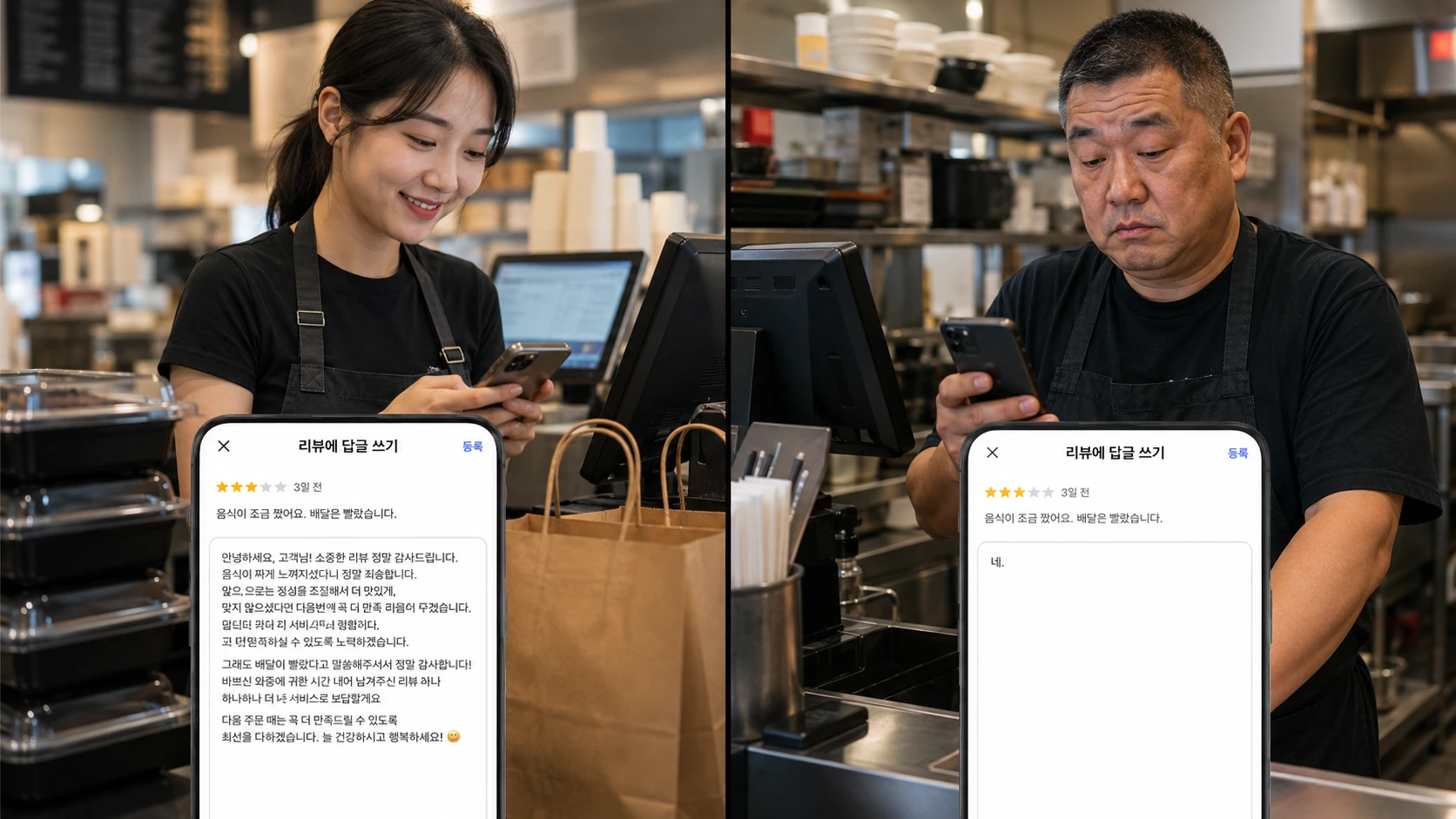
Even within the same brand, inconsistent responses across locations erode the brand’s image.
Response guidelines by review type
Responses should match the tone of each review. Using the same reply for every review comes across as perfunctory. By defining three core response types, you can standardize the criteria that previously varied by store.
Positive reviews – turning praise into relationship‑building opportunities
It’s easy to brush off a glowing review, but it’s actually the best chance to drive repeat orders. Highlight the specific menu item or comment the customer mentioned, and respond with concrete detail. That leaves a far stronger impression than a generic “Thank you.” Consistency matters, though—if the level of care varies by store, the impact diminishes, so the brand should define a uniform tone for positive responses.
Negative reviews – the area that demands the most care
When a dissatisfied customer posts a review, the audience isn’t just the author—potential buyers are reading the reply too. Defensive or excuse‑making responses alienate both the reviewer and the onlookers. An apology paired with a commitment to improve, delivered in a measured, non‑emotional tone, is essential. Franchisees often struggle to strike that balance on a busy floor, so the franchisor may choose to have headquarters post replies for especially sensitive negative reviews.
Unanswered reviews – a common and costly loss
The biggest loss isn’t a poorly crafted reply; it’s the absence of a reply altogether. A store with no response signals to customers that the location is unmanaged. Since the lack of a reply is the primary driver of this gap, automating the creation of a reply starter reduces the burden and cuts the loss.
How AI‑generated delivery review replies work
The key to AI‑generated delivery review replies is standardizing the reply’s starting point. When broken into steps, the workflow looks like this:
Step 1 · Monitoring
All incoming reviews are aggregated on a single dashboard, allowing the franchisor to track the brand‑wide review flow even across multiple franchise locations.
Step 2 · Draft suggestion
AI generates a draft reply tailored to each review’s content. This eliminates the blank‑page pressure and ensures every draft starts from the brand‑approved tone, preventing divergent opening sentences across stores.
Step 3 · Review & Edit
Franchisees or headquarters review the suggested draft and fine‑tune it to fit the specific store context. AI provides the starter; the final judgment and responsibility remain with a human, so unintended replies never go live unchecked.
Step 4 · Publish
After approval, the reply is posted. Whether the franchisee or headquarters publishes it, the process stays within the same workflow, preserving a consistent brand voice.
This workflow does more than save time. Faster response speeds and fewer missed replies improve operational efficiency, and—most importantly for the franchisor—all stores begin their replies from the same standardized baseline.
How to lock brand tone into the system
Even with type‑specific principles and operational flows, the final variable is the “tone.” Whether you aim for a friendly neighborhood‑shop feel or a formal, precise response, the reply to the same review must differ. It’s impractical for people to explain and train every tone, and the gap widens as franchise locations multiply.
FDAM, the franchisor headquarters‑only ERP, solves this with a brand‑tone approach. Once you select one of five preset tones, the AI drafts review replies that match that tone. Whether the headquarters or the franchisee posts the reply, the starting tone is consistent, so the brand’s voice doesn’t fragment across stores. As the number of franchise locations grows, the structural limit of manually matching tone is reduced.
Another difference is that review management lives inside the headquarters’ operating system instead of a separate tool. Because sales, opening, and operations management all run in one platform, review responses are part of the same workflow, reducing the risk of fragmented data.
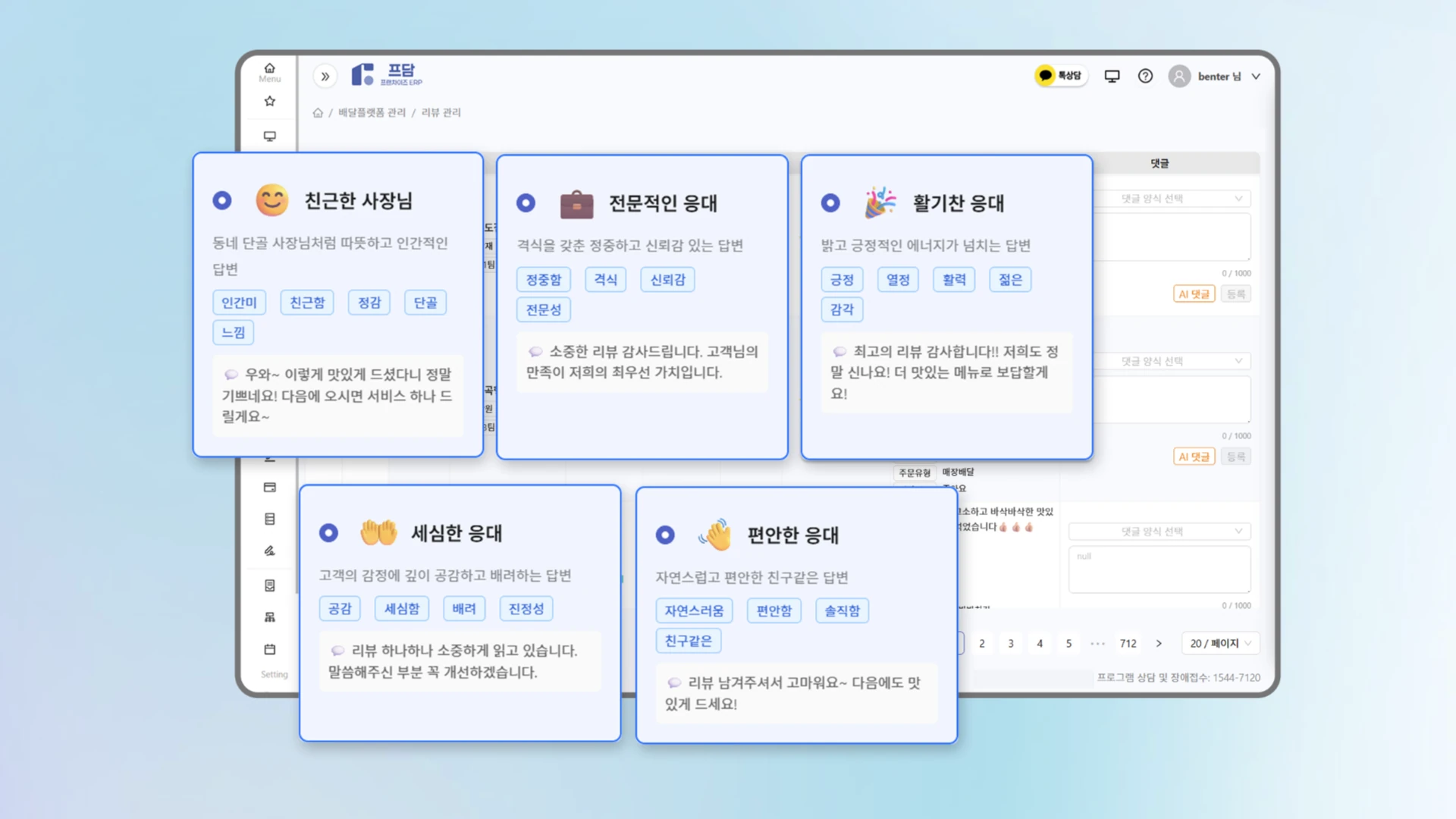
Choosing a brand tone gives every reply a unified starting point.
Delivery‑review volume won’t shrink, but the system eases the franchisee’s response burden while preserving brand tone. That balance is the role of AI‑generated delivery‑review replies.
Frequently Asked Questions
Q. Who should post the delivery review response—the franchisor headquarters or the franchise location?
A. Primary responsibility lies with the franchisee who knows the store best. However, FDAM also allows the headquarters to write and upload replies directly, so the headquarters can handle missed reviews or brand‑sensitive ones.
Q. Does the AI automatically post delivery‑review replies?
A. The AI suggests a draft reply based on the review content. The franchisee or headquarters reviews, edits, and then posts it, eliminating the blank‑page burden while keeping final approval in human hands.
Q. How should we handle negative reviews?
A. Remember that negative reviews are seen not only by the author but also by potential customers weighing an order. A concise apology and commitment to improvement, delivered in a measured tone, works better than excuses. For brand‑level sensitive reviews, the headquarters can respond directly.
Q. How do we prevent inconsistent reply tones across stores?
A. FDAM sets reply tones to one of five options. No matter which franchise location posts the reply, the starting tone is the same, so the brand’s voice stays consistent even as the number of franchise locations grows.
Delivery‑review management that protects brand tone,
Start with FDAM
Consult with us to learn how AI-generated delivery review responses for both franchisor headquarters and franchise locations will be applied.
Request a deployment consultation